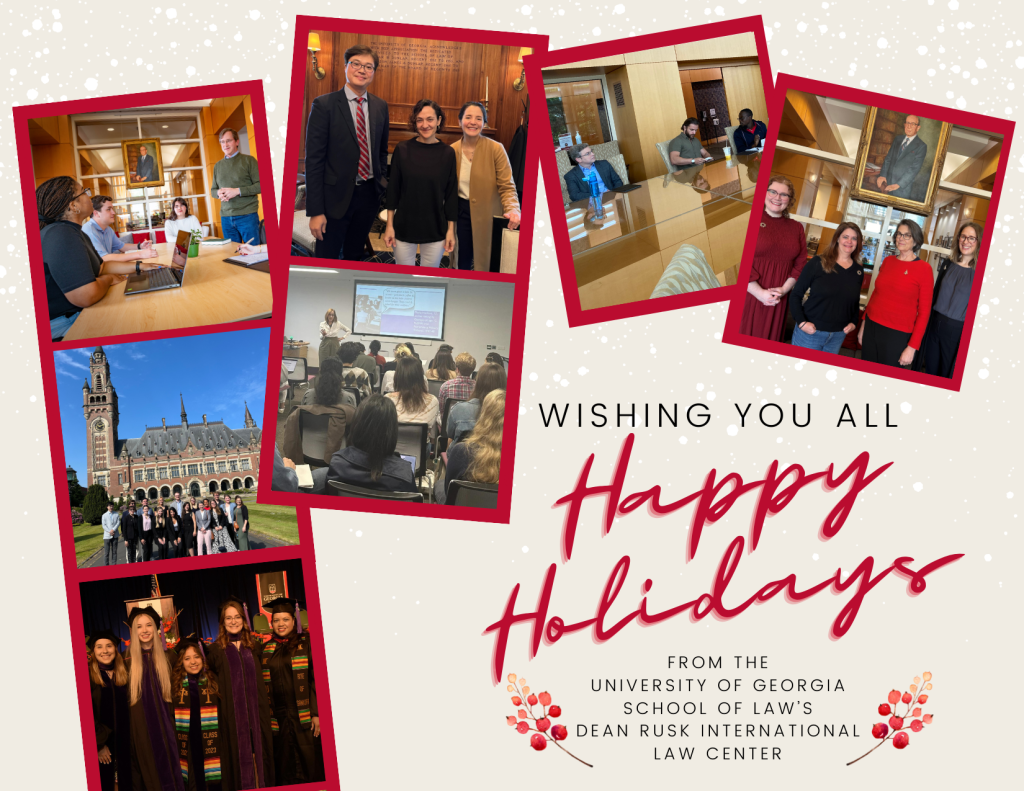
As the end of 2023 approaches, we at the University of Georgia School of Law’s Dean Rusk International Law Center want to express our gratitude. It has been a busy year full of global engagement, research, education, and service, all of which was made possible by the support of faculty, students, staff, alumni/ae, institutional partners, and friends across the globe.
If you would like to be regularly updated on our Center’s work in 2024, we invite you to subscribe to our Exchange of Notes blog and to our bi-weekly Center newsletter, which you can be added to by emailing: ruskintlaw@uga.edu
Wishing you and yours a joyful holiday season and a happy new year.
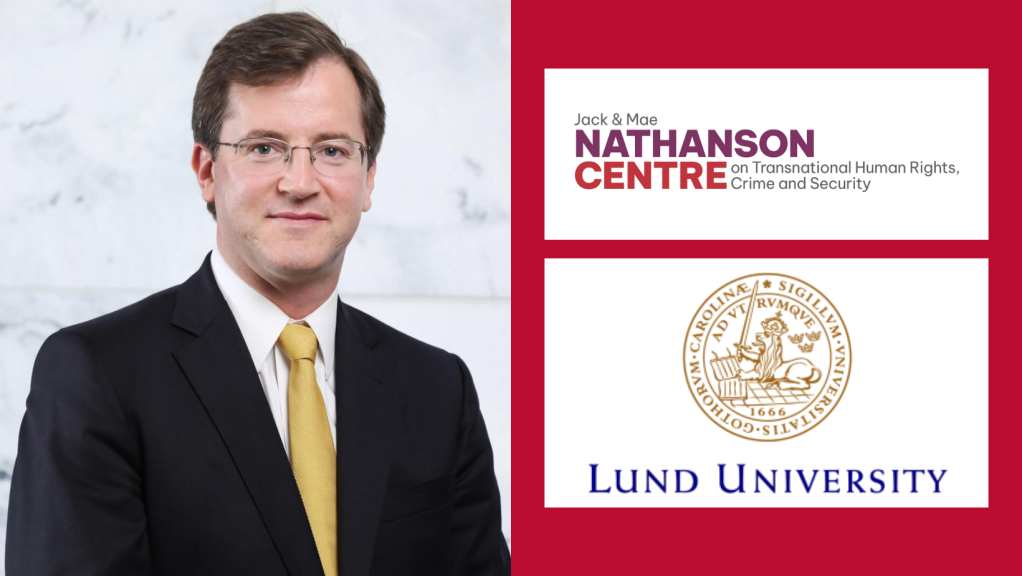
Christopher M. Bruner, Stembler Family Distinguished Professor in Business Law and Faculty Co-Director of the Dean Rusk International Law Center, recently presented working papers in Canada and Sweden.
He presented “Corporate Governance and Sustainability Incentives” at a conference titled “Addressing the Sustainability Impacts of Corporations” in October. The conference was hosted by the Nathanson Centre on Transnational Human Rights, Crime and Security at the Osgoode Hall Law School (York University) in Toronto.
Bruner also presented “Corporate Personhood, Corporate Rights, and the Contingency of Corporate Law” at “Decoding the Rights of Companies in the Technocene,” a conference hosted in December by the Lund University Faculty of Law in Lund, Sweden.
Bruner’s scholarship focuses on corporate law, corporate governance, comparative law and sustainability. He is a research member of the European Corporate Governance Institute (ECGI) and has presented his work in numerous countries around the world.
Distinguished Research Professor & Shackelford Distinguished Professor in Taxation Law Emeritus Walter Hellerstein co-presented a paper on the value added taxation of crypto-assets at the Organisation for Economic Co-operation and Development (OECD) Working Party No. 9 on Consumption Taxes in Paris, France, in November.
The Working Party No. 9 on Consumption Taxes is a forum for the discussion of consumption tax policy and administration, working with both Members and non-Members of the OECD to develop appropriate and effective taxation outcomes.
Hellerstein, a recipient of the National Tax Association’s Daniel M. Holland Medal for outstanding lifetime contributions to the study and practice of public finance, is widely regarded as the nation’s leading academician on state and local taxation. He has authored numerous books, textbooks, and law review articles, and has practiced extensively in the field. Hellerstein is currently a Visiting Professor at the Vienna University of Economics and Business, and he remains actively involved in his scholarship, consulting, and, in particular, his work as an academic advisor to the OECD.
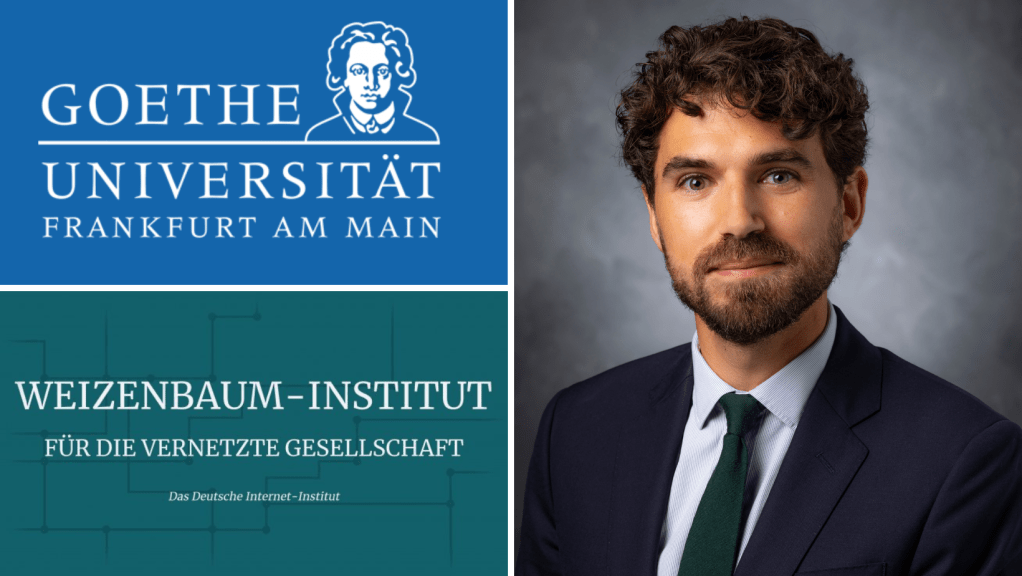
At these gatherings, Kadri discussed several of his current projects, including his work investigating how large technology companies have adopted particular strands of feminism to gain, exercise, and justify their power to regulate sexual speech and imagery. He also presented a related project that explores a recent legislative trend to regulate “cyberflashing,” which is the act of sending a nude image to a person without receiving prior consent. Lastly, Kadri discussed a piece proposing a regulatory response to how data brokers are enabling and exacerbating interpersonal abuse like stalking and harassment.
The Weizenbaum Institute aims to investigate “the ethical, legal, economic and political aspects of digital change” to create an empirical basis for “responsible digitalisation.” Kadri explains how his current research fits within this framework:
“With each new innovation in the digital age, it can be tempting to assume that our capacity to use technology in a certain way means that we should use it in that way. My work, in part, seeks to resist this kind of technological determinism. Digitalization has offered huge benefits for humanity, but that doesn’t mean humanity should abdicate responsibility for judging — including through law — how we should use technology. Though it’s not for me to say, my hunch is that this kind of critical approach to technology (and law) would align with the Weizenbaum Institute’s aims to create a foundation for “responsible digitalisation.”
Kadri is an Assistant Professor of Law at UGA Law, and his research focuses on torts and criminal law, with an emphasis on how technology, law, and social norms enable and affect privacy, speech, and abuse. His scholarship appears in journals including the Harvard Law Review Forum, UCLA Law Review, Texas Law Review, Utah Law Review,Maryland Law Review, and Journal of Free Speech Law and he has published shorter pieces in The New York Times and Slate. His course offerings include Torts, Cybercrime, and Regulating Digital Abuse.
Prior posts on Kadri’s scholarship can be found here.
One of the Dean Rusk International Law Center’s current Visiting Research Scholars, Daesun Kim, Esq., attended this week’s Global Atlanta event, “Georgia and Japan: 50 Years of Commerce and Culture — Debriefing on the 2023 SEUS-Japan Conference.” Global Atlanta is one of the Center’s institutional partners. Below are some of Kim’s reflections of the event.
Global Atlanta, Baker Donelson, and the Japan-America Society of Georgiagathered on November 30 to discuss the October 2023 SEUS-Japan Conference. Around 50 economic and development leaders from Georgia participated in the October conference, which took place in Tokyo for the first time since COVID and included representatives from the 16 states in the Southeastern United States (SEUS). The visit by the Georgia delegation, in particular, holds significant meaning as it coincides with the 50th anniversary, commemorating the longstanding tradition and history between Japan and the state of Georgia.
The speakers at this week’s event, who reflected on their experience visiting Japan as part of this delegation, included:
Bob Johnson, immigration attorney at Baker Donelson, and board member of the Japan-America Society of Georgia
Trevor Williams, Managing Editor at Global Atlanta (moderator)
Jim Whitcomb, Chair of the Japan-America Society of Georgia
Jessica Cork, VP of Community Engagement and Communications at YKK, who was honored with the Busbee Award
Mellissa Takeuchi, Project Manager at the Georgia Department of Economic Development
The panelists’ takeaways from the SEUS-Japan Conference included the level of significance attributed to developing and maintaining personal connections with various government high-level officials. Georgia is a hub for Japanese businesses in the southeastern United States, with currently more than 500 Japanese-affiliated companies operating in the state, including YKK (USA) America, Inc., Kubota Manufacturing of America Corp., NACOM Corporation, and Yamaha Motor Mfg. Corp. of America. These officials see their establishment of personal and professional connections as significant contributors to the enhancement of economic and diplomatic cooperation.
These relationships are of particular importance for Georgia, whose Savannah Port acts as a gateway between Japan and the southeastern region of the U.S and thus plays a crucial role in the auto-EV-battery supply chain. It is anticipated that all states within SEUS will contribute to this industry’s growth; in particular, the panelists saw the development of certain business relationships, such as Toyota’s automotive and EV battery ventures, as important outcomes of the SEUS-Japan Conference.
Takeuchi highlighted the significance of the longstanding 50-year collaboration between SEUS and Japan. She noted a renewed energy from Japan to engage more actively and collaborate further with SEUS following the recent Japan visit. Additionally, she noted the importance of the Georgia-kai, a Georgia-based organization of Japanese expatriates, which holds a pivotal role in the state’s continued engagement with both existing and prospective Japanese industries.
The panelists agreed that Georgia and Japan’s growing relationship across economic, business, diplomatic, and cultural sectors is a direct result of this mutual investment in sustained communication and relationship building, the direct result of initiatives like the SEUS-Japan Conference.



 exchange of notes