University of Georgia School of Law Professor Laura Phillips-Sawyer participated in the Business History Conference in London, England in March. The theme of the 2026 BHC annual meeting was “Co-Creation.” She received financial support to travel to London from the Dean Rusk International Law Center as a Rusk Scholar-in-Residence, an initiative promoting international opportunities for Georgia Law faculty that advance the mission of the Center.
Phillips-Sawyer presented a new paper: The 21st Century ‘New Economy’: A Legal and Business History of Vertical Disintegration. This paper explores and tests the historical interdependence of two developments. First, it surveys the extent to which American production and distribution systems have shifted away from vertical integration toward being governed, in the 21st century, by a “network of contracts”—a phenomenon visible in high-profile firms such as Dell, Apple, United Fruit, FedEx, and Amazon. Second, it examines how changes in antitrust law legalized the types of business contracts—such as exclusive dealing and exclusive distribution channel agreements—that have facilitated this structural shift.
Phillips-Sawyer also organized a panel discussion for the conference. The panel included Brian Callaci, chief economist at the Open Markets Institute, and Erik Peinert, a political scientist at Boston University who formerly worked at the American Economic Liberties Project.
Phillips-Sawyer is an expert in U.S. antitrust law and policy. Broadly, she is interested in questions of economic regulation, which intersect with legal history, economic thought, business strategy and structure, and political organization. She currently holds the Jane W. Wilson Associate Professorship in Business Law at the University of Georgia School of Law. Before coming to Georgia Law, Phillips-Sawyer taught international political economy at the Harvard Business School.
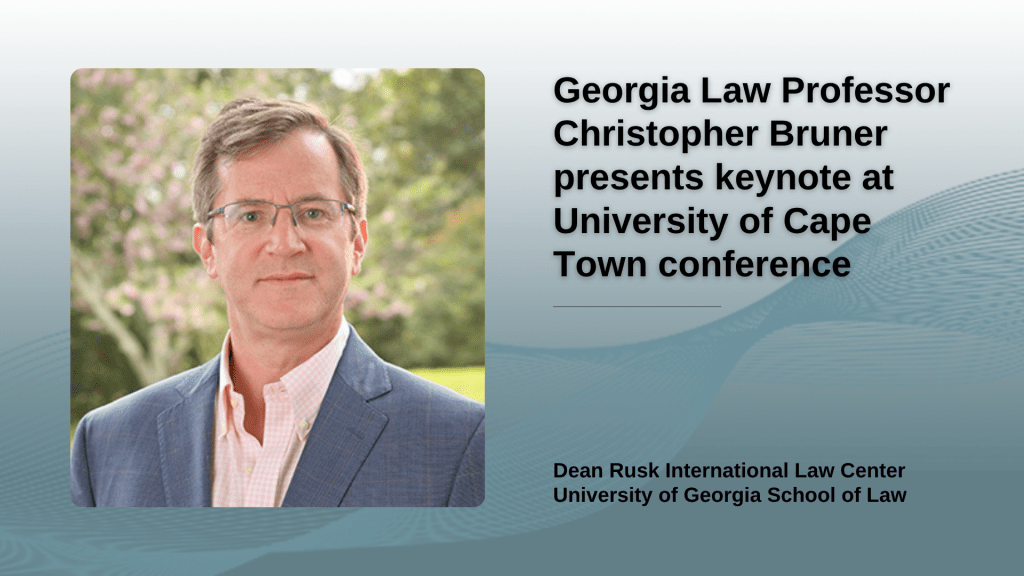
University of Georgia School of Law Professor Christopher Bruner presented a keynote address at the Inaugural Corporate Securities Regulation Conference hosted by the Department of Commercial Law of the University of Cape Town (South Africa) Faculty of Law in April.
The conference was co-sponsored by Strate, the central securities depository for South Africa. Another keynote address was presented by André Nortjé, Chief Executive Officer of Strate, and following their keynotes Bruner and Nortjé participated in a conversation moderated by Professor Dennis Davis, Chair of the Companies Tribunal of South Africa.
Bruner is the Stembler Family Distinguished Professor in Business Law at the University of Georgia School of Law and serves as a faculty co-director of the Dean Rusk International Law Center.
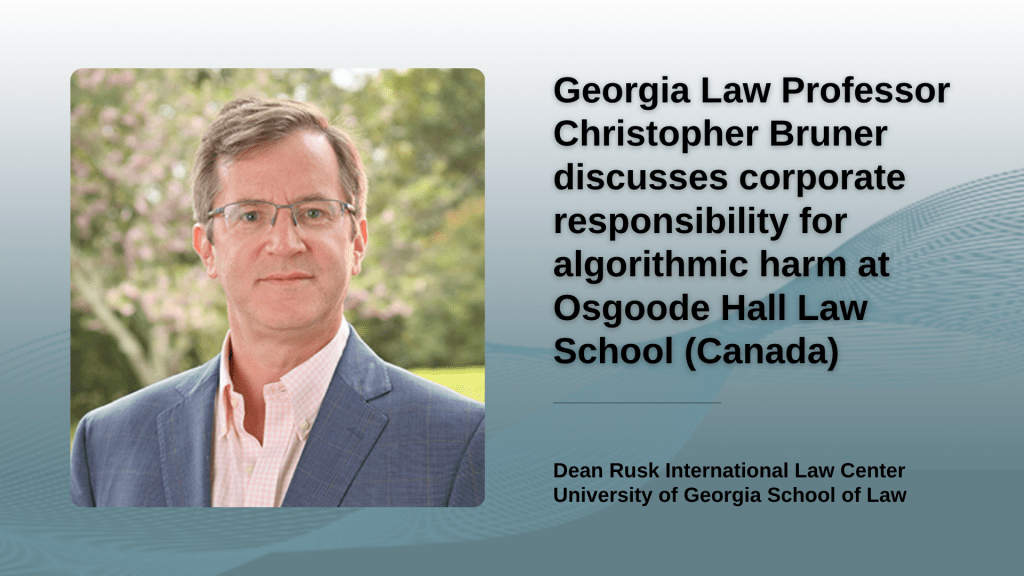
Bruner is the Stembler Family Distinguished Professor in Business Law at the University of Georgia School of Law and serves as a faculty co-director of the Dean Rusk International Law Center.
Bruner is the Stembler Family Distinguished Professor in Business Law at the University of Georgia School of Law and serves as a faculty co-director of the Dean Rusk International Law Center.
University of Georgia School of Law Professor Laura Phillips-Sawyer participated in the Business History Conference in Atlanta, Georgia earlier this year. She was one of several speakers in the Harvard Business School Workshop entitled “Globalization, Multinationals, and Institutions.” Additionally, she chaired the panel “Trust and Antitrust: Standard Oil and the Creation of the Global Economy.”
Phillips-Sawyer is an expert in U.S. antitrust law and policy. Broadly, she is interested in questions of economic regulation, which intersect with legal history, economic thought, business strategy and structure, and political organization. She currently holds the Jane W. Wilson Associate Professorship in Business Law at the University of Georgia School of Law.
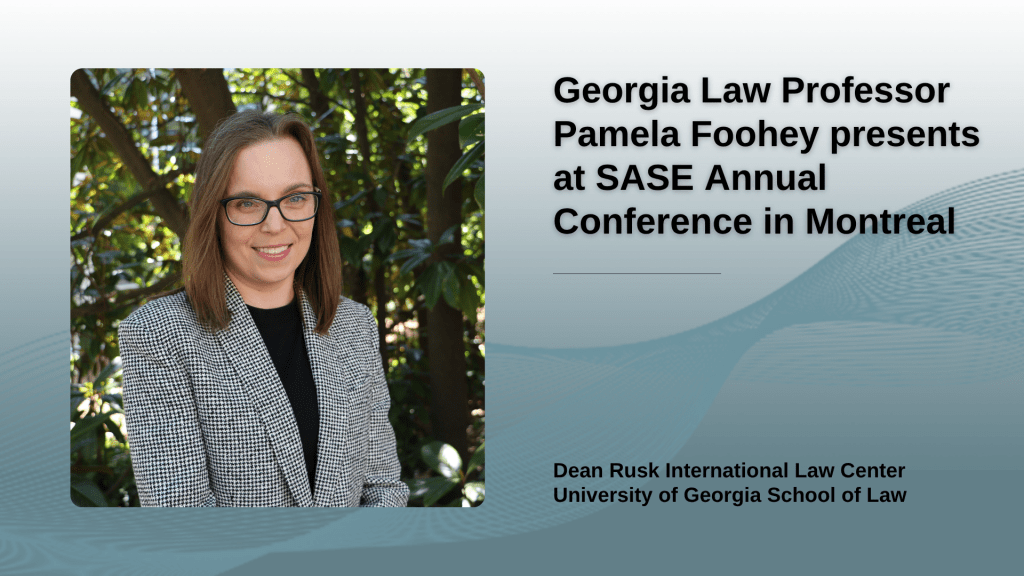
Foohey joined Georgia Law faculty as a full professor in 2024. She currently holds the Allen Post Professorship and teaches Bankruptcy, Secured Transactions and a Bankruptcy Practice Seminar. Specializing in bankruptcy, commercial law, consumer finance and business law, Foohey’s scholarship primarily involves empirical studies of bankruptcy and related parts of the legal system. She presently is a co-investigator on the Consumer Bankruptcy Project, a long-term research project studying persons who file bankruptcy. Data from this project serve as the basis of her co-authored book Debt’s Grip: Risk and Consumer Bankruptcy, University of California Press (Aug. 5, 2025). Her work in business bankruptcy focuses on nonprofit entities, with a particular emphasis on how religious organizations use bankruptcy. Data from this project are included in her in-progress book Forgive Us Our Debts: How Black Churches Use Bankruptcy to Survive, forthcoming with the University of Chicago Press.
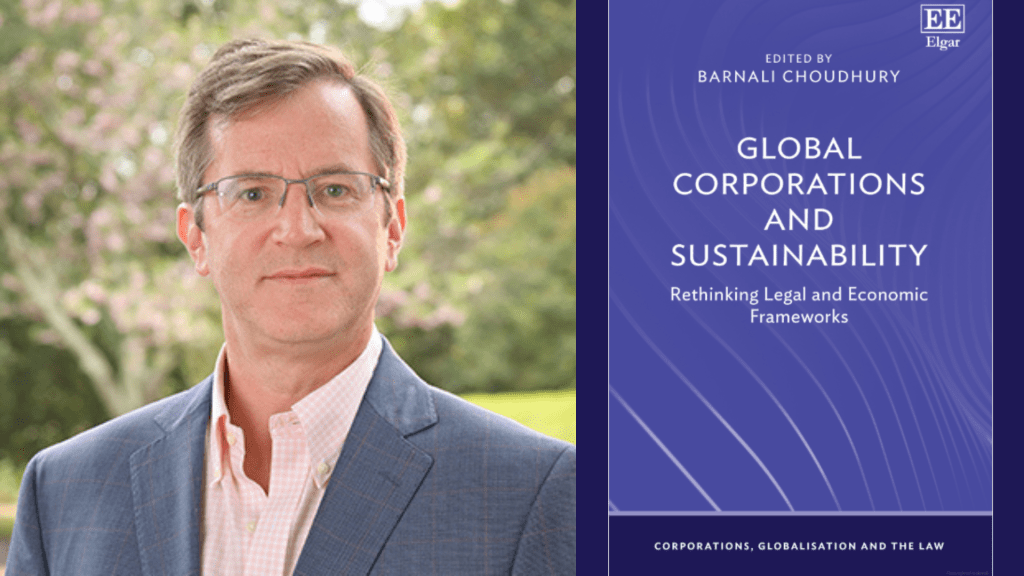
Bruner’s chapter builds on ideas he presented in 2023 at a conference hosted by the University of Macerata in Italy.
Bruner is the Stembler Family Distinguished Professor in Business Law at the University of Georgia School of Law and serves as a faculty co-director of the Dean Rusk International Law Center.
Christopher M. Bruner is the Stembler Family Distinguished Professor in Business Law at the University of Georgia School of Law and serves as a faculty co-director of the Dean Rusk International Law Center.
The University of Georgia School of Law’s spring 2025 International Law Colloquium welcomed Sarah Dadush, Professor of Law at Rutgers Law School, who presented her working paper, “Shared Responsibility in Contract Law.” Professor Christopher Bruner, Stembler Family Distinguished Professor in Business Law and Faculty Co-Director of the Dean Rusk International Law Center at Georgia Law, served as her faculty discussant. Dadush’s presentation marks the conclusion of the 2025 International Law Colloquium.
Dadush’s scholarly focus lies in business and human rights, consumer law, and social enterprise law. She also serves as the Director of the Responsible Contracting Project (RCP), a project designed to advocate for human rights and environmental due diligence in contract drafting. The RCP is located within the Rutgers Law School’s Center for Corporate Law and Governance.
Below is an abstract of Dadush’s working paper:
At first, the notion that there is such a thing as shared responsibility in American contract law may sound fanciful, if not absurd. A key reason why parties contract in the first place is to allocate risks and responsibilities between them and to clarify who must do what to move the collaboration forward. As such, contractual obligations are understood to be binary, belonging either to one party or the other, not both. In practice, this means that, if there is a breach, only the obligated party will be held responsible, not both. And, if remedies are awarded, they will flow only from the breaching to the non-breaching party, not between them. Thus, the notion that the parties might be contractually responsible not just for their own obligations, but also for those of their counterparty, seems incoherent.
And yet, as this Article shows, it is not uncommon for courts to go beyond the express terms of the contract to make the parties share responsibility for the performance of one another’s obligations. Thus shared responsibility: Each party is held responsible for the other’s contractual (non)performance, even in the absence of an express commitment to share responsibility for performance.
This Article “goes fishing” for shared responsibility in three key areas of contract law: The contents of the contract, breach, and remedies. It demonstrates that shared responsibility is brought to bear to resolve contract disputes more often and with greater legal effect than the simple, binary understanding of contract might predict. When it enters the judicial analysis, shared responsibility can drastically change the answers to the questions: Who had the obligation to perform? Who breached? And, finally, whose harm should be remedied and how?
Having shown that shared responsibility is already a prominent, if overlooked, feature of American contract law, this Article argues that, in certain situations, courts should employ shared responsibility as a default rule. Specifically, courts should employ a shared responsibility default (SRD) when the contract was breached, or otherwise failed, and (1) both parties contributed to the failure, and (2) the failure could, or has already, generated high social costs (e.g., public endangerment, human rights violations in supply chains, consumer deception). In such situations, the SRD would activate the tort law principles of comparative negligence and proximate cause in contract, holding both parties accountable for their respective contributions to the contract’s failure and related social costs. In doing so, the SRD would equip courts to resolve contract disputes in a manner that attends to both contract policy and public policy objectives.
This year, Professor Desirée LeClercq led the colloquium, which was designed to introduce students to features of international economic law through engagement with scholars in the international legal field. To view the full list of International Law Colloquium speakers, visit our website.
This program w made possible through the Kirbo Trust Endowed Faculty Enhancement Fund and the Talmadge Law Faculty Fund.
University of Georgia School of Law Professor Christopher M. Bruner presented on a panel titled “Sustainability and Emerging Markets” at the “Corporate Governance in the Global South” roundtable hosted by George Washington University Law School in Washington, D.C. The panel was moderated by Rosa Celorio, Associate Dean for International and Comparative Legal Studies and Burnett Family Distinguished Professorial Lecturer in International and Comparative Law and Policy at George Washington University Law School.
Christopher M. Bruner is the Stembler Family Distinguished Professor in Business Law at the University of Georgia School of Law and serves as a faculty co-director of the Dean Rusk International Law Center.