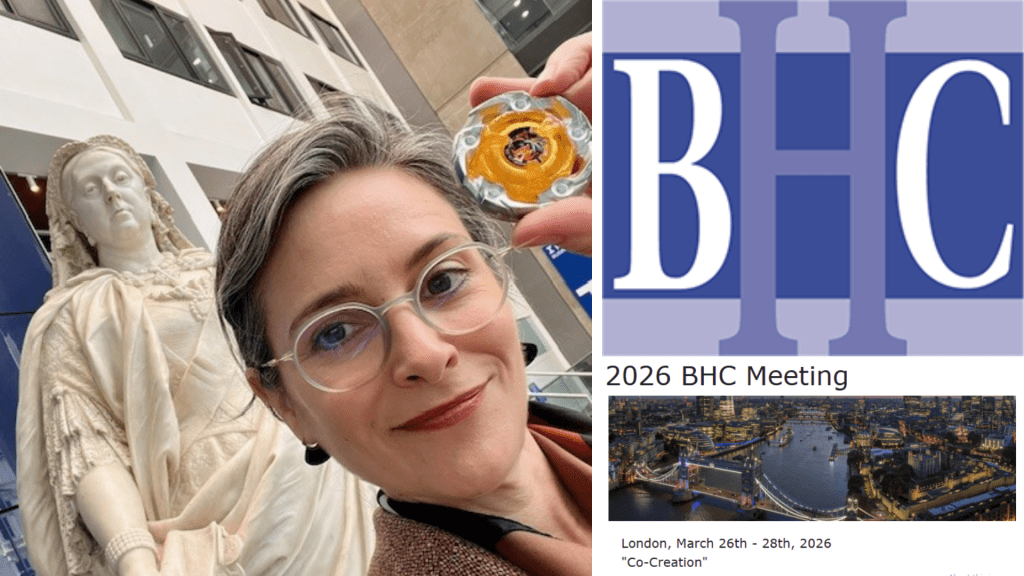
Georgia Law Professor Laura Phillips-Sawyer presents at Business History Conference in London

University of Georgia School of Law Professor Laura Phillips-Sawyer participated in the Business History Conference in London, England in March. The theme of the 2026 BHC annual meeting was “Co-Creation.” She received financial support to travel to London from the Dean Rusk International Law Center as a Rusk Scholar-in-Residence, an initiative promoting international opportunities for Georgia Law faculty that advance the mission of the Center.

Phillips-Sawyer presented a new paper: The 21st Century ‘New Economy’: A Legal and Business History of Vertical Disintegration. This paper explores and tests the historical interdependence of two developments. First, it surveys the extent to which American production and distribution systems have shifted away from vertical integration toward being governed, in the 21st century, by a “network of contracts”—a phenomenon visible in high-profile firms such as Dell, Apple, United Fruit, FedEx, and Amazon. Second, it examines how changes in antitrust law legalized the types of business contracts—such as exclusive dealing and exclusive distribution channel agreements—that have facilitated this structural shift.

Phillips-Sawyer also organized a panel discussion for the conference. The panel included Brian Callaci, chief economist at the Open Markets Institute, and Erik Peinert, a political scientist at Boston University who formerly worked at the American Economic Liberties Project.

Phillips-Sawyer is an expert in U.S. antitrust law and policy. Broadly, she is interested in questions of economic regulation, which intersect with legal history, economic thought, business strategy and structure, and political organization. She currently holds the Jane W. Wilson Associate Professorship in Business Law at the University of Georgia School of Law. Before coming to Georgia Law, Phillips-Sawyer taught international political economy at the Harvard Business School.

Georgia Law Professor Laura Phillips-Sawyer participates in the Business History Conference

University of Georgia School of Law Professor Laura Phillips-Sawyer participated in the Business History Conference in Atlanta, Georgia earlier this year. She was one of several speakers in the Harvard Business School Workshop entitled “Globalization, Multinationals, and Institutions.” Additionally, she chaired the panel “Trust and Antitrust: Standard Oil and the Creation of the Global Economy.”

Phillips-Sawyer is an expert in U.S. antitrust law and policy. Broadly, she is interested in questions of economic regulation, which intersect with legal history, economic thought, business strategy and structure, and political organization. She currently holds the Jane W. Wilson Associate Professorship in Business Law at the University of Georgia School of Law.

Georgia Law Professor Phillips-Sawyer presents at King’s College

University of Georgia School of Law professor Laura Phillips-Sawyer recently presented her work “Reassessing Vertical Restraints:  How Global Value Chains Have Rewritten the Boundaries of the Firm” at the Rethinking Economic Regulation conference at King’s College, London. The conference is organized by the Competition Law Center at the George Washington University, as well as by the Dickson Poon School of Law and the Faculty of Social Science & Public Policy at King’s College London.

Below is the conference precis:

In the 1980s and 1990s, countries in Europe and elsewhere embraced a model of the political economy characterised by privatisation, market competition, and politically-insulated economic regulation. Yet, whilst this model may have performed well on some narrow and aggregate-level objectives, it has raised concerns about unequal outcomes, lack of investment, and market failure, especially in the utility sectors. These concerns have prompted ad hoc policy changes and calls for select re-nationalisation. Yet, what is missing from the debate is a wider systemic analysis of the underlying causes of the disappointing outcomes. This two-day workshop brings together an inter-disciplinary group of established and emerging scholars – in particular, lawyers, economists, historians, and political scientists – who centre on the different causes of the failings of the now dominant political-economic model. The workshop facilitates knowledge production and exchange and will contribute to the production of a special issue on the wider theme.

Phillips-Sawyer is an expert in U.S. antitrust law and policy. Broadly, she is interested in questions of economic regulation, which intersect with legal history, economic thought, business strategy and structure, and political organization. She currently holds the Jane W. Wilson Associate Professorship in Business Law at the University of Georgia School of Law. 

UGA Professor Ramnath discusses book, “Boats in a Storm: Law, Migration, and Decolonization in South and Southeast Asia, 1942–1962” at law school

Kalyani Ramnath, Assistant Professor in the Department of History at the Franklin College of Arts & Sciences and Assistant Professor (by courtesy) at the University of Georgia School of Law, recently discussed her first book (detailed in previous post here) at an event organized by the Dean Rusk International Law Center. Joining Ramnath in conversation about Boats in a Storm: Law, Migration, and Decolonization in South and Southeast Asia, 1942–1962 (Stanford University Press, 2023) were Diane Marie Amann, Regents’ Professor, Emily & Ernest Woodruff Chair in International Law, and Co-Director of the Dean Rusk International Law Center, and Laura Phillips-Sawyer, Jane W. Wilson Associate Professor in Business Law.

Below is a description of Ramnath’s book:

Drawing on archival materials from India, Sri Lanka, Myanmar, London, and Singapore, Kalyani Ramnath narrates how former migrants battled legal requirements to revive prewar circulations of credit, capital, and labor, in a postwar context of rising ethno-nationalisms that accused migrants of stealing jobs and hoarding land. Ultimately, Ramnath shows how decolonization was marked not only by shipwrecked empires and nation-states assembled and ordered from the debris of imperial collapse, but also by these forgotten stories of wartime displacements, their unintended consequences, and long afterlives.

Ramnath received her Ph.D. in history from Princeton University in 2018, and was a Prize Fellow in Economics, History, and Politics at the Center for History and Economics at Harvard University from 2018 – 2021. She also holds a bachelor’s degree in arts and law (B.A., LL.B. (Hons.) (JD equivalent) from the National Law School of India University (NLSIU) and a master’s degree in law (LL.M.) from the Yale Law School.