
Georgia Law Professor Laura Phillips-Sawyer presents at Business History Conference in London

University of Georgia School of Law Professor Laura Phillips-Sawyer participated in the Business History Conference in London, England in March. The theme of the 2026 BHC annual meeting was “Co-Creation.” She received financial support to travel to London from the Dean Rusk International Law Center as a Rusk Scholar-in-Residence, an initiative promoting international opportunities for Georgia Law faculty that advance the mission of the Center.

Phillips-Sawyer presented a new paper: The 21st Century ‘New Economy’: A Legal and Business History of Vertical Disintegration. This paper explores and tests the historical interdependence of two developments. First, it surveys the extent to which American production and distribution systems have shifted away from vertical integration toward being governed, in the 21st century, by a “network of contracts”—a phenomenon visible in high-profile firms such as Dell, Apple, United Fruit, FedEx, and Amazon. Second, it examines how changes in antitrust law legalized the types of business contracts—such as exclusive dealing and exclusive distribution channel agreements—that have facilitated this structural shift.

Phillips-Sawyer also organized a panel discussion for the conference. The panel included Brian Callaci, chief economist at the Open Markets Institute, and Erik Peinert, a political scientist at Boston University who formerly worked at the American Economic Liberties Project.

Phillips-Sawyer is an expert in U.S. antitrust law and policy. Broadly, she is interested in questions of economic regulation, which intersect with legal history, economic thought, business strategy and structure, and political organization. She currently holds the Jane W. Wilson Associate Professorship in Business Law at the University of Georgia School of Law. Before coming to Georgia Law, Phillips-Sawyer taught international political economy at the Harvard Business School.

Georgia Professor Greg Day presents at Japan’s Fair Trade Commission Symposium

University of Georgia Professor Greg Day was recently invited to present “The Evolving Landscape of Dark Patterns in the United States” at Japan’s Fair Trade Commission symposium titled Dark Patterns: The Role of Competition Policy on Deceptive Web Designs. Day’s presentation centered around antitrust, consumer protection laws, and dark patterns.

Below is a description of the symposium:

There are a variety of acts known as “dark patterns,” such as forcing consumers to register as members when browsing or purchasing products, or obscuring important information for consumers. These acts of dark patterns not only disadvantage consumers and other users, but there are also concerns that they may harm fair and free competition between businesses that use dark patterns and those that do not use such means. It is necessary to consider how to address the issue of dark patterns from the perspective of Antimonopoly Act and competition policy.

This symposium will include speeches and a panel discussion regarding current situation of dark patterns, their regulatory trends and future issues in Japan and abroad, and the way competition policy should approach dark patterns.

Day is an Associate Professor of Legal Studies at the Terry College of Business and holds a courtesy appointment in the School of Law. He is also an Affiliated Fellow at Yale Law School’s Information Society Project as well as the University of North Carolina’s Center for Information, Technology, and Public Life. His research has primarily focused on the intersection of competition, technology, innovation, and privacy as well as the disparate impact of anticompetitive conduct.

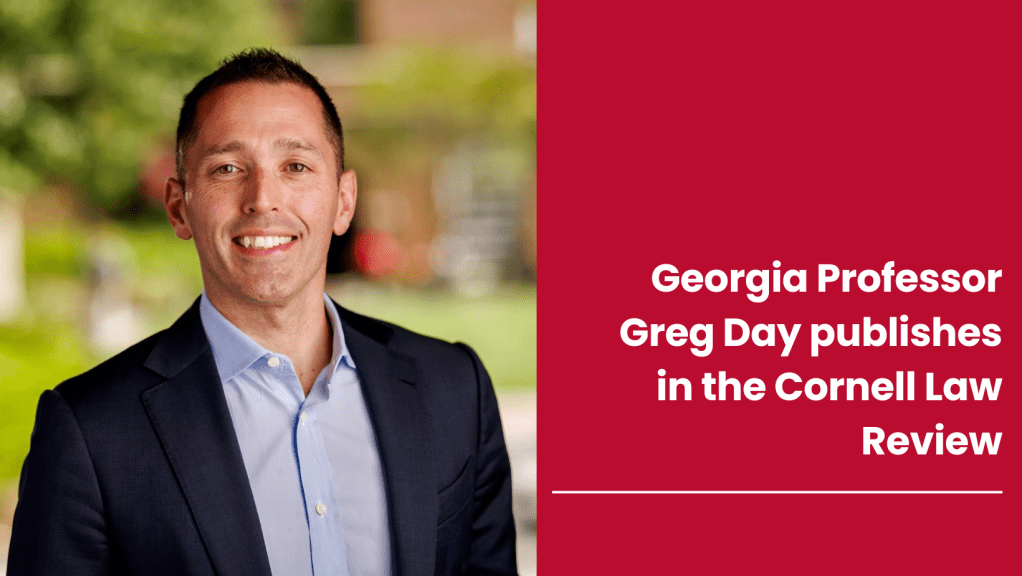
Georgia Professor Greg Day publishes in the Cornell Law Review

Greg Day, Associate Professor of Legal Studies at the Terry College of Business and professor (by courtesy) at the University of Georgia School of Law, published “Antitrust for Immigrants” in the Cornell Law Review.

Below is an abstract from the draft paper:

Immigrants and undocumented people have often encountered discrimination because they compete against “native” businesses and workers, resulting in protests, boycotts, and even violence intended to exclude immigrants from markets. Key to this story is government’s ability to discriminate as well: it is indeed common for state and federal actors to enact protectionist laws and regulations meant to prevent immigrants from braiding hair, manicuring nails, operating food trucks, or otherwise competing. But antitrust courts have seldom mentioned a person’s immigration status, much less offered a remedy.

This Article shows that antitrust’s “consumer welfare” standard has curiously ignored the plight of immigrants. Part of the reason is that antitrust law is characterized as a “colorblind” regime benefitting consumers collectively, meaning that it isn’t supposed to prioritize insular groups such as immigrants. Courts and scholars have also described matters of inequality and discrimination as “social harms” existing beyond antitrust’s scope. In fact, antitrust lawsuits have successfully sought to drive immigrants out of markets, alleging that competitors gained an “unfair” advantage from employing undocumented workers. Under this view of antitrust law, the exclusion of immigrants is an appropriate way of promoting competition.

This Article argues that anti-immigrant discrimination creates the exact types of harms that antitrust was meant to remedy. Since excluding immigrants can misallocate resources on citizenship or racial lines as opposed to their most productive usages, certain acts of discrimination should entail “conduct without a legitimate business purpose,” even when based solely on racial animus. A hidden type of market power is revealed in that foreign-born people are less able to employ self-help remedies to correct market failures. In addition to analyzing antitrust’s purpose and economic foundation, this Article delves into antitrust’s history to show that an original function of competition law was to protect foreigners. By demonstrating how incumbents can inflict greater levels of harm on immigrants while wielding less market power, this Article reimagines the consumer welfare standard and its colorblind approach as well as reveals how marginalized communities defy antitrust’s assumptions of self-help remedies.

Greg Day is an Associate Professor of Legal Studies at the Terry College of Business and holds a courtesy appointment in the School of Law. He is also an Affiliated Fellow at Yale Law School’s Information Society Project as well as the University of North Carolina’s Center for Information, Technology, and Public Life. His research has primarily focused on the intersection of competition, technology, innovation, and privacy as well as the disparate impact of anticompetitive conduct.