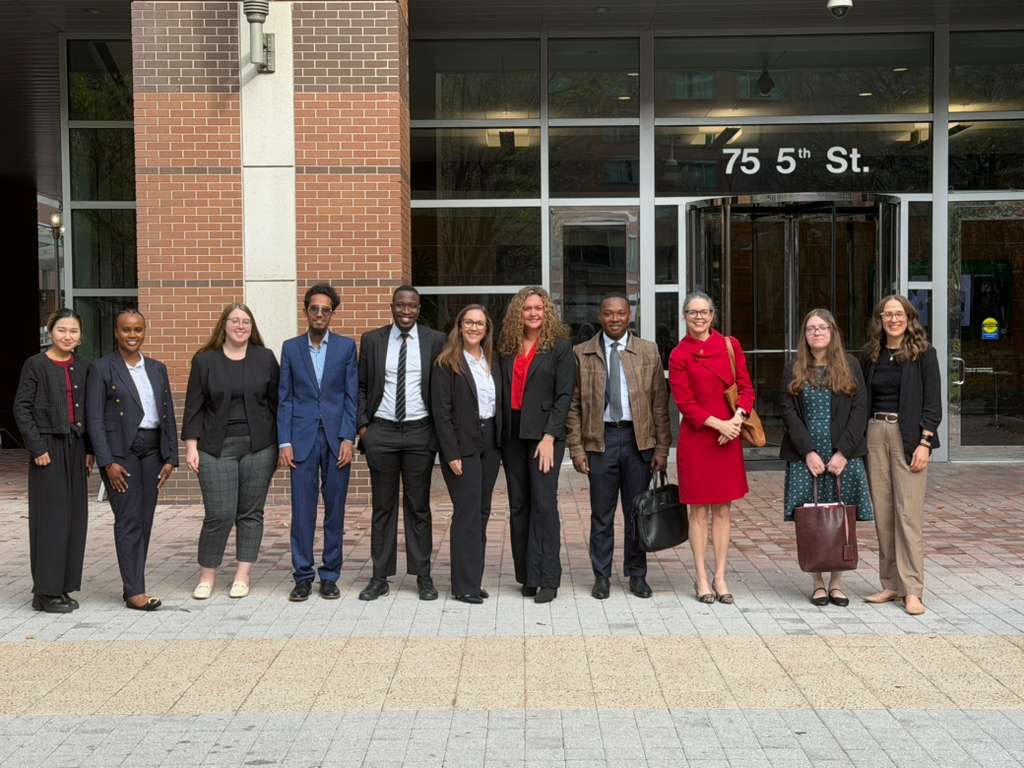
In November, University of Georgia School of Law Professor Desirée LeClercq traveled to Atlanta with a group of students as the culmination of their semester-long exploration of international trade.
15 students, including J.D., LL.M., and Graduate Certificate in International Law students, spent the semester examining potential trade and investment opportunities between the State of Georgia and the United Kingdom from an interdisciplinary perspective. They researched and wrote a paper examining key export and import sectors in Georgia and the United Kingdom, and then prepared a hypothetical Memorandum of Understanding (MoU) between the two. The students spent the day in Atlanta presenting to, and fielding technical questions from, three different audiences: representatives from the state of Georgia, transactional and international lawyers from Eversheds Sutherland, and foreign diplomats from the U.K. consulate.
Georgia Department of Economic Development
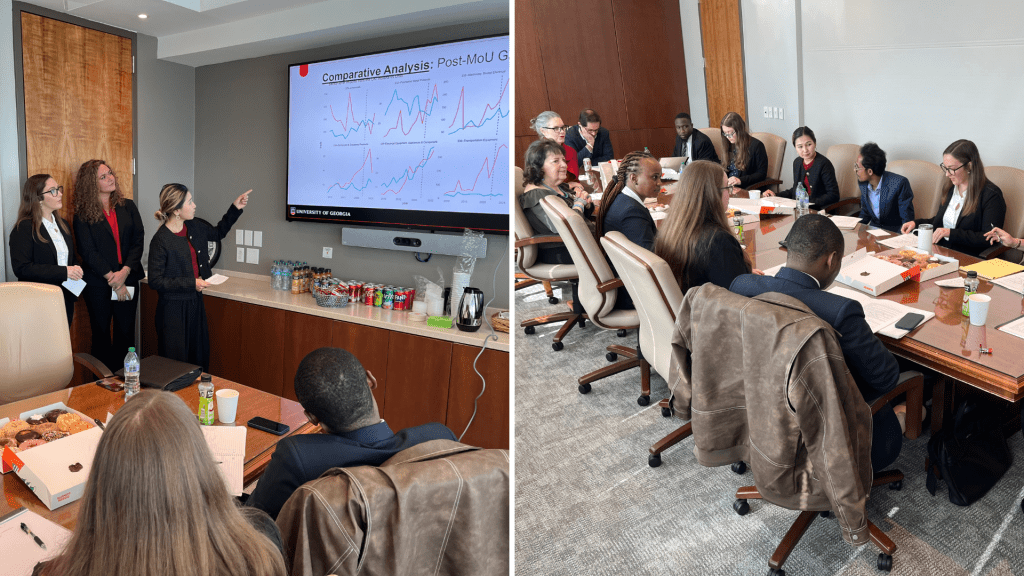
The group’s first stop of the day was hosted by the Georgia Department of Economic Development (GDEcD), the state’s sales and marketing arm, and had in attendance other state representatives.
At the GDEcD, Madina Bekisheva (GCIL student), Sutton Eady (J.D. ’27), Md. Asaduzzaman Jabin (GCIL student), and Jalyn Ross (J.D. ’27) worked together to present their portion of the hypothetical legal instrument. In their presentation, the group argued for greater collaboration and synergies between the state and the United Kingdom to attract, facilitate, and potentially grow trade. Their arguments centered on export and import data from similarly situated states and novel predictive models they had built demonstrating how enhanced collaborations with the United Kingdom could increase trade and job opportunities in Georgia. The students used the model to identify specific sectors in industry, renewable energy, commerce, and agriculture, among others, where Georgia’s economy and workers could benefit.
Eversheds Sutherland
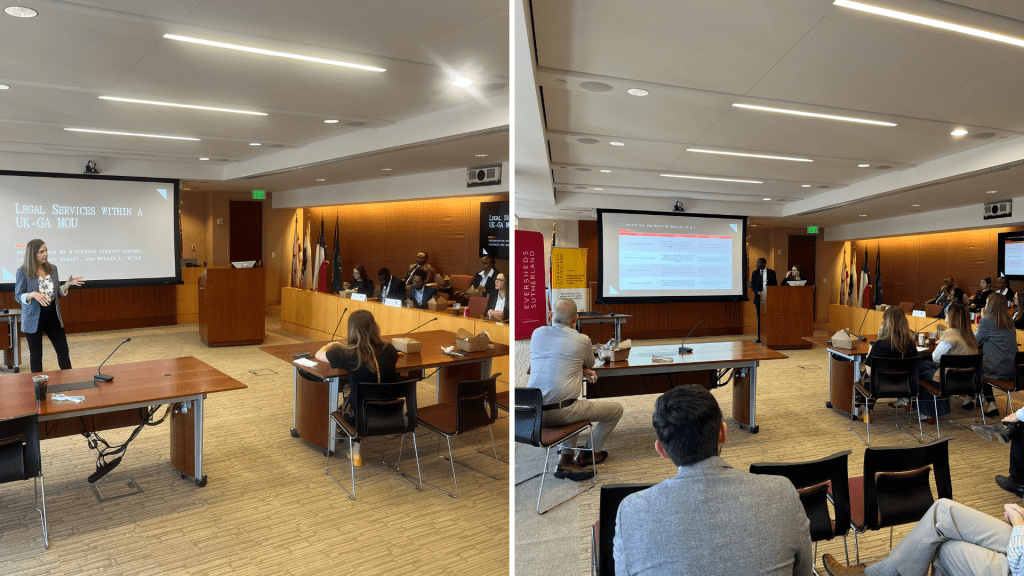
The group’s second stop of the day was the Atlanta office of Eversheds Sutherland, a global law firm specializing in corporate, energy, litigation, tax, and real estate. This firm has a meaningful relationship with the UK, as it is where the Eversheds law firm originated prior to their 1988 merger with Sutherland. The firm’s global headquarters is located in London, and its historic ties to the country are evident in their presence throughout the British legal market. Students Leighlee Mahony (J.D. ’26) and N’Guessan “Clement” Kouame (LL.M. ’24, J.D. ’26) presented. Both students argued that enhanced trade and investment collaboration between Georgia and the United Kingdom could offer reciprocity in sectors, including legal services.
The students were hosted by Jenny Lambert, Partner, and attended by several practicing attorneys in transactional and international work. The students benefitted both from the lunch that Eversheds Sutherland generously provided, as well as in-depth and vigorous questioning by the firm’s attorneys.
British Consulate General Atlanta
The group’s third and final stop of the day was the British Consulate General Atlanta. Students Maya Roper (J.D. ’27), Victor Azure (LL.M. ’26), Wambui Kamau (LL.M. ’26), and Madina Bekisheva (GCIL student) presented the group’s data and modeling to U.K. diplomats and officials. The group again walked the audience through specific trade and industry sectors, with a special focus on battery production for electric vehicles, the Georgia aerospace industry’s advantage, and veterinary medicine.
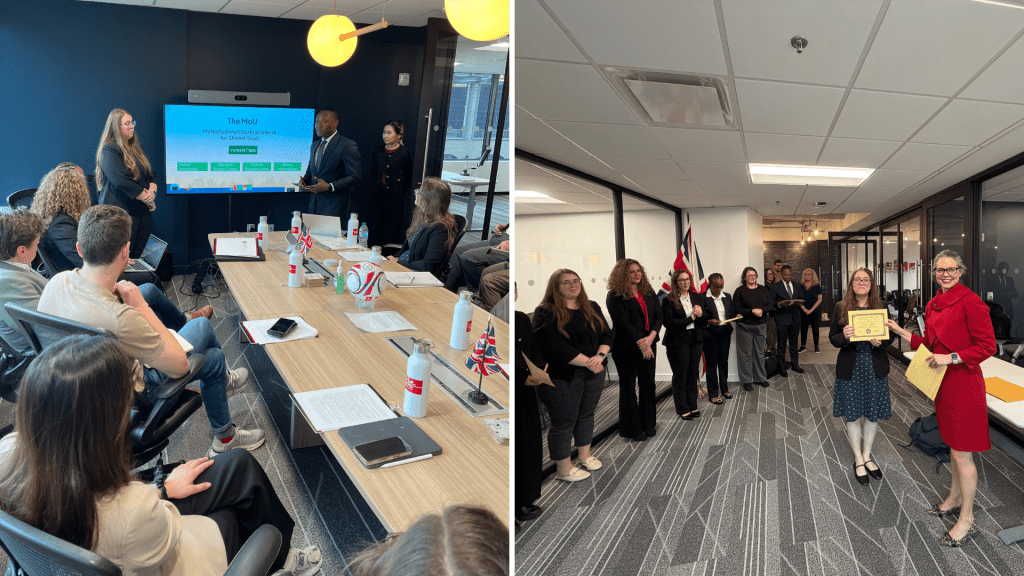
Student Reflections
“Coming from a non-law background in Computer Science, I learned that successful trade and partnerships do not thrive on innovation alone. They must be shaped by policy and political realities, economic conditions, population needs, national interests, and stakeholder relationships. The Atlanta trip made this clear by showing how quickly trade negotiations can shift based on context, not on the brilliance of the technology or business itself.” – Md. Asaduzzaman Jabin (GCIL student)
“This course was a great blend of theory and practice, requiring intensive and insightful legal research to understand and gather the materials, as well as concise, precise, and clear drafting of the MoU. The most significant site visit for me was the visit to the Georgia Department of Economic Development. It was a great experience to compare our findings with the department’s work and its vision for improvement. It was also interesting to know that people at the GDDE were doubtful about the use of models for the prediction of growth or value from MoUs. It shows how sometimes new technology may face skepticism for its implementation and convince people to advance or improve their old methods.” – N’Guessan “Clement” Kouame (LL.M. ’24, J.D. ’26)
 exchange of notes