Doty named Director of Georgia Law’s Dean Rusk International Law Center; Amann and Cohen Faculty Co-Directors

Kathleen A. Doty is the new Director of the Dean Rusk International Law Center at the University of Georgia School of Law. Assisting her are two Faculty Co-Directors, Diane Marie Amann and Harlan G. Cohen. The appointments took effect on August 1.

Since May 2017, Doty (left) has served as the Center’s Interim Director. She joined the law school in 2015, serving first as the Center’s Associate Director of Global Practice Preparation and then as Director of Global Practice Preparation. Her portfolio included: planning and the implementation of lectures, conferences and other events; research projects; advising students interested in global legal practice; administering Global Externships Overseas and At-Home; and coordinating and serving as a faculty member in the Global Governance Summer School, a 10-day offering in Europe conducted in partnership with the Leuven Centre for Global Governance Studies at the University of Leuven, Belgium.

As Director, Doty will oversee both global practice preparation and international professional education, including the Master of Laws, or LL.M., degree for foreign-trained lawyers. Her duties as a member of the law faculty will include teaching the Legal System of the United States course to LL.M. candidates.

Dean Peter B. “Bo” Rutledge said:

“We are very pleased that Kate Doty has agreed to take on this leadership role at the law school. I am confident that the center will benefit from her energy and extensive experience in the practice of international law.”

This autumn, the Center will celebrate its 40th birthday. Its namesake is Dean Rusk, who served as a law professor at the University of Georgia after serving as Secretary of State to Presidents John F. Kennedy and Lyndon B. Johnson. The Center serves as the law school’s international law and policy nucleus for education, scholarship, and other collaborations among faculty and students, the law school community, and diverse local and global partners. U.S. News & World Report ranks the law school’s international law curriculum 18th among U.S. law schools.

Doty will be the fifth person to lead the Dean Rusk International Law Center, following in the footsteps of Fredrick W. Huszagh, Thomas J. Schoenbaum, Gabriel M. Wilner, C. Donald Johnson Jr., and, most recently, Diane Marie Amann (left).

Professor Amann, who holds the Emily & Ernest Woodruff Chair in International Law, has just completed a term as Georgia Law’s Associate Dean for International Programs & Strategic Initiatives. An expert in public international law, she is a Counsellor of the American Society of International Law and serves as Special Adviser to the International Criminal Court Prosecutor on Children in & affected by Armed Conflict.

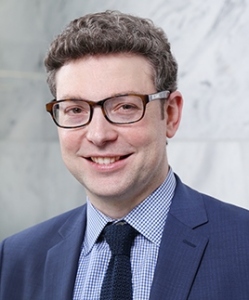
Amann will serve as Faculty Co-Director with Professor Cohen (right), holder of the Gabriel M. Wilner/UGA Foundation Professorship in International Law and an international economic law expert who is the Managing Editor of AJIL Unbound, the online platform of the American Journal of International Law.

In Dean Rutledge’s words:

“Diane provided excellent leadership for the Center over the past two-plus years, creating a strong foundation on which Kate and her team, assisted by Harlan and Diane, will build. I am confident the law school’s influence in the area of international law and policy will continue to grow.”

Before joining the Dean Rusk International Law Center, Doty practiced treaty law in Washington, D.C., as Assistant Counsel for Arms Control & International Law at the Office of the General Counsel, Strategic Systems Programs, U.S. Department of the Navy. Before that, she was Attorney-Editor at the D.C.-based American Society of International Law, where her duties included managing the American Journal of International Law and editing publications like ASIL Insights, International Law in Brief, International Legal Materials and the Benchbook on International Law. Her published writings cover issues such as the European Court of Human Rights, refugee law, transitional justice and the U.S. military commissions at Guantánamo.

She serves in leadership roles for the American Society of International Law (with which Georgia Law is an Academic Partner), as Chair of ASIL’s Non-Proliferation, Arms Control, and Disarmament Interest Group and Vice Chair of its Lieber Society on the Law of Armed Conflict. In 2016, Doty was selected as a Young Leaders Fellow by the World Affairs Council of Atlanta and joined other fellows in a professional development tour of China.

While earning her J.D. degree at the University of California, Davis School of Law, she competed in the international rounds of the Philip C. Jessup International Law Moot Court Competition. After serving as a judicial clerk on the Hawaiʻi Intermediate Court of Appeals, she was the inaugural Fellow of the California International Law Center at Cal-Davis Law. She received her undergraduate degree from Smith College, with a major in Latin American Studies and a minor in Film Studies, and studied abroad at La Universidad de la Habana in Cuba. She is fluent in Spanish and proficient in French.

Application season opens for University of Georgia School of Law LLM Class of 2019

Today’s the 1st day that foreign-trained lawyers may apply for 2018-19 study toward the Master of Laws, or LL.M., degree at the University of Georgia School of Law.

Over the last 4 decades, the law school has produced more than 450 LL.M. graduates, with ties to 75 countries and every continent in the world. They include judges and law firm partners, leaders in governments and in intergovernmental and nongovernmental organizations, CEOs and heads of corporate legal departments, and university professors and administrators.

Our LL.M. students pursue a one-year, full-time plan of courses side by side with J.D. candidates, gaining exposure to diverse viewpoints on a range of legal issues. They follow a flexible curriculum tailored to individual career goals – whether it’s preparation to sit for a U.S. bar examination, pursuit of a Concentration affording advancement in their home country’s legal profession or academic institutions, or something else.

As shown in our prior posts, LL.M. students benefit from the superb resources of a highly ranked law school in the heart of a top-20 public university: renowned faculty; research facilities like the Alexander Campbell King Law Library, as well as the Louis B. Sohn Library on International Relations and other initiatives at the Dean Rusk International Law Center; experiential learning opportunities; professional development and career preparation; and world-class lectures and conferences.

Details in our new LL.M. brochure (above), available in downloadable PDF and online booklet formats.

Further information available at our website, or by e-mailing LLM@uga.edu. Click here to apply now.

Global Governance Summer School enriches our study abroad tradition

Leuven Dean Bart Kerremans provides statistical analyses of the political economy of the 2017 U.S. and 2017 French presidential elections

LEUVEN and BRUSSELS, Belgium – The 2017 Global Governance Summer School may have ended, but memories linger of a brilliant week in these 2 Belgian cities.

Bicycles line sidewalks all over the University of Leuven, also known as KU Leuven

The 2017 GGSS marked the 1st summer school collaboration between our Dean Rusk International Law Center, University of Georgia School of Law, and our Belgium partner, the Leuven Centre for Global Governance Studies at the University of Leuven, one of Europe’s premier institutions of higher education since its founding in 1425.

At the same time, it contributed to Georgia Law’s long tradition of summer study in Belgium – a tradition that began in 1973 as the Brussels Seminar led by the late Professor Gabriel N. Wilner and supported by another Georgia Law professor, our Center’s namesake, Dean Rusk. Over the years hundreds of U.S. and European law students took part, sometimes launching careers in global practice. We’re proud to have continued the tradition with this year’s GGSS.

Leuven streetscape

As previously posted, our 2017 GGSS journey began at The Hague, political capital of the Netherlands, where students received professional development briefings at the International Criminal Court, the Iran-U.S. Claims Tribunal, and the International Court of Justice.

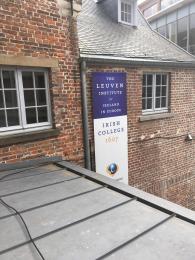
The Leuven Institute is housed in the buildings of an Irish College founded in 1607

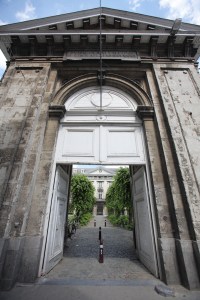
We then moved to Leuven, a centuries-old Flanders city about 15 miles west of Brussels. The lovely Leuven Institute for Ireland in Europe was our home base for the week of June 25. Days were intense, while summery weather, late-evening sunsets, and endless lanes of historic buildings and convivial sidewalk cafes made for relaxing evenings.

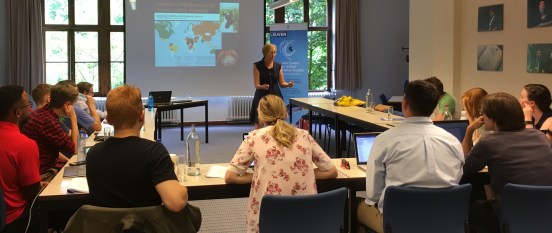
The week began with students taking part in classroom seminars:

Leuven Professor Jan Wouters introduces global governance

Day 1 focused on “Global Governance and International Law: Concepts, Norms, Actors, and Processes,” and featured 4 lectures: “Global Governance: An Introduction” by Leuven Law Professor Jan Wouters, GGSS Co-Director and Leuven Centre Director; “A Classic Account of International Law” by Professor Diane Marie Amann, GGSS Co-Director; “International Organizations as Rulemakers” by Dr. Philip De Man, Leuven Centre Senior Researcher; “Why Global Governance?” by Georgia Law Professor Harlan G. Cohen.

Georgia Law Professor Diane Marie Amann examines relationship between armed conflict and extraction of oil and other natural resources

Day 2 covered “Global Economic and Trade Governance,” with these lectures: “Concepts, Principles, and Issues: Global Economic and Trade Law” by Georgia Law Professor Cohen; “A Legal Perspective on Global Economic and Trade Law” by Leuven Law Professor Geert Van Calster; “International Commercial Responsibility” by Georgia Law Professor Amann; and “A Political Economic Perspective on Global Economic and Trade Governance” by Dean Bart Kerremans, head of Leuven’s Faculty of Social Sciences.

Leiden Professor Horst Fischer surveys human rights institutions

Day 3 shifted to “Global Human Rights, Rule of Law, and Security Governance.” Leiden Law Professor Horst Fischer began with a lecture on “Human Rights Governance”; then followed a lecture on “Rule of Law Governance” by as Dr. Nicolas Hachez, Leuven Centre Senior Researcher. The afternoon kicked off with a conversation on the practice of human rights law between Alison A. Smith, Legal Counsel at the Brussels NGO No Peace Without Justice, and Georgia Law Professor Amann.

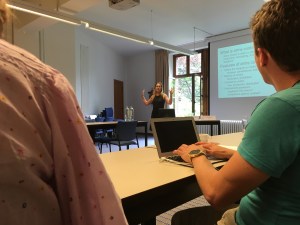
Rusk Interim Director Kathleen A. Doty summarizes arms control law to prepare students for treaty negotiation exercise

Our Center’s Interim Director, Kathleen A. Doty, then led the GGSS students’ simulated negotiation of a treaty aimed at controlling the use of drones. The day concluded with a dialogue between Leuven Law Professor Dominik Steiger and Georgia Law Professor Cohen on “Withdrawal from International Organizations and Global Governance.”

These classroom sessions prepared students for Day 4, an expert conference on “International Law and Global Governance in Turbulent Times.”

Dr. Tom Pegram, University College London, addresses conference as panelists and other participants look on

Taking part in the 1st conference panel, “Global Governance of Human Rights,” were: Georgia Law Professor Amann; Leuven Centre researcher Anna-Luise Chané; Mercedes García Pérez, Head of Division-Human Rights, European External Action Service; Dr. Tom Pegram, Senior Lecturer, University College London; and Katrien Meuwissen, Development Officer, European Network of National Human Rights Institutions.

Speaking at the conference panel on “Global Governance of Democracy and Rule of Law” were: Bologna Political Science Professor Daniela Piana; Leuven Researcher Dr. Mattieu Burnay; Professor Laurent Pech, Middlesex University London; Leuven researcher Tim Courthaut; and Dr. Petra Bard of the Central European University-Budapest.

Georgia Law Professor Harlan G. Cohen (3d from right) speaks on developments in international trade

Closing the conference was a panel on “Global Economic and Trade Governance in Protectionist Times,” featuring Professor Miles Kahler, American University; Professor John Kirton, University of Toronto; Georgia Law Professor Cohen; Tomas Baert, European Commission, Head of Unit Trade Strategy; Professor Jean-Christophe Defraigne, Université Saint-Louis Bruxelles; and Professor Pieter de Wilde, Norwegian University of Science and Technology.

GGSS concluded with a day in Brussels, capital of Belgium and home to many European and international legal institutions.

At NATO HQ in Brussels on final day of Global Governance Summer School: from left, Nils Okeson, Brian Griffin, Jennifer Cotton, Wade Herring, Nicholas Duffey, James Cox, Kathleen A. Doty, Kristopher Kobl, Lyddy O’Brien, Casey Callaghan, Ezra Thompson, Diane Marie Amann, Evans Horsley, and Eduard Snijders

Students took a morning tour of the headquarters of the North Atlantic Treaty Organization. There they learned about the work of NATO’s lawyers from member of the NATO Office of Legal Affairs, headed by Steven Hill. They lunched among NATO staffers and uniformed personnel from NATO’s 29 member states.

Alumnus Stephen Spinks briefs students on global legal practice

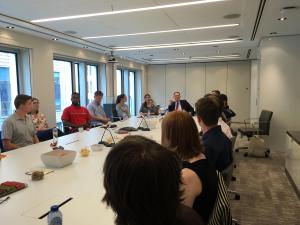
In Brussels’ “European quarter,” students stopped at the European Parliamentarium and then took part in a briefing at Sidley Austin LLP, a global law firm whose law practice all manner of global law fields, including trade, environment, life sciences, data privacy, and dispute settlement. Leading the briefing (right) was the managing partner of Sidley’s Brussels office, Stephen O. Spinks, who is a Georgia Law alumnus and member of our Dean Rusk International Law Center Council. As Spinks told student, he himself had studied in GGSS’ forerunner, the Brussels Seminar. He returned after receiving his J.D. degree, earned a master’s degree at Vrije Universiteit Brussel, and began his career as a specialist in trade and competition/antitrust, law. Sprinks’ inspiring story capped a great week for students, many of whom are spending the balance of summer at Global Externships.

Poster outside the Koninklijk Paleis van Brussel, or Royal Palace of Brussels

At the centenary of chemical warfare, a visit to Flanders’ WWI battlefields

YPRES, Belgium – Beautiful vistas and bright sunlight cannot blind the visitor to the pain of this place.

This place is Flanders Fields, the name given to the part of west Belgium, close to the French border, that saw intense battles and horrendous casualties during World War I. This town – Ypres in French and Ieper in Flemish, but called “Wipers” by British WWI soldiers – played a central role. So too nearby Passchendaele/Passendale. Both towns were leveled, and like many in the region, were rebuilt in the old manner after the war ended.

During the war, upwards of half a million persons died in this area alone.

Our visit to Flanders Fields occurred on the 4th of July. Memories linger, and were sparked again by today’s commemoration of the 100th anniversary of the 1st large-scale use, in Ypres, of chemical weapons; mustard gas, to be precise. It was the 3d compound to be attempted, after chlorine and phosgene proved less reliable as lethal weapons, according to our tour guide, Raoul Saracen, a retired history teacher. Initial efforts to fight back against chemicals also were crude: before the development and widespread distribution of gas masks, Canadian troops resorted to breathing through kerchiefs soaked in ammonia-rich urine.

The cruelty of chemical warfare did not stop its use. Recording other places where chemicals have been used was a signpost in Langemark, the cemetery where German soldiers (including several with whom I share a surname) are buried. Tokyo, Japan, Halabja, Iraq, and Ghouta, Syria, receive mention, though more recent gassing sites in that last country have yet to be added.

The thousands of headstones in the many Flanders Fields cemeteries of course give pause. So too the cramped trenches, still on display at Sanctuary Wood Museum.

Yet it was a different site that stole my breath – the “dressing station,” a kind of field hospital, at Essex Farm Cemetery. The station’s cement-bunker cells were small, dark, and saddening, a truly concrete reminder of the scourge of war.

(Cross-posted)


Georgia Law 3L Chanel Chauvet begins term as Student President of International Law Students Association

Chanel Chauvet, a Dean Rusk International Law Center Student Ambassador and member of the J.D. Class of 2018 at the University of Georgia School of Law, has turned to social media to reach the global membership of the International Law Students Association, whom she now serves as 2017-18 Student President.

In the YouTube video above, she offers her

“deepest gratitude for the confidence that the International Law Student Association chapters all around the world have placed in me and members of my administration.”

That team of student officers were elected earlier this year by vote of the chapters. Chanel adds:

“I would also like to thank the faculty at the University of Georgia School of Law and my family for their support.”

Also thanked were predecessor presidents, among them Kaitlin Ball, who earned her Georgia Law J.D. in 2014 and is now a Ph.D. candidate in the Department of Politics & International Studies at the University of Cambridge, England. They are the 2d and 3d Georgia Law students to hold the position; also leading ILSA while a student was Richard Alembik (JD’91).

My student in a number of international law classes and a presenter at Georgia Law’s IntLawGrrls conference last spring, Chanel is working this summer as a Legal Fellow at CARE headquarters in Atlanta. Last summer, she earned a Certificate in International Humanitarian Law at Leiden Law School’s Grotius Centre in The Hague, Netherlands. Prior Exchange of Notes blog posts by or about her are here.

Her ILSA statement looks forward in particular to ILSA’s 2 signature events, the International Law Weekend set for October 19-21 in New York, and the Philip C. Jessup International Moot Court Competition, final rounds of which will occur in April 2018 in Washington, D.C.

¡Brava!

Hague briefings at ICC, Iran-U.S. Claims Tribunal and ICJ launch 2017 Global Governance Summer School

At the Iran-U.S. Claims Tribunal, front from left: Ana Morales Ramos, Legal Adviser; Hossein Piran, Senior Legal Adviser; Kathleen A. Doty, Interim Director, Dean Rusk International Law Center; David Caron, Tribunal Member; and Georgia Law Associate Dean Diane Marie Amann. Back row, students Nicholas Duffey, Lyddy O’Brien, Brian Griffin, Wade Herring, Jennifer Cotton, Evans Horsley, Casey Callaghan, Kristopher Kolb, Nils Okeson, James Cox, and Ezra Thompson.

HAGUE – Briefings at key international law institutions here have highlighted the initial leg of the Global Governance Summer School led by the University of Georgia School of Law Dean Rusk International Law Center.

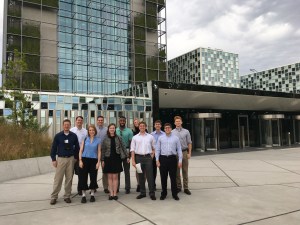
Our students’ journey began with a visit yesterday to the International Criminal Court Permanent Premises (left), a tile-and-ivy structure, located in dunelands not far from the North Sea, that opened just 18 months ago. Accompanying them were Associate Dean Diane Marie Amann and our Center’s Interim Director, Kathleen A. Doty, both of whom will lecture at the summer school next week.
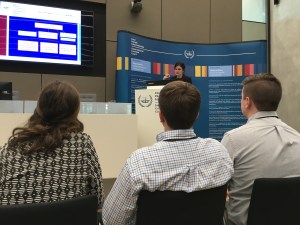
Outlining the work of the Office of the Prosecutor were the Prosecutor’s Senior Legal Adviser, Shamila Batohi, and Legal Assistant, Annie O’Reilly (right), with whom Associate Dean Amann works in her capacity as the Prosecutor’s Special Adviser on Children in and affected by Armed Conflict. Topics included case selection and specific cases, complementarity and state cooperation, and the role of the prosecution in relation to other organs of the court.

Then Leiden Law Professor Dov Jacobs, a Legal Assistant in Defense at the ICC and member of the defense team for Laurent Gbagbo, the former Ivoirian President now on trial before the court. Shifting from the theoretical to the practical and back again, he spoke about the nature and challenges of international criminal justice, particularly as it relates to the defense function before contemporary bodies like the ICC.

The journey continued today with a morning briefing at the Iran-U.S. Claims Tribunal, an international organization established by treaty 36 years ago as a means to settle disputes arising out of the 1979 takeover of the U.S. Embassy in Tehran. It comprises 3 Americans, 3 Iranians, and three members from other countries. Offering a fascinating dialogue on the history and operations of the tribunal were Dr. David Caron, a U.S. member of the tribunaland an international law professor at Kings College London, and Dr. Hossein Piran, Senior Legal Adviser at the tribunal.

(It was a treat to learn that one of Dr. Piran’s professors was the late Gabriel N. Wilner, who founded our European summer study abroad during his long tenure on the Georgia Law faculty. Holding the professorship named after Wilner is Georgia Law Professor Harlan Cohen, who will lecture in this summer school next week, along with Leuven Law Professor Jan Wouters and others.)

The afternoon brought us to the Hague’s Vredepalais (left), or Peace Palace, built in the early 1900s to house international institutions that would foster pacific, rather than warlike, settlements of disputes.

Leading discussion on one of those institutions, the International Court of Justice set up under the 1945 Charter of the United Nations, was Dr. Xavier-Baptiste Ruedin (right), Legal Adviser for Judge Joan E. Donoghue. Topics ranged from provisional measures, like those recently issued in a case involving India and Pakistan, to jurisdiction via advisory opinion (including one soon to arrive at the court, following yesterday’s U.N. General Assembly vote) or contentious case.

A question common to all 3 visits was the role of such institutions – and international law more generally – in the governance of global affairs. We’ll continue to seek answers next week, when our Global Governance Summer School moves to Belgium for classroom seminars and an experts conference with our partner institution, KU Leuven’s Leuven Centre for Global Governance Studies.

“International Law and Global Governance in a Turbulent World” to be explored at Georgia Law-Leuven Centre conference, June 29 in Belgium

“International Law and Global Governance in a Turbulent World” is the title of the daylong conference we’ll be co-presenting later this month at the University of Leuven in Belgium.

Set for Thursday, June 29, 2017, the conference will be held in Auditorium Zeger Van Hee at Leuven’s College De Valk (Law School, pictured below), Tiensestraat 41, Leuven. It is free and open to the public; register no later than June 27 here.

The conference also is a component of the Global Governance Summer School that we at the Dean Rusk International Law Center, University of Georgia School of Law, are presenting in partnership with the Leuven Centre for Global Governance Studies at the University of Leuven. Co-Directors are Georgia Law Associate Dean Diane Marie Amann and the Leuven Centre’s Director, Law Professor Jan Wouters. (prior post) Applications for the summer school are still being accepted here.

Here’s the June 29 conference concept:

“This conference aims to discuss some of the main challenges faced by contemporary international law and global governance in a time of crises. The conference starts with an exploration of the main challenges inherent to the enforcement of universal values such as human rights. Unlike in many other fields, legal standards are well-established and are the object of a broad, sometimes even universal consensus. Yet, not a single day passes without more of less grave violations of such standards in one or the other part of the world. The conference will then also focus on the difficulties to come up with a consensus on the rule of law at the global level. Starting from an analysis of the diversity in the ways the rule of law has been understood across time and geography, the conference will address some of the main challenges to the rule of law within the European Union and at the United Nations level. Finally the conference will also address the risks for the emergence of trade wars in a context of rising protectionism. Questions such as the future of multilateral and bilateral trade agreements will be discussed in light of the changes in the US foreign trade policy and the rising skepticism of citizens vis-à-vis further liberalization of international trade.”

These issues will be explored within the following framework:

  • Panel 1: Global Governance of Human Rights. How to enforce universal values in contested world?
  • Panel 2: Global Governance of Democracy and Rule of Law in international perspective.
  • Panel 3: Global Economic and Trade Governance in Protectionist Times. Will we see the emergence of trade wars in the coming years?

A transatlantic array of speakers will take part. Confirmed so far are Georgia Law Professors Diane Marie Amann and Harlan G. Cohen, and from Leuven, Anna-Luise Chané and Dr. Matthieu Burnay, along with scholars from numerous other institutions: Dr. Tom Pegram, University College London, England; Dr. Katrien Meuwissen, European Association of National Human Rights Institutions; Professor Daniela Piana, University of Bologna, Italy; Professor Petra Bard, Central European University, Budapest, Hungary; Professor Laurent Pech, Middlesex University, London, England; Professor Miles Kahler, American University School of International Service, Washington, D.C.; Professor John Kirton, University of Toronto Munk School of Global Affairs, Canada; and Mr. Tomas Baert, Head of Unit, Trade Strategy, European Commission, Brussels, Belgium.

We hope to see you there; more information here and here.

Cohen publishes article on political question doctrine in wake of Zivotofsky

Harlan Grant Cohen, the Gabriel N. Wilner/UGA Foundation Professor in International Law here at the University of Georgia School of Law, has published an article examining the U.S. political question doctrine in light of recent Supreme Court litigation in Zivotofsky, which arose out of the request by U.S. citizens that their child, born in Jerusalem, be issued a passport designating “Israel” as the child’s birthplace. Entitled “A Politics-Reinforcing Political Question Doctrine,” Professor Cohen’s article appears at 49 Arizona State Law Journal 1 (2017).

The manuscript, which forms part of our Dean Rusk International Law Center Research Paper Series at SSRN, may be downloaded at this SSRN link.

Here’s the abstract:

“The modern political question doctrine has long been criticized for shielding the political branches from proper judicial scrutiny and allowing the courts to abdicate their responsibilities. Critics of the doctrine thus cheered when the Supreme Court, in Zivotofsky I, announced a narrowing of the doctrine. Their joy though may have been short-lived. Almost immediately, Zivotofsky II demonstrated the dark side of judicial review of the separation of powers between Congress and the President: deciding separations of powers cases may permanently cut one of the political branches out of certain debates. Judicial scrutiny in a particular case could eliminate political scrutiny in many future ones.

“A return to the old political question doctrine, with its obsequious deference to political branch decisions, is not the answer. Instead, what is needed is a politics-reinforcing political question doctrine that can balance the need for robust review with the desire for robust debate. The uncertain boundaries between the political branches’ overlapping powers create space for political debate. Their overlapping powers allow different groups to access the political system and have a voice on policy. Deciding separation of powers questions once-and-for-all can shut off those access points, shutting down political debate. A politics-reinforcing political question doctrine preserves the space in the political system for those debates by turning the pre-Zivotofsky political question doctrine on its head. Whereas the pre-Zivotofsky political question suggested abstention when the branches were in agreement and scrutiny when they were opposed, a politics-reinforcing political question doctrine suggests the opposite, allowing live debates to continue while scrutinizing political settlements. In so doing, it brings pluralism and politics back into the political question analysis, encouraging democracy rather than deference.”

Georgia Law Professor Larry D. Thompson, Independent Compliance Monitor in VW fuel emissions matter

A University of Georgia School of Law professor is overseeing compliance reforms by Volkswagen AG, following the global automaker’s recent sentencing in a criminal case arising out of its fuel emissions tests.

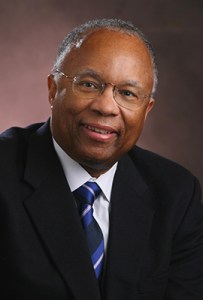
The professor is Larry D. Thompson, holder of the  John A. Sibley Chair of Corporate and Business Law and a member of the law school’s Dean Rusk International Law Center Council, teaches Corporate Responsibility, White Collar Crime Business Crimes. He is also Counsel at Finch McCranie LLP in Atlanta. His distinguished career includes service as Deputy Attorney General of the United States, as U.S. Attorney for the Northern District of Georgia, and as General Counsel of PepsiCo.

Thompson was named Independent Compliance Monitor in the VW matter in April, pursuant to a settlement by which a U.S. District Court judge in Detroit accepted VW’s plea to three felony counts: conspiracy to defraud the United States by engaging in wire fraud and violating the Clean Air Act; obstruction of justice; and importing merchandise via false statements. VW agreed to a fine exceeding $4 billion, and also to oversight by the Independent Compliance Monitor.

At the time, the company issued the following statement, by Hiltrud Werner, Board Member of Integrity and Legal Affairs, from its headquarters in Wolfsburg, Germany:

“Volkswagen welcomes the appointment of Larry D. Thompson to this new position, and we intend to cooperate fully with his important work.”

Since then, Thompson has assembled the team of lawyers he will lead in this work.

Applications welcome for Dean Rusk International Law Center Director

We at the University of Georgia School of Law Dean Rusk International Law Center, a global nucleus that will celebrate its 40th anniversary this October, seek applications for the position of Director. As stated in the vacancy notice:

“The Director’s work shall consist of (a) teaching (b) service (including, among other matters, symposia, seminars and training) and ( c) administration. A faculty director (or co-directors) may advise the director but will have no direct or indirect supervisory responsibility. This position will begin July 1, 2017 and be located in Athens, Georgia. Athens is an energetic city with a vibrant arts and cultural environment. It is located 75 miles northeast of Atlanta.

“To meet the requirements for appointment at the rank of Academic Professional, applicants must have a J.D. from an accredited university and should ideally have (1) superior academic credentials, (2) a superior teaching ability, (3) a record of participation in institutional and professional service, and (4) recognition in the field of international law.”

Details and online application here.