The client, a gay transgender rights advocate from the state of Guerrero, Mexico, and the petitioner in Case No. 20-1693, Santiaguez v. Garland, seeks deferral of removal pursuant to the treaty’s provisions respecting non-refoulement, or non-return. Specifically, the client asks not to be sent back to his home country, where his brother, also gay, recently was killed due to sexual orientation.
Georgia Law 3L Noah Nix (pictured above) argued on behalf of the client last week at the Second Circuit’s New York courthouse. He challenged prior rulings in the case, in which both the Immigration Judge and the Board of Immigration Appeals had agreed that no Mexican public official would likely acquiesce to the Clinic’s client being tortured if he returned. The Board of Immigration Appeals also had found that the Immigration Judge did not violate the client’s due process rights when refusing to allow a country conditions expert to testify at the client’s merits hearing.
Today the Second Circuit panel, composed of Chief Judge Debra Ann Livingston, Judge Barrington D. Parker Jr., and Judge Eunice C. Lee, ruled on behalf of the Clinic’s client. Specifically, reasoning that the agency had not properly considered the client’s evidence, the panel issued an order vacating the agency’s decision and remanding the case for further proceedings.
Assisting in brief-writing in the case were two Georgia Law students who have since graduated, Jared Allen and Olivia Hunter. The team worked under the supervision of Thomas V. Burch, the Clinic’s Director.
University of Georgia scholars’ presentations were as follows:
► Professor Diane Marie Amann (pictured above left) gave an online talk entitled “Absent at the Creation? Women and International Criminal Justice” as part of a Saturday hybrid session exploring “In/Ex-clusiveness of the Legal Construction of Justice.” The presentation drew on her research into the experiences of women professionals at post-World War II international criminal trials. Amann is Regents’ Professor of International Law, Emily & Ernest Woodruff Chair in International Law, and Faculty Co-Director of the Dean Rusk International Law Center here at the University of Georgia School of Law; additionally, she serves on the Coordinating Committee of ESIL’s Interest Group on International Criminal Justice. Also participating on this agora session were scholars from the Netherlands’ University of Amsterdam and Erasmus University, and also from the Irish Centre for Human Rights at the National University of Ireland-Galway.
► Professor Harlan Grant Cohen (second from left), who is Gabriel M. Wilner/UGA Foundation Professor in International Law and Faculty Co-Director of the Dean Rusk International Law Center here at the University of Georgia School of Law, presented twice:
He asked “What’s in a Name?” in his presentation at “De-formalizing the International Judiciary,” a Wednesday workshop hosted by ESIL’s Interest Group on International Courts & Tribunals. The talk highlighted Judicialization and Public Support for Compliance with International Commitments, Cohen’s experimental work with Ryan Powers, an Assistant Professor at our university’s School of Public & International Affairs, and anticipated their future work on how various audiences respond to international “courts.” Also taking part in the session were scholars from: National Academy of Legal Studies and Research University of Law, in Hyderabad, India; University of Toronto, Canada; Humboldt University Berlin; and Leiden University, the Netherlands.
On Thursday, Cohen presented “Why Study International Precedent” at “‘Connecting Social Practices to Legal Outcomes,” the workshop of the ESIL Interest Group on Social Sciences & International Law. In his talk, Cohen outlined how international legal theory would change if the emergence of precedent were made the core case of international law, rather than an anomaly. Presenting as well at this session, entitled “Precedent,” was a scholar from the European University Institute, Italy.
► Professor Melissa J. “MJ” Durkee (center), who is Associate Dean for International Programs, Director of the Dean Rusk International Law Center, and Allen Post Professor here at the University of Georgia School of Law, likewise gave two presentations at the ESIL conference:
She presented “The Technology of Inclusion in International Climate Law,” a talk that drew from her forthcoming Yale Journal of International Law article The Pledging World Order, at a Wednesday workshop session entitled “Just Energy Transition – the International Human Rights Law Perspective.” The workshop’s overall title was “In/Ex-clusiveness in the Energy Transition and Climate Action”; host was the ESIL Interest Group on International Environmental Law. Also on Durkee’s panel were scholars from Leiden University in the Netherlands and from the China Institute of Boundary & Ocean Studies and Research Institute of Environmental Law of Wuhan University, China.
Durkee explored “The Logics of Inclusion and Exclusion in International Participatory Structures,” at a Thursday workshop entitled “International Organizations, Elites, and Masses: Perspectives on In/Exclusion,” and sponsored by the ESIL Interest Group on International Organizations. Her talk concerned an early-stage project that organizes perspectives on the inclusion and exclusion of nonstate actors in the activities of international organizations. Presenting other papers were scholars from the University of Hong Kong, the University of Melbourne in Australia, Max Planck Institute for Comparative Public Law & International Law in Germany the University of Hamburg in Germany, and the Guangdong University of Foreign Studies in China.
Meanwhile, Professor Tim R Samples (second from right), Associate Professor of Legal Studies at the University of Georgia Terry College of Business who has a courtesy appointment at Georgia Law, took part in three presentations.
Professor Samples and Dr. Katie Ireland (right), who recently joined the university’s DigiLab, spoke at two ESIL workshops along with their co-author, Caroline Kraczon, a Georgetown University Law Center 3L who earned her first degrees at the University of Georgia. Their paper, “Terms of Use Agreements and Social Platforms,” discusses their interdisciplinary project based on an original dataset of 75 digital platforms’ terms-of-use and core policies. The trio presented this research at the Wednesday workshop of the International Law & Technology Interest Group, on “Algorithmic and Technological Modes of In-/Exclusion: International Legal Method and Critique,” and also at “‘In/Ex-clusiveness through the Lens of International Business and Human Rights’” the Thursday workshop of the International Business & Human Rights Interest Group.
In addition, Samples co-presented Investment Law’s Transparency Gap, an article forthcoming in Cornell International Law Journal, with co-author Sebastian Puerta, a Ph.D. student in Economics at the University of California-Berkeley who earned his first degrees at the University of Georgia. Their work uses predictive modeling to estimate missing claims and awards in investment treaty arbitration. They spoke at a session of ESIL’s International Economic Law Interest Group, “In/ex-cluding Civil Society in Investment Law-making and Arbitration.” Also taking part in this session were scholars from the Institute of International Relations in Czechoslovakia, Ghent University and Université Libre de Bruxelles in Belgium, University of Vienna in Austria, University of Trento in Italy, and Carleton University in Canada.
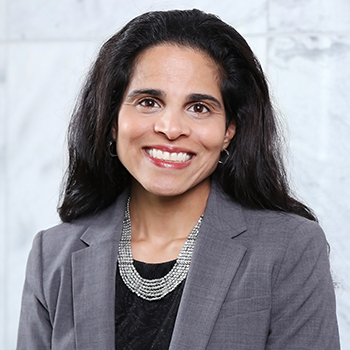
Professor Melissa J. “MJ” Durkee, Associate Dean for International Programs, Director of the Dean Rusk International Law Center, and Allen Post Professor here at the University of Georgia School of Law, moderated an online book discussion sponsored by the American Society of International Law.
Discussion centered on The Globalization of Legal Education: A Critical Perspective, published last month as an open access Oxford University Press title. Featured speakers were the co-editors, Bryant Garth (pictured above, upper right) and Gregory Shaffer (lower right), along with Swethaa Ballakrishnan (lower left), all of them professors at University of California-Irvine School of Law. Md. Rizwanul Islam (upper left), a professor at North South University Bangladesh, was the discussant.
Cohosting the event were ASIL’s Teaching International Law Interest Group and also its International Legal Theory Interest Group, of which Durkee (top, center) is Vice-Chair and another Georgia Law professor, Harlan G. Cohen, is Chair.
Video of the book discussion is available here and on YouTube.
Usha Rodrigues, University Professor and M.E. Kilpatrick Chair of Corporate Finance & Securities Law and the University of Georgia School of Law, serving currently as the University of Georgia Interim Vice Provost for Academic Affairs, recently was featured the German daily newspaper Frankfurter Allgemeine Zeitung.
Here’s the SSRN abstract of Professor Durkee’s essay:
“The 1972 United Nations Conference on the Human Environment produced the Stockholm Declaration, an environmental manifesto that forcefully declared a human right to environmental health and birthed the field of modern international environmental law. The historic event powerfully “dramatized . . . the unity and fragility of the biosphere,” sparking a remarkable period of international legal innovation and cooperation on environmental protection in the decades to come.
“The Stockholm Declaration can be rightly celebrated for putting environmental issues on the international legal agenda and driving the development of environmental law at the domestic level around the world. At the same time, the Declaration’s distinctive framing of environmental problems and solutions deeply influenced these abundant subsequent laws, and here its legacy is mixed. This special issue, in celebration of the Georgia Journal of International and Comparative Law’s 50th anniversary volume, evaluates the legacy of the Stockholm Declaration and the legal movement it launched.”
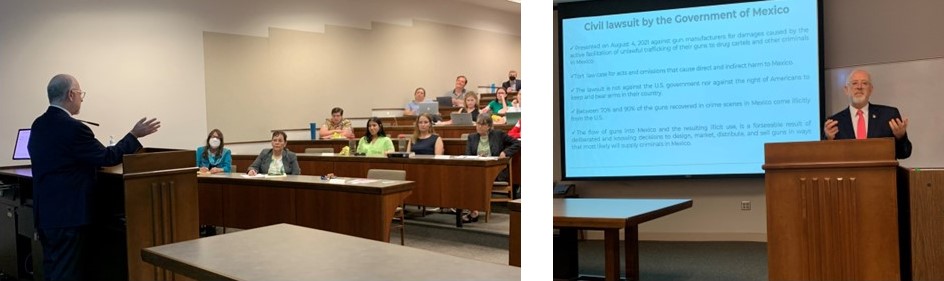
In a talk entitled “Institutional Structure of the U.S.-Mexico Relations and Key Bilateral Issues: Mexico’s Legal Case Against U.S. Gun Manufacturers,” Ambassador Javier Díaz de León began by outlining ways that Mexico and the United States – often along with their neighbor to the north, Canada – discuss and seek solutions to common problems.
One concern, of course, is security; in Mexico’s case, the southward flow of firearms and money that enable drug cartels to operate. After providing statistics on the high proportion of weapons confiscated in Mexico that have been manufactured or distributed in the United States, Ambassador Díaz turned to what he rightly called the “landmark” step that his government took on August 4, 2021, when it filed Estados Unidos Mexicanos v. Smith & Wesson Brands et al. in the U.S. District Court for the District of Massachusetts. That civil tort suit alleges that Smith & Wesson and 10 other firearms manufacturers or distributors unlawfully permitted U.S. weapons to enter Mexico, where firearms are, for the most part, prohibited. According to Ambassador Díaz, a federal judge heard argument on defendants’ motion to dismiss last spring, but has not yet ruled on that motion, and discovery is under way.
Following his presentation, Georgia Law Regents’ Professor Diane Marie Amann, one of our Center’s Faculty Co-Directors, moderated questions from the audience, composed mostly of students.
Melissa J. “MJ” Durkee, Associate Dean for International Programs, Director of the Dean Rusk International Law Center at the University of Georgia School of Law, participated in last week’s 7th Global Meeting on Law and Society in Portugal.
“The Pledging World Order,” Durkee’s article that is forthcoming in the Yale Journal of International Law, was discussed at a panel on “Transnational Orders of Finance, Trade and Investment.” Session Chair was Gregory Shaffer, who is Chancellor’s Professor of Law and Political Science at the University of California-Irvine School of Law and the President of the American Society of International Law. Sonia Rolland, Professor of Law at Northeastern University School of Law, served as Discussant.
The Global Meeting, a quinquennial gathering of the Law & Society Association and other sociolegal organizations from around the world, was held at ISCTE University Institute of Lisbon, with organizational support from DINÂMIA’CET and CIES at ISCTE.
A client of the Community Health Law Partnership Clinic here at the University of Georgia School of Law was recently granted asylum, a status that provides permanent protection to noncitizens fleeing persecution on the basis of their race, religion, nationality, political opinion, or membership in particular social groups.
The Clinic’s client had fled to the United States alone as a 16-year-old, after facing death threats and physical violence in Guatemala, and had requested asylum at the U.S. border. The Asylum Office ofthe U.S. Citizenship and Immigration Services initially interviewed the client in 2018. (photo credit) However, a torrent of subsequent administrative decisions upended longstanding asylumpolicies, leaving his fate in limbo.
The Community HeLP Clinic reactivated the case early this year. It successfully argued that the Guatemalan government was unable or unwilling to control persecution against the client by private actors. As a result of the asylum grant, the client no longer faces deportation and can focus on rebuilding his life in the United States.
The Clinic’s Staff Attorney, Kristen Shepherd, handled the initial presentation of the case before the Asylum Office. Navroz N. Tharani, who completed his Georgia Law JD in May 2022, wrote the brief, supervised by Shepherd and by Clinic Director Jason Cade, who is Associate Dean for Clinical Programs and Experiential Learning and J. Alton Hosch Associate Professor of Law. Eddy Atallah, a member of the JD Class of 2021, assisted with earlier research.
Christopher M. Bruner, the Stembler Family Distinguished Professor in Business Law here at the University of Georgia School of Law, participated in a roundtable discussion titled “Present and Future of Corporations in Society” at last week’s 7th Global Meeting on Law and Society in Portugal.
The Global Meeting, a quinquennial gathering of the Law & Society Association and other sociolegal organizations from around the world, was held at ISCTE University Institute of Lisbon, with organizational support from DINÂMIA’CET and CIES at ISCTE.
Durkee’s presentation, entitled “Interpretive Entrepreneurship: How firms use international legal interpretation to modify their compliance obligations,” formed part of a panel on “Legal Interpretation and Ambiguity.” Also on her panel were professors Jennifer Arlen, New York University School of Law, and J.S. Nelson, Harvard Business School.
This was the 3d ComplianceNet conference – an interdisciplinary gathering designed to bring together scholars to study the interaction between rules and human behavior.






 exchange of notes
