Harlan Cohen, the Gabriel M. Wilner/UGA Foundation Professor in International Law and Faculty Co-Director of the Dean Rusk International Law Center here at the University of Georgia School of Law, presented on “The Sociology of WTO Precedent” last month as part of a 2-day Behavioural Approaches in International Law Workshop.
Walter Hellerstein, Distinguished Research Professor & Shackelford Distinguished Professor in Taxation Law Emeritus here at the University of Georgia School of Law, recently participated in numerous events related to tax:
He was a member of a panel on “Taxable Persons and Related Issues in VAT Law,” at a conference entitled “Court of Justice of the European Union: Recent VAT Case Law,” sponsored by Austria’s Vienna University of Economics and Business.
Professor Amann spoke on “Nuremberg Women as Shapers of International Criminal Justice,” as part of a panel entitled “Hidden Figures in International Courts and Tribunals.” She joined Howard University Professor J. Jarpa Dawuni, Director of the Institute for African Women in Law, and University of Baltimore Law Professor Nienke Grossman, Co-Director of the Center for International and Comparative Law. One of the seminar series’ organizers, Nina Pineau, moderated, while her co-organizer, Rita Guerreiro Texeira, gave opening remarks. Both are doctoral researchers at the Belgium-based Leuven Centre, with which our own Center partnered, pre-pandemic, on our Global Governance Summer School.
Scheduled to run throughout the 2021 spring and fall terms, the Women in International Law seminar commemorates 100 years since the first arrival of women law students at KU Leuven, one of the premier institutions of higher education in Europe. Details on and registration for subsequent sessions, at which experts who work in in Amsterdam, Istanbul, Lisbon, London, Geneva, The Hague, and Rome, on issues including international organizations, international fair trials, and law of the sea, here.
Ringhand, whose courses have included Constitutional Law, Elections Law, and Comparative Constitutional Law, is among Georgia Law’s most highly regarded instructors. Associate Dean for Academic Affairs from 2015 to 2018, she has twice received the law school’s highest teaching honor, the C. Ronald Ellington Award for Excellence in Teaching, as well as the John C. O’Byrne Memorial Award for Significant Contributions Furthering Student-Faculty Relations.
In Spring 2019, as a Fulbright Distinguished Chair, Ringhand was Visiting Professor at the University of Aberdeen in Scotland, and delivered a Gresham College Fulbright Lecture in London (prior posts). She recently received a Stanton Foundation grant to develop and teach an undergraduate course, “Democracy and the Constitution.”
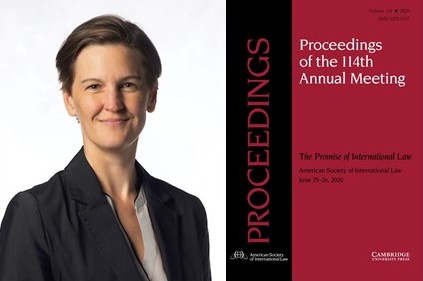
Melissa J. “MJ” Durkee, the Allen Post Professor here at the University of Georgia School of Law, has published an essay in the most recent volume of proceedings from an annual meeting of the American Society of International Law.
What role should non-state actors have in the work of international organizations? It is particularly fitting that this panel is titled “between participation and capture,” because the phrase calls up the conflicting values that animate this question. When we think of non-state actors “participating” in the work of international organizations, we think about open, transparent organizations that are receiving the benefit of diverse perspectives and expertise. We may associate this phrase with process, access, and legitimacy in governance. On the other hand, when we think about non-state actors “capturing” the agenda of international organizations, we have a conflicting set of mental images: we imagine corruption, mission-drift, and the erosion of legitimacy in global governance. Openness is both valuable and dangerous.
The clinics’ project confronted abuse of immigrant women while in the custody of U.S. Immigration and Customs Enforcement (ICE) at the Irwin Detention Center, a privately run facility in south Georgia. As previously posted, the women there were subjected to nonconsensual, medically unindicated, or invasive gynecological procedures. Those who spoke out about abuses faced accelerated deportation proceedings, solitary confinement, and other acts of retaliation. The project has pursued several administrative, judicial, and advocacy avenues, including ongoing litigation of Oldaker v. Giles, a consolidated habeas petition and class action complaint filed in the U.S. District Court for the Middle District of Georgia.
The Project’s efforts have resulted in the release of nearly all 80 women in ICDC, as well as over 200 men, and stays of deportation for most of the Oldaker plaintiffs.
Leading the project on behalf of Georgia Law were Jason Cade (above right), Associate Dean for Clinical Programs & Experiential Learning, J. Alton Hosch Professor of Law, and Director of the Community HeLP Clinic, and Clare Norins (above left), Clinical Assistant Professor and Director of the First Amendment Clinic. Also taking part in this team effort were 3L students Raneem Ashrawi, Frederick King, Julia Griffis, and Anish Patel, 2L students Thomas Evans, Paige Medley, and Davis Wright, First Amendment Clinic Legal Fellow Samantha Hamilton, Community HeLP Clinic Staff Attorney Kristen Shepherd, and administrative associate Sarah Ehlers.
Other collaborators included non-profits, private firms, legislative advocates, and community organizers.
Diane Marie Amann, the Emily & Ernest Woodruff Chair in International Law and Dean Rusk International Law Center Faculty Co-Director here at the University of Georgia School of Law, recently took part in an online panel entitled “International Courts and Their Role in Cross-Border Criminal Prosecutions.”
The panel was one of several at the 2021 symposium of the George Washington University International Law Review, which considered international law and policy challenges created by global technological and physical shifts.
Joining Amann, who is also the Special Adviser to the International Criminal Court Prosecutor on Children in & affected by Armed Conflict, in the roundtable discussion were: Olympia Bekou, Professor of Public International Law and Head of the University of Nottingham School of Law; and Patricia Viseur Sellers, Special Advisor for Gender for the Office of the Prosecutor of the International Criminal Court, Visiting Fellow, Kellogg College, University of Oxford, and Practicing Professor, London School of Economics. Moderator was Michael J. Matheson, Adjunct Professor at GW Law.
“Economics and security seem increasingly intertwined. Citing national security, states subject foreign investments to new scrutiny, even unwinding mergers. The provision of 5G has become a diplomatic battleground—Huawei at its center. Meanwhile, states invoke national security to excuse trade wars. The USA invoked the General Agreement on Tariffs and Trade national security exception to impose steel and aluminum tariffs, threatening more on automotive parts. Russia invoked that provision to justify its blockade of Ukraine, as did Saudi Arabia and the United Arab Emirates to excuse theirs of Qatar. And with the spread of COVID-19, states are invoking national security to scrutinize supply lines. Multiplying daily, such stories have led some observers to dub the era one of geoeconomics.
“Nonetheless, these developments remain difficult to judge, and the relationship between economics and national security remains confused and slippery. The essay seeks clarity in the deeper logic of these labels, revealing a fundamental choice between the logics of markets and the logics of state. Whether invoked to ‘secure’ borders, privacy, health, the environment, or jobs, ‘national security’ is a claim about the proper location of policymaking. Appeals to economics, with their emphasis on global welfare and global person-to-person relationships, are such claims as well. Resolving disputes, this essay argues, requires recognizing these root choices.”
► Superb members of the law faculty, including: Dean Peter B. “Bo” Rutledge, an international arbitration expert; our Center’s Interim Director, Lori A. Ringhand, a scholar of comparative constitutional law and elections law; the Center’s Faculty Co-Directors, Professors Diane Marie Amann, an expert in security governance fields including the laws of war and international criminal justice, and Harlan G. Cohen, an expert in global governance and foreign relations law; Professors Melissa J. “MJ” Durkee, whose expertise includes international business law and international environmental law, Christopher M. Bruner, a comparative corporate governance scholar, Thomas E. Kadri, whose expertise includes cybercrime and global data privacy, Jason A. Cade, an immigration expert, Jonathan Peters, a journalism and law professor expert in international media and free speech, Anne Burnett, foreign and international law librarian, Elizabeth Weeks and Fazal Khan, health law specialists, Kent Barnett, Sonja West, and Elizabeth Chamblee Burch, who have presented overseas on administrative law, media law, and civil procedure, respectively, Walter Hellerstein, a world-renowned tax specialist, Nathan S. Chapman, a scholar of due process and extraterritoriality, Michael L. Wells, a European Union scholar, and Andrea Dennis, whose book “Rap on Trial” has garnered international media attention.
► Talented students pursuing JD, MSL, and LLM degrees, including: the staffers and editors of the Georgia Journal of International and Comparative Law who produce one of the country’s oldest student journals, and who led our January 2021 conference, “The Future of Global Healthcare Governance”; the advocates on our Willem C. Vis International Commercial Arbitration Moot and Philip C. Jessup International Law Moot Court teams; students in our Appellate Litigation Clinic who argue asylum cases before U.S. Courts of Appeals; participants in our full-semester NATO Externship and in our Global Externships; and the student leaders of our International Law Society.
► Academics, practitioners, and policymakers, from all over the world, who have contributed to our events – conferences, workshops, and lectures, as well as our International Law Colloquium and Consular Series.
► Graduates who excel as partners in international commercial law firms, as heads of nongovernmental organizations and international organizations, as in-house counsel at leading multinational enterprises, and as diplomats and public servants – and who give back through mentoring and other support.
With thanks to all, we look forward to continue strengthening our initiatives in international, comparative, transnational, and foreign relations law – not least, in the preparation of Georgia Law students to practice in our 21st C. globalized legal profession.
Georgia Law 3L Maddie Conkel argued on behalf of the petitioner in Case No. 19-15144, Denis Aguilera Fernandez v. Garland. On account of the Covid-19 pandemic, Conkel’s argument was delivered online to a panel composed of Eleventh Circuit Judges William H. Pryor Jr., Jill A. Pryor, and Ed Carnes (audio here).
In earlier proceedings both the Immigration Judge and the Board of Immigration Appeals agreed that the Clinic’s client – whom Cuban police had detained and beaten repeatedly over two years in an effort to prevent him from protesting the Cuban government – was “thoroughly credible.” They further agreed that his mistreatment, though “severe and regrettable,” did not rise to the level of “persecution,” and that he had no reasonable fear of future persecution.
Conkel’s argument sought reversal of the resulting denials of asylum and withholding of removal. Georgia Law 3L Sarah Nelson helped Conkel prepare for the argument, and several other students helped the Clinic brief the case.





 The U.S. Court of Appeals for the Eleventh Circuit heard arguments this week in an asylum and immigration case prepared by a team of students in the
  exchange of notes