
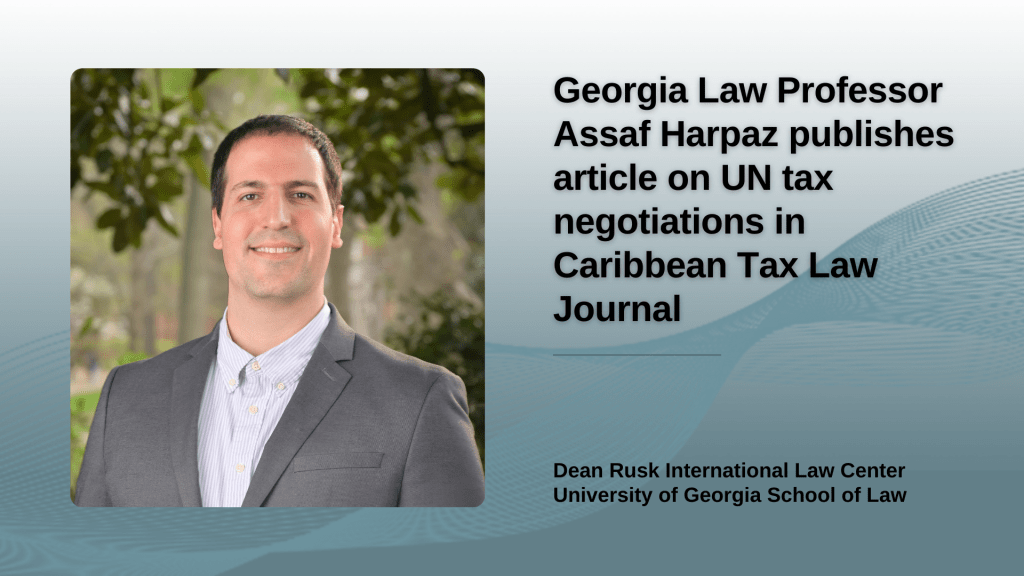
University of Georgia School of Law Professor Assaf Harpaz published the article “UN Tax Negotiations: North–South Tensions and the Challenge of Institutional Legitimacy” for the Caribbean Tax Law Journal special issue on international tax cooperation at the United Nations.
The article abstract can be found below:
The drafting process for a United Nations Framework Convention on International Tax Cooperation, along with two early protocols, is now underway. A UN framework convention represents a Global South effort to shift international tax policymaking from the OECD to the UN. For developing countries, the UN has long been viewed as a more inclusive space for tax policy negotiations, producing more favorable but historically less influential standards compared to the OECD.
Support for the UN framework convention, including its terms of reference, has been sharply divided across traditional Global North-South lines. The backlash following the OECD’s recent two-pillar reform triggered the UN initiative, as Global South countries quickly turned to the UN to begin a new chapter in cross-border taxation. Nonetheless, the UN framework convention faces an uphill battle as the Global North and South fundamentally diverge on questions of choice of forum, tax principles, and the desired scope of the convention. The U.S.’s recent withdrawal from the UN negotiation process casts further doubt on the institution’s capacity to achieve universality and compete with the OECD for the informal title of “World Tax Organization.
This article examines the ongoing UN tax negotiations, focusing on the Global North-South tensions and the historical context of the UN forum shift. It argues that the North-South divide remains a barrier to garnering institutional legitimacy, potentially undermining the framework convention’s viability.
Harpaz joined the University of Georgia School of Law as an assistant professor in summer 2024 and teaches classes in federal income tax and business taxation. Harpaz’s scholarly focus lies in international taxation, with an emphasis on the intersection of taxation and digitalization. He explores the tax challenges of the digital economy and the ways to adapt 20th-century tax laws to modern business practices.
 exchange of notes