Georgia Law Professor Diane Marie Amann publishes “Child-Taking” in Michigan Journal of International Law

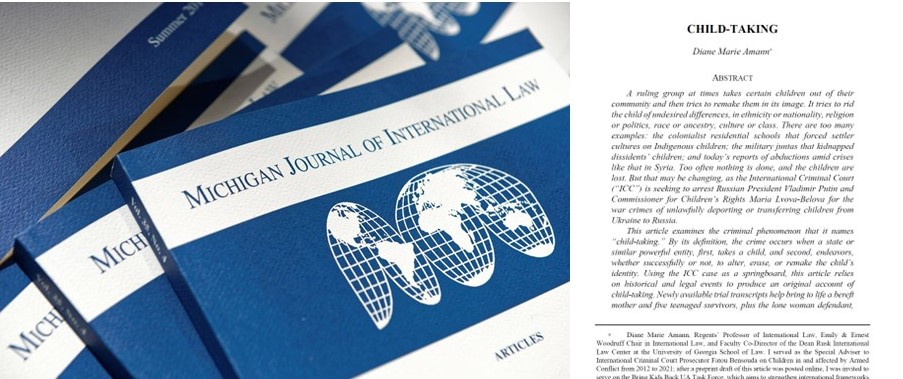
“Child-Taking,” an article by University of Georgia School of Law Professor Diane Marie Amann, has just been published at 45 Michigan Journal of International Law 305-79 (2024).

As theorized in the article, “child-taking” occurs when a state or similar powerful entity takes a child and then endeavors to alter, erase, or remake the child’s identity. It is a criminal phenomenon that has been repeated across decades and centuries. On rare occasion, criminal prosecutions have occurred, as with the Situation in Ukraine before the International Criminal Court. More often redress, if any, must take place in other forums. The article thus considers these other types of transitional justice, with particular attention to the legacies of forced residential schooling imposed upon Indigenous children in the United States, Canada, and elsewhere.

Amann presented aspects of this research at numerous venues, including King’s College London, Yale University, the University of Cambridge, University College London, and the American Society of International Law Annual Meeting.

Amann is Regents’ Professor of International Law, Emily & Ernest Woodruff Chair in International Law, and a Faculty Co-Director of our Dean Rusk International Law Center here at Georgia Law. She served from 2012 to 2021 as International Criminal Court Prosecutor Fatou Bensouda’s Special Adviser on Children in & affected by Armed Conflict.

Here’s the abstract of the “Child-Taking” article, the print version of which is available here:

A ruling group at times takes certain children out of their community and then tries to remake them in its image. It tries to rid the child of undesired differences, in ethnicity or nationality, religion or politics, race or ancestry, culture or class. There are too many examples: the colonialist residential schools that forced settler cultures on Indigenous children; the military juntas that kidnapped dissidents’ children; and today’s reports of abductions amid crises like that in Syria. Too often nothing is done, and the children are lost. But that may be changing, as the International Criminal Court (“ICC”) is seeking to arrest Russian President Vladimir Putin and Commissioner for Children’s Rights Maria Lvova-Belova for the war crimes of unlawfully deporting or transferring children from Ukraine to Russia.

“This article examines the criminal phenomenon that it names ‘child-taking.’ By its definition, the crime occurs when a state or similar powerful entity, first, takes a child, and second, endeavors, whether successfully or not, to alter, erase, or remake the child’s identity. Using the ICC case as a springboard, this article relies on historical and legal events to produce an original account of child-taking. Newly available trial transcripts help bring to life a bereft mother and five teenaged survivors, plus the lone woman defendant, who testified at a little-known child-kidnapping trial before a postwar Nuremberg tribunal. Their stories, viewed in the context of the evolution of international child law, inform this article’s definition. These sources further reveal child-taking to be what the law calls a matter of international concern. At its most serious, child-taking may constitute genocide or another crime within the ICC’s jurisdiction. Yet even if circumstances preclude punishment in that permanent criminal court, child-taking remains a grave offense warranting prosecution or other forms of local and global transitional justice. This is as true for the Indigenous children of residential schools in North America, Australia, and elsewhere, and for children in Syria and many other places in the world, as it is for the children of Ukraine.
Georgia Law Professor Amann presents “Child-Taking” at Forced Separation Workshop in London

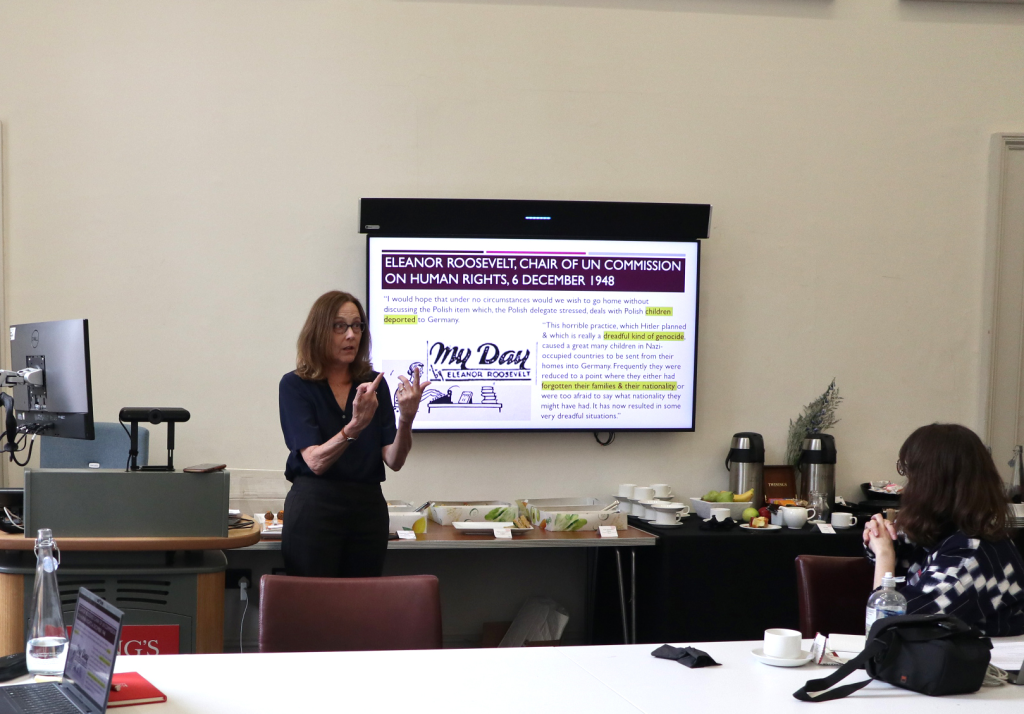
Professor Diane Marie Amann recently presented her research on “Child-Taking” during a Forced Separation Workshop at King’s College London, which cosponsored the event along with Queen’s University Belfast School of Law and the UK Gender, Justice and Security Hub.

Organizers of the workshop – Professor Fionnuala Ni Aolain, Dr. Rebekka Friedman, and Dr. Diana Florez – brought together a global array of participants who engaged in a multidisciplinary exploration of instances and consequences of separating families. Studied were contemporary and historical contexts across the globe. They included: armed conflict and similar violence; security, carceral, and migration detention; coerced schooling; enslavement; and illegal adoptions.

Amann’s talk drew from her article, “Child-Taking,” soon to be published in the Michigan Journal of International Law. (Preprint draft available at SSRN.) As Amann theorizes it, child-taking occurs when a state or similarly powerful entity abducts children from their community and then endeavors to remake the children in its own image. This conduct, involving children taken from Ukraine, lies at the heart of the International Criminal Court warrants pending against President Vladimir Putin and another top Russian official. The article also examines other examples of the phenomenon, including the Nazis’ kidnappings of non-German children during World War II and the forced placement of Indigenous children into boarding schools in North America, Australia, and elsewhere.

Amann is Regents’ Professor of International Law, Emily & Ernest Chair in International Law, and Faculty Co-Director of the Dean Rusk International Law Center here at the University of Georgia School of Law. She writes and teaches in areas including child and human rights, constitutional law, transnational and international criminal law, and global legal history.   

Georgia Law Professor Amann presents “Child-Taking” at Yale University

Professor Diane Marie Amann recently presented her research on “Child-Taking” as a guest lecturer in a course on the Russo-Ukrainian War taught at Yale University this semester. Students from Yale’s law school, management school, and school of global affairs comprise the class, which is taught by Yale Law Professor Eugene R. Fidell and Margaret M. Donovan.

Amann is Regents’ Professor of International Law, Emily & Ernest Chair in International Law, and Faculty Co-Director of the Dean Rusk International Law Center here at the University of Georgia School of Law. She writes and teaches in areas including child and human rights, constitutional law, transnational and international criminal law, and global legal history.

Amann’s online guest lecture drew from her article, “Child-Taking,” soon to be published in the Michigan Journal of International Law. (Preprint draft available at SSRN.) As Amann theorizes it, child-taking occurs when a state or similarly powerful entity abducts children from their community and then endeavors to remake the children in its own image. This conduct, involving children taken from Ukraine, lies at the heart of the International Criminal Court warrants pending against President Vladimir Putin and another top Russian official. The article also examines other examples of the phenomenon, including the Nazis’ kidnappings of non-German children during World War II and the forced placement of Indigenous children into boarding schools in North America, Australia, and elsewhere.

Amann also has presented this scholarship at meetings of the American Society of International Law and at University College London Faculty of Laws and King’s College London Department of War Studies.

UGA Law Professor Amann presents “Child-Taking” scholarship at British universities in Cambridge and London

University of Georgia School of Law Professor Diane Marie Amann, whose expertise includes child rights, international criminal law, and global legal history, recently discussed her research on “child-taking” at two universities in the United Kingdom.

At the end of September Amann – who is Regents’ Professor of Law, Emily & Ernest Woodruff Chair in International Law, and Faculty Co-Director of the Dean Rusk International Law Center – presented “Child-Taking and Human Rights Law” at the 2023 European Human Rights Law Conference. Entitled “Human Rights Law: Prospects, Possibilities, Fears & Limitations,” the two-day conference took place at the University of Cambridge Faculty of Law.

Last week, she gave a public lecture on “Child-Taking in International Criminal Law” at King’s College London Department of War Studies.

Both talks drew from Amann’s forthcoming article, “Child-Taking,” to be published in the Michigan Journal of International Law.

As Amann theorizes it, child-taking occurs when a state or similarly powerful entity abducts children from their community and then endeavors to remake the children in its own image. This conduct lies at the heart of the International Criminal Court warrants pending against President Vladimir Putin and another top Russian official. The article also examines other examples of the phenomenon, including the Nazis’ kidnappings of non-German children during World War II and the forced placement of Indigenous children into boarding schools in North America, Australia, and elsewhere.