University of Georgia School of Law Professor Diane Marie Amann recently gave an online lecture entitled “Justice for Child-Taking and Other Crimes against and affecting Children” as part of “International Criminal Law, Conflict Resolution and Transitional Justice,” the week-long 24th Specialization Course in International Criminal Law for Young Penalists, held in Sicily, at the Siracusa International Institute for Criminal Justice and Human Rights, Italy.
Amann is Regents’ Professor of International Law, Emily & Ernest Woodruff Chair in International Law, and a Faculty Co-Director of our Dean Rusk International Law Center here at Georgia Law. Her Siracusa lecture drew upon her expertise on children, violence, conflict, and justice. Her most recent publication in this field is “Child-Taking,” 45 Michigan Journal of International Law 305 (2024); all her related publications are available here.
University of Georgia School of Law Professor Diane Marie Amann spoke at last week’s Nuremberg Forum 2024, the annual three-day meeting of the International Nuremberg Principles Academy. It was held in the Nuremberg, Germany, courtroom where hundreds of Nazi defendants were tried in the wake of World War II.
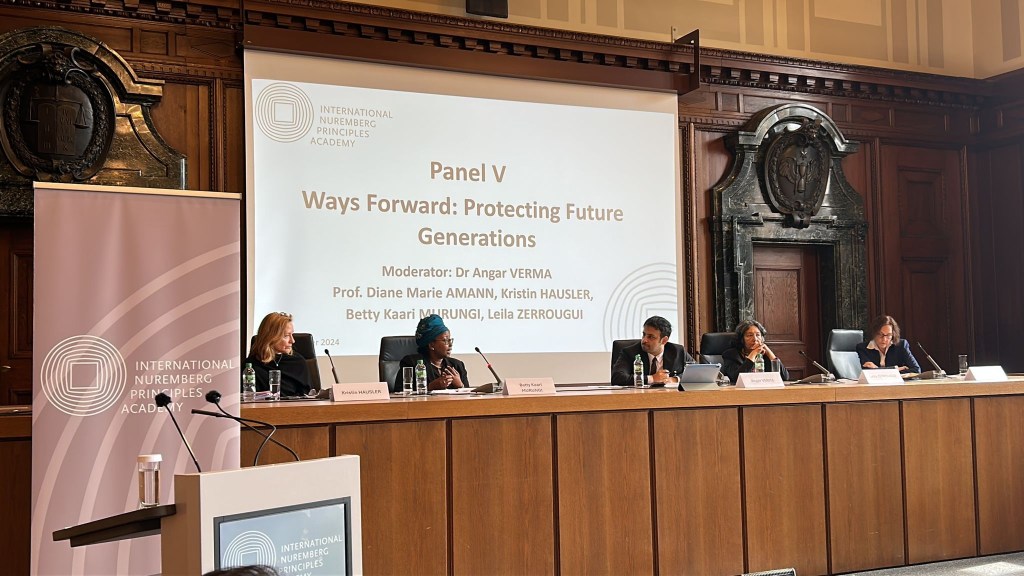
The theme of this year’s Forum was “For Every Child: Protecting Children’s Rights in Armed Conflict.” Amann spoke on the closing panel, “Ways Forward: Protecting Future Generations,” pictured above. She is pictured at right along with, l to r: Kristin Hausler; Betty Kaari Murungi; moderator Angar Verma; and Leila Zerrougui.
Amann gave an overview of her new article “Child-Taking,” 45 Michigan Journal of International Law 305 (2024), with focus on forced residential schooling of Indigenous children. As theorized in the article available here, child-taking occurs when a state or similar powerful entity takes a child and then endeavors to alter, erase, or remake the child’s identity. Though a criminal phenomenon, it may be redressed not only in criminal justice systems, but also through transitional justice mechanisms.
Amann is Regents’ Professor of International Law, Emily & Ernest Woodruff Chair in International Law, and a Faculty Co-Director of our Dean Rusk International Law Center here at Georgia Law. She served from 2012 to 2021 as International Criminal Court Prosecutor Fatou Bensouda’s Special Adviser on Children in & affected by Armed Conflict. This fall, she is spending a research-intensive semester in the United Kingdom, where she is a Research Visitor at the Oxford Faculty of Law Bonavero Institute of Human Rights.
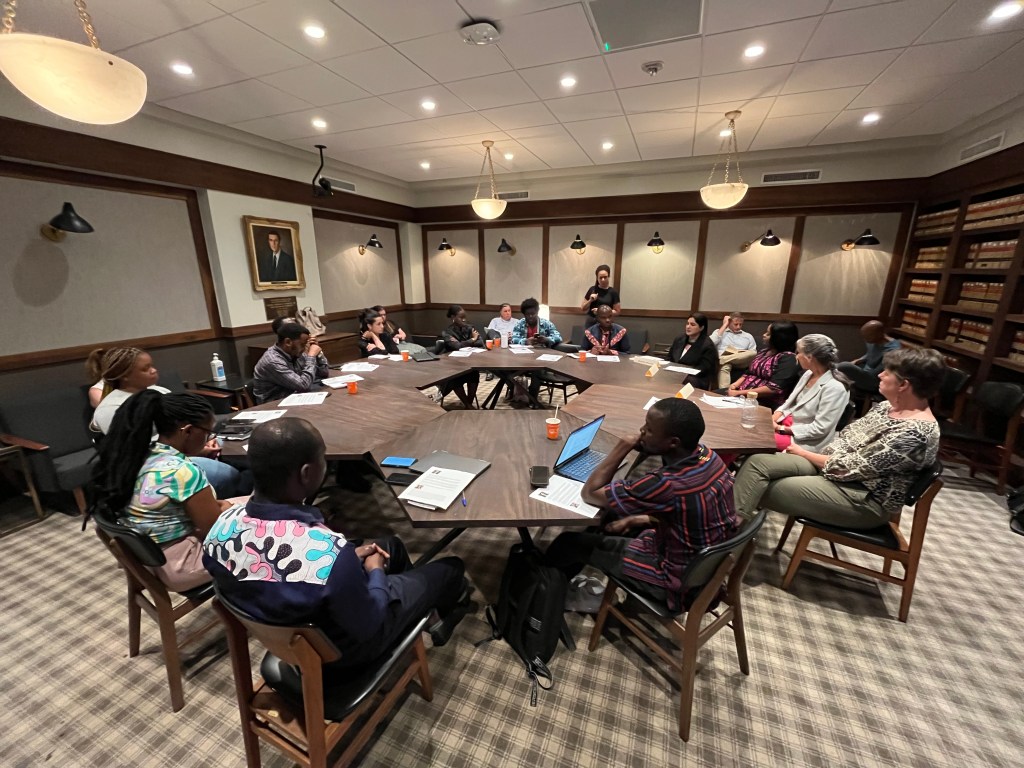
The 10 Fellows in attendance have work experience in anti-human trafficking, advocacy for women and girls, human rights, and refugee and victim assistance, among other topics. A total of 10 countries were represented in this group: The Republic of Congo, Ethiopia, Mali, South Africa, Zambia, Zimbabwe, Kenya, Burkina Faso, Uganda, and the Ivory Coast.
Scartz, Prittie, and Lartey began the roundtable by discussing their respective backgrounds and work, and then answered the Fellows’ questions. This is the second year that the law school has hosted a group of Fellows.
The Mandela Washington Fellowship for Young African Leaders is the flagship program of the U.S. government’s Young African Leaders Initiative (YALI) and sponsored by the U.S. Department of State. Since 2014, nearly 4,200 young leaders from every country in Sub-Saharan Africa have participated in the Fellowship. Mandela Washington Fellows, between the ages of 25 and 35, are accomplished innovators and leaders in their communities and countries.
Professor Diane Marie Amann recently was featured in Expresso, a newspaper based in Lisbon, Portugal, regarding efforts to hold Russian officials accountable for the war in Ukraine.
Reviewing various obstacles to these efforts, Tribuna quoted Amann as follows (in translation):
“One question, obviously, is whether this court will be able to arrest the accused leaders,” acknowledges Diane Marie Amann. Still, she points out, “this is a challenge in all criminal cases, and the magnitude of the challenge should not impede the effort to ensure justice.”
Recalling the March 17, 2023, arrest warrants issued by the International Criminal Court against Russian President Vladimir Putin and his Children’s Rights Commissioner Maria Lvova-Belova (about which Amann has written here), Tribuna wrote:
Although neither has been detained – which highlights the challenge that any legal system faces when trying to guarantee justice while the conflict is ongoing – the decision had effects, considers Amann. “It raised public awareness about the criminal allegations and encouraged states and civil society actors to call for the return of children.”
Amann is Regents’ Professor of International Law, Emily & Ernest Chair in International Law, and Faculty Co-Director of the Dean Rusk International Law Center here at the University of Georgia School of Law. She writes and teaches in areas including transnational and international criminal law, child and human rights, constitutional law, and global legal history.
University of Georgia School of Law Professor Diane Marie Amann, whose expertise includes child rights, international criminal law, and global legal history, recently discussed her research on “child-taking” at two universities in the United Kingdom.
At the end of September Amann – who is Regents’ Professor of Law, Emily & Ernest Woodruff Chair in International Law, and Faculty Co-Director of the Dean Rusk International Law Center – presented “Child-Taking and Human Rights Law” at the 2023 European Human Rights Law Conference. Entitled “Human Rights Law: Prospects, Possibilities, Fears & Limitations,” the two-day conference took place at the University of Cambridge Faculty of Law.
Both talks drew from Amann’s forthcoming article, “Child-Taking,” to be published in the Michigan Journal of International Law.
As Amann theorizes it, child-taking occurs when a state or similarly powerful entity abducts children from their community and then endeavors to remake the children in its own image. This conduct lies at the heart of the International Criminal Court warrants pending against President Vladimir Putin and another top Russian official. The article also examines other examples of the phenomenon, including the Nazis’ kidnappings of non-German children during World War II and the forced placement of Indigenous children into boarding schools in North America, Australia, and elsewhere.




 exchange of notes