Georgia Law Professor Nathan S. Chapman presents at international symposium in Italy

University of Georgia School of Law Professor Nathan S. Chapman presented “Christianity, Natural Rights, and Early American Constitutionalism” as part of an interdisciplinary, international symposium titled Natural Rights Across Denominational Divides at the University of Notre Dame‘s campus in Rome, Italy during November. 

This symposium invited Catholic, Protestant, and Orthodox scholars to present and discuss papers debating and discussing the role of natural rights in their theological and legal traditions. The papers will be published in the American Journal of Jurisprudence (Oxford University Press).

Chapman currently serves as the law school’s associate dean for faculty development and holds the Cleveland Distinguished Chair of Law. He writes and teaches about constitutional law, especially constitutional rights, and law and religion. Most recently, he is the author, with Michael W. McConnell, of Agreeing to Disagree: How the Establishment Clause Promotes Religious Pluralism and Protects Freedom of Conscience (OUP, 2023).

Georgia Law Professor Nathan S. Chapman presents at Notre Dame Religious Liberty Summit in Dublin, Ireland

University of Georgia School of Law Professor Nathan S. Chapman presented “Adjudicating Religious Sincerity” at the Notre Dame Religious Liberty Summit in Dublin, Ireland.

From their website:

The fifth annual Notre Dame Religious Liberty Summit brought together the world’s leading defenders of religious liberty for conversation between religious leaders, scholars, and advocates about the future of religious liberty. The Summit’s theme at the 2025 Notre Dame Religious Liberty Summit is Political Authority, Civil Society, and Religious Freedom.

Over 100 leading scholars, faith leaders, and advocates gathered in Dublin, Ireland. During the three days of the summit, more than 20 speakers will participate in 6 panel discussions. Featured topics included:

  • Suppression of Religion in the Global South
  • Combating Religious Oppression by Powerful States
  • Threats to Civil Society – Religious Education
  • Threats to Civil Society – Religious Social Service Providers
  • Suppression of Religion in Hong Kong and China
  • Persecution of Christians Worldwide

Chapman currently serves as the law school’s associate dean for faculty development and holds the Cleveland Distinguished Chair of Law. He writes and teaches about constitutional law, especially constitutional rights, and law and religion. Most recently, he is the author, with Michael W. McConnell, of Agreeing to Disagree: How the Establishment Clause Promotes Religious Pluralism and Protects Freedom of Conscience (OUP, 2023).

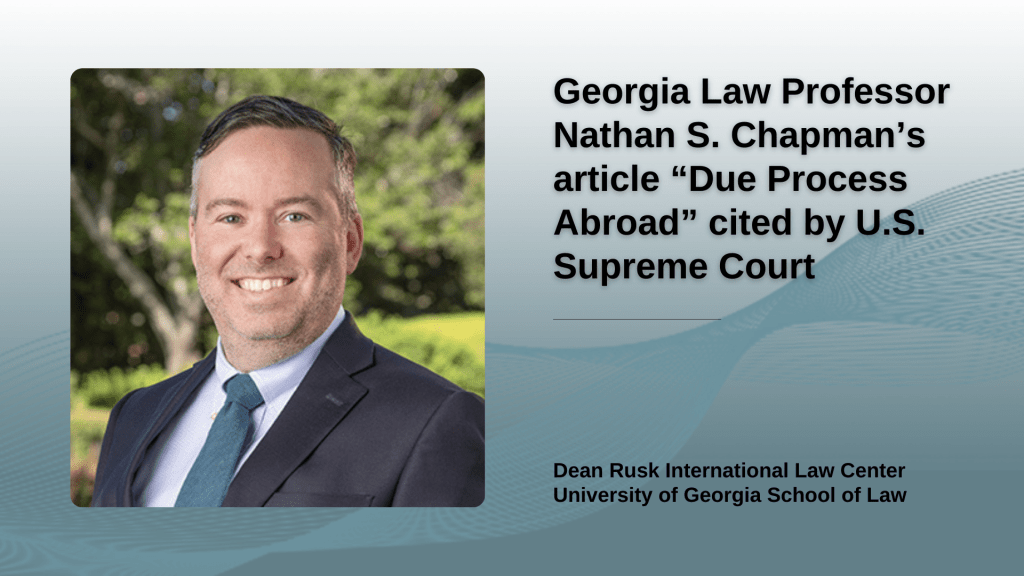
Georgia Law Professor Nathan S. Chapman’s article “Due Process Abroad” cited by U.S. Supreme Court

University of Georgia School of Law Professor Nathan S. Chapman’s articles “Due Process Abroad” (112 Northwestern University Law Review 377 (2017)) and “Due Process as Separation of Powers” (121 Yale Law Journal 1672 (2012) (with M.W. McConnell)) were cited by the U.S. Supreme Court in Fuid v. Palestine Liberation Organization.

Below is the abstract from “Due Process Abroad”:

Defining the scope of the Constitution’s application outside U.S. territory is more important than ever. In February, the Supreme Court heard oral argument about whether the Constitution applies when a U.S. officer shoots a Mexican teenager across the border. At the same time, federal courts across the country scrambled to evaluate the constitutionality of an Executive Order that, among other things, deprived immigrants of their right to reenter the United States. Yet the extraterritorial reach of the Due Process Clause—the broadest constitutional limit on the government’s authority to deprive persons of “life, liberty, or property”—remains obscure.

Up to now, scholars have uniformly concluded that the founding generation did not understand due process to apply abroad, at least not to aliens. This Article challenges that consensus. Based on the historical background, constitutional structure, and the early practice of federal law enforcement on the high seas, this Article argues that the founding generation understood due process to apply to any exercise of federal law enforcement, criminal or civil, against any person anywhere in the world. Outside the context of war, no one believed that a federal officer could deprive a suspect of life, liberty, or property without due process of law— even if the capture occurred abroad or the suspect was a noncitizen.

This history supports generally extending due process to federal criminal and civil law enforcement, regardless of the suspect’s location or citizenship. This principle has immediate implications for cross-border shootings, officially sponsored kidnappings and detentions abroad, the suspension of immigration benefits, and the acquisition of foreign evidence for criminal defendants.

Chapman currently serves as the law school’s associate dean for faculty development and holds the Cleveland Distinguished Chair of Law. He writes and teaches about constitutional law, especially constitutional rights, and law and religion. Most recently, he is the author, with Michael W. McConnell, of Agreeing to Disagree: How the Establishment Clause Promotes Religious Pluralism and Protects Freedom of Conscience (OUP, 2023).

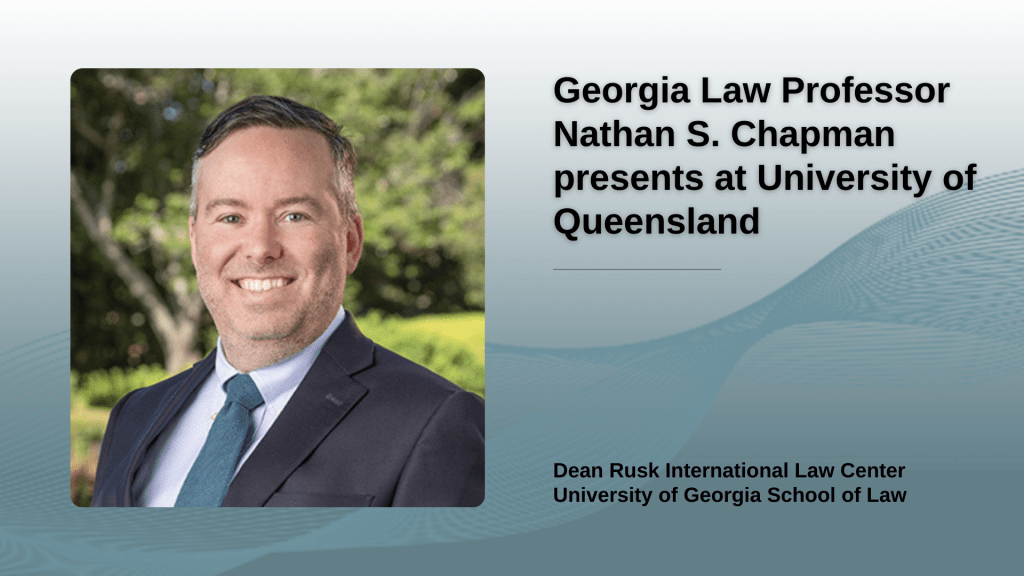
Georgia Law Professor Nathan S. Chapman presents at University of Queensland

University of Georgia School of Law Professor Nathan S. Chapman gave two presentations at the University of Queensland Law School in Brisbane, Australia this summer. He presented “Natural Law and Religious Liberty” at a faculty and student seminar, and “Fair Notice and Qualified Immunity” was presented at a faculty workshop.

Chapman received financial support to travel to the University of Queensland from the Dean Rusk International Law Center as a Rusk Scholar-in-Residence, an initiative promoting international opportunities for Georgia Law faculty that advance the mission of the Center.

Chapman currently serves as the law school’s associate dean for faculty development and holds the A. Gus Cleveland Distinguished Chair of Law. He writes and teaches about constitutional law, especially constitutional rights, and law and religion. Most recently, Chapman is the author, with Michael W. McConnell, of Agreeing to Disagree: How the Establishment Clause Promotes Religious Pluralism and Protects Freedom of Conscience (OUP, 2023).

Georgia Law hosts annual Georgia Journal of International and Comparative Law conference, “Defending Democracy: A Comparative Perspective”

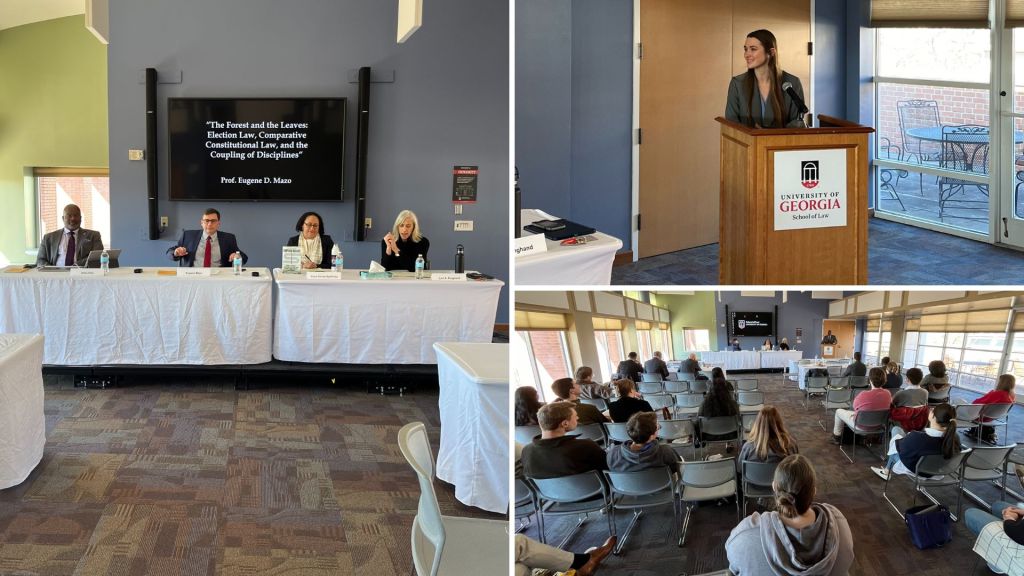
The annual conference of the University of Georgia School of Law’s Georgia Journal of International and Comparative Law, entitled “Defending Democracy: A Comparative Perspective,” took place last week.

As posted previously, this event brought together comparative law scholars from across the country to discuss a range of issues involving democracy, democratic backsliding, and comparative constitutional protections of democratic norms and institutions. Discussions included comparative lessons in “militant democracy,” the role of judges in defining or protecting democracy and democratic participation, democratic protections in the American constitutional system and how they differ from other nations, democracy and free speech, and lessons from recent elections around the world. University of Georgia School of Law Professor Lori A. Ringhand, J. Alton Hosch Professor of Law & Josiah Meigs Distinguished Teaching Professor, worked with GJICL students to conceptualize the conference theme and panels.

The panels from the conference are outlined below:

Panel 1: Democracy and Institutional Legitimacy: Panelists included Richard Albert, Hines H. Baker and Thelma Kelley Baker Chair in Law, University of Texas at Austin School of Law; Zachary Elkins, Professor, University of Texas at Austin; and moderator Taher S. Benany, Associate Director, Dean Rusk International Law Center, University of Georgia School of Law

Panel 2: Democratic Governance and Constitutional Design: Panelists included David E. Landau, Mason Ladd Professor and Associate Dean for International Programs, Florida State University College of Law; David S. Law, E. James Kelly, Jr., Class of 1965 Research Professor of Law, University of Virginia; Miguel Schor, Class of 1977 Distinguished Scholar and Professor of Law, Drake University Law School; and moderator Joseph S. Miller, Ernest P. Rogers Chair of Intellectual Property and Unfair Competition Law, University of Georgia School of Law

Panel 3: Individual Rights and Democratic Participation: Panelists included Ciara Torres-Spelliscy, Professor of Law, Stetson Law; Eugene D. Mazo, Associate Professor of Law, Duquesne University; Atiba Ellis, Laura B. Chisholm Distinguished Research Scholar and Professor of Law, Case Western Reserve School of Law; and moderator Lori A. Ringhand, J. Alton Hosch Professor of Law & Josiah Meigs Distinguished Teaching Professor, University of Georgia School of Law

Georgia Law Dean Usha R. Rodrigues, University Professor & M.E. Kilpatrick Chair of Corporate Finance and Securities Law, provided introductory remarks for the conference. Jasmine Furin, Editor in Chief, Georgia Journal of International and Comparative Law, gave a closing address. Professor Desirée LeClercq serves as the journal’s Faculty Adviser.

This event was cosponsored by the Dean Rusk International Law Center.

“Defending Democracy: A Comparative Perspective,” February 21 Georgia Journal of International and Comparative Law annual conference

This year’s annual conference of the Georgia Journal of International and Comparative Law will address “Defending Democracy: A Comparative Perspective.”

The daylong conference will take place on Friday, February 21 in the Larry Walker Room of Dean Rusk Hall at the University of Georgia School of Law.

Sponsoring along with GJICL, a student-edited journal established more than 50 years ago, is the law school’s Dean Rusk International Law Center. GJICL Editor in Chief, Jasmine Furin (J.D. ’25) and Executive Board members Logan Berg, Nina Dickerson, and Caleb Morris worked with Professor Lori A. Ringhand, J. Alton Hosch Professor of Law & Josiah Meigs Distinguished Teaching Professor; Center staff Sarah Quinn, Director; Catrina Martin, Global Practice Preparation Assistant; Taher S. Benany, Center Associate Director; and with the GJICL’s Faculty Advisor, Professor Desirée LeClercq, who is Assistant Professor of Law & Faculty Co-Director of the Dean Rusk International Law Center.

Below is the concept note of the conference:

Nations across the world are struggling to defend their institutions of democratic government. Voters are dissatisfied with how their institutions are working, social media is changing how nations define and regulate political speech, and courts are struggling to understand their rule in policing constraints on the exercise of political power and protecting individual rights. 

This event brings together comparative law scholars from across the country to discuss a range of issues involving democracy, democratic backsliding, and comparative constitutional protections of democratic norms and institutions. Discussions may include comparative lessons in “militant democracy,” the role of judges in defining or protecting democracy and democratic participation, democratic protections in the American constitutional system and how they differ from other nations, democracy and free speech, and lessons from recent elections around the world. 

The day’s events are as follows:

9:00-9:15am | Welcome Messages

Usha Rodrigues, Dean, University Professor & M.E. Kilpatrick Chair of Corporate Finance and Securities Law

9:15-10:30am | Panel 1: Democracy and Institutional Legitimacy 

  • Richard Albert, Hines H. Baker and Thelma Kelley Baker Chair in Law, University of Texas at Austin School of Law 
  • Zachary Elkins, Professor, University of Texas at Austin 
  • Panel Moderator: Taher S. Benany, Associate Director, Dean Rusk International Law Center, University of Georgia School of Law

10:30-10:45am | Break

10:45-12:00pm | Panel 2: Democratic Governance and Constitutional Design

  • David E. Landau, Mason Ladd Professor and Associate Dean for International Programs, Florida State University College of Law
  • David S. Law, E. James Kelly, Jr., Class of 1965 Research Professor of Law, University of Virginia
  • Miguel Schor, Class of 1977 Distinguished Scholar and Professor of Law, Drake University Law School
  • Panel Moderator: Joseph S. Miller, Ernest P. Rogers Chair of Intellectual Property and Unfair Competition Law, University of Georgia School of Law

12:00-1:00pm | Lunch

1:00-2:15pm | Panel 3: Individual Rights and Democratic Participation

  • Ciara Torres-Spelliscy, Professor of Law, Stetson Law
  • Eugene D. Mazo, Associate Professor of Law, Duquesne University
  • Atiba Ellis, Laura B. Chisholm Distinguished Research Scholar and Professor of Law, Case Western Reserve School of Law 
  • Panel Moderator: Lori A. Ringhand, J. Alton Hosch Professor of Law & Josiah Meigs Distinguished Teaching Professor, University of Georgia School of Law

2:15 | Closing Remarks

Jasmine Furin, Editor in Chief, Georgia Journal of International and Comparative Law

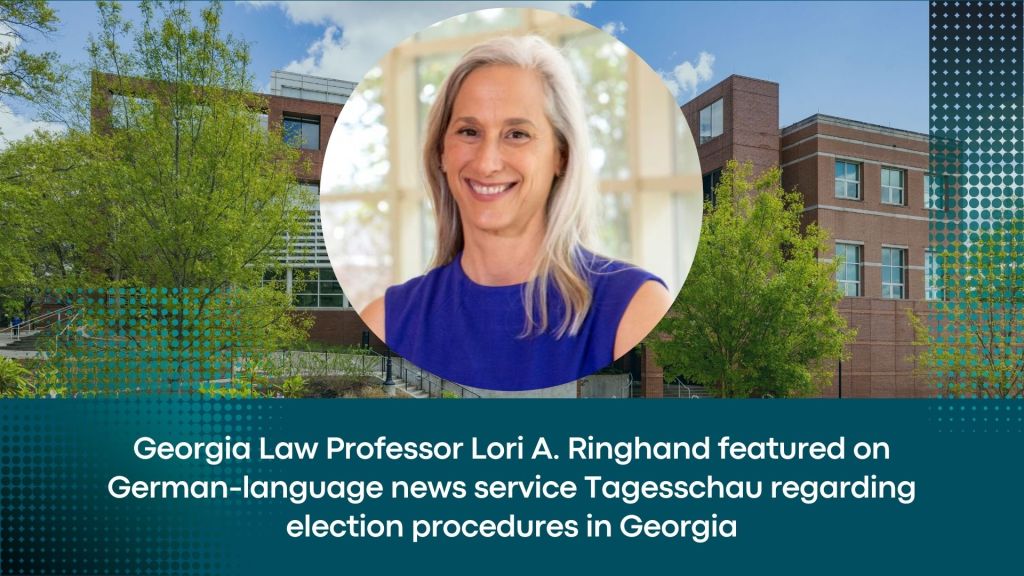
Georgia Law Professor Lori A. Ringhand featured on German-language news service Tagesschau regarding election procedures in Georgia

University of Georgia School of Law Professor Lori A. Ringhand was featured on the German-language news service Tagesschau regarding election procedures in Georgia. The article titled “Wahlhelfer mit ‘Panik-Knöpfen’” was reported by Ralf Borchard and published October 31, 2024.

Ringhand teaches courses on constitutional law and election law. She has been a member of the University of Georgia School of Law faculty since 2008 and was named a Hosch Professor in 2012 and awarded a Josiah Meigs Distinguished Professorship, UGA’s highest teaching honor, in 2021. She is a nationally known Supreme Court scholar and the author of two books about the Supreme Court confirmation process: Supreme Court Confirmation Hearings and Constitutional Change (with Paul M. Collins) published by Cambridge University Press; and Supreme Bias: Gender and Race in U.S. Supreme Court Confirmation Hearings, (with Christina L. Boyd and Paul M. Collins), published by Stanford University Press. She also is the co-author of Constitutional Law: A Context and Practices Casebook, which is part of a series of casebooks dedicated to incorporating active teaching and learning methods into traditional law school casebooks. Ringhand also publishes extensively on election law related issues, and was awarded a Fulbright Distinguished Chair Award at the University of Aberdeen in Scotland to explore the different approaches to campaign finance regulation taken by the United States and the United Kingdom.

Georgia Law Professor Amann presents “Child-Taking” at Yale University

Professor Diane Marie Amann recently presented her research on “Child-Taking” as a guest lecturer in a course on the Russo-Ukrainian War taught at Yale University this semester. Students from Yale’s law school, management school, and school of global affairs comprise the class, which is taught by Yale Law Professor Eugene R. Fidell and Margaret M. Donovan.

Amann is Regents’ Professor of International Law, Emily & Ernest Chair in International Law, and Faculty Co-Director of the Dean Rusk International Law Center here at the University of Georgia School of Law. She writes and teaches in areas including child and human rights, constitutional law, transnational and international criminal law, and global legal history.

Amann’s online guest lecture drew from her article, “Child-Taking,” soon to be published in the Michigan Journal of International Law. (Preprint draft available at SSRN.) As Amann theorizes it, child-taking occurs when a state or similarly powerful entity abducts children from their community and then endeavors to remake the children in its own image. This conduct, involving children taken from Ukraine, lies at the heart of the International Criminal Court warrants pending against President Vladimir Putin and another top Russian official. The article also examines other examples of the phenomenon, including the Nazis’ kidnappings of non-German children during World War II and the forced placement of Indigenous children into boarding schools in North America, Australia, and elsewhere.

Amann also has presented this scholarship at meetings of the American Society of International Law and at University College London Faculty of Laws and King’s College London Department of War Studies.

Georgetown Law Professor Cliff Sloan discusses “The Court at War” at Georgia Law

Georgetown Law Professor Cliff Sloan recently discussed his new book, The Court at War: FDR, His Justices, and the World They Made, in an event sponsored by the Dean Rusk International Law center here at the University of Georgia School of Law.

Sloan was joined in conversation by two of the law school’s professors: Nathan S. Chapman, Pope F. Brock Professor of Law; and Diane Marie Amann, who is Regents’ Professor of International Law, Emily & Ernest Woodruff Chair in International Law, and the Center’s Faculty Co-Director.

Below is a description of the book:

By the summer of 1941, in the ninth year of his presidency, Franklin Roosevelt had molded his Court. He had appointed seven of the nine justices—the most by any president except George Washington—and handpicked the chief justice.

But the wartime Roosevelt Court had two faces. One was bold and progressive, the other supine and abject, cowed by the charisma of the revered president.

The Court at War explores this pivotal period. It provides a cast of unforgettable characters in the justices—from the mercurial, Vienna-born intellectual Felix Frankfurter to the Alabama populist Hugo Black; from the western prodigy William O. Douglas, FDR’s initial pick to be his running mate in 1944, to Roosevelt’s former attorney general and Nuremberg prosecutor Robert Jackson.

The justices’ shameless capitulation and unwillingness to cross their beloved president highlight the dangers of an unseemly closeness between Supreme Court justices and their political patrons. But the FDR Court’s finest moments also provided a robust defense of individual rights, rights the current Court has put in jeopardy. Sloan’s intimate portrait is a vivid, instructive tale for modern times.

Sloan joined Georgetown – where he teaches constitutional law, criminal justice, and death penalty litigation – following a distinguished legal career, in all three branches of the federal government, at leading law firms, and in-house at the Washington Post.  He is also the author of The Great Decision: Jefferson, Adams, Marshall, and the Battle for the Supreme Court, a 2009 history of the Court’s foundational decision in Marbury v. Madison.

Immigrants and rights of free speech, free exercise of religion topic of Georgia Law Review symposium March 18

“Immigrants and the First Amendment: Defining the Borders of Noncitizen Free Speech and Free Exercise Claims” is the title of this year’s annual day-long symposium of the Georgia Law Review, to be held Friday, March 18, in hybrid format at the University of Georgia School of Law. Featured will be a keynote by immigrant activist Ravi Ragbir, the plaintiff in a high-profile federal lawsuit alleging retaliation for activism.

Here’s the concept note:

“Immigration law, as well as immigrant activism, are intersecting with the First Amendment in new and surprising ways. This year’s Georgia Law Review Symposium will bring together a diverse set of voices to discuss these exciting new crossovers, providing a forum to explore the nuances of the First Amendment’s scope as applied to immigrants, immigrant advocates, and potential immigrants outside of the country. This is an area of law that is becoming increasingly more topical, and many questions that arise from these areas remain unanswered or ambiguous.”

Details and registration here for the conference, which will take place in-person in the Larry Walker Room on the 4th floor of Georgia Law’s Dean Rusk Hall, and which also welcomes online attendees.

Following opening remarks at 9 a.m., panels will proceed as follows:

9:10-10:35 a.m., “Immigrant Speech and Government Retaliation”

“Despite being entitled to First Amendment rights, immigrants, particularly those without documentation, are highly vulnerable to government suppression of, or retaliation against, their exercise of free speech rights. Recent or ongoing cases in this area include Oldaker v. Giles in the Middle District of Georgia, which concerns first amendment claims brought on behalf of women alleging retaliation for medical abuse at an immigration detention center; and Ragbir v. Homan, which concerns the government’s retaliatory deportation of prominent immigrant rights activists.”

Speaking within that theme on this first panel of the morning will be: Alina Das, Professor of Clinical Law, New York University School of Law; Charles H. Kuck, Managing Partner of Kuck Baxter LLC, an immigration law firm in Atlanta, and an Adjunct Professor at Emory University School of Law; Daniel I. Morales, Associate Professor of Law and George A. Butler Research Professor, University of Houston Law Center; and Clare R. Norins, Clinical Assistant Professor and Director of the First Amendment Clinic at Georgia Law. Moderating will be Jason A. Cade, who is Associate Dean for Clinical Programs, Experiential Learning and J. Alton Hosch Associate Professor of Law, and Community Health Law Partnership Clinic Director at Georgia Law.

10:35 a.m.-12 noon, “Back to the Future: Immigrant Speech Rights Yesterday and Tomorrow”

“From John Lennon to Charlie Chaplin to many less famous immigrants, United States immigration history is riddled with deportation or exclusion decisions based on immigrants’ expression. Looking to the future, it is possible that constitutional free speech rights are best shored up by legislative and administrative solutions.”

Speaking within that theme on this last morning panel will be: Michael Kagan, Joyce Mack Professor of Law and Director of the Immigration Clinic at the William S. Boyd School of Law, University of Nevada-Las Vegas; Jennifer Koh, Associate Professor of Law and Co-Director of the Nootbaar Institute for Law at the Caruso School of Law, Pepperdine University, Malibu, California; Julia Rose Kraut, author of Threat of Dissent: A History of Ideological Exclusion and Deportation in the United States (Harvard University Press 2020); and Gregory P. Magarian, Thomas and Karole Green Professor of Law, Washington University in St. Louis School of Law. Moderating will be Jonathan Peters, Associate Professor of Journalism at the University of Georgia Grady College of Journalism and Mass Communications, who also holds a courtesy appointment on the Georgia Law faculty.

1-2:20 p.m., “The First Amendment’s Limits Abroad After Trump v. Hawaii: Free Exercise, Executive Power, and Justiciability”

“Trump v. Hawaii is the most recent high-profile iteration of immigration actions allegedly taken on the basis of religion. In addition to exploring first amendment issues respecting the religion of potential migrants, this panel will also cover issues relating to the differences in executive power as it pertains to potential immigrants as opposed to immigrants already on U.S. soil, as well as the difficulties associated with immigrants vindicating asserted constitutional rights from abroad.”

Speaking within that theme on this afternoon panel will be: Christopher Lund, Associate Dean for Research and Faculty Development and Professor of Law, Wayne State University Law School, Detroit, Michigan; Zachary Price, Professor of Law, University of California Hastings College of the Law; and Shalini Bhargava Ray, Associate Professor of Law, University of Alabama School of Law. Moderating will be Nathan S. Chapman, Pope F. Brock Associate Professor in Professional Responsibility at Georgia Law.

2:20-3:15 p.m., “Keynote Address” by Ravi Ragbir, followed by a closing reception.