Kobi Korankye: Ph.D. student in Philosophy, Franklin College of Arts and Sciences
Beatrice Robson: Ph.D. student in Agricultural and Applied Economics, College of Agricultural and Environmental Sciences
Uyiosa (“Uyi”) Ugiagbe: Ph.D. student in Mathematics Education, Mary Frances Early College of Education
All information about the Graduate Certificate in International Law, including upcoming application cycles and virtual information sessions, can be found here.
The International Law Colloquium, a time-honored tradition here at the University of Georgia School of Law, returns this spring semester with another great lineup of global legal experts.
In Spring 2025, this for-credit course is designed to introduce students to features of international economic law, broadly defined, through engagement with scholars in the international legal field. The course broadly defines “international economic law” to include traditional approaches (trade and investment agreements) as well as non-traditional, emerging approaches (examining the effects of IEL on marginalized communities and considering re-distributional policies). This course consists of presentations of substantial works-in-progress on a variety of international law topics by prominent scholars from other law schools. In keeping with a tradition established when the series began in 2006, students will write reaction papers on the scholars’ manuscripts, and then discuss the papers with the authors in class. Leading the class will be Desirée LeClercq, Assistant Professor of Law & Faculty Co-Director of the Dean Rusk International Law Center. Other Georgia Law faculty, including Diane Marie Amann and Christopher Bruner, will join in the dialogues.
Further supporting the colloquium are staff at our Center; in particular, the Center’s Global Practice Preparation team, which includes Catrina Martin and student workers Casey Smith (J.D. ’26) and Aubry Tedford (J.D. ’25). The colloquium further benefits from generous support from the Kirbo Trust Endowed Faculty Enhancement Fund and the Talmadge Law Faculty Fund.
Presenting at the Spring 2025 Colloquium (pictured above, clockwise from top left):
January 17: Harlan Cohen, Fordham University School of Law “The International Order, International Law, and the Definition of Security”
January 24: Luwam Dirar, Western New England University School of Law “Emancipation, Decolonization, and Gender in the Context of African Integration”
January 31: Diane Marie Amann, University of Georgia School of Law “Economies of Injustice and the Forced Residential-Schooling of Indigenous Americans”
February 7: Christopher Bruner, University of Georgia School of Law “Sustainable Corporate Governance and Prospects for a US Value Chain Due Diligence Law”
February 14: Katrin Kuhlman, Georgetown University School of Law “Micro International Law”
February 21: Olabisi D. Akinkugbe, Schulich School of Law “Trade and Development in an Era of Geopolitics: A Third World View”
February 28: Ben Heath, Temple University School of Law “Sanctions and Sanctuary: Refuge, Violence, and the Legal Ordering of (Economic) Warfare”
March 14: Weijia Rao, Boston University School of Law “Signaling through National Security Lawmaking”
March 21: Julian Arato, Michigan University School of Law “The Institutions of Exceptions”
April 4: Trang (Mae) Nguyen, Temple University School of Law “Goods’ Citizenship”
April 11: Rachel Brewster, Duke University School of Law “Global settlements in the Foreign Corrupt Practices Act”
April 18: Sarah Dadush, Rutgers Law School “Shared Responsibility in American Contract Law”
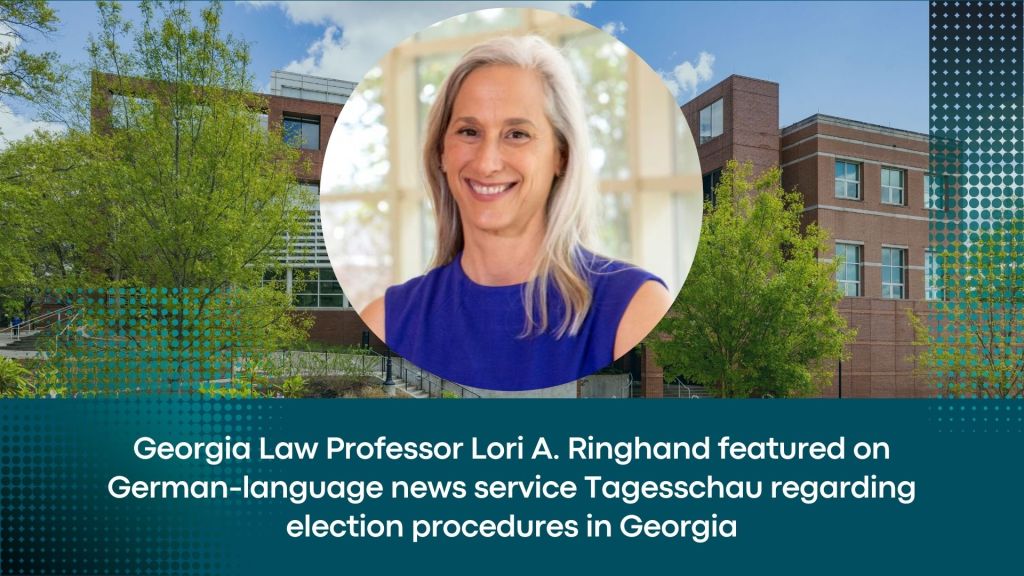
University of Georgia School of Law Professor Lori A. Ringhand was featured on the German-language news service Tagesschau regarding election procedures in Georgia. The article titled “Wahlhelfer mit ‘Panik-Knöpfen’” was reported by Ralf Borchard and published October 31, 2024.
Ringhand teaches courses on constitutional law and election law. She has been a member of the University of Georgia School of Law faculty since 2008 and was named a Hosch Professor in 2012 and awarded a Josiah Meigs Distinguished Professorship, UGA’s highest teaching honor, in 2021. She is a nationally known Supreme Court scholar and the author of two books about the Supreme Court confirmation process: Supreme Court Confirmation Hearings and Constitutional Change (with Paul M. Collins) published by Cambridge University Press; and Supreme Bias: Gender and Race in U.S. Supreme Court Confirmation Hearings, (with Christina L. Boyd and Paul M. Collins), published by Stanford University Press. She also is the co-author of Constitutional Law: A Context and Practices Casebook, which is part of a series of casebooks dedicated to incorporating active teaching and learning methods into traditional law school casebooks. Ringhand also publishes extensively on election law related issues, and was awarded a Fulbright Distinguished Chair Award at the University of Aberdeen in Scotland to explore the different approaches to campaign finance regulation taken by the United States and the United Kingdom.
University of Georgia School of Law Professor Christopher M. Bruner was featured on Law360 regarding opportunities for international law firms amid shifting geopolitical landscapes. The article titled “What’s Next For The Global Legal Market In 2025?” was written by Cara Bayles and published December 5, 2024.
From the article:
Shrinking markets may even present opportunities for firms that “lean into the geopolitical conflict,” by representing Chinese companies in contentious regulatory matters with the U.S., according to Christopher Bruner, a professor of business law and international law at the University of Georgia School of Law.
“What for one firm might pose risks in terms of how they operate in China, for another might present opportunities if they are helping companies navigate those choppy geopolitical waters,” he said.
Christopher M. Bruner is the Stembler Family Distinguished Professor in Business Law at the University of Georgia School of Law and serves as a faculty co-director of the Dean Rusk International Law Center.
Several University of Georgia School of Law students were involved in research and editing for the 13th edition of the 2024 Guide to Listing in Belgium, published earlier this year by a Georgia Law alumnus. This book provides an overview on the governance and regulatory landscape of listed companies in Belgium.
Johan Van den Cruijce (LL.M. ’94), Managing Director of Atlas Services Belgium, a company of the Orange group, co-authored the publication with his colleagues Nicolas Janssens de Bisthoven, Julie Van Opdenbosch, and Hilde Santens. Georgia Law students who have contributed to this version and to past editions include: Daniel “Tripp” Vaughn (J.D. ’25), Emina Sadic Herzberger (J.D., ’22), Starlyn Endres (J.D., ’22), and Alina Salgado (J.D., ’23).
Below is an abstract of the book:
The purpose of this Guide is to outline the specific issues and continuing obligations a listed company may be confronted with in Belgium. The point of reference for this Guide is the position of an issuer that is listed on a Belgian regulated market. A listing on a regulated market is subject to more conditions and triggers more ongoing obligations than a listing on any other trading venue. Insight into the organisation and functioning of a regulated market can thus ease the understanding of the regulatory framework of all other trading venues in Belgium.
This Guide deals with topics ranging from company law, corporate governance, finance and tax to opportunities for employee participation and the obligations and status of directors and executive managers. The Guide also covers the reasons and procedures for a possible de-listing, which is an issue that may become relevant to any listed company. Experience has shown that institutional investors and corporate governance rating agencies are keen to gain a deeper understanding of the rights and obligations of the various players that emerge in de-listing. This newly expanded 2024 edition also highlights the impact of important recent developments and insights in the fields of reporting, compliance, sustainability and valuation.
This Guideis conceived as a quick-reference document. All chapters can be consulted separately and the notes allow the reader to find additional information on the topics and issues discussed.
Profits from book sales will be donated to the Orange Belgium Fund, supporting projects that enhance digital inclusion in Belgium. This Fund is managed by the King Baudouin Foundation.
University of Georgia School of Law Professor Desirée LeClercq was recently featured in Inside US Trade regarding the U.S.-Mexico-Canada Agreement’s Rapid Response Mechanism (RRM) and how it may be used by the upcoming Trump administration.
University of Georgia School of Law Assistant Professor Desirée LeClercq…says a recent study she conducted with El Colegio de Sonora professor Alex Covarrubias-V and Cirila Quintero Ramirez, a research professor at El Colegio de Frontera Norte, Unidad Matamoros, suggests that the mechanism has disproportionately served a relatively narrow group of workers with ties to major U.S. unions and non-governmental organizations, without raising labor standards overall.
LeClercq, who was USTR’s director of labor affairs during President Trump’s first term, said she believes a second Trump administration, less beholden to such groups, might be incentivized to use the tool more broadly to try to improve labor standards that give Mexico an unfair competitive edge.
LeClercq joined the University of Georgia School of Law in 2024 as an assistant professor. She teaches International Trade and Workers Rights, International Labor Law, International Law and U.S. Labor Law, as well as the International Law Colloquium. She also serves as a faculty co-director of the Dean Rusk International Law Center and as the faculty adviser for the Georgia Journal of International and Comparative Law.
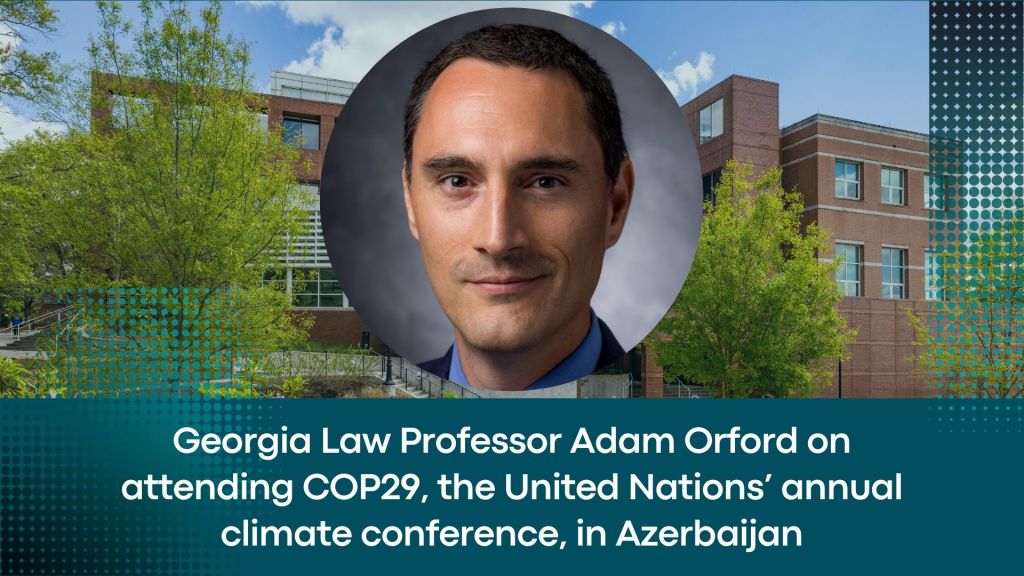
Adam D. Orford, Assistant Professor of Law at the University of Georgia School of Law, participated in the recent 29th Conference of Parties to the United Nations Framework Convention on Climate Change (COP29) in Baku, Azerbaijan. He served as an observer for the American Bar Association. Orford’s interdisciplinary research investigates legal and policy approaches to environmental protection, human health and well-being, and deep decarbonization of the U.S. economy. He also participates in collaborative research initiatives across the University of Georgia, including as lead of the Georgia element of the National Zoning Atlas and as a participant in investigations into the legal, political, environmental and social dimensions of new energy manufacturing and emerging carbon removal technologies.
In his guest post below, Orford summarizes the ABA’s role and the major outcomes at COP29. More detail on this issues can be found in the four COP primers he published at Environmental Law Prof Blog (here, here, here, and here).
ABA’s Role
I participated in COP29 as a delegate for the ABA, which has sent delegates to the climate COPs since 2021. This program followed a 2019 ABA resolution on climate change that urged
“federal, state, local, territorial, and tribal governments, and the private sector, to recognize their obligation to address climate change,”
and called on lawyers to
“engage in pro bono activities to aid efforts to reduce greenhouse gas emissions and adapt to climate change, and to advise their clients of the risks and opportunities that climate change provides.”
The focus of the ABA’s delegations has been to work with other national bar associations to educate the profession about the critical role that lawyers and law associations play in responding to climate change—an issue which may arise unexpectedly, in practices as diverse as environment and energy, human rights, corporate governance, personal injury, real estate development, trusts and estates, municipal management, international trade, and more.
Participating law associations have developed a Climate Registry that is posted on the International Bar Association’s website, providing ready tools to other lawyers and law associations for adopting climate resolutions and other guidance to address climate change. The ABA does not take positions on negotiating outcomes at the COPs, but its delegations work to assist ABA members in understanding the often complex climate COP processes and outcomes.
COP29 Outcomes
As part of my work, I tracked the progress of dozens of negotiations aimed at implementing commitments made by the parties to the UNFCCC and Paris Agreement. Here are some of the most significant outcomes of this year’s negotiations:
A contentious and chaotic COP
Azerbaijan, this year’s host and lead facilitator for the conference’s negotiations, came into COP29 with little climate leadership experience, and it often struggled to maintain trust among the parties.
From remarks praising fossil fuels to open the conference, to procedural maneuvering to achieve controversial results, to protests from many parties that they were not being sufficiency included in negotiations, to delays in the development and circulation of draft negotiating texts, to limited participation from civil society, to relatively disappointing outcomes on many important issues, COP29 highlighted just how difficult climate negotiations have become as the world has continued to warm and countries have fallen behind on taking necessary actions to abate their greenhouse gas emissions.
Disappointing climate finance commitments
This was the year that the parties were required to agree upon a so-called “New Quantified Collective Goal” for climate finance, meaning the amount of annual funding that wealthy developed countries are committed to “mobilizing” for the benefit of poorer developing countries. The prior commitment, $100 billion per year, had only ever been met once, and the actual need is estimated to exceed $1 trillion per year.
After two weeks of contentious debate that included developed countries pushing for expanding contributions from emerging economies and developing countries pushing for $1.3 trillion with a significant public finance component, developed countries only agreed to commit to achieving $300 billion per year—by 2035.
This result was so far below the developing country goals that at one point they walked out of the negotiations entirely in protest.
Procedural machinations to allow carbon credit trading
After years of controversy and delay, the parties at COP29 agreed to finalize the “Article 6 rulebook,” meaning the rules and definitions for international trade in carbon credits originally contemplated by the Paris Agreement in 2015. This outcome was achieved through an irregular procedure, however: A subsidiary implementing body had ratified the rules months before the COP and then provided them to the parties as a take-it-or-leave-it fait accompli. The parties did quickly agree to accept the new rules, but then developed lengthy further guidance intended to promote transparency and environmental integrity in the markets.
Backsliding on the commitment to transition away from fossil fuels
At last year’s COP28 in Dubai, all parties had agreed to include text indicating a goal to “transition away” from fossil fuels as part of the global climate response. However, major oil producers, including especially Saudi Arabia, have since backed away from this commitment, and they worked vigorously throughout COP29 to avoid repeating this language in any form at any point. This opposition nearly derailed several negotiations, and resulted in at least one item being deferred until COP30 next year.
In addition, although countries are supposed to submit their third voluntary climate action plans in February 2025, very few made firm commitments to reduce their climate emissions at COP29—a troubling change from the relatively robust pledges at prior COPs.
Leadership vacuum
COP29 began just days after the U.S. Presidential election. That election’s outcome will have major implications for the trajectory of United States, and therefore global, climate policy.
With the U.S. delegation largely unable to make credible future commitments, there was some speculation that this would provide an opportunity for China to take on a larger global leadership role, particularly in the development of low-carbon energy technologies necessary to respond to climate change. However, China’s most significant efforts at COP29 were quite different:
China opposed calls for it to join developed countries and make firm climate finance commitments; and
It pushed unsuccessfully to add international trade issues to the negotiating agenda.
With the world’s two largest greenhouse gas emitters both taking a back seat, global climate policy lacks clear leadership at a critical time. 2024 is likely to be the warmest year in human history; and 2025 is likely to be warmer still.
Nonetheless, the COP process remains the most important forum for developing international commitments to climate change response. While imperfect, the parties do continue to make progress—sometimes a little, sometimes a lot—every year.
Many parties are already pointing to the disappointing outcomes of COP29 as the basis for redoubling their efforts to strengthen commitments at future COPs. Next year’s COP30 will be held in Belém, Brazil.
Left: The ABA delegation included (from left to right) Uma Outka, law professor at the University of Kansas; Kamran Jamil, law clerk at SD California and co-chair of the ABA International Law Division young lawyers division; and Adam D. Orford, Assistant Professor at the University of Georgia School of Law. Top Right: COP29 plenary session with Mukhtar Babayev, Minister of Ecology and Natural Resources of the Azerbaijan Republic.
The international tax framework relies on early-twentieth-century principles and favors the interests of the Global North, which created it. It bases taxing rights on a corporation’s physical presence and mostly allocates profits to the country of residence. Moreover, it has been slow to adapt to modern business practices. In the digital economy, companies shift profits with relative ease and often do not require a physical presence in the location of their consumers. International taxation needs reform, but leading proposals do not reflect meaningful input from the Global South and are unlikely to serve the needs of developing countries.
In 2021, the Organisation for Economic Co-operation and Development (OECD), known informally as the “World Tax Organization,” introduced new rules for the cross-border taxation of multinational enterprises. The new rules intend to address the tax challenges of digitalization and profit-shifting, and they are likely the most significant change to international taxation in several decades. However, the OECD does not represent the interests of developing economies, and the proposed reform has not remedied the historic imbalance which disfavors the Global South.
This Article highlights the shortcomings of the OECD’s multilateral efforts in the context of taxation and digitalization. It analyzes the political lawmaking of the OECD and presents the new rules as a compromise that fails to address inequities in cross-border taxation. The Article argues that the reform undermines tax sovereignty and that the current international tax regime overlooks the involvement of the world’s developing countries. It asserts that attempts to promote inclusivity within the OECD have largely been expressive and that the international tax framework inherently disadvantages developing countries and their interests. The Article proposes steps to promote the equal-footed participation of developing countries in future international tax policy initiatives. First, it recommends expanding voting rights for non-members within the OECD. Second, it supports the creation of a new intergovernmental framework within the United Nations that is better positioned to revisit traditional international tax norms through a genuinely inclusive process.
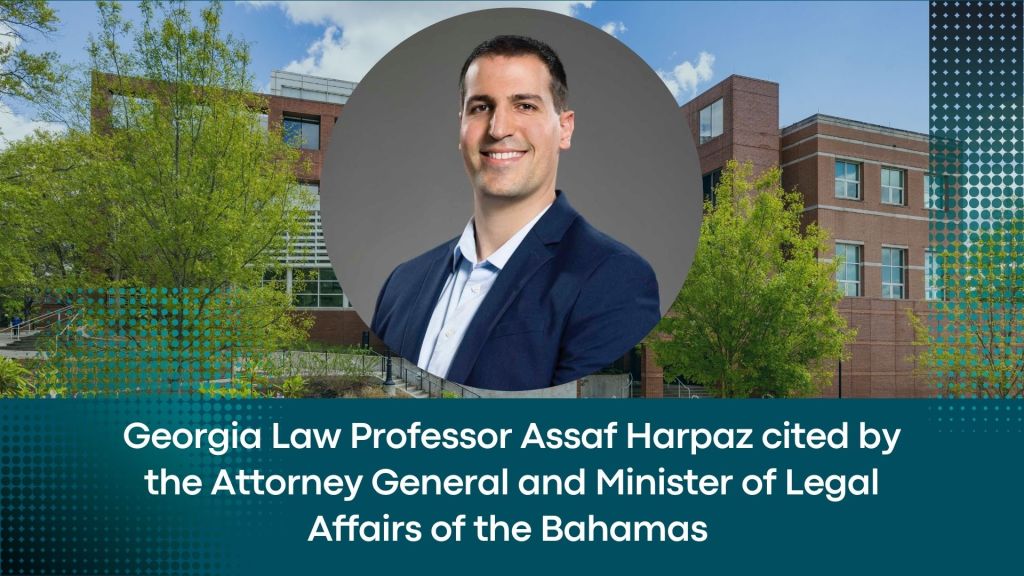
Assaf Harpaz joined University of Georgia School of Law as an assistant professor in summer 2024 and teaches classes in federal income tax and business taxation. Harpaz’s scholarly focus lies in international taxation, with an emphasis on the intersection of taxation and digitalization. He explores the tax challenges of the digital economy and the ways to adapt 20th-century tax laws to modern business practices.
Attendees included Samuel Kuo (LL.M. ’25) and Eman Mistry (J.D. ’25). Both students received a Louis B. Sohn Professional Development Fellowship to support their attendance of this conference. Awarded by the law school’s Dean Rusk International Law Center, Sohn Fellowships enable students to attend professional development opportunities related to international law.
Both Kuo and Mistry attended numerous panel discussions addressing a range of topics in international law. Kuo reflected on the experience, stating:
“I enjoyed the panel on the topic of disclosure in international arbitration moderated by Kelly Turner at the American Arbitration Association, featuring Dorothy Du from Motorola, Charles Kotuby from Three Crowns, Sarah Reynolds from Reynolds ADR and Javier Rubinstein from Rubinstein ADR LLC. The discussion centered upon the use of generative AI in international arbitration practice. All areas of the legal profession are preparing for ethical AI use, and it was refreshing to hear a discussion on whether parties should disclose the use of generative AI in anticipating arbitration.”
To read prior posts about prior recipients of Sohn Fellowships, please click here and here.







 exchange of notes