Georgia Law partners with the Washington International Trade Association to present webinar about careers in international trade 

In March, the University of Georgia School of Law partnered with the Washington International Trade Association (“WITA”) to present a webinar about careers in international trade and law. This webinar was part of WITA Academy’s ongoing Pathways to Opportunity Series: Careers in International Trade & Law, through which law students and undergraduates are able to learn about career opportunities in international trade and law from law firms and trade professionals. This webinar featured alumni/ae from Georgia Law and the university.

The webinar included:

  • Introductions from Diego Añez, Executive Director, WITA Academy; Managing Director, Washington International Trade Association and Kenneth I. Levinson, Chief Executive Officer, Washington International Trade Association
  • A panel discussion featuring:
    • Nancy Fischer, Global Head of Regulatory Practices, International Trade Partner, Pillsbury Winthrop Shaw Pittman LLP (B.B.A. The University of Georgia; J.D. Syracuse University College of Law)
    • Eric Heath, Senior Attorney Advisor, U.S. International Trade Commission (B.A. Lipscomb University; J.D. University of Georgia School of Law, LL.M. University of Edinburgh Law School)
    • Tina Termei, Director & Associate General Counsel, Amazon | Global Trade, Transportation, Logistics, & Supply Chain (B.A. Emory University; J.D. The University of Georgia School of Law)
  • Panel moderation from: Desirée LeClercq, Assistant Professor, University of Georgia School of Law and Faculty Co-Director, Dean Rusk International Law Center

During the panel discussion, students were able to gain insights from trade law experts, engage with policymakers and legal practitioners, and explore career opportunities in international trade law from government, companies, and law firms. Students gained a unique perspective on the wide-ranging career paths available in the trade law and policy community, creating connections with key players across both the public and private sectors. All attendees received a free one-year membership to WITA.

A recording of the panel is available to WITA members. To join, email: events@wita.org

Georgia Law Professor Desirée LeClercq publishes in Cornell International Law Journal 

University of Georgia School of Law Professor Desirée LeClercq recently published an article, “Gender-Based Violence at Sea,” in the Cornell International Law Journal. The article stems from LeClercq’s previous contribution to Cornell’s Transnational Labor Law Conference as a conference co-organizer.

LeClercq’s article highlights the pervasive gender-based violence and harassment that female seafarers endure at sea. Furthermore, LeClercq argues the International Labour Organization (ILO) has failed to properly protect workers despite the protections intended by the Maritime Labour Convention, 2006.

Below is an abstract from the article:

“This Symposium contribution assesses the ability of international law to evolve to offer essential protections for workers in an increasingly globalized world. It focuses on protections for women seafarers, specifically around gender-based violence and harassment on board vessels. Even though it is the world’s oldest transnational sector, seafaring remains overwhelmingly male-dominated. Consequently, international law was not initially conceived with women seafarers in mind. Now that women have broken into the maritime profession, they count on international law to evolve in kind. Notwithstanding, they continue to face sexist, if not violent, workplaces, and report high incidents of gender-based violence and harassment at sea.

The international organization responsible for adopting and supervising protections for workers, the International Labour Organization (ILO), has long prioritized the special needs of seafarers. Its Maritime Labor Convention, 2006, promised to ensure holistic protections for all women and men at sea and to quickly adapt with evolving sectoral challenges. A close look at the prevalence of gender-based violence and harassment at sea shows, however, that the ILO’s bureaucratic pathologies and interinstitutional processes preclude it from accomplishing that mission. The ILO’s failure to quickly respond to mounting evidence of that violence and harassment has broad implications for international law, which must absorb and respond to transnational work’s dynamic and fluctuating demands to remain useful and relevant.”

LeClercq joined the University of Georgia School of Law in 2024 as an assistant professor. She teaches International Trade and Workers Rights, International Labor Law, International Law and U.S. Labor Law. This semester, LeClercq is overseeing the International Law Colloquium, a for-credit course designed to introduce students to international economic law through engagement with scholars in the international legal field. She also serves as a faculty co-director of the Dean Rusk International Law Center and as the faculty adviser for the Georgia Journal of International and Comparative Law.

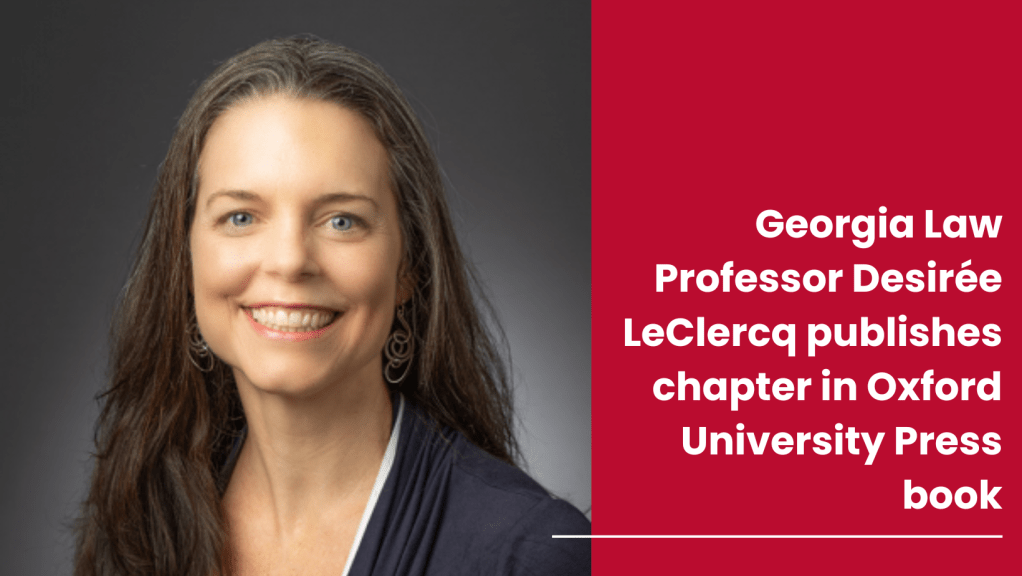
Georgia Law Professor Desirée LeClercq publishes chapter in Oxford University Press book

Assistant Professor Desirée LeClercq published “Enforcing International Sustainability Standards on International and National Platforms” in The Sustainability Revolution in International Trade Agreements (G. Vidigal and K. Claussen, eds.) (Oxford University Press, 2024).

Below is a description of the book:

Once seen as aspirational and relatively innocuous, ‘sustainability’ or ‘sustainable development’ provisions are now changing the face of international trade agreements. The Sustainability Revolution in International Trade Agreements gathers fundamental, first-hand analyses of these novel commitments across dozens of agreements, considering their legal, political, and economic aspects.

Drawing on perspectives from different parts of the world and engaging experts in the law and practice of sustainability provisions, this volume offers a comprehensive assessment of the latest developments and innovations in international trade agreements. It also evaluates the development challenges that sustainability requirements pose for countries with limited resources and capacity, for whom lower labour and environmental regulatory costs have been a competitive asset.

The present volume explores the intersectional aspects of sustainability – such as gender equality, biodiversity, animal welfare, and Indigenous rights – in addition to the more traditional dimensions of sustainability, namely economic development, environmental conservation, and improvement of labour standards.

There is little doubt that a sustainability revolution in global production patterns is needed. Considering the details of its operation – how it can come into being, who will bear the increased production costs, and how decisions on difficult trade-offs will be made – reveals the immense challenges involved in developing a new international law for sustainable trade. Read together, the chapters in this volume outline the contours this emerging legal framework, examine its practical operation, and offer important reflections upon the real extent and the foreseeable consequences of this sustainability revolution in international trade agreements.

Desirée LeClercq joined the University of Georgia School of Law in 2024 as an assistant professor. She teaches International Trade and Workers Rights, International Labor Law, International Law and U.S. Labor Law. She also serves as a faculty co-director of the Dean Rusk International Law Center and as the faculty adviser for the Georgia Journal of International and Comparative Law.