Georgia Law Professor Desirée LeClercq cited in Financial Times 

University of Georgia School of Law Professor Desirée LeClercq‘s report “Enforcement of the United States-Mexico-Canada Agreement (“USMCA”) Rapid Response Mechanism: Views from Mexican Auto Sector Workers” was cited in the article “How the Democrats Worker-Centred Trade Policy Failed” in the Financial Times.

Below is the article’s abstract:

This study examines whether the RRM empowers workers’ voices in the Mexican auto sector. To this end, between January and March 2024, we interviewed 130 workers across seven supplier facilities (auto plants facilities and logistics facilities) and five assembly plants, for a total of 12 facilities. Three of the facilities were not unionized; nine facilities were unionized. Three of the twelve plants had used the RRM (“RRM facilities”), addressing various violations of labor rights, voting processes to approve or reject collective contracts, voting processes to elect independent unions, and dismissals and intimidation of workers in union activism. All three RRM cases were remediated through plans requiring the facility to hold a new legitimization vote and union election and offer worker-level trainings. Our preliminary results problematize some assumptions that drove RRM implementation. The Biden administration and members of the United States Congress have promoted the RRM as a way to strengthen the Mexican government’s efforts to implement Mexican labor law reform, empower workers in productive export sectors, and give them a voice over their labor conditions. Our results suggest that, four years after the implementation of the USMCA and the reforms of Mexico’s labor legislation, a little more than half of the workers are aware of the labor law reform, and opinions are divided on whether it is strengthening labor rights. Some workers thought the reforms were going well, while many thought the reform process was going poorly or did not know how it was going. The majority of workers we interviewed revealed that they did not understand the new democratic procedures to legitimize their collective bargaining agreements, nor that they could access the RRM platform to express their complaints. Nevertheless, the workers we interviewed at RRM facilities tended to be more knowledgeable of the labor law reforms and its attendant rights and processes than those at facilities that have not undergone RRM investigation and remediation, and they tended to view their bargaining representative and conditions of work more favorably. Our study suggests that when workers are given the opportunity to participate in democratic elections under international supervision, after receiving training on the shop floor about their rights and election procedures, they gain knowledge and ownership over their working conditions.

LeClercq joined the University of Georgia School of Law in 2024 as an assistant professor. She teaches International Trade and Workers Rights, International Labor Law, International Law and U.S. Labor Law, as well as the International Law Colloquium. She also serves as a faculty co-director of the Dean Rusk International Law Center and as the faculty adviser for the Georgia Journal of International and Comparative Law.

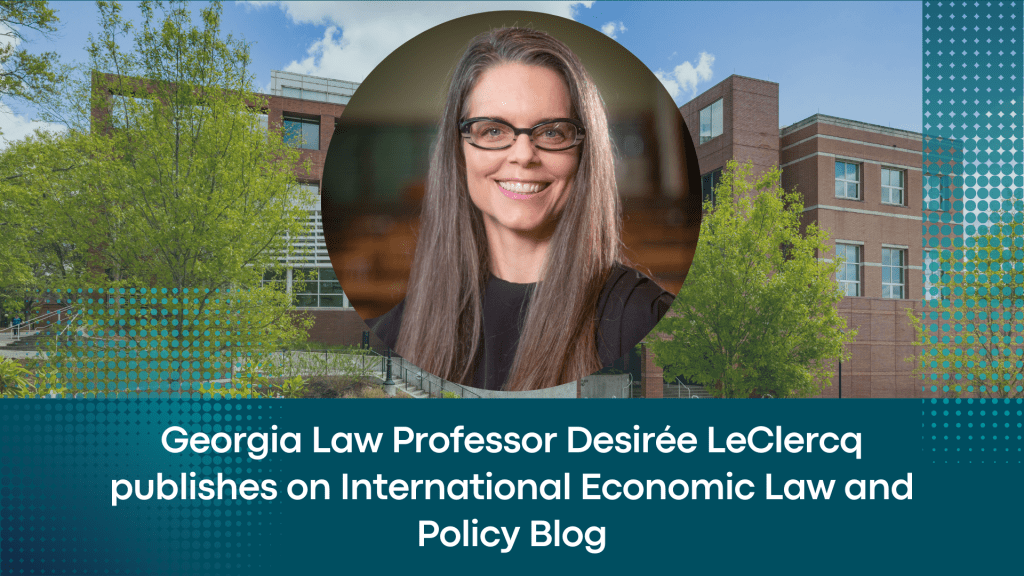
Georgia Law Professor Desirée LeClercq publishes on International Economic Law and Policy Blog

University of Georgia School of Law Professor Desirée LeClercq published an article titled “Whither the Worker-Centered Trade Policy?” for the International Economic Law and Policy Blog. This article presents LeClercq’s views on the Trump administration’s trade agenda.

Below is an excerpt from the article:

“The Biden administration changed U.S. trade policy significantly when it adopted a “worker-centered” trade policy that justified entering into “frameworks” and not trade agreements. That policy didn’t win many accolades from the trade crowd. Many critics felt that it forewent critical opportunities by refusing to discuss market access in new trade contexts. Without getting into that debate, this post discusses whether the Biden administration’s worker-centered trade policy – and notably, use of that policy under the United States-Mexico-Canada Agreement (USMCA) Facility-Specific Rapid-Response Labor Mechanism (RRM) – will outlive the administration.

I think it will, but it will look different. And some, including labor rights advocates like myself, might prefer the Trump administration’s approach.”

LeClercq joined the University of Georgia School of Law in 2024 as an assistant professor. She teaches International Trade and Workers Rights, International Labor Law, International Law, U.S. Labor Law and the International Law Colloquium. She also serves as a faculty co-director of the Dean Rusk International Law Center and as the faculty adviser for the Georgia Journal of International and Comparative Law.

Georgia Law Professor Desirée LeClercq publishes article in World Trade Review

University of Georgia School of Law Professor Desirée LeClercq published her article “Tonia Novitz, Trade, Labour, and Sustainable Development: Leaving No One in the World of Work Behind Edward Elgar Publishing, 2024 – Kevin J. Middlebrook, The International Defense of Workers: Labor Rights, US Trade Agreements, and State Sovereignty Columbia University Press, 2024” in the World Trade Review.

LeClercq’s article reviews two books that examine trade and labor rights, the development of the United States-Mexico-Canada Agreement (USMCA) and the Rapid Response Mechanism.

Below is an excerpt from the article:

Over the past decade, trade lawyers and legal researchers have had to take a crash course in international labor law and the so-called ‘sustainable development’ framework. Trade bans across the Atlantic punish governments and corporations for engaging in forced labor. The European Union (EU) recently revised its trade agenda to ensure that commitments to trade agreements with sustainable development provisions are enforceable through sanctions. The United States adopted a ‘worker-centered’ trade policy foregrounding international labor law, the International Labor Organization (ILO), and conceptions of workplace democracy, choice, and voice. The trade and labor linkage, long the source of dispute, is apparently with us to stay, with its attendant implications for trade, political relationships, and international economic law. Namely, who establishes the rules? Governments? International organizations? Civil society? And who decides whether and how those rules are violated?

LeClercq joined the University of Georgia School of Law in 2024 as an assistant professor. She teaches International Trade and Workers Rights, International Labor Law, International Law and U.S. Labor Law. She also serves as a faculty co-director of the Dean Rusk International Law Center and as the faculty adviser for the Georgia Journal of International and Comparative Law.

Georgia Law Professor Desirée LeClercq testifies before the U.S. International Trade Commission in Washington, DC

University of Georgia School of Law Professor Desirée LeClercq testified before the United States International Trade Commission hearing on the United States Mexico Agreement (USMCA) Automotive Rules of Origin: Economic Impact and Operation, 2025 Report earlier this month.

During this hearing, LeClercq presented her empirical study examining the effects of the USMCA Rapid Response Mechanism on workers in the Mexican auto sector. Current 3L Gloria Maria Correa assisted LeClercq in researching for this report. The abstract from the pre-hearing brief is as follows:

This pre-hearing brief is a submission to the U.S. International Trade Commission in relation to its investigation on the USMCA Automotive Rules of Origin: Economic Impact and Operation, 2025 Report. This investigation is a useful exercise and an opportunity to provide information about a recent study, entitled “Enforcement of the United States-Mexico-Canada Agreement (“USMCA”) Rapid Response Mechanism: Views from Mexican Auto Sector Workers,” conducted at Cornell University to help inform the Commission’s assessment. This study explores whether efforts under the United States-Mexico-Canada Agreement (USMCA) Facility-Specific Labor Rapid Response Mechanism (RRM) are leveling the playing field between U.S. and Mexican auto facilities by strengthening the labor rights of workers in the Mexican auto sector.

Desirée LeClercq joined the University of Georgia School of Law in 2024 as an assistant professor. She teaches International Trade and Workers Rights, International Labor Law, International Law and U.S. Labor Law. She also serves as a faculty co-director of the Dean Rusk International Law Center and as the faculty adviser for the Georgia Journal of International and Comparative Law.

Georgia Law Professor Desirée LeClercq presents at 2nd annual Trade and Public Policy Network Conference in Oxford

University of Georgia Assistant Professor of Law & Faculty Co-Director of the Dean Rusk International Law Center, Desirée LeClercq, presented at the 2nd annual Trade and Public Policy Network Conference in Oxford, England. LeClercq’s work was entitled: “Enforcement of the United States-Mexico-Canada Agreement Rapid Response Mechanism.”

Desirée LeClercq joined the University of Georgia School of Law as an assistant professor in summer 2024 and currently teaches International Trade and Workers Rights, International Labor Law, International Law, and U.S. Labor Law. She serves as a faculty co-director of the Dean Rusk International Law Center and as the faculty adviser for the Georgia Journal of International and Comparative Law.

Georgia Professor Desirée LeClercq to present at WTO’s Annual Public Forum in Switzerland

Assistant Professor Desirée LeClercq will present at the World Trade Organization’s (WTO) 2024 Public Forum. The theme for this year’s forum is Re-globalization: Better Trade for a Better World, described below:

Since the WTO’s inception in 1995, global trade has rapidly expanded and become increasingly interconnected. The international trading system has helped lift 1.5 billion people out of absolute poverty and unlocked new opportunities for businesses, workers and consumers. At the same time, the gains from trade have not always been shared equally. This needs to change.

As the WTO celebrates its 30th anniversary, the 2024 Public Forum will look to the future, exploring how re-globalization can help make trade more inclusive and ensuring that its benefits reach more people.

LeClercq will present research under the United States-Mexico-Canada agreement’s dispute settlement provisions and their effects on vulnerable workers in Mexico.

The WTO 2024 Public Forum also discussed the TradeExperettes’ report: Ten “Quick Wins” for Re-globalization and Resilience in Trade. LeClercq authored “Quick Win No. 3: Empower all workers to ensure a fair, equitable and sustainable trade policy,” which urges greater inclusion of non-union workers at the trade bargaining table.

Desirée LeClercq joined the University of Georgia School of Law as an assistant professor in summer 2024 and currently teaches International Trade and Workers Rights, International Labor Law, International Law, and U.S. Labor Law. LeClercq’s scholarly focus lies in international and labor law. She also serves as a faculty co-director of the Dean Rusk International Law Center and as the faculty adviser for the Georgia Journal of International and Comparative Law.

Georgia Law welcomes four new professors, including two international law scholars

The University of Georgia School of Law is pleased to welcome four new professors this fall: Pamela Foohey, Assaf Harpaz, Desirée LeClercq, and Meighan Parker. Of the four, LeClercq and Harpaz are international law scholars who will contribute to Georgia Law’s ongoing tradition of excellence in international law that dates to 1940.

Desirée LeClercq, Assistant Professor of Law & Faculty Co-Director of the Dean Rusk International Law Center

LeClercq teaches International Trade and Workers Rights, International Labor Law, International Law and U.S. Labor Law. She serves as a faculty co-director of the Dean Rusk International Law Center and as the faculty adviser for the Georgia Journal of International and Comparative Law. Specializing in international and labor law, LeClercq has recently published extensively in flagship and specialty law reviews, including the Fordham Law Review, the Virginia Journal of International Law, the Journal of International Economic Law, the Columbia Journal of Transnational Law, the Administrative Law Review, the American University Law Review and the Berkeley Journal of International Law. Notably, her Columbia Journal of Transnational Law article titled “A Worker-Centered Trade Policy” won the ComplianceNet Outstanding Junior Publication Award. LeClercq has also contributed several book chapters on international trade and labor, and she is a frequent contributor to Fortune.

Previously she served as a director of labor affairs in the Office of the U.S. Trade Representative from 2016 to 2020, during which time she was an adjunct professor at the American University Washington College of Law. Additionally, LeClercq worked for nearly a decade as a legal officer at the International Labor Organization in Geneva, Switzerland, and served as staff counsel for the chairman of the National Labor Relations Board.

Assaf Harpaz, Assistant Professor of Law

Harpaz’s scholarly focus lies in international taxation, with an emphasis on the intersection of taxation and digitalization. He teaches classes in federal income tax and business taxation. He explores the tax challenges of the digital economy and the ways to adapt 20th-century tax laws to modern business practices. In addition, he researches the use of tax expenditures and the historical expansion and politicization of the tax expenditure budget in the U.S. federal income tax system.

His recent scholarship includes his international tax article published in the University of Pennsylvania Journal of International Law titled “International Tax Reform: Who Gets a Seat at the Table?” His work has also been published in Law and Contemporary Problems, the Cornell Journal of Law and Public Policy, the Yale Journal of International Law and Tax Notes International. Moreover, he has contributed expert pieces for Newsweek, WalletHub, FinanceBuzz and the Maurer Global Forum.

Before joining UGA, Harpaz served as a visiting assistant professor at the Drexel University Kline School of Law teaching courses in federal income tax and enterprise tax.