Scholarly achievements, thriving initiatives featured in newsletter of Dean Rusk International Law Center

For a recap of the year’s global law-and-practice accomplishments here at the University of Georgia School of Law, have a look at the just-published annual newsletter of the Dean Rusk International Law Center. Features include:

► Welcome to new professors, Melissa J. Durkee and Christopher Bruner, as well as scholarly achievements of our many other globally minded faculty and staff, including Diane Marie Amann, Jason Cade, Nathan S. Chapman, Harlan G. Cohen, Kathleen A. Doty, Matthew I. Hall, Walter Hellerstein, Laura Tate Kagel, Jonathan Peters, Lori Ringhand, Peter B. “Bo” Rutledge, Christian Turner, and Carol Watson.

Events past and future, including day-long conferences cosponsored with the Georgia Journal of International & Comparative Law, public lectures and our Consular Series of lunch talks with Atlanta-based diplomats, and cosponsorship of panels at regional and national international law meetings.

► Initiatives aimed at preparing our J.D. and LL.M. students for global legal practice, including our Global Externships and our Global Governance Summer School, plus support for students’ organizations and international advocacy teams.

The full newsletter is here.


In international law journal, Library Director Carol A. Watson publishes article on “fake news”

Critical reading is the core topic of the article that Carol A. Watson, Director of the Alexander Campbell King Law Library here at the University of Georgia School of Law, has just published in a Cambridge University Press law journal.

Watson’s article, “Information Literacy in a Fake/False News World: An Overview of the Characteristics of Fake News and its Historical Development,” 46 International Journal of Legal Information 93 (2018), stems from her panel presentation at the 2017 Annual Course of the International Association of Law Libraries.

Here’s an extract:

“Prior to designing strategies and information literacy programs to combat the dissemination and proliferation of fake/false news, it is instructive for legal information professionals to understand the characteristics of fake news and the context of its historical development.”

The full article is available here.

Exploring “Executive Branch Lawyering” with US Judge David Barron, former head of Department of Justice Office of Legal Counsel

Executive Branch Lawyering course, from left: Maria Eliot, Wade Herring, Professor Diane Marie Amann, Sarah Mirza, Hanna Karimipour, Jennifer Cotton, Taylor Samuels, Judge David J. Barron, Morgan Pollard, Keelin Cronin, Joe Stuhrenberg

Who decides how America wages war?

What does “commander in chief” mean?

What (national or international) laws govern the United States’ waging of war?

How and by whom are those law identified, interpreted, decided, and implemented?

Those questions and many more arose during the Executive Branch Lawyering course that I just had the honor of co-teaching with David J. Barron, Judge of the U.S. Court of Appeals for the 1st Circuit and also The Honorable S. William Green Visiting Professor of Public Law at Harvard Law School, where he had taught full-time before his 2014 appointment to the federal bench.

My own association with Barron – like me, a former law clerk to U.S. Supreme Court Justice John Paul Stevens – dates to 2008. That year, Barron and I were among the charter contributors to “Convictions,” a legal blog published for a time at Slate. And in 2017 Judge Barron began serving on the Judicial Advisory Board of the American Society of International Law, with which I am affiliated thanks to my editorship of ASIL’s Benchbook on International Law (2014).

For an 18-month period between those years, Barron served as Assistant Attorney General in charge of the Office of Legal Counsel, providing legal advice to then-President Barack Obama and to agencies in the Executive Branch. That experience formed the basis of the 1-credit course that he and I co-taught last week at my home institution, the University of Georgia School of Law.

Our texts included Barron’s 2016 book, Waging War: The Clash Between Presidents and Congress, 1776 to ISIS, as well as The Terror Presidency: Law and Judgment Inside the Bush Administration, a 2009 memoir by Harvard Law Professor Jack Goldsmith, who had led OLC from 2003 to 2004 – plus executive orders, congressional enactments, judicial decisions, and other primary materials.

To prepare for sessions with Judge Barron, a topnotch group of 9 Georgia Law students and I examined a selection of historical moments when Presidents’ war-waging generated tensions, with other branches of government established in the U.S. Constitution and with other stakeholders. Of particular concern were instances related to executive detention in time of war, for example: treatment of British officers held during the American Revolution; General Andrew Jackson’s jailing of a judge who issued a writ of habeas corpus during the 1814 military occupation of New Orleans; and 2 capital military trials, the 1st of an Indiana civilian in the Civil War and the 2d of Nazi saboteurs in World War II.

Sessions with Judge Barron concerned US executive detention and related issues since the terrorist attack of September 11, 2001. The focus was on OLC’s legal, ethical, and practical duties in advising on such policies – and, through careful and extensive role-playing, on how Executive Branch lawyers go about the day-to-day work of giving such advice.

A most valued, and rewarding, teaching experience.

(Cross-posted from Diane Marie Amann blog)

Georgia Law Professor Harlan Cohen Fall 2018 Senior Fellow at NYU Law Institute for International Law & Justice

cohen2017New York University School of Law is hosting University of Georgia School of Law professor Harlan Grant Cohen (right) during the Fall 2018 semester. He serves as a Senior Fellow at the Institute for International Law and Justice (IILJ).

A member of our Georgia Law faculty since 2007, Cohen (right) publishes and teaches in a range of international law areas, including trade, foreign affairs, global governance, and human rights. He is the inaugural holder of the Gabriel M. Wilner/UGA Foundation Professorship in International Law and Faculty Co-Director of the Dean Rusk International Law Center.

logos combinedWhile at IILJ, Cohen will work on projects reconsidering the normative narratives underpinning the global trading system and exploring and mapping international law’s various communities of practice. He will also be involved in Institute programs on History and Theory of International Law, Global Governance, and Infrastructure as Regulation (InfraReg).

The IILJ organizes research projects with academic and policy institutions, and conducts academic and practical training initiatives.

Center to sponsor “Inquiry on Protecting Children in Conflict” panel at annual International Law Weekend, October 19 in New York City

In support of International Law Weekend, a three-day conference of the American Branch of the International Law Association, the University of Georgia School of Law Dean Rusk International Law Center will sponsor a panel entitled “The Inquiry on Protecting Children in Conflict,” set for 3 p.m. Friday, October 19, in Room 2-02B, Fordham Law School, 150 West 62d Street, New York City.

To be discussed are findings and recommendations of the 2018 report of the Inquiry on Protecting Children in Conflict, an initiative chaired by Gordon Brown, former United Kingdom Prime Minister and current UN Special Envoy for Global Education. The Inquiry reviewed the adequacy and effectiveness of the child-protection frameworks set out in international criminal law, international humanitarian law, and international human rights law, and also proposed reforms aimed at enhancing accountability and deterring future atrocities. The report has just been in book form as Protecting Children in Armed Conflict (Hart 2018).

Panelists include:

  • Shaheed Fatima QC, Barrister, Blackstone Chambers, London (pictured above at right), who led the legal panel that compiled the Inquiry’s report.
  • Professor Harold Hongju Koh, Sterling Professor of International Law at Yale Law School (second from right), who served as a consultant to the Inquiry.
  • Mara Redlich Revkin, Ph.D. Candidate in Political Science at Yale University and Lead Researcher on Iraq and Syria for the United Nations University Project on Children and Extreme Violence (pictured at left).
  • Professor Diane Marie Amann, Emily & Ernest Woodruff Chair in International Law at the University of Georgia School of Law and our Center’s Faculty Co-Director (second from left). Amann, who serves as Special Adviser to the Prosecutor of the International Criminal Court on Children in and affected by Armed Conflict, is a member of the Inquiry’s Advisory Panel.

Another principal cosponsor of International Law Weekend, which constitutes the 97th annual meeting of the American Branch of the International Law Association, is the worldwide International Law Students Association, with which Georgia Law students’ International Law Society is affiliated.

Full program, other details, and registration here.

Georgia Law Professor Harlan Cohen presents at European Society of International Law annual meeting in the UK

cohen2017Medium-logo_esil

Harlan Grant Cohen, the Gabriel M. Wilner/UGA Foundation Professor in International Law and Faculty Co-Director of the Dean Rusk International Law Center here at the University of Georgia School of Law, recently presented at the annual meeting of the European Society of International Law in Manchester, United Kingdom.

Cohen presented his paper, entitled “What is International Trade Law For?” as part of the International Economic Law Interest Group Roundtable, “The Multilateral Trading System in Trouble.”

Known by its acronym ESIL, the goals of the European Society of International Law “are to contribute to the rule of law in international relations and to promote the study of public international law.”

Georgia Law dean, alumnus co-author essay on human rights lawsuits in US

Alien Tort Cases Will Survive Supreme Court Trim,” predicts an essay published Monday in the Daily Report. Co-authoring the essay were Peter B. “Bo” Rutledge, Herman Talmadge Chair and Dean at the University of Georgia School of Law, and Michael Baker (JD’18), a Law Clerk for Superior Court Judge Ron Mullins, Chattahoochee Judicial Circuit. (Among other achievements, Baker served last year as Executive Conference Editor for the Georgia Journal of International & Comparative Law.)

In their essay, Rutledge and Baker noted that in the last several decades federal courts have adjudicated many lawsuits testing the scope of the Alien Tort Statute of 1789, which states:

The district courts shall have original jurisdiction of any civil action by an alien for a tort only, committed in violation of the law of nations or a treaty of the United States.

Most recently, that litigation gave rise to the April 2018 decision in Jesner v. Arab Bank, in which the U.S. Supreme Court held that the statute does not permit suits against foreign corporations.

Taking issue with commentators who have viewed Jesner as “a blow … to the cause of human rights,” the essay outlined, with references to other federal cases, “three anticipated battlegrounds in future ATS litigation.” Specifically, the decision in Jesner leaves open:

  1. Whether the statute precludes suits against all corporate defendants, or just against foreign corporations.
  2. Whether corporate officers remain liable even if lawsuits may not proceed against the corporation with which they are affiliated.
  3. What is the “degree of domestic conduct necessary for the ATS to have effect.”

The authors thus conclude:

“[T]he only certainty is that ATS litigation remains a ripe area for international human rights litigation.”

Their full essay is here.

International Law Society hosts gathering of globally minded students

1

International Law Society leadership, from left: Hanna Karimipour, President; Sam Hatcher, Treasurer; and Caitlin Felt, Social Chair

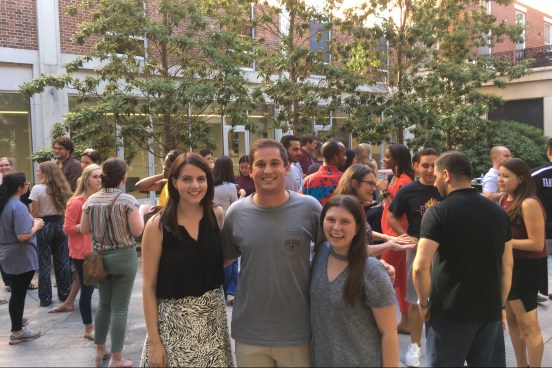
The International Law Society, the University of Georgia School of Law chapter of the worldwide International Law Students Association, hosted a mixer at the end of last week to welcome new globally minded students to their community.

3Co-sponsored by the Dean Rusk International Law Center, the mixer took place last Thursday in the law school’s Eversheds Sutherland Courtyard. This much-anticipated event afforded JD, LLM, and MSL students the chance to relax and learn from each other’s interests and experiences.

IMG_5291


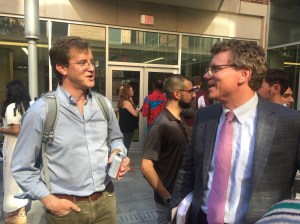
Several faculty members, including Professors Diane Marie Amann, Christopher Bruner (near right), Rob McNiff (far right), and Dan Coenen, dropped by to learn about students’ international ambitions and share their own unique advice and experiences. Staff of the Dean Rusk International Law Center was also on hand to discuss the Center’s international initiatives such as Global Externships Overseas, the Global Governance Summer School, and upcoming events.

The event kicked off with a welcome from Hanna Karimipour, International Law Society President. She gave an overview of the chapter and of opportunities afforded to its members. Kathleen A. Doty, Director of the Dean Rusk International Law Center, then provided information about upcoming events and initiatives at the Center.


A warm thank you to all who were able to attend.

Human rights, criminal justice, NATO, business practice, reception with Georgia Law alums: Global Governance Summer School day 3, Brussels

Professor Amann, Ana Sofie Silveira, Lucia Hakala, Eunjun Kim, Bryant Oliver, Professor Doty, NATO Legal Adviser Steven Hill, Hanna Karimipour, Maddie Neel, Julian Skoruppa, Brooke Carrington, Saif Ahmed, Caroline Harvey, Mills Culver, and Frances Plunkett

BRUSSELS – A variety of briefings in this Belgium capital, and home of many European Union institutions, highlighted day 3 of the Global Governance School that our University of Georgia School of Law Dean Rusk International Law Center offers with the Leuven Centre for Global Governance Studies at KU Leuven, one of Europe’s premier research institutions.

Our cohort of students from Georgia Law and multiple European universities first traveled to the Brussels office of No Peace Without Justice (left), a nongovernmental organization founded a quarter-century ago to promote “the protection and promotion of human rights, democracy, the rule of law and international justice.” There Alison A. Smith (left), Legal Counsel and Director of the organization’s International Criminal Justice Program, took part in a dialogue on “International Human Rights Lawyering” with Georgia Law Professor Diane Marie Amann, Emily & Ernest Woodruff Chair in International Law and one of our Center’s Faculty Co-Directors. Then the organization’s Secretary-General, Niccolò A. Figà-Talamanca, described the Rome diplomatic conference that led to adoption in 1998 of the Rome Statute of the International Criminal Court.

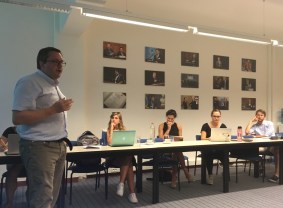
Next, Steven Hill, Legal Adviser and Director of the Office of Legal Affairs at the North Atlantic Treaty Organization, outlined the work of his office, where an 8-lawyer team serves as counsel to NATO Secretary-General Jens Stoltenburg and further liaises with NATO lawyers throughout the world. He then discussed key issues likely to be discussed at next week’s NATO Summit. (Preparations for that meeting of member states’ heads of state and government precluded a visit to the new NATO headquarters; we are grateful to the Brussels law firm Van Bael & Bellis for providing the lovely conference room, pictured above, where our students met with Hill.)

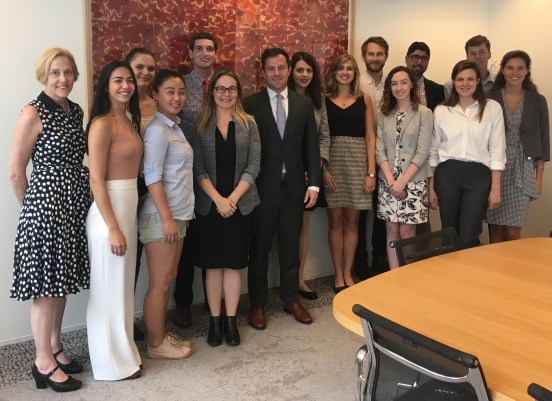
Finally, we made our way to the Brussels office of Sidley Austin LLP. There Stephen Spinks (Georgia Law JD’76), a member of our Dean Rusk International Law Center Council, led a presentation on key areas of global business practice at his office. Spinks is the immediate past managing partner of that office, and a well-known lawyer expert in matters related to EU competition (in effect, antitrust) law and trade law. Assisting in the presentation by Spinks (standing, at left) were 4 additional Sidley lawyers. From left: Dr. Michele Boggiani, who spoke on anti-corruption and life sciences law, Paul Greaves, on data privacy law, Anne Robert, on competition law, and Dr. Bregt Natens, on trade law.

The day concluded with a lively reception that Sidley kindly hosted. Participants included our students, firm attorneys, Center Director Kathleen A. Doty and myself, Sidley attorneys including Wim Nauwelaerts (LLM’94), an alumnus and head of the firm’s data privacy group, plus other Georgia Law graduates. These included: Johan De Bruycker (LLM’90), General Counsel, Ageas, Brussels; Porter Elliott (JD’96), the Van Bael & Bellis partner who helped secure a room for the morning NATO presentation; Daniel J. Felz (JD’09), an associate at Alston & Bird LLP; Professor Erik Franckxx (LLM’83), Professor of Law Director of the Department of International and European Law at Vrije Universiteit Brussel; and Dr. Christof Siefarth (LLM’86), a partner at GÖRG law firm in Cologne, Germany, and member of our Center’s Council.

Our group returns to Brussels tomorrow, to the Royal Flemish Academy of Belgium for Science and the Arts, to take part in Reconnect: Reconciling Europe with its Citizens through Democracy and the Rule of Law, a conference kicking off a 4-year-research project among 18 partners, including our partner institution, the Leuven Centre for Global Governance Studies, KU Leuven.

Contemporary challenges to global trade and sustainable development the focus of 2018 Georgia Law-Leuven Centre Global Governance Summer School day 2

IMG_2511

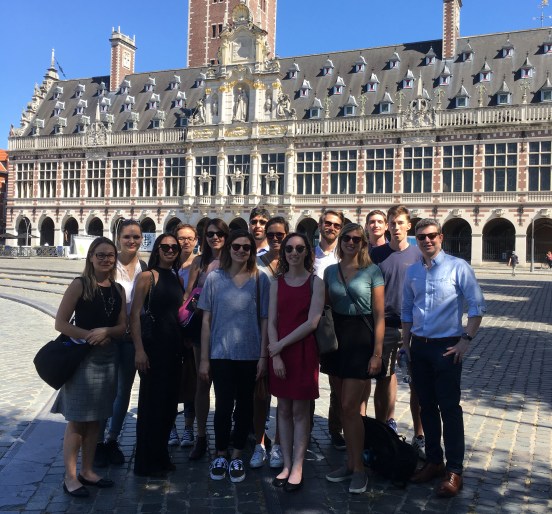
Global Governance Summer School students and faculty at the Central Library at Leuven. From Left: Professor Doty, Lucia Halala, Ana Sofia Silveira, Sarah Brugger, Hanna Karimipour, Caroline Harvey, Saif-Ullah Ahmed, Frances Plunkett, Brooke Carrington, Julian Skoruppa, Maddie Neel, Bryant Oliver, Mills Culver, Professor Cohen.

LEUVEN – Fresh from a walking tour of this centuries-old university city (top), not to mention last night’s celebrations in the Oude Markt plaza of Belgium’s breathtaking World Cup win, students in our 2018 Georgia Law-Leuven Centre Global Governance Summer School returned to the classroom today to explore contemporary challenges in the areas of global trade and sustainable development.

They took part in four lectures on the subject:IMG_2537 (1)

1st, Dr. Jan Van Hove (left), Professor of European and International Economics at KU Leuven, presented “A Political Economic Perspective on Global Economic and Trade Governance,” focusing on the changing landscape of global trade, including disruptions to traditional trade regimes.

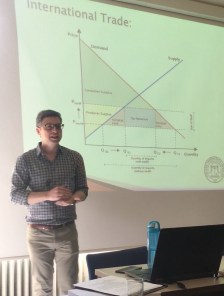
IMG_25492d, Georgia Law Professor Harlan G. Cohen (right), Gabriel M. Wilner/UGA Foundation Professor in International Law and one of our Center’s Faculty Co-Directors, lectured on “Global Economic and Trade Law.” His lecture highlighted the issue of governance choice in the areas of trade, finance, and international business transactions.

IMG_2558 (1)3d, Leuven Law Professor Geert Van Calster (left) spoke on “Trade Policy and Sustainable Development.” Concepts like regulatory harmonization and risk management design informed his lecture.

IMG_25654th, Dr. Axel Marx (right) concluded the day with a lecture on “Challenges of the Post-Westphalian Order.” Among the challenges to traditional public international law he discussed were non-state actors and the effectiveness of international rules and standards.

Tomorrow, students will travel to Belgium’s nearby capital, Brussels, for a day of professional development briefings at a variety of law offices.