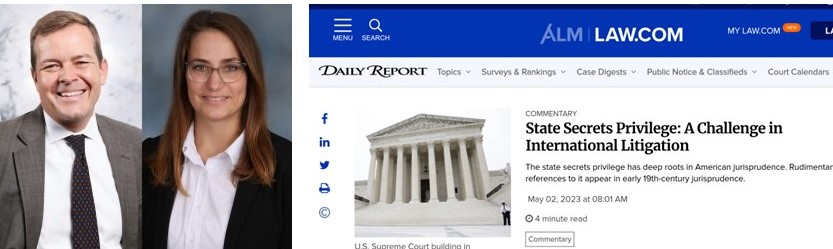
Georgia Law Dean Bo Rutledge and student Alexandra Lampe publish commentary on federal appellate ruling involving state secrets privilege

The implications of a recent federal appellate ruling related to international civil litigation is the subject of a commentary published last week by the dean and a student researcher here at the University of Georgia School of Law.

Coauthoring the Daily Report article, entitled “State Secrets Privilege: A Challenge in International Litigation,” were international business law expert Peter B. “Bo” Rutledge, Dean and Herman E. Talmadge Chair of Law at Georgia  Law, along with Alexandra Lampe, a member of Georgia Law’s Master of Laws (LL.M.) Class of 2023.

The article discusses Sakab Saudi Holding Co. v. Aljabri, 58 F.4th 585 (1st Cir. 2023), in which the Boston-based U.S. Court of Appeals affirmed a dismissal of a suit arising out of an asset seizure, lest further litigation risk disclosure of state secrets. After describing the ruling in the context of other case law, Rutledge and Lampe concluded:

“Parties in international commercial disputes with any kind of national security implication approaching U.S. courts, thus, should be aware to not expect too much from such proceedings. … [T]he broad application and interpretation of the state secrets privilege in the U.S. can complicate the resolution of international disputes.”

Georgia Law Professor Hellerstein in Bloomberg article on tax havens

Walter Hellerstein, Distinguished Research Professor and Shackelford Distinguished Professor in Taxation Law Emeritus here at the University of Georgia School of Law, was featured last Tuesday on Bloomberg’ Daily Tax Report.

The article, entitled “Minnesota Targets Corporations Shifting Profits to Tax Havens” and written by Michael H. Bologna, discussed the practice of worldwide combined tax reporting.

Bon voyage to students taking part in Georgia Law global summer initiatives

In the weeks ahead, more than two dozen students will travel to participate in two global practice preparation offerings administered by the University of Georgia School of Law Dean Rusk International Law Center. These are the:

GGSS

This year’s Global Governance Summer School will focus on economic and human rights. It’s set to begin at the end this month, when students will travel to Belgium for a week of lectures led by Georgia Law Professor Zohra Ahmed as well as Leuven professors. The first week of this for-credit course also will include professional development briefings at the European Parliament, the North Atlantic Treaty Organization, and a private law firm.

Then programming shifts to The Hague, Netherlands, where Professor Melissa J. “MJ” Durkee, the Center’s Director, Associate Dean for International Programs, and Allen Post Professor at Georgia Law, will lead briefings at the International Criminal Court, the International Court of Justice, the International Residual Mechanism for Criminal Tribunals, and Leiden University. Casey Graham, Sarah Quinn, and Catrina Martin will provide logistical assistance during the program. (Above, many in the group gather for a predeparture photo.)

Seventeen Georgia Law students will take part: Andrew Arrington, Hao Chen “Bobby” Dong, and Marly “Jansen” Killian, Allison Reid, all rising 3Ls; Mona Abboud, Madison Graham, Megan Jones, Anna “Carolina” Mares, Erin Nalley, Caden Pruitt, Hannah Silvers, Tiffany Torchia, Daniel “Tripp” Vaughn, all rising 2Ls; and Alma Bajramovic, Thomas Kingsley, Angela Mossgrove, Jasmine Underwood, all pursuing Graduate Certificates in International Law.

GEO

Our Center’s Global Externship Overseas initiative places Georgia Law students in externships lasting between four and twelve weeks. It thus offers students the opportunity to gain practical work experience in a variety of legal settings worldwide. Some students opt to combine the GEO opportunity with participation in GGSS.

This summer, fifteen Georgia Law students are set to pursue Global Externships Overseas, in practice areas such as privacy and technology law, international environmental law, intellectual property law, European Union competition and trade law, international arbitration, corporate law, and human rights law.

Private-sector placements among rising 3Ls include: Caroline Bailey, GreenCo S.A., Buenos Aires, Argentina; Hao Chen “Bobby” Dong, Baker Tilly, Hamburg and Frankfurt, Germany; Matthew Philips, PSA Legal, New Delhi, India; Benjamin Siegel, Soreinen, Tallinn, Estonia. Among rising 2Ls, private-sector placements include: Mona Abboud, Alston & Bird, Brussels, Belgium; Madison Graham, Van Bael & Bellis, Brussels, Belgium; Sierra Hamilton, Weickmann & Weickmann, Munich, Germany; Anna “Carolina” Mares, Houerbi Law Firm, Tunis, Tunisia; Matthew McKaig, GÖRG, Berlin, Germany; Caden Pruitt, Bodenheimer, Cologne, Germany; Daniel “Tripp” Vaughn, Deloitte, Baku, Azerbaijan.

Public-sector placements include: rising 3L Allison Reid, Eliberare, Brasov, Romania; and rising 2Ls Jasmine Furin, Office of the Privacy Commissioner, Hamilton, Bermuda; Bryonna Howard, No Peace Without Justice, Brussels, Belgium; and Erin Nalley, New Zealand Department of Conservation, Wellington, New Zealand.

More information on both of these Georgia Law initiatives here.

Georgia Law Professor Jason Cade presents on immigration at Wisconsin International Law Journal symposium

Professor Jason A. Code, an immigration law expert here at the University of Georgia School of Law, presented in April as part of the Wisconsin International Law Journal 2023 symposium, “Immigration and Access to Legal Resources for Migrants and Refugees,” held at the University of Wisconsin Law School in Madison.

Cade, who is Associate Dean for Clinical Programs and Experiential Learning, J. Alton Hosch Professor of Law, and Director of the Community HeLP Clinic at Georgia Law, gave a presentation entitled “Not Just a Pandemic Problem: Administrative Failures in the Humanitarian Immigration System” in a panel exploring the impact of the Covid-19 pandemic. Other panelists included Evelyn Marcelina Rangel-Media, Temple University Beasley School of Law, Wooksoo Kim, University at Buffalo School of Social Work, and Emily Ryo, University of Southern California Gould School of Law.

Georgia Law’s first international law professor, Sigmund A. Cohn, featured in Dean Rusk International Law Center exhibit

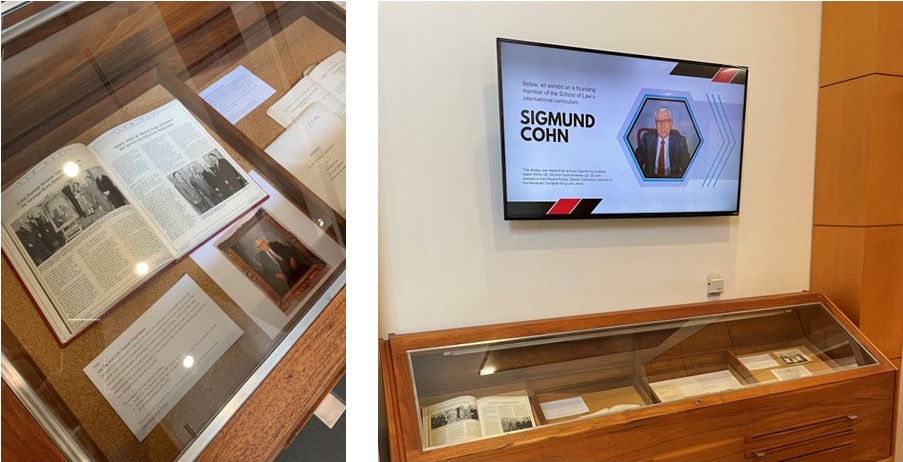
An ongoing exhibit here at the Dean Rusk International Law Center, University of Georgia School of Law, celebrates the distinguished life and career of Professor Sigmund A. Cohn, who taught the law school’s first international law class, in 1940.

Cohn’s courses, in international law and in comparative law, blazed a trail. Others would follow Cohn’s path; among them, past Georgia Law Professors Dean Rusk, Louis B. Sohn, and Gabriel Wilner.

The exhibit was researched and curated by two of the Center’s Student Ambassadors, 3L Isabel White and 2L Carolina Mares, along with Rachel Evans, Metadata Services & Special Collections Librarian at the law school’s Alexander Campbell King Law Library. It features a collection of archival items about Cohn’s life and work.

Cohn was born in 1898 in Breslau, Germany (now Wrocław, Poland) to a Jewish family. He became a lawyer and then a judge in Germany’s Weimar Republic. But in 1934, Nazi Germany’s antisemitic laws forced him out of his judicial position. Cohn immigrated to Italy for a few years, but then was forced to immigrate once again, to the United States.

He was hired by Georgia Law, and became its first professor of Jewish ancestry, at a time when state laws barred the paying of foreign citizens. His hiring thus was supported financially by Harold Hirsch – then general counsel at the Coca-Cola Co., and the lawyer for whom Georgia Law’s Hirsch Hall is named.

A portrait of Professor Cohn greets visitors to the Dean Rusk International Law Center.

Cohn’s legacy likewise continues in the form of Georgia Law’s highly ranked curriculum (here and here), in global practice preparation and international professional education, benefiting candidates for Juris Doctor, Master of Laws (LL.M.), and Master in the Study of Law (M.S.L.) degrees as well as Graduate Certificate in International Law students.

Georgia Law Professor Bruner presents on national identity and economic development at Princeton University “Post-Colonial Era” symposium

“National Identity and Economic Development in Market-Dominant Small Jurisdictions” is the title of the workshop paper that Christopher Bruner, the Stembler Family Distinguished Professor in Business Law here at the University of Georgia School of Law, presented last Friday at Princeton University.

Bruner’s talk was part of a symposium on “Law, Identity, and Economic Development in the Post-Colonial Era: The Case of the Northern Atlantic and Larger Caribbean Regions,” hosted by the Princeton School of Public and International Affairs. The university’s Liechtenstein Institute on Self-Determination co-sponsored the event.

Georgia Law Professor Amann takes part in podcast tribute to last surviving prosecutor at post-WWII Nuremberg trials, Benjamin B. Ferencz (1920-2023)

Among the international law experts featured in a podcast honoring the last surviving Nuremberg prosecutor is a Faculty Co-Director of our Center, Professor Diane Marie Amann.

The tribute, entitled “In Memoriam: Benjamin B. Ferencz,” was released recently at Asymmetrical Haircuts: Your International Justice Podcast. In it, the podcast’s co-founders, journalists Janet Anderson and Stephanie van den Berg, first provided their own memories of Ferencz, who died on April 7 in Florida, at age 103. They continue with comments not only from Professor Amann, but also from Christopher “Kip” Hale, Adama Dieng, David Donat Cattin, and Ferencz’ son, Don Ferencz.

As a twenty-something lawyer, Ferencz had played a role post-World War II trials at Nuremberg, leading the Einsatzgruppen trial. (His wife, Gertrude Fried Ferencz (1919-2019), likewise worked at the trials, in administrative capacities.) He remained active throughout his life in promoting international criminal law – to quote his own favorite phrase, campaigning for “Law, Not War.”

The comments by Amann, who is Regents’ Professor of International Law and Emily & Ernest Woodruff Chair in International Law here at the University of Georgia School of Law, drew from a tribute she posted here the day after Ferencz’ passing.

(Depicted in photo montage at podcast website: from top left, Amann interviewing Ferencz at International Humanitarian Law Dialogs, Chautauqua, New York; Ferencz with inter alia his son Don Ferencz, Kip Hale, and then-Prosecutor of the International Criminal Court, Fatou Bensouda; prosecutor Ferencz addressing a court at Nuremberg; and Ferencz on a bench dedicated to him at the Peace Palace at The Hague, the Netherlands, in which the phrase “Law Not War” has been carved)

Georgia Law Professor MJ Durkee publishes article on industry groups and international governance in Journal of Human Rights and the Environment

Professor Melissa J. “MJ” Durkee, who is the Associate Dean for International Programs, Director of the Dean Rusk International Law Center, and Allen Post Professor here at the University of Georgia School of Law, has published “Industry Groups in International Governance: A Framework for Reform” in the bi-annual, peer-reviewed Journal of Human Rights and the Environment.

Here’s the abstract:

“The Sustainable Development Goals and the UN Guiding Principles on Business and Human Rights encourage engaging with businesses as partners in important global governance agendas. Indeed, many international organizations are now partnering with business groups to secure funding and private sector engagement. At the same time, reforms at the World Health Organization, Food and Agriculture Organization and others seek to restrain the dangers of mission distortion and capture by business groups. Shareholders at major multinational oil and gas companies also recognize these dangers and seek to rein in lobbying that is at odds with the goals of the Paris Climate Agreement. Despite these tensions, little scholarly attention has been paid to the regulations that govern how industry and trade groups may participate in the work of international organizations. Specifically, little attention has been devoted to how those regulations could best capture the potential benefits of business engagement while restraining the potential harms. This article offers a history of engagement between international organizations and industry and trade associations, reviews arguments for embracing or restraining their participation, and develops a framework for regulations to govern their access.”

A version of this new article also is available at SSRN.

Georgia Law Professor Walter Hellerstein publishes chapter in volume on international tax law developments

A chapter by Walter Hellerstein, Distinguished Research Professor and Shackelford Distinguished Professor in Taxation Law Emeritus here at the University of Georgia School of Law, appears in a new publication that is part of a series of books on international tax law.

Hellerstein’s chapter, entitled “Joint and Several Liability for Collection of Supplies Over Platforms,” appears in CJEU-Recent Developments in Value Added Tax 2021 (Vienna: Linde Verlag, 2023).

The volume features analyses of significant judgments by the Luxembourg-based Court of Justice of the European Union, or CJEU. Editors were a team led by Professor Georg Kofler, of Austria’s Wirtschaftsuniversität Wien / the Vienna University of Economics & Business.

Georgia Law Professor Amann presents at Temple Law workshop on Philippe Sands’ Chagos book, “Last Colony”

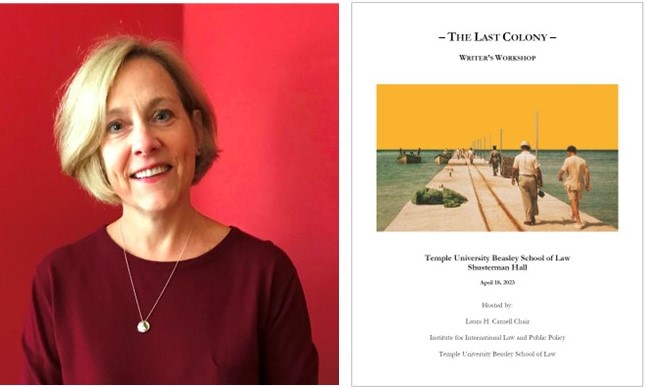
University of Georgia School of Law Professor Diane Marie Amann was one of about two dozen experts in international law and policy who participated Tuesday in a daylong writers’ workshop in Philadelphia, centered on a new book, The Last Colony: A Tale of Exile, Justice and Britain’s Colonial Legacy.

Last Colony charts the journey, through many national and international courtrooms, that led to the 2019 Advisory Opinion of the International Court of Justice on case related to colonization in the Indian Ocean region: Legal Consequences of the Separation of the Chagos Archipelago from Mauritius in 1965. The book appeared in the United Kingdom in 2022 and will be released in the United States later this year. Its author, University College London Law Professor Philippe Sands KC, counsel for Mauritius in the ICJ proceedings, was among those who took part in Tuesday’s event.

Workshop sponsors were the Institute for International Law & Public Policy and the Laura H. Carnell Chair at Temple University Beasley School of Law; the principal organizer was Temple Law Professor Jeffrey Dunoff, Laura R. Carnell Professor of Law. Papers are set to be published in a forthcoming issue of the Temple Journal of International & Comparative Law.

Amann is is Regents’ Professor of International Law and Emily & Ernest Woodruff Chair in International Law, and a Faculty Co-Director of our Dean Rusk International Law Center here at Georgia Law. For Tuesday’s workshop, she prepared a paper entitled “What Figures Lurk on Madame’s Path? Reflections on Philippe Sands’ Last Colony.”