University of Georgia School of Law Professor Desirée LeClercq recently delivered a presentation on the future of multilateralism, trade, and worker rights to World Trade Organization officials and researchers in Geneva, Switzerland.
LeClercq received financial support to attend this workshop from the Dean Rusk International Law Center as a Rusk Scholar-in-Residence, an initiative promoting international opportunities for Georgia Law faculty that advance the mission of the Center.
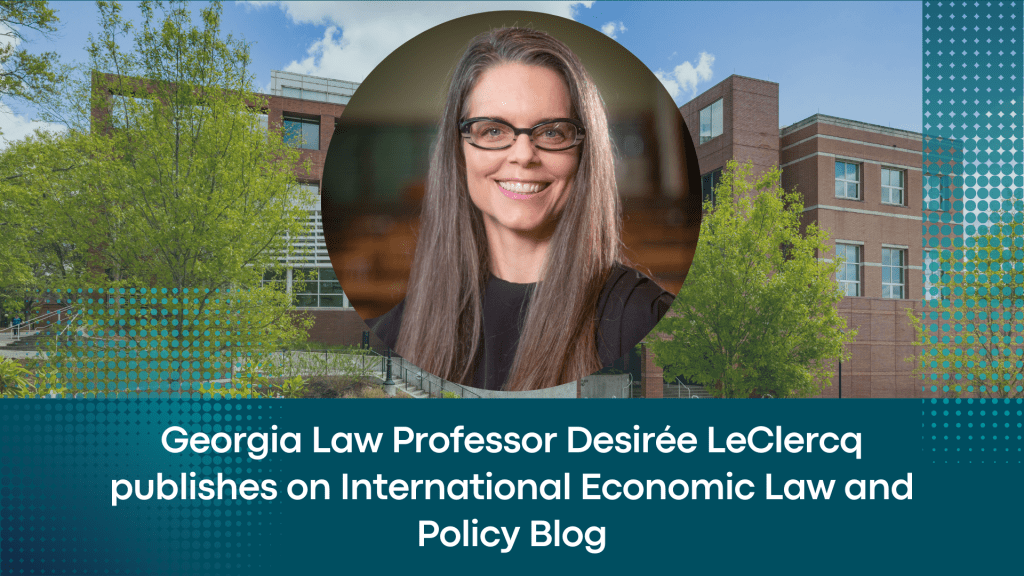
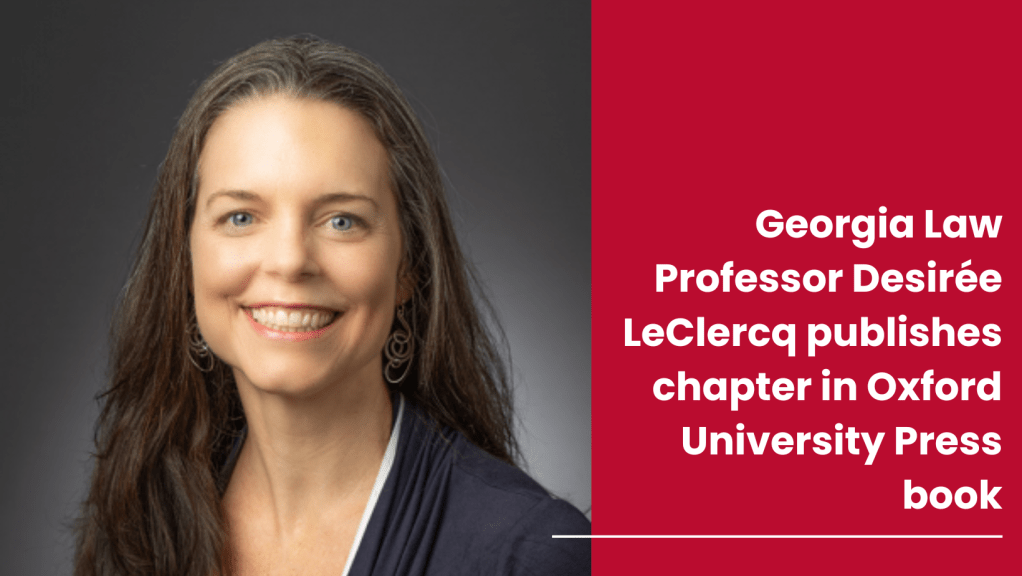
LeClercq joined the University of Georgia School of Law in 2024 as an assistant professor. She teaches International Trade and Workers Rights, International Labor Law, International Law and U.S. Labor Law. She also serves as a faculty co-director of the Dean Rusk International Law Center and as the faculty adviser for the Georgia Journal of International and Comparative Law.
The University of Georgia School of Law’s spring 2025 International Law Colloquium welcomed Professor Katrin Kuhlmann, who presented her working paper, “Micro International Law.” Greg Day, Associate Professor in the Terry College of Business at the University of Georgia, served as Kuhlmann’s faculty discussant.
Kuhlmann is the Faculty Director and Co-founder of the Center on Inclusive Trade and Development at Georgetown Law. Her scholarly focus lies in international law, development, inclusive and sustainable international trade law, regional trade agreements, agricultural law and food security, comparative economic law, African trade and development law and corridors, and the interdisciplinary connections between law and development.
Below is an abstract of Kuhlmann’s working paper:
International law has long been viewed as the domain of countries and capitals, not fields or factories, but this overly top-down perspective misses a critical and under-studied part of the picture. Underneath the macro level of standardized legal norms, international law is much more nuanced, with multiple sites of influence, production, design, adoption, and decision-making that scholars have largely neglected but which need to be better understood. Models stemming from legal systems in less powerful states, smaller-scale stakeholder interests, and local solutions are often treated as one-off anecdotes or isolated case studies without broader implications.
Capturing these lessons, cataloging them, and building a methodology around them could be transformational at a time when international law needs a refresh to make it more responsive to a new set of global challenges ranging from inequality to food insecurity to climate change.
This paper presents a conceptual and methodological framework for “micro international law” as a sub-field of international law. Adding a micro dimension to international law would bring it in line with other disciplines that recognize the importance of studying smaller-scale, more granular interventions. It would also make a significant contribution to the international legal field by integrating theoretical and empirical approaches to focus on the impact innovations within domestic legal systems and the interests of individuals have on international law (and the impact of international law on these systems and stakeholders), ultimately providing a framework for designing international law differently to equitably address more specialized needs and positively impact the lives of those international law aims to serve and benefit.
This year, Professor Desirée LeClercq is overseeing the colloquium, which is designed to introduce students to features of international economic law through engagement with scholars in the international legal field. To view the full list of International Law Colloquium speakers, visit our website.
This program is made possible through the Kirbo Trust Endowed Faculty Enhancement Fund and the Talmadge Law Faculty Fund.
University of Georgia School of Law Professor Desirée LeClercq contributed to the annual report published by Johns Hopkins University’s Institute for America, China, and the Future of Global Affairs (ACF) entitled “Getting China Right at Home.” LeClercq authored the article “A Pragmatic Approach to U.S.-China Labor Tensions,” which centers on the importance of the International Labor Organization in improving worker’s rights in China.
Below is an excerpt from the article:
“Tensions with the People’s Republic of China (PRC) concerning its treatment of workers have featured prominently in U.S. trade and diplomatic policies. The new administration must draw lessons from the failure of policies employed to date to entice the PRC to align its labor policies with international legal standards, not least because residual noncompliance in China has impacted domestic interests in the United States. Instead, the International Labor Organization (ILO), as a neutral intermediary, could better engender incremental changes in the treatment of workers.”
LeClercq joined the University of Georgia School of Law in 2024 as an assistant professor. She teaches International Trade and Workers Rights, International Labor Law, International Law and U.S. Labor Law. She also serves as a faculty co-director of the Dean Rusk International Law Center and as the faculty adviser for the Georgia Journal of International and Comparative Law.
University of Georgia School of Law Professor Desirée LeClercq was recently featured in Inside US Trade regarding the U.S.-Mexico-Canada Agreement’s Rapid Response Mechanism (RRM) and how it may be used by the upcoming Trump administration.
University of Georgia School of Law Assistant Professor Desirée LeClercq…says a recent study she conducted with El Colegio de Sonora professor Alex Covarrubias-V and Cirila Quintero Ramirez, a research professor at El Colegio de Frontera Norte, Unidad Matamoros, suggests that the mechanism has disproportionately served a relatively narrow group of workers with ties to major U.S. unions and non-governmental organizations, without raising labor standards overall.
LeClercq, who was USTR’s director of labor affairs during President Trump’s first term, said she believes a second Trump administration, less beholden to such groups, might be incentivized to use the tool more broadly to try to improve labor standards that give Mexico an unfair competitive edge.
LeClercq joined the University of Georgia School of Law in 2024 as an assistant professor. She teaches International Trade and Workers Rights, International Labor Law, International Law and U.S. Labor Law, as well as the International Law Colloquium. She also serves as a faculty co-director of the Dean Rusk International Law Center and as the faculty adviser for the Georgia Journal of International and Comparative Law.
This study examines whether the RRM empowers workers’ voices in the Mexican auto sector. To this end, between January and March 2024, we interviewed 130 workers across seven supplier facilities (auto plants facilities and logistics facilities) and five assembly plants, for a total of 12 facilities. Three of the facilities were not unionized; nine facilities were unionized. Three of the twelve plants had used the RRM (“RRM facilities”), addressing various violations of labor rights, voting processes to approve or reject collective contracts, voting processes to elect independent unions, and dismissals and intimidation of workers in union activism. All three RRM cases were remediated through plans requiring the facility to hold a new legitimization vote and union election and offer worker-level trainings. Our preliminary results problematize some assumptions that drove RRM implementation. The Biden administration and members of the United States Congress have promoted the RRM as a way to strengthen the Mexican government’s efforts to implement Mexican labor law reform, empower workers in productive export sectors, and give them a voice over their labor conditions. Our results suggest that, four years after the implementation of the USMCA and the reforms of Mexico’s labor legislation, a little more than half of the workers are aware of the labor law reform, and opinions are divided on whether it is strengthening labor rights. Some workers thought the reforms were going well, while many thought the reform process was going poorly or did not know how it was going. The majority of workers we interviewed revealed that they did not understand the new democratic procedures to legitimize their collective bargaining agreements, nor that they could access the RRM platform to express their complaints. Nevertheless, the workers we interviewed at RRM facilities tended to be more knowledgeable of the labor law reforms and its attendant rights and processes than those at facilities that have not undergone RRM investigation and remediation, and they tended to view their bargaining representative and conditions of work more favorably. Our study suggests that when workers are given the opportunity to participate in democratic elections under international supervision, after receiving training on the shop floor about their rights and election procedures, they gain knowledge and ownership over their working conditions.
LeClercq joined the University of Georgia School of Law in 2024 as an assistant professor. She teaches International Trade and Workers Rights, International Labor Law, International Law and U.S. Labor Law, as well as the International Law Colloquium. She also serves as a faculty co-director of the Dean Rusk International Law Center and as the faculty adviser for the Georgia Journal of International and Comparative Law.
“The Biden administration changed U.S. trade policy significantly when it adopted a “worker-centered” trade policy that justified entering into “frameworks” and not trade agreements. That policy didn’t win many accolades from the trade crowd. Many critics felt that it forewent critical opportunities by refusing to discuss market access in new trade contexts. Without getting into that debate, this post discusses whether the Biden administration’s worker-centered trade policy – and notably, use of that policy under the United States-Mexico-Canada Agreement (USMCA) Facility-Specific Rapid-Response Labor Mechanism (RRM) – will outlive the administration.
I think it will, but it will look different. And some, including labor rights advocates like myself, might prefer the Trump administration’s approach.”
LeClercq joined the University of Georgia School of Law in 2024 as an assistant professor. She teaches International Trade and Workers Rights, International Labor Law, International Law, U.S. Labor Law and the International Law Colloquium. She also serves as a faculty co-director of the Dean Rusk International Law Center and as the faculty adviser for the Georgia Journal of International and Comparative Law.
LeClercq’s article reviews two books that examine trade and labor rights, the development of the United States-Mexico-Canada Agreement (USMCA) and the Rapid Response Mechanism.
Below is an excerpt from the article:
Over the past decade, trade lawyers and legal researchers have had to take a crash course in international labor law and the so-called ‘sustainable development’ framework. Trade bans across the Atlantic punish governments and corporations for engaging in forced labor. The European Union (EU) recently revised its trade agenda to ensure that commitments to trade agreements with sustainable development provisions are enforceable through sanctions. The United States adopted a ‘worker-centered’ trade policy foregrounding international labor law, the International Labor Organization (ILO), and conceptions of workplace democracy, choice, and voice. The trade and labor linkage, long the source of dispute, is apparently with us to stay, with its attendant implications for trade, political relationships, and international economic law. Namely, who establishes the rules? Governments? International organizations? Civil society? And who decides whether and how those rules are violated?
LeClercq joined the University of Georgia School of Law in 2024 as an assistant professor. She teaches International Trade and Workers Rights, International Labor Law, International Law and U.S. Labor Law. She also serves as a faculty co-director of the Dean Rusk International Law Center and as the faculty adviser for the Georgia Journal of International and Comparative Law.
University of Georgia Assistant Professor of Law & Faculty Co-Director of the Dean Rusk International Law Center, Desirée LeClercq, presented at the 2nd annual Trade and Public Policy Network Conference in Oxford, England. LeClercq’s work was entitled: “Enforcement of the United States-Mexico-Canada Agreement Rapid Response Mechanism.”
Desirée LeClercq joined the University of Georgia School of Law as an assistant professor in summer 2024 and currently teaches International Trade and Workers Rights, International Labor Law, International Law, and U.S. Labor Law. She serves as a faculty co-director of the Dean Rusk International Law Center and as the faculty adviser for the Georgia Journal of International and Comparative Law.
Since the WTO’s inception in 1995, global trade has rapidly expanded and become increasingly interconnected. The international trading system has helped lift 1.5 billion people out of absolute poverty and unlocked new opportunities for businesses, workers and consumers. At the same time, the gains from trade have not always been shared equally. This needs to change.
As the WTO celebrates its 30th anniversary, the 2024 Public Forum will look to the future, exploring how re-globalization can help make trade more inclusive and ensuring that its benefits reach more people.
LeClercq will present research under the United States-Mexico-Canada agreement’s dispute settlement provisions and their effects on vulnerable workers in Mexico.
The WTO 2024 Public Forum also discussed the TradeExperettes’ report: Ten “Quick Wins” for Re-globalization and Resilience in Trade. LeClercq authored “Quick Win No. 3: Empower all workers to ensure a fair, equitable and sustainable trade policy,” which urges greater inclusion of non-union workers at the trade bargaining table.
Desirée LeClercq joined the University of Georgia School of Law as an assistant professor in summer 2024 and currently teaches International Trade and Workers Rights, International Labor Law, International Law, and U.S. Labor Law. LeClercq’s scholarly focus lies in international and labor law. She also serves as a faculty co-director of the Dean Rusk International Law Center and as the faculty adviser for the Georgia Journal of International and Comparative Law.
Once seen as aspirational and relatively innocuous, ‘sustainability’ or ‘sustainable development’ provisions are now changing the face of international trade agreements. The Sustainability Revolution in International Trade Agreements gathers fundamental, first-hand analyses of these novel commitments across dozens of agreements, considering their legal, political, and economic aspects.
Drawing on perspectives from different parts of the world and engaging experts in the law and practice of sustainability provisions, this volume offers a comprehensive assessment of the latest developments and innovations in international trade agreements. It also evaluates the development challenges that sustainability requirements pose for countries with limited resources and capacity, for whom lower labour and environmental regulatory costs have been a competitive asset.
The present volume explores the intersectional aspects of sustainability – such as gender equality, biodiversity, animal welfare, and Indigenous rights – in addition to the more traditional dimensions of sustainability, namely economic development, environmental conservation, and improvement of labour standards.
There is little doubt that a sustainability revolution in global production patterns is needed. Considering the details of its operation – how it can come into being, who will bear the increased production costs, and how decisions on difficult trade-offs will be made – reveals the immense challenges involved in developing a new international law for sustainable trade. Read together, the chapters in this volume outline the contours this emerging legal framework, examine its practical operation, and offer important reflections upon the real extent and the foreseeable consequences of this sustainability revolution in international trade agreements.
Desirée LeClercq joined the University of Georgia School of Law in 2024 as an assistant professor. She teaches International Trade and Workers Rights, International Labor Law, International Law and U.S. Labor Law. She also serves as a faculty co-director of the Dean Rusk International Law Center and as the faculty adviser for the Georgia Journal of International and Comparative Law.




 exchange of notes