UGA Law Professor Cohen Speaks with International Law Society

Gabriel M. Wilner/UGA Foundation Professor in International Law & Faculty Co-Director of the Dean Rusk International Law Center Harlan Grant Cohen spoke to International Law Society (ILS) members in late September as part of an ongoing brown bag lunch series with international law faculty at UGA Law.

Cohen provided the students in attendance with an introduction to his current research. He then outlined his path into academia and offered students insight into the spectrum of professional opportunities within the field of international law, noting fast-growing sectors like export controls, CFIUS issues, and space law. He also offered some reflections on the changing nature of the field, including the recent trend of withdrawal from international organizations and treaties; the emergence of new centers of power that challenge norms in international law; and increasing economic competition influencing international law through mechanisms such as trade rules and sanctions. Cohen encouraged student questions to drive the majority of the conversation, providing career and networking advice throughout the discussion. He recommended that students interested in international law enroll in the spring Public International Law course, attend conferences and get involved in international law organizations, and try to learn a second language if possible.

ILS President, 2L Madison Graham, spearheaded this series with the intention of orienting new law students towards the international law faculty. She hopes to expand the student body’s definition of what international law means and to bring their attention to the academic achievements of the international law faculty here at UGA Law.

ILS is the student chapter of the International Law Students Association, a Washington, D.C.-based organization that for decades has provided students with opportunities to study, research, and network in the international law arena through conferences, publications, and administration of the Philip C. Jessup International Law Moot Court Competition. At UGA Law, ILS hosts events and projects designed to stimulate and advance understand of international, comparative, foreign, and transnational law and institutions. ILS’ faculty advisor is Diane Marie Amann, Regents’ Professor of International Law, Emily & Ernest Woodruff Chair in International Law, Faculty Co-Director of the Dean Rusk International Law Center.
Georgia Law Professor Harlan G. Cohen presents paper on trade-security measures at Temple Law-ASIL workshop

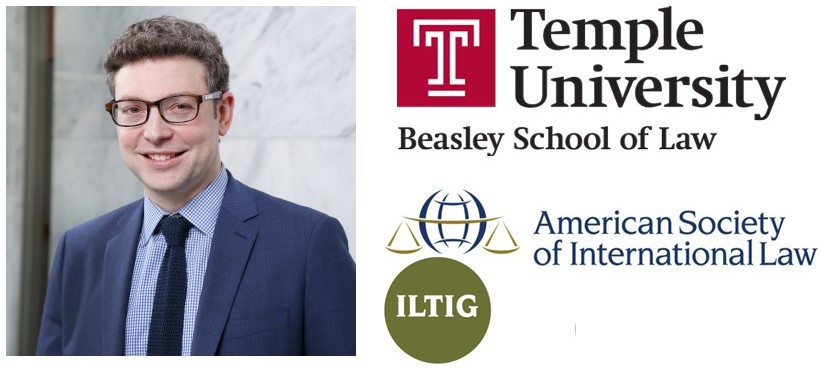
Harlan Grant Cohen, who is Gabriel M. Wilner/UGA Foundation Professor in International Law and Faculty Co-Director of the Dean Rusk International Law Center here at the University of Georgia School of Law, took part earlier this month in a workshop at Temple University Beasley School of Law in Philadelphia.

Cohen presented “Toward Best Practices for Trade-Security Measures” at the workshop, which waswhich was organized by Temple Law Professor J. Benton Heath and hosted by Temple Law’s Institute for International Law and Public Policy, in coordination with the American Society of International Law International Legal Theory Interest Group.

Within the overall theme of “The Concept of Security in International Law,” the workshop brought together scholars from a range of fields in order to address shifting understandings of security in international law and foreign affairs, as well as how law can respond to these developments.

Georgia Law Professor Cohen discusses developments in international trade law as part of plenary opening ASIL interest group conference at Texas A&M Law

Harlan Grant Cohen, who is Gabriel M. Wilner/UGA Foundation Professor in International Law and Faculty Co-Director of the Dean Rusk International Law Center here at the University of Georgia School of Law, took part in last Thursday’s opening plenary of the Biennial Conference of the American Society of International Law International Economic Law Interest Group.

On the opening plenary panel entitled “Sustainable Development and the Multiple Aims of Trade Law,” Cohen (above, 2d from left) primarily discussed the new competition to define international trade’s purpose, as well as the increasing enmeshments of trade and national security.

Organizer of the plenary was Nicolas Lamp, Queen’s University, Ontario (above, with Cohen to his left). Other panelists included (l to r): Ernesto Fernández Monge, Pew Charitable Trusts; Olabisi Akinkugbe, Schulich School of Law, Dalhousie University; Kathleen Claussen, University of Miami School of Law; Tony VanDuzer, University of Ottawa Faculty of Law; and Maria Panezi, University of New Brunswick School of Law. (photo credit)

The overall theme of the conference, which took place September 22 to 24 at Texas A&M University School of Law in Fort Worth, Texas, was “Energy, Sustainability, and International Economic Law.”

Georgia Law Professor Cohen publishes introduction to AJIL Unbound symposium

Harlan Grant Cohen, who is Gabriel M. Wilner/UGA Foundation Professor in International Law and Faculty Co-Director of the Dean Rusk International Law Center here at the University of Georgia School of Law, published “Introduction to the Symposium on Gregory Shaffer, ‘Governing the Interface of U.S.-China Trade Relations'” in 116 AJIL Unbound 38 (2022).

Professor Cohen also helped organize and edit the symposium, in which numerous scholars offer commentary on a 2021 American Journal of International Law article by Shaffer, who is Chancellor’s Professor of Law and Political Science at the University of California-Irvine, and President-Elect of the American Society of International Law.

Georgia Law Professor Diane Marie Amann to keynote, and alumna Lauren Brown to present, at upcoming European Society of International Law Research Forum in Glasgow, Scotland

The University of Georgia School of Law will be well represented at the annual Research Forum of the European Society of International Law, to be held March 31-April 1, 2022, at the University of Glasgow, Scotland. This year’s host, the Glasgow Centre for International Law & Security, has chosen a timely theme given the ongoing Ukraine-Russia conflict: “International Law an Global Security: Regulating an Illusion?” Among the many scholars exploring that topic will be:

  • Georgia Law Professor Diane Marie Amann (above left), who is scheduled to deliver the keynote address, entitled No Exit at Nuremberg: The Postwar Order as Stage for 21st-Century Global Insecurity, during the session beginning at 9 a.m. GMT/4 a.m. Eastern on Thursday, March 31. Amann is Regents’ Professor of International Law, Emily & Ernest Woodruff Chair in International Law, and Faculty Co-Director of the Dean Rusk International Law Center at Georgia Law; served from 2012 to 2021 as International Criminal Court Prosecutor Fatou Bensouda’s Special Adviser on Children in & affected by Armed Conflict; and is a member of the Coordinating Committee of ESIL’s Interest Group on International Criminal Justice. She is writing a book, under contract with Oxford University Press, on lawyers and other women professionals at the first post-World War II international criminal trial, held from 1945 to 1946 in Nuremberg, Germany.
  • Lauren Brown (above right), who earned her Georgia Law J.D. degree magna cum laude and was elected to the Order of the Coif in 2019, will present Keys to the Kingdom: Export Controls and What They Really Mean at 1:30 p.m. GMT/8:30 a.m. Eastern on Wednesday, March 30, as part of a panel entitled “International Economic Law and New Frontiers of Global Security.” Brown, who is an Associate in the International Trade Practice at the Squire Patton Boggs law firm in Washington, D.C., also holds a master’s degree from the University of Edinburgh, Scotland, as well as a bachelor’s degree from the University of North Carolina at Chapel Hill.

Registration to attend this event, either in-person or online, is free and available here.

Georgia Law Professor Harlan G. Cohen awarded Jackson Prize for his JIEL article “Nations and Markets”

The world’s leading international economic law publication has awarded its top scholarship honor to Harlan G. Cohen, Gabriel M. Wilner/UGA Foundation Professor in International Law and Faculty Co-Director of the Dean Rusk International Law Center here at the University of Georgia School of Law.

Cohen is the winner of the 2020 John H. Jackson Prize, bestowed by the Board of Editors of the Journal of International Economic Law, for his article “Nations and Markets” (prior posts).

As stated on the website of this Oxford University Press journal, the prize is named after its founding editor, John Howard Jackson (1932-2015), who, in the course of his career teaching law at Georgetown, Michigan, and Berkeley, kept “a keen eye on new developments and novel systemic interactions in the field beyond the four corners” of the General Agreement on Tariffs and Trade/World Trade Organization. With an aim to “underlining the importance of construing international economic law in this broader, ever changing perspective,” the Jackson Prize “is awarded annually to the article or other contribution in the JIEL that most significantly breaks new ground and adds new insights to the study and understanding of international economic law, especially in fields beyond a self-contained analysis of WTO law.”

Published in December 2020, Cohen’s “Nations and Markets” appears in volume 23, issue 4, of the peer-reviewed journal, at pages 793-815, and is available online here. Here’s the abstract:

Economics and security seem increasingly intertwined. Citing national security, states subject foreign investments to new scrutiny, even unwinding mergers. The provision of 5G has become a diplomatic battleground—Huawei at its center. Meanwhile, states invoke national security to excuse trade wars. The USA invoked the General Agreement on Tariffs and Trade national security exception to impose steel and aluminum tariffs, threatening more on automotive parts. Russia invoked that provision to justify its blockade of Ukraine, as did Saudi Arabia and the United Arab Emirates to excuse theirs of Qatar. And with the spread of COVID-19, states are invoking national security to scrutinize supply lines. Multiplying daily, such stories have led some observers to dub the era one of geoeconomics. Nonetheless, these developments remain difficult to judge, and the relationship between economics and national security remains confused and slippery. The essay seeks clarity in the deeper logic of these labels, revealing a fundamental choice between the logics of markets and the logics of state. Whether invoked to ‘secure’ borders, privacy, health, the environment, or jobs, ‘national security’ is a claim about the proper location of policymaking. Appeals to economics, with their emphasis on global welfare and global person-to-person relationships, are such claims as well. Resolving disputes, this essay argues, requires recognizing these root choices.

Georgia Law Professor Cohen presents “Sociology of WTO Precedent” at Leiden “Behavioral Approaches” workshop

Harlan Cohen, the Gabriel M. Wilner/UGA Foundation Professor in International Law and Faculty Co-Director of the Dean Rusk International Law Center here at the University of Georgia School of Law, presented on “The Sociology of WTO Precedent” last month at a workshop entitled “Behavioral Approaches to International Law.”

It was sponsored online by the Grotius Centre for International Legal Studies at Leiden Law School in the Netherlands, in partnership with the Institute of Law and Economics at the University of Hamburg in Germany, and iCourts at the University of Copenhagen in Denmark. Organizers were Leiden Professor Daniel Peat, Copenhagen Professor Veronika Fikfak, and Hamburg Professor Eva van der Zee.

Georgia Law Prof. Cohen presents on “Future of Trade” in webinar hosted by CAROLA/Georgetown Law

Harlan Cohen, the Gabriel M. Wilner/UGA Foundation Professor in International Law and Faculty Co-Director of the Dean Rusk International Law Center here at the University of Georgia School of Law, recently joined a quartet of scholars and practitioners in presenting a webinar on “The Future of Trade,” hosted by CAROLA, the Center for the Advancement of the Rule of Law in the Americas at Georgetown Law.

Topics discussed included the World Trade Organization, the United States-Mexico-Canada Agreement, increasing U.S. use of national security measures to pursue trade objectives, and trade wars between the United States and China.

Georgia Law Prof. Cohen presents “Nations and Markets” at International Economic Law and Policy seminar

Harlan Cohen, who is Gabriel M. Wilner/UGA Foundation Professor in International Law and Faculty Co-Director of the Dean Rusk International Law Center here at the University of Georgia School of Law, recently presented his paper, “Nations and Markets,” in the International Economic Law and Policy work-in-progress seminar.

IELAP is a London-based series (currently online) convened by: Dr. Federico Ortino, Reader of International Economic Law, King’s College London; Dr. Lauge Poulsen, Associate Professor in International Political Economy and Director of Graduate Studies in Political Science, University College London; and Dr. Mona Pinchis-Paulsen , Assistant Professor at the Department of Law, London School of Economics.

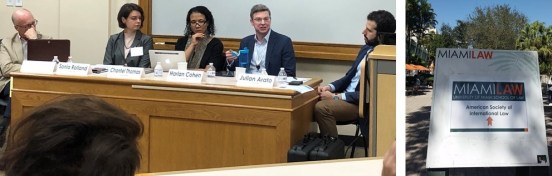
Georgia Law Professors Cohen, Durkee present at Miami Law for ASIL international economic law biennial

Two international law experts here at the University of Georgia School of Law presented their scholarship and took part in panel discussions at “Designing International Economic Law: Challenges and Opportunities,” an American Society of International Law biennial conference held last week at the University of Miami School of Law.

Harlan G. Cohen, Gabriel M. Wilner/UGA Foundation Professor in International Law and Faculty Co-Director of our Dean Rusk International Law Center, presented “Nations and Markets,” and also participated in a roundtable on “Critical Perspectives on International Economic Law.”

Professor Melissa J. Durkee, J. Alton Hosch Associate Professor of Law, presented “Interpretive Entrepreneurs and the Re-Design of International Economic Law.”

The 2-day conference included scholars and practitioners from Argentina, Australia, Barbados, Brazil, Canada, China, Colombia, Denmark, Ecuador, England, Finland, France, Germany, Hungary, Indonesia, Israel, Italy, Japan, Luxembourg, Mexico, the Netherlands, New Zealand, Qatar, South Africa, Switzerland, and Turkey, as well as the United States.

(photo credits here and here)