“Law of Global Economic Statecraft,” October 24 Georgia Journal of International and Comparative Law conference, to feature book keynote discussion with Nicholas Mulder

This year’s annual conference of the Georgia Journal of International and Comparative Law will consider a highly topical question: “The Law of Global Economic Statecraft.” Featured will be a keynote discussion by Cornell University historian Nicholas Mulder, author of The Economic Weapon: The Rise of Sanctions as a Tool of Modern War (Yale University Press 2022), as well as panels including more than a dozen experts from around the world.

The daylong conference will take place on Monday, October 24, in the Larry Walker Room of Dean Rusk Hall at the University of Georgia School of Law.

Sponsoring along with GJICL, a 50-year-old student-edited journal, is the law school’s Dean Rusk International Law Center. GJICL Executive Conference Editor, 3L Claire Kimbrell, and Senior Conference Editor, Sarah Grace McCord, worked closely with Catrina Martin, the Center’s Global Practice Preparation Assistant, and with GJICL’s Faculty Advisor, Professor Harlan Grant Cohen, who is Gabriel M. Wilner/UGA Foundation Professor in International Law and one of the Center’s Faculty Co-Directors.

The University of Georgia Willson Center for Humanities & Arts is a cosponsor of the keynote event. Additional conference cosponsors include these University of Georgia units: Georgia Law students’ International Law Society; the Center for International Trade & Security, School of Public & International Affairs; the Department of History, Franklin College of Arts & Sciences; and the Department of Economics, Terry College of Business.

Registration for all aspects of the conference (to be livestreamed for online registrants) here.

Here’s the concept note:

“The global economy has been weaponized.  It’s not clear when it happened, or whether it’s even something new, but watching the response to Russia’s invasion of Ukraine has made it impossible to ignore.  With breathtaking speed, a full phalanx of sophisticated economic tools was mobilized against Russia that threatened to sever it from the global economy.  For its, part, Russia demonstrated the continued force of its own economic weapons – its control over substantial supplies of oil and gas.  But the speed with which these tools were amassed was in fact testament to years of experiments and practice.  Economic tools that had been developed to isolate “rogue states,” to fight terrorist networks, and to punish human rights abusers had begun to show how the carrot of the global market could quickly become a lever of influence and a forceful stick.  But these tools gained new prominence as they were refined and redeployed for use in the intensifying economic and geopolitical rivalry between China, the United States, and Europe.  

“Is international law prepared for this reality?  Until recently, tools of economic pressure have been left largely to the margins of the discipline, treated at best as the preferred alternative to more regulated fields of military activities, at worst as exceptional tools that could largely be ignored – even in the face of critiques from the Global South and regarding human rights.  While every international law textbook has chapters on the regulation of military activity and economic cooperation, few have standalone sections on sanctions.  International economic law regimes meanwhile struggle to adapt to the realities of ‘geoeconomics’ and ‘weaponized interdependence,’ in which, structures designed to encourage economic cooperation are repurposed as tools of competition and rivalry.

“A reconsideration is long overdue.  This symposium surveys the current state of economic statecraft – the tools in use, their purposes, and their targets.  It explores how they are or should be regulated.  But most importantly, it seeks to put today’s economic statecraft in historical, political, and legal context asking critical questions about the international order they reflect and the international order they might require.”

The day’s events are as follows:

9-9:10 am Welcome

  • Melissa J. “MJ” Durkee, Associate Dean for International Programs, Director of the Dean Rusk International Law Center, and Allen Post Professor, University of Georgia School of Law

9:10-10:30 am How We Got Here

Speaking on this 1st panel:

  • Zohra Ahmed, Assistant Professor of Law, University of Georgia School of Law
  • Mona Ali, Associate Professor of Economics, State University of New York-New Paltz
  • Henrique Choer Moraes, Minister-Counsellor, Embassy of Brazil in New Zealand
  • Nicholas Mulder, Assistant Professor and Milstein Faculty Fellow, Cornell University Department of History

10:45 am-12:05 pm Where We Are

Lauren Brown, Associate, Squire Patton Boggs, Washington, D.C., will moderate this 2d panel. Speaking will be:

  • Sarah Bauerle Danzman, Director, Tobias Center for Innovation in International Development, and Associate Professor, International Studies, Indiana University-Bloomington
  • Maryam Jamshidi, Associate Professor of Law University of Florida Levin College of Law
  • Tom Ruys, Professor, Faculty of Law and Criminology, Department of European, Public, and International Law, Ghent University, Belgium
  • Jan Zahradil, Member, European Parliament

1:05-2:25 pm Where We’re Headed

Speakers on this 3d panel:

  • Elena Chachko, Lecturer on Law, Harvard Law School
  • J. Benton Heath, Assistant Professor of Law, Temple University Beasley School of Law
  • Henry Farrell, SNF Agora Institute Professor of International Affairs at SAIS, Johns Hopkins University
  • Mona Paulsen, Assistant Professor of Law, London School of Economics Law School, England

2:40-3:55 pm Keynote Book Discussion on “The Economic Weapon: The Rise of Sanctions as a Tool of Modern War”

3:55 pm Thank You

  • Courtney Robinson, Editor-in-Chief, Georgia Journal of International and Comparative Law
One week at Guantánamo Bay, a land filled with stark contrasts

Davis Wright is a recent graduate of the University of Georgia School of Law (JD magna cum laude 2022). During his time in law school, Davis was: Executive Articles Editor for Vol. 50 of the Georgia Journal of International & Comparative Law; co-founder and co-president of the Privacy, Security, and Technology Law Society; and participant in the 2021 Philip C. Jessup International Law Moot Court Competition. Additionally, he completed a semester-long externship in Norfolk, Virginia, in the legal department of HQ SACT, a leading unit of the North Atlantic Treaty Organization; his prior post on that NATO experience is here. This month, Davis will begin practicing law as an Associate at Jones Day in Atlanta. He would like to thank Georgia Law’s Dean Rusk International Law Center for contributing funding to allow him to fly to Washington, D.C., in order to participate as a nongovernmental organization (NGO) observer in Guantánamo Bay, Cuba – an experience that he recounts in this post.

From September 9 to 16, 2022, I was granted the opportunity to be the National Institute of Military Justice NGO Observer at the U.S. Military Commission hearings at Naval Station Guantanamo Bay (NSGB) in Guantánamo Bay, Cuba, in the case against the defendant known as Abd al-Hadi al-Iraqi, although he calls himself Nashwan al-Tamir.

During my time in Guantanamo, I found stark contrasts everywhere: internally, with how I viewed Mr. al-Hadi’s treatment, and externally, with all that I observed on NSGB.

Guantánamo Bay is a beautiful place. Flying into the airstrip of NSGB, you can see the stunning landscape of Cuba, with many mountains jutting out from the island.

After crossing the bay via ferry, surveying the views on water, I arrived at the area of the base that includes Camp Justice, the makeshift complex where the military commissions are held.

After completing check-in, passing through security, and being instructed on what I could and could not do while on base, I was given a tour of the base by my escort.

This was where I noticed the first contrast:

  • Initially, I was shown rocky beaches with clear blue water, breathtaking lookouts with 360-degree views, and lively wildlife that was all around, including iguanas, banana rats, deer, and guinea fowl.
  • But then I also was able to view Camp X-Ray, the hastily thrown together detention facility that housed the first of captives held at Guantánamo Bay in the United States’ war on terror. In this facility, and then in the more permanent Camp Delta afterwards, detainees were (and still are) held without charges, and many allege that they were tortured and abused. X-Ray is now unused and run down, poking out through the overgrown foliage that threatens to swallow it. Nevertheless, it casts a dark shadow and eerie presence over the otherwise idyllic landscape.

The next day, we were shown all that Guantánamo Bay has to offer. There are the aforementioned beaches, a bowling alley, an arcade, an Irish pub, a tiki bar, basketball, racquetball, and pickleball courts, mini-golf, and much more. And I took advantage, by eating, drinking, and enjoying myself on an island that displayed beauty everywhere I looked.

This was the next contrast.

Because while I had just enjoyed what was essentially a day of vacation on a Sunday in Guantánamo Bay, the next morning, behind layers of security, I was observing a U.S. Military Commission hearing for Mr. al-Hadi.

The pre-sentencing hearing that day focused on Mr. al-Hadi’s failing health. Mr. al-Hadi has previously endured 5 spine surgeries, due to a degenerative-spine disease. He needs a sixth. However, an MRI machine is needed to evaluate his spine, and the only one to which he has access at Guantánamo Bay has been broken since November 2021. Although the previous MRI machine had been provided via an awarded contract to a private company, the government failed to contract for maintenance, and, as a result, the machine demagnetized due to a catastrophic loss of helium. Mr. al-Hadi also needs a dexa scan, and the base does not have this capability.

The government has provided an estimate of December 2022 for the operability of a new MRI machine and download of software to the existing CT scan machine to make a dexa scan possible. However, the previous (and now broken) MRI machine took several years to finally make its way to the base and become operational. Due to this, the defense counsel expressed deep skepticism over whether the government’s timeline was realistic. Counsel asked to take the testimony of the Senior Medical Officer – the equivalent of Mr. al-Hadi’s primary care physician – to inquire into his current health situation. Defense counsel also asked to take the testimony of the chair of the Senior Medical Advising Committee, arguing that this individual likely has information regarding the procurement and administration of the MRI machine.

Who, exactly, is this defendant?

Mr. al-Hadi was captured in Turkey in late 2006 and held at a CIA black site for 5 to 6 months. After this time, he was transferred to the detention facility at NSGB. As described in an article by New York Times reporter Carol Rosenberg, this past June Mr. al-Hadi pleaded guilty to the “war crimes of attacking private property – a U.S. military medevac helicopter that insurgents who answered to him failed to shoot down in Afghanistan in 2003 – and of treachery and conspiracy connected to insurgent bombings that killed at least three allied troops, one each from Canada, Britain and Germany.” Many of his fellow detainees are accused of other war crimes; they include Abd al-Rahim al-Nashiri, who allegedly orchestrated the attacks on the USS Cole, and Khalid Shaikh Mohammed, who is alleged to have been one of the masterminds behind the 9/11 attacks.

This is yet another contrast.

It is hard to feel sympathetic for the detainees, including Mr. al-Hadi, because most have legitimately committed heinous crimes against the United States. Yet – unlike others who have also committed heinous crimes but were convicted in U.S. courts – detainees at Guantánamo Bay were held for lengthy periods of time without charges. Many detainees allege that they were tortured either before coming to or during their time on base. These men are also aging and facing increasing health problems, which the government, to date, has inadequately addressed. It is easy to want to ignore these injustices when faced with the war crimes that were committed by those held in Guantanamo Bay. But as Dr. Martin Luther King Jr. said: “Injustice anywhere is a threat to justice everywhere.” And although that quote may be cliché, the United States (and those keeping it accountable) must fight to the urge to allow the crimes of the accused to determine the quality of the legal process they receive.

After the Monday hearing, Tuesday was a classified session, which NGO observers were prohibited from attending, presumably because the judge granted one or both of the defense counsel’s motions for new testimony. And the Wednesday through Friday hearings were either cancelled or classified as well.

This led to the final contrast that I observed. While I got a few more days of relaxing in the sun on the government’s dime, I was flown down to Guantanamo Bay on a charter flight, housed, and provided an escort all for no cost, it remains to be seen whether Mr. al-Hadi ever gets his MRI and dexa scan from that same government.

Welcoming newest class of Master of Laws (LL.M.) students to Georgia Law

With the Fall 2022 semester in full swing, we at the Dean Rusk International Law Center are proud to welcome another class of talented lawyers, now studying for our University of Georgia School of Law Master of Laws (LL.M.) degree.

The group of 23 hail from 15 different countries in Africa, Asia, Europe, and the Americas, including Argentina, Brazil, Egypt, Georgia, Germany, India, Iran, Nigeria, Panama, Russia, Tunisia, Turkey, Ukraine, Uzbekistan, and Vietnam. Among them are a judge and lawyers specializing in a wide range of fields, including corporate transactional law, employment law, international trade, arbitration, antitrust law, and information privacy.

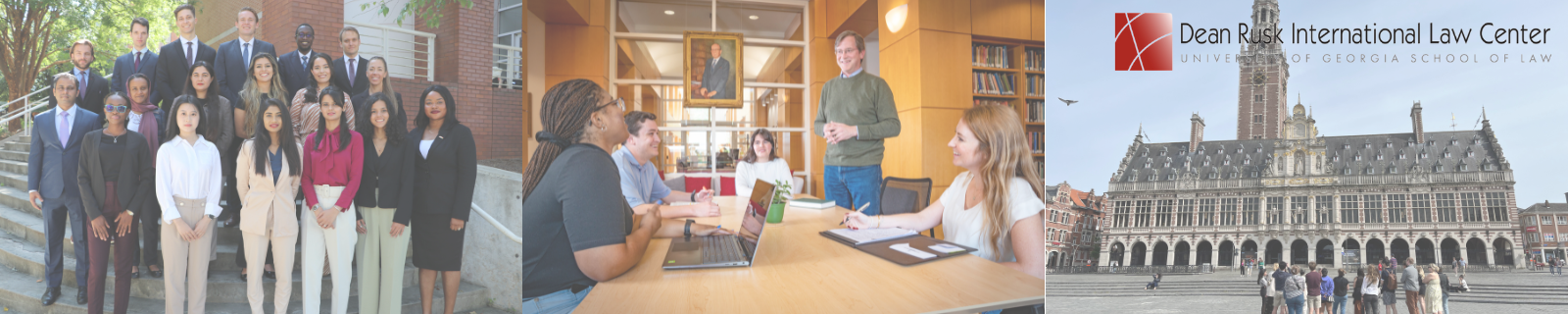
Some of them are pictured above, standing on the steps of Dean Rusk Hall. Left to right, they are: top row, Vladyslav Rudzinskyi, John Omotunde, Jasur Ziyautdinov, Abdulganiyu Mustapha; middle row, Tatyana Popovkina, Ngoc Quynh Vu, Anastasia Popkova, Alexandra Lampe, Khatia Zukhubaia, Rawdha Hidri, Sarthak Goel; and bottom, Saideh Ghasemi Moghadam, Manaswini Reddy Mogiligundla, Gloria Correa, Oleksandra Iordanova, Olha Kaliuzhna, Rocío Buosi, Jeremias Brusau, Mahmoud Mohamed, and Binh Nguyen. LL.M. students not pictured are Divine Atsegbua, Alexandre Laranjeira, and Abdullah Talha Tosun.

This Class of 2023 joins a tradition that began at the University of Georgia School of Law in the early 1970s, when a Belgian lawyer became the first foreign-trained practitioner to earn a Georgia Law LL.M. degree. In the ensuing four decades, the law school and its Dean Rusk International Law Center have produced nearly 600 LL.M. graduates, with ties to nearly 100 countries and every continent in the world.

Side by side with J.D. candidates, LL.M.s follow a flexible curriculum tailored to their own career goals – goals that may include preparation to sit for a U.S. bar examination, or pursuit of a concentration affording advancement in their home country’s legal profession or academic institutions.

The application for the LL.M. Class of 2024 is now open; for information or to apply for LL.M. studies, see here.

Consul General’s talk on Mexico’s federal lawsuit against arms makers opens 2022-2023 events calendar at Georgia Law’s Dean Rusk International Law Center

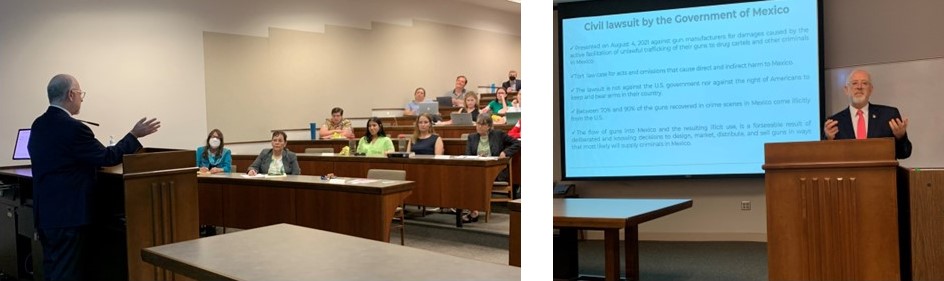
Our schedule of 2022-2023 events here at the University of Georgia School of Law Dean Rusk International Law Center opened yesterday with a compelling presentation by the Consul General of Mexico in Atlanta.

In a talk entitled “Institutional Structure of the U.S.-Mexico Relations and Key Bilateral Issues: Mexico’s Legal Case Against U.S. Gun Manufacturers,” Ambassador Javier Díaz de León began by outlining ways that Mexico and the United States – often along with their neighbor to the north, Canada – discuss and seek solutions to common problems.

One concern, of course, is security; in Mexico’s case, the southward flow of firearms and money that enable drug cartels to operate. After providing statistics on the high proportion of weapons confiscated in Mexico that have been manufactured or distributed in the United States, Ambassador Díaz turned to what he rightly called the “landmark” step that his government took on August 4, 2021, when it filed Estados Unidos Mexicanos v. Smith & Wesson Brands et al. in the U.S. District Court for the District of Massachusetts. That civil tort suit alleges that Smith & Wesson and 10 other firearms manufacturers or distributors unlawfully permitted U.S. weapons to enter Mexico, where firearms are, for the most part, prohibited. According to Ambassador Díaz, a federal judge heard argument on defendants’ motion to dismiss last spring, but has not yet ruled on that motion, and discovery is under way.

Following his presentation, Georgia Law Regents’ Professor Diane Marie Amann, one of our Center’s Faculty Co-Directors, moderated questions from the audience, composed mostly of students.

This marked the ambassador’s second visit to our University of Georgia School of Law Dean Rusk International Law Center; in 2018, also as part of our Consular Series, he spoke on “Mexico’s Relation with Georgia: Connecting Paths.”

Cosponsoring yesterday’s event with our Center were the Latin American & Caribbean Studies Institute at the University of Georgia, as well as two Georgia Law student groups, the Hispanic Law Students Association and the International Law Society.

Follow this webpage or our Twitter feed to learn about upcoming events.

Georgia Law’s Community HeLP Clinic assists client in winning bid for asylum

A client of the Community Health Law Partnership Clinic here at the University of Georgia School of Law was recently granted asylum, a status that provides permanent protection to noncitizens fleeing persecution on the basis of their race, religion, nationality, political opinion, or membership in particular social groups. 

The Clinic’s client had fled to the United States alone as a 16-year-old, after facing death threats and physical violence in Guatemala, and had requested asylum at the U.S. border. The Asylum Office of the U.S. Citizenship and Immigration Services initially interviewed the client in 2018. (photo credit) However, a torrent of subsequent administrative decisions upended longstanding asylum policies, leaving his fate in limbo. 

The Community HeLP Clinic reactivated the case early this year. It successfully argued that the Guatemalan government was unable or unwilling to control persecution against the client by private actors. As a result of the asylum grant, the client no longer faces deportation and can focus on rebuilding his life in the United States.

The Clinic’s Staff Attorney, Kristen Shepherd, handled the initial presentation of the case before the Asylum Office. Navroz N. Tharani, who completed his Georgia Law JD in May 2022, wrote the brief, supervised by Shepherd and by Clinic Director Jason Cade, who is Associate Dean for Clinical Programs and Experiential Learning and J. Alton Hosch Associate Professor of Law. Eddy Atallah, a member of the JD Class of 2021, assisted with earlier research.

Georgia Law students bound for summer Global Externships with law firms, corporations, NGOs across the globe

Eleven Georgia Law students will earn global practice experience this summer through the Global Externship Overseas initiative of the Dean Rusk International Law Center here at the University of Georgia School of Law.

Through the GEO initiative, students enhance their legal studies by working for law firms, in-house legal departments, and nongovernmental organizations. This summer’s placements are based in Asia, Europe, and the Americas. Practice areas include dispute resolution, data privacy, corporate law, refugee law, cultural heritage law, international human rights law, and international criminal law.

This year’s GEO class includes these placements in private-sector legal settings:

These students will work for nongovernmental organizations:

More information here about GEOs and other Dean Rusk International Law Center initiatives. (image credit)

Georgia Law students take part in ASIL annual meeting through Louis B. Sohn Professional Development Fellowships

Still holding warm memories of this year’s American Society of International Law Annual Meeting are the four University of Georgia School of Law students who volunteered at last month’s gathering of international lawyers in Washington, D.C. Pictured above, they are, from left, LL.M. candidates Agustina Figueroa Imfeld and Veronika Grubenko, along with 1Ls Jack Schlafly and John Carter.

Once again this year, Louis B. Sohn Professional Development Fellowships, awarded by the law school’s Dean Rusk International Law Center, supported the students’ travel to the April 2022 conference. (Prior posts here, here, and here.)

Meeting students and professionals from many locales was rewarding, Grubenko said. “Each of them shared their knowledge of preparing and sitting for various bar exams, job search, and university experiences.” For those students who had never visited Washington before, the opportunity to visit historical landmarks, at a time when the famed cherry blossoms still were in bloom, was most welcome.

In addition to assisting with annual meeting logistics, all four attended “Privatizing International Governance,” a session chaired by Melissa J. “MJ” Durkee, who is Associate Dean for International Programs, Director of the Dean Rusk International Law Center, and Allen Post Professor here at Georgia Law.

Many other sessions also were of interest, on issues ranging from transnational discovery of e-evidence to international criminal law. In the words of Figueroa Imfeld:

“There were so many pressing issues being discussed: climate change, shareholder activism, migration, war, sanctions, digital privacy, etc. It was particularly interesting to hear from lawyers on the opposite sides of those issues, which made me rethink a lot of my own opinions about them.”

Citing in particular remarks delivered by Chile Eboe-Osuji, former President of the International Criminal Court, on the ICC’s jurisdiction over the ongoing conflict in Ukraine, Carter described the annual meeting as “highly engaging” and “intellectually stimulating,” adding that it “helped expose me to career paths that I can model as I move forward in law school.” Echoing him was Schlafly, who said: “Attending the ASIL conference further confirmed my desire to work in international law.”

Georgia Law students named top oralists, and team finishes in world’s top 16, at Jessup International Law Moot Court

Our exceptionally talented team of University of Georgia School of Law students – 2Ls Millie Price, Courtney Robinson, Caleb Grant, James Stewart, and Alex Krupp – competed last week through to the Octofinals of one of the world’s most prestigious law tournaments, the Philip C. Jessup International Law Moot Court Competition.

2022 Georgia Law Jessup team: clockwise from upper left, Caleb Grant, James Stewart, Alex Krupp, Millie Price, Courtney Robinson

Making their achievement even sweeter, team member Robinson tied as the best overall oralist through the Advanced Rounds, while teammate Stewart was named fifth best. They and they teammates prepared written memorials and gave oral arguments as if they were appearing before the International Court of Justice, the judicial arm of the United Nations which adjudicates international law disputes.

In reaching the Octofinals, the Georgia Law team bested many other competitors, in a tournament that attracted nearly 3,500 students from about 700 law schools in 100 countries and jurisdictions. They lost in that International Round to a team from Canada’s University of Western Ontario. Winning the entire tournament was Harvard, against whom Georgia had competed last month in Jessup’s U.S. championship round.

Leading the team were 3L coach Courtney Hogan and faculty advisor/coach Anna White Howard, both themselves former Jessup advocates.

The team benefited from moots and other assistance by many members of the Georgia Law community, including: Professor Melissa J. “MJ” Durkee, Associate Dean for International Programs and Director of the law school’s Dean Rusk International Law Center, and Professors Diane Marie Amann and Harlan Grant Cohen, the Center’s Faculty Co-Directors; Georgia Law Dean Peter B. “Bo” Rutledge; Kellie Casey, Director of Advocacy; Anne Burnett, Foreign and International Law Librarian; Professors Nathan S. Chapman, Rob McNiff, and Lori A. Ringhand; and alums, Judge Ben Cheesbro, Ellen Clarke, Erik Chambers Myra Creighton, Amy Helmick, and Roger Grantham..

The Washington, D.C.-based International Law Students Association is Jessup’s primary host, with the law firm of White & Case sponsoring the International Rounds as well as some national competitions.

Immigrants and rights of free speech, free exercise of religion topic of Georgia Law Review symposium March 18

“Immigrants and the First Amendment: Defining the Borders of Noncitizen Free Speech and Free Exercise Claims” is the title of this year’s annual day-long symposium of the Georgia Law Review, to be held Friday, March 18, in hybrid format at the University of Georgia School of Law. Featured will be a keynote by immigrant activist Ravi Ragbir, the plaintiff in a high-profile federal lawsuit alleging retaliation for activism.

Here’s the concept note:

“Immigration law, as well as immigrant activism, are intersecting with the First Amendment in new and surprising ways. This year’s Georgia Law Review Symposium will bring together a diverse set of voices to discuss these exciting new crossovers, providing a forum to explore the nuances of the First Amendment’s scope as applied to immigrants, immigrant advocates, and potential immigrants outside of the country. This is an area of law that is becoming increasingly more topical, and many questions that arise from these areas remain unanswered or ambiguous.”

Details and registration here for the conference, which will take place in-person in the Larry Walker Room on the 4th floor of Georgia Law’s Dean Rusk Hall, and which also welcomes online attendees.

Following opening remarks at 9 a.m., panels will proceed as follows:

9:10-10:35 a.m., “Immigrant Speech and Government Retaliation”

“Despite being entitled to First Amendment rights, immigrants, particularly those without documentation, are highly vulnerable to government suppression of, or retaliation against, their exercise of free speech rights. Recent or ongoing cases in this area include Oldaker v. Giles in the Middle District of Georgia, which concerns first amendment claims brought on behalf of women alleging retaliation for medical abuse at an immigration detention center; and Ragbir v. Homan, which concerns the government’s retaliatory deportation of prominent immigrant rights activists.”

Speaking within that theme on this first panel of the morning will be: Alina Das, Professor of Clinical Law, New York University School of Law; Charles H. Kuck, Managing Partner of Kuck Baxter LLC, an immigration law firm in Atlanta, and an Adjunct Professor at Emory University School of Law; Daniel I. Morales, Associate Professor of Law and George A. Butler Research Professor, University of Houston Law Center; and Clare R. Norins, Clinical Assistant Professor and Director of the First Amendment Clinic at Georgia Law. Moderating will be Jason A. Cade, who is Associate Dean for Clinical Programs, Experiential Learning and J. Alton Hosch Associate Professor of Law, and Community Health Law Partnership Clinic Director at Georgia Law.

10:35 a.m.-12 noon, “Back to the Future: Immigrant Speech Rights Yesterday and Tomorrow”

“From John Lennon to Charlie Chaplin to many less famous immigrants, United States immigration history is riddled with deportation or exclusion decisions based on immigrants’ expression. Looking to the future, it is possible that constitutional free speech rights are best shored up by legislative and administrative solutions.”

Speaking within that theme on this last morning panel will be: Michael Kagan, Joyce Mack Professor of Law and Director of the Immigration Clinic at the William S. Boyd School of Law, University of Nevada-Las Vegas; Jennifer Koh, Associate Professor of Law and Co-Director of the Nootbaar Institute for Law at the Caruso School of Law, Pepperdine University, Malibu, California; Julia Rose Kraut, author of Threat of Dissent: A History of Ideological Exclusion and Deportation in the United States (Harvard University Press 2020); and Gregory P. Magarian, Thomas and Karole Green Professor of Law, Washington University in St. Louis School of Law. Moderating will be Jonathan Peters, Associate Professor of Journalism at the University of Georgia Grady College of Journalism and Mass Communications, who also holds a courtesy appointment on the Georgia Law faculty.

1-2:20 p.m., “The First Amendment’s Limits Abroad After Trump v. Hawaii: Free Exercise, Executive Power, and Justiciability”

“Trump v. Hawaii is the most recent high-profile iteration of immigration actions allegedly taken on the basis of religion. In addition to exploring first amendment issues respecting the religion of potential migrants, this panel will also cover issues relating to the differences in executive power as it pertains to potential immigrants as opposed to immigrants already on U.S. soil, as well as the difficulties associated with immigrants vindicating asserted constitutional rights from abroad.”

Speaking within that theme on this afternoon panel will be: Christopher Lund, Associate Dean for Research and Faculty Development and Professor of Law, Wayne State University Law School, Detroit, Michigan; Zachary Price, Professor of Law, University of California Hastings College of the Law; and Shalini Bhargava Ray, Associate Professor of Law, University of Alabama School of Law. Moderating will be Nathan S. Chapman, Pope F. Brock Associate Professor in Professional Responsibility at Georgia Law.

2:20-3:15 p.m., “Keynote Address” by Ravi Ragbir, followed by a closing reception.

Georgia Law at top in international law, Center-administered NATO externship featured in national preLaw magazine

The just-released issue of preLaw magazine places the University of Georgia School of Law among the United States’ top international law curriculums; in so doing, it features an initiative of our Dean Rusk International Law Center.

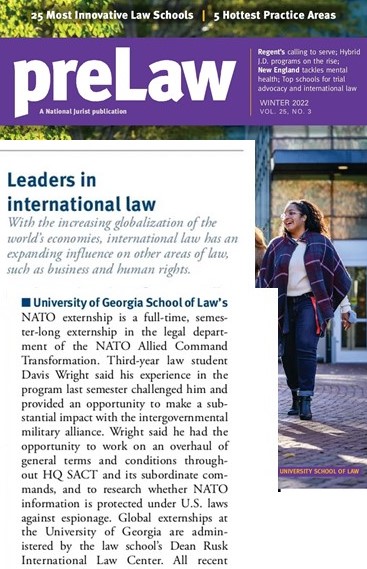
In an article entitled “25 Most Innovative Law Schools,” author Michelle Weyenberg reports (page 42) on a valued partnership which Georgia Law entered several years ago with the North Atlantic Treaty Organization. Georgia Law’s “NATO externship,” she writes, “is a full-time, semester-long externship in the legal department of the NATO Allied Command Transformation.” She then describes experiences by our most recent extern, 3L Davis Wright, who worked in-person in Norfolk, Virginia, throughout the Fall 2021 semester (prior post):

“Third-year law student Davis Wright said his experience in the program last semester challenged him and provided an opportunity to make a substantial impact with the intergovernmental military alliance. Wright said he had the opportunity to work on an overhaul of general term and conditions throughout HQ SACT and in its subordinate commands, and to research whether NATO information is protected under U.S. laws against espionage.”

The NATO externship is one of many with international components in Georgia Law’s D.C. Semester in Practice initiative, directed by Georgia Law Professor Jessica Heywood, and also one of our Center’s many Global Externships Overseas and At-Home (GEO/GEA), administered by Sarah Quinn, our Center’s Associate Director for Global Practice Preparation.