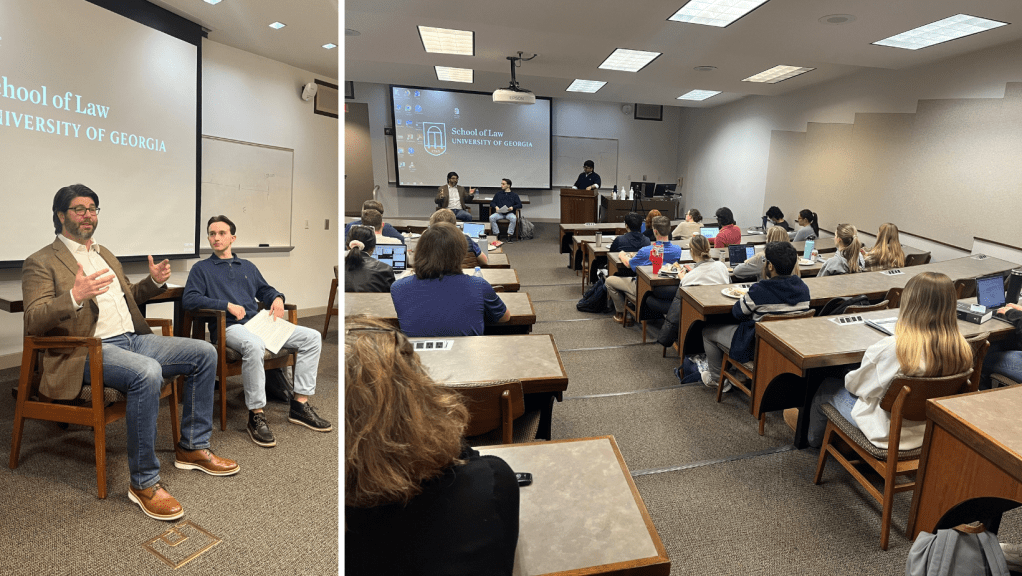
University of Georgia School of Law alumnus Clete Johnson (J.D., ’04), Partner at Wilkinson Barker Knauer LLP and non-resident senior fellow with the Strategic Technologies Program at the Center for Strategic and International Studies (CSIS), recently spoke to students about TikTok and its national security implications at an event hosted by the Dean Rusk International Law Center, the International Law Society, and the Privacy, Security, and Technology Law Society.
Johnson discussed how being in law school during 9/11 galvanized his interest in national security law. After graduation, he moved to DC and was able to gain experience in a wide variety of national security and cybersecurity leadership roles. His work in these national security and intelligence communities, in the regulatory arena, and in the Executive Branch now inform his advocacy to improve the efficiency of government-industry collaboration. Johnson stated that we are at an inflection point: incredible breakthroughs in technology and connectivity have the potential to solve the grand challenges of our time, but, as large holders of data, they can pose dangers to our freedoms.
Johnson was most recently the senior adviser for cybersecurity and technology at the U.S. Department of Commerce, where he coordinated the department’s cybersecurity initiatives and support for the Commission on Enhancing National Cybersecurity. He was also the department’s representative for National Security Council staff deliberations on cybersecurity, encryption, and other policy issues at the intersection of technology and security. Previously, Johnson was appointed by the Federal Communications Commission (FCC) chairman as the FCC’s first chief counsel for cybersecurity. In that position, he helped develop the FCC’s cybersecurity mission, focusing on creating new legal mechanisms for government collaboration with private sector stakeholders to improve the security and reliability of communications infrastructure. He was also the primary drafter of the charter for the Cybersecurity Forum for Independent and Executive Branch Regulators, a coordinating body of regulatory agencies presently chaired by the FCC. Prior to his time at the FCC, Johnson was Senator John D. Rockefeller IV’s designated counsel on the Senate Intelligence Committee and counsel for defense, foreign policy, and international trade. In those roles, he was a leading staffer on bipartisan Senate cybersecurity initiatives and the primary staff drafter of the legislation that codified the National Institute of Standards and Technology’s collaborative process to work with industry to develop and update the Cybersecurity Framework.
Before his government service, Johnson worked for a major Washington-based law firm, where he practiced in the areas of international trade, defense, and security. Earlier, he served as a U.S. Army officer in Germany, Korea, and the Balkans. He is a graduate of the University of Georgia School of Law, where he was editor-in-chief of the Georgia Journal of International and Comparative Law, and he received a master of science degree in international relations from the London School of Economics and Political Science. He received his bachelor’s degree from Harvard University, where he graduated cum laude, cross-enrolled at the Massachusetts Institute of Technology for service as executive officer of its Army ROTC Paul Revere Battalion.
 exchange of notes