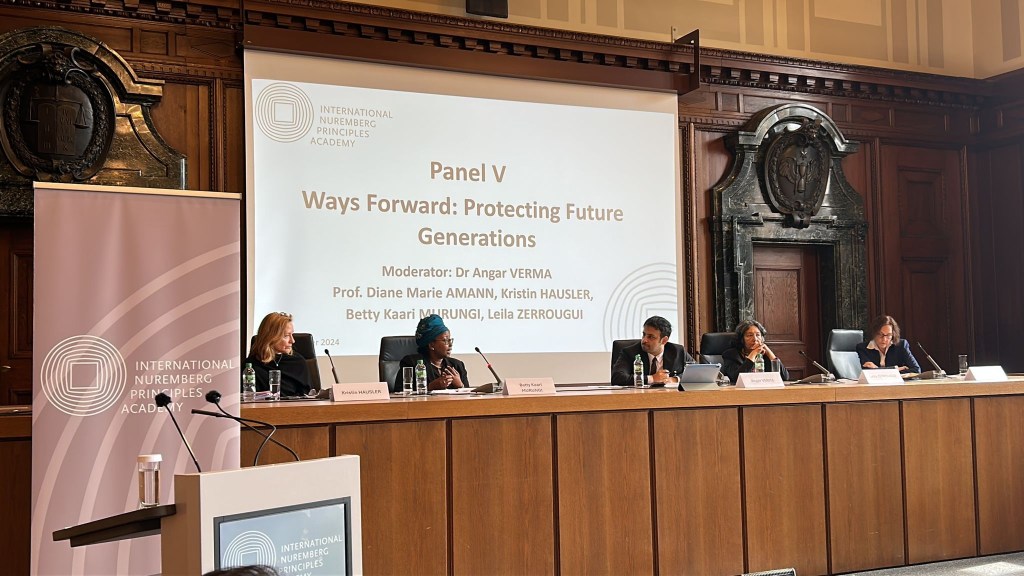
University of Georgia School of Law Professor Diane Marie Amann spoke at last week’s Nuremberg Forum 2024, the annual three-day meeting of the International Nuremberg Principles Academy. It was held in the Nuremberg, Germany, courtroom where hundreds of Nazi defendants were tried in the wake of World War II.
The theme of this year’s Forum was “For Every Child: Protecting Children’s Rights in Armed Conflict.” Amann spoke on the closing panel, “Ways Forward: Protecting Future Generations,” pictured above. She is pictured at right along with, l to r: Kristin Hausler; Betty Kaari Murungi; moderator Angar Verma; and Leila Zerrougui.
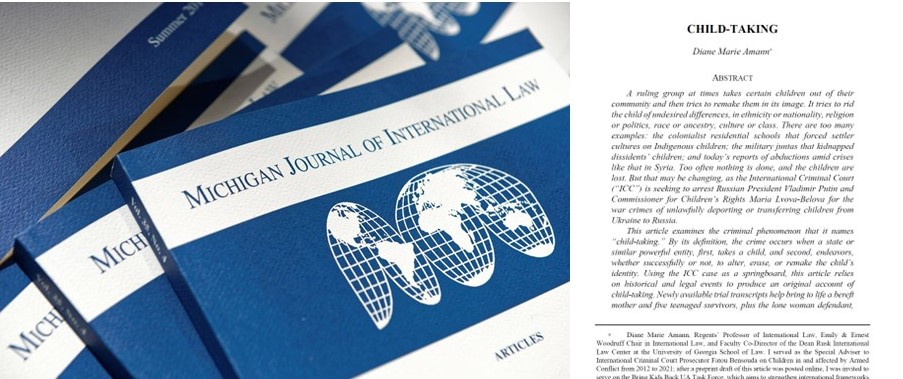
Amann gave an overview of her new article “Child-Taking,” 45 Michigan Journal of International Law 305 (2024), with focus on forced residential schooling of Indigenous children. As theorized in the article available here, child-taking occurs when a state or similar powerful entity takes a child and then endeavors to alter, erase, or remake the child’s identity. Though a criminal phenomenon, it may be redressed not only in criminal justice systems, but also through transitional justice mechanisms.
Amann is Regents’ Professor of International Law, Emily & Ernest Woodruff Chair in International Law, and a Faculty Co-Director of our Dean Rusk International Law Center here at Georgia Law. She served from 2012 to 2021 as International Criminal Court Prosecutor Fatou Bensouda’s Special Adviser on Children in & affected by Armed Conflict. This fall, she is spending a research-intensive semester in the United Kingdom, where she is a Research Visitor at the Oxford Faculty of Law Bonavero Institute of Human Rights.
University of Georgia School of Law alumnus and adjunct professor Kannan Rajarathinam (LL.M. ’88) was interviewed in Hindustan Times about his new book, The DMK Years: Ascent, Descent, Survival (India Viking, 2024). The book will be available for purchase on November 15, 2024 in the United States.
Political commentator and author R. Kannan recently launched his book, ‘The DMK Years: Ascent, Descent, Survival’ which is [an] account of the DMK’s journey, from its foundation in 1949 by CN Annadurai to its present-day prominence under Tamil Nadu Chief Minister MK Stalin. In an interview with Hindustan Times, the author speaks on the DMK’s 75th founding day and the Hindu assertion of the BJP that has forced the DMK to hold a conference for Murugan, the Hindu deity. Chief Minister Stalin’s son Udhayanidhi’s real test is a post-Stalin-phase, he says, adding that DMK’s strength is in its [organizational] base and a divided opposition, but if actor Vijay were to join forces with AIADMK or others, the ruling party might be in trouble for the 2026 assembly polls.
The University of Georgia School of Law’s Dean Rusk International Law Center is hosting a book talk on Tuesday, November 19th for Rajarathinam. The conversation will be co-facilitated by Professor Laura Phillips-Sawyer of Georgia Law and Dr. Laura Zimmermann of the School of Public and International Affairs. This event is part of International Education Week, a joint initiative of the U.S. Department of State and the U.S. Department of Education, an effort to promote programs that prepare Americans for a global environment and celebrate the benefits of international education.
Kannan Rajarathinam is an adjunct professor at the University of Georgia School of Law teaching a course on International Organizations. Between 1993 and 2022, he served the United Nations in various capacities, including senior political affairs officer, head of office, senior planning and coordination officer, chief civil affairs officer, and legal officer from Afghanistan to Bosnia and Herzegovina. Before joining the UN, he briefly taught at the University of Madras in India as a guest faculty member and junior professor and practiced law. Presently, he serves on the Dean Rusk International Law Center Advisory Council.
As theorized in the article, “child-taking” occurs when a state or similar powerful entity takes a child and then endeavors to alter, erase, or remake the child’s identity. It is a criminal phenomenon that has been repeated across decades and centuries. On rare occasion, criminal prosecutions have occurred, as with the Situation in Ukraine before the International Criminal Court. More often redress, if any, must take place in other forums. The article thus considers these other types of transitional justice, with particular attention to the legacies of forced residential schooling imposed upon Indigenous children in the United States, Canada, and elsewhere.
Amann is Regents’ Professor of International Law, Emily & Ernest Woodruff Chair in International Law, and a Faculty Co-Director of our Dean Rusk International Law Center here at Georgia Law. She served from 2012 to 2021 as International Criminal Court Prosecutor Fatou Bensouda’s Special Adviser on Children in & affected by Armed Conflict.
Here’s the abstract of the “Child-Taking” article, the print version of which is available here:
A ruling group at times takes certain children out of their community and then tries to remake them in its image. It tries to rid the child of undesired differences, in ethnicity or nationality, religion or politics, race or ancestry, culture or class. There are too many examples: the colonialist residential schools that forced settler cultures on Indigenous children; the military juntas that kidnapped dissidents’ children; and today’s reports of abductions amid crises like that in Syria. Too often nothing is done, and the children are lost. But that may be changing, as the International Criminal Court (“ICC”) is seeking to arrest Russian President Vladimir Putin and Commissioner for Children’s Rights Maria Lvova-Belova for the war crimes of unlawfully deporting or transferring children from Ukraine to Russia.
“This article examines the criminal phenomenon that it names ‘child-taking.’ By its definition, the crime occurs when a state or similar powerful entity, first, takes a child, and second, endeavors, whether successfully or not, to alter, erase, or remake the child’s identity. Using the ICC case as a springboard, this article relies on historical and legal events to produce an original account of child-taking. Newly available trial transcripts help bring to life a bereft mother and five teenaged survivors, plus the lone woman defendant, who testified at a little-known child-kidnapping trial before a postwar Nuremberg tribunal. Their stories, viewed in the context of the evolution of international child law, inform this article’s definition. These sources further reveal child-taking to be what the law calls a matter of international concern. At its most serious, child-taking may constitute genocide or another crime within the ICC’s jurisdiction. Yet even if circumstances preclude punishment in that permanent criminal court, child-taking remains a grave offense warranting prosecution or other forms of local and global transitional justice. This is as true for the Indigenous children of residential schools in North America, Australia, and elsewhere, and for children in Syria and many other places in the world, as it is for the children of Ukraine.
University of Georgia School of Law Associate Dean & Hosch Professor Jason A. Cade’s article “Deporting the Pardoned” was recently cited by the U.S. Court of Appeals for the Ninth Circuit in the case Lopez v. Garland.
Below is an excerpt from the article:
Federal immigration laws make noncitizens deportable on the basis of state criminal convictions. Historically, Congress implemented this scheme in ways that respected the states’ sovereignty over their criminal laws. As more recent federal laws have been interpreted, however, a state’s decision to pardon, expunge, or otherwise set aside a conviction under state law will often have no effect on the federal government’s determination to use that conviction as a basis for deportation. While scholars have shown significant interest in state and local laws regulating immigrants, few have considered the federalism implications of federal rules that ignore a state’s authority to determine the continuing validity of its own convictions. This Article contends that limitations on the preclusive effect of pardons, expungements, appeals, and similar post-conviction processes undermine sovereign interests in maintaining the integrity of the criminal justice system, calibrating justice, fostering rehabilitation, and deciding where to allocate resources. In light of the interests at stake, Congress should be required to clearly express its intent to override pardons and related state post-conviction procedures. A federalism-based clear statement rule for statutory provisions that restrict generally applicable criminal processes would not constrain the federal government’s power to set immigration policy. Congress remains free to make its intent clear in the statute. But the rule would ensure that Congress, rather than an administrative agency, has made the deliberative choice to upset the usual constitutional balance of federal and state power.
Jason A. Cade is Associate Dean for Clinical Programs and Experiential Learning, J. Alton Hosch Professor of Law & Community Health Law Partnership Clinic Director. In addition to overseeing the law school’s 11 in-house clinics and 7 externship programs, Cade teaches immigration law courses and directs the school’s Community Health Law Partnership Clinic (Community HeLP), in which law students undertake an interdisciplinary approach to immigrants’ rights through individual client representation, litigation, and project-based advocacy before administrative agencies and federal courts.
Additional information about the Community HeLP Clinic can be found here.
University of Georgia Assistant Professor of Law & Faculty Co-Director of the Dean Rusk International Law Center, Desirée LeClercq, presented at the 2nd annual Trade and Public Policy Network Conference in Oxford, England. LeClercq’s work was entitled: “Enforcement of the United States-Mexico-Canada Agreement Rapid Response Mechanism.”
Desirée LeClercq joined the University of Georgia School of Law as an assistant professor in summer 2024 and currently teaches International Trade and Workers Rights, International Labor Law, International Law, and U.S. Labor Law. She serves as a faculty co-director of the Dean Rusk International Law Center and as the faculty adviser for the Georgia Journal of International and Comparative Law.
University of Georgia School of Law assistant professor Assaf Harpaz has been selected as a laureate to present his paper titled “Global Tax Wars and the Shift to Source-Based Taxation” at the Journal of International Economic Law Junior Faculty Forum (JIEL JFF).
Below is an abstract of the paper:
Current debates in international taxation often focus on how to fairly allocate taxing rights between jurisdictions. When an enterprise earns income abroad, both the country of residence (where the taxpayer resides) and the country of source (where income is generated) have legitimate, competing claims to tax that income. The issue is further complicated in a digital economy where tax avoidance and profit shifting practices are abundant.
Income tax treaties have traditionally favored residence-based taxation. Now, the international tax framework is at a crossroads with intergovernmental organizations battling to redefine the principles of cross-border taxation. The regime has been dominated by the Global North through the Organisation for Economic Co-operation and Development (OECD), which has drawn backlash due to its undemocratic procedure and unfavorable outcomes for developing countries. The United Nations has held a relatively peripheral role in global tax governance, yet this could change with an upcoming UN Framework Convention on International Tax Cooperation – an initiative overwhelmingly supported by developing countries. This article conceptualizes the international tax discourse as “tax wars,” contrasting the taxing powers and interests of the OECD-led Global North with those of the UN-backed Global South. It highlights the distributive effects of tax treaties and argues for a shift toward source-based taxation. To do so, it proposes revisiting the permanent establishment standard in model treaty language, creating an opportunity for broader taxation of business profits in the source country. This transition will address longstanding disparities and is increasingly warranted in a digital economy that does not rely on physical presence
Assaf Harpaz joined University of Georgia School of Law as an assistant professor in summer 2024 and will teach classes in federal income tax and business taxation. Harpaz’s scholarly focus lies in international taxation, with an emphasis on the intersection of taxation and digitalization. He explores the tax challenges of the digital economy and the ways to adapt 20th-century tax laws to modern business practices.
University of Georgia School of Law Master of Laws (LL.M.) student Michael Faleye was selected as a recipient of the Personal Travel Allowance Scholarship from Education African Scholars Global Connect. This organization is dedicated to supporting African students pursuing higher education abroad and to impact their home and host communities. They provide resources and support to help students secure admission and scholarships, and they encourage students to use their education and skills to contribute to the development and nation-building efforts of their home countries.
Below is Education African Scholars Global Connect’s vision statement:
Our vision is to become the leading resource for African youths seeking higher education abroad and to inspire a new generation of leaders and change-makers in Africa. We believe that investing in the education and development of African youths is the key to a brighter future for the continent, and we are dedicated to helping students achieve their full potential and make a lasting impact on their communities and nations.
Michael, who is from Nigeria, earned his law degree with honors at the University of Lagos and completed his legal training at the Nigerian Law School. As a student, he was actively involved in student parliamentary politics as senate president of the Law Students Society. After being called to the Nigerian bar in 2019, he began his legal career in Lagos at Wole Olanipekun & Co., a leading litigation law firm, and then practiced at Fides and Fiducia LP, a full-service law firm, from which he was placed on secondment to Eroton Exploration and Production Company Ltd/Midwestern Oil & Gas Company Ltd. In 2022, he transitioned to an in-house position with one of Africa’s premier financial institutions, Guaranty Trust Holding Company Plc. Michael’s expertise encompasses commercial law, corporate governance and regulatory compliance. He is a member of the Institute of Chartered Secretaries and Administrators of Nigeria (ICSAN) and holds certifications in EU privacy law (GDPR) compliance and Intellectual Property “Copyright X” from Harvard Law School’s Berkman Klein Center. His goal is to work in the areas of business law that revolve around mergers & acquisitions, venture capital, and privacy law.
The Master of Laws (LL.M.) degree at the University of Georgia School of Law offers foreign law graduates opportunities to learn about the U.S. legal system, deepen knowledge of an area of specialization, and explore new legal interests at one of the nation’s top law schools. The ten-month program provides individualized support through the Dean Rusk International Law Center and prepares international students for a globalized legal market. Applications are open now for the class of 2026. More information about applying to the program can be found here.
University of Georgia School of Law professor Christopher M. Bruner published an article titled “National Identity and Economic Development in Market-Dominant Small Jurisdictions” in UC Berkeley’s peer-reviewed Journal of Law and Political Economy.
A working paper version of the article was previously presented at the symposium on “Law, Identity, and Economic Development in the Post-Colonial Era: The Case of the Northern Atlantic and Larger Caribbean Regions,” hosted by the Princeton School of Public and International Affairs. For more information, please see our previous post.
Below is an abstract of the article:
Small jurisdictions that are globally competitive in providing cross-border financial services—market-dominant small jurisdictions (MDSJs)—occupy fascinating and unique positions in global markets, reflecting the complexity of their linkages with major economies. This article explores how the distinctive features of MDSJs highlight important dimensions of the relationship between national identity and economic development. I review literatures that aim to explain how jurisdictions behave in the economic context, focusing on concepts of nationalism, national identity, and nation branding, and how such phenomena might impact one another. I then assess their application to the relationship between national identity and economic development in MDSJs, where realities of size and geography prompt substantial outward orientation and incentivize innovations in law and finance to service economic activity largely occurring elsewhere. The article culminates with a vivid case study—the role of national identity in developing, marketing, and maintaining Bermuda’s outsized role in global insurance markets.
Christopher M. Bruner is the Stembler Family Distinguished Professor in Business Law at the University of Georgia School of Law and serves as a faculty co-director of the Dean Rusk International Law Center.
The faculty sponsor for Amann’s visit is Professor Dapo Akande. Oxford’s Chichele Professor of Public International Law and a member of the U.N. International Law Commission, he has just been nominated as the UK candidate for election to the International Court of Justice.
Amann, who is Regents’ Professor, Emily & Ernest Woodruff Chair in International Law, and Faculty Co-Director of the Dean Rusk International Law Center here at the University of Georgia School of Law, held the same Oxford post during another research-intensive semester, Spring 2018.
She plans to pursue her scholarship related to women professionals who played roles in international criminal trials after World War II and also her work on child rights, especially as they relate to armed conflict and similar violence.
As a Research Visitor, she also will have the opportunity to take part in Bonavero Institute activities, and will benefit from Oxford’s libraries, seminars and lectures, and other offerings.
The Bonavero Institute was founded in 2016 as a unit of the Oxford Faculty of Law, under the direction of Professor Kate O’Regan, a former judge on the Constitutional Court of South Africa.
Since the WTO’s inception in 1995, global trade has rapidly expanded and become increasingly interconnected. The international trading system has helped lift 1.5 billion people out of absolute poverty and unlocked new opportunities for businesses, workers and consumers. At the same time, the gains from trade have not always been shared equally. This needs to change.
As the WTO celebrates its 30th anniversary, the 2024 Public Forum will look to the future, exploring how re-globalization can help make trade more inclusive and ensuring that its benefits reach more people.
LeClercq will present research under the United States-Mexico-Canada agreement’s dispute settlement provisions and their effects on vulnerable workers in Mexico.
The WTO 2024 Public Forum also discussed the TradeExperettes’ report: Ten “Quick Wins” for Re-globalization and Resilience in Trade. LeClercq authored “Quick Win No. 3: Empower all workers to ensure a fair, equitable and sustainable trade policy,” which urges greater inclusion of non-union workers at the trade bargaining table.
Desirée LeClercq joined the University of Georgia School of Law as an assistant professor in summer 2024 and currently teaches International Trade and Workers Rights, International Labor Law, International Law, and U.S. Labor Law. LeClercq’s scholarly focus lies in international and labor law. She also serves as a faculty co-director of the Dean Rusk International Law Center and as the faculty adviser for the Georgia Journal of International and Comparative Law.




 exchange of notes