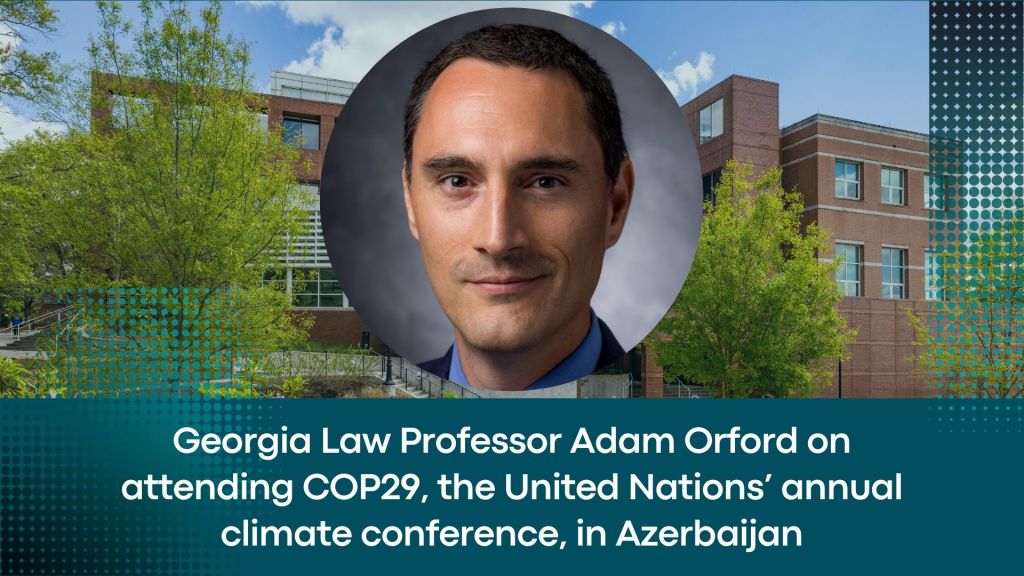
Georgia Law Professor Adam Orford on attending COP29, the United Nations’ annual climate conference, in Azerbaijan

Adam D. Orford, Assistant Professor of Law at the University of Georgia School of Law, participated in the recent 29th Conference of Parties to the United Nations Framework Convention on Climate Change (COP29) in Baku, Azerbaijan. He served as an observer for the American Bar Association. Orford’s interdisciplinary research investigates legal and policy approaches to environmental protection, human health and well-being, and deep decarbonization of the U.S. economy. He also participates in collaborative research initiatives across the University of Georgia, including as lead of the Georgia element of the National Zoning Atlas and as a participant in investigations into the legal, political, environmental and social dimensions of new energy manufacturing and emerging carbon removal technologies.

In his guest post below, Orford summarizes the ABA’s role and the major outcomes at COP29. More detail on this issues can be found in the four COP primers he published at Environmental Law Prof Blog (here, here, here, and here).
ABA’s Role

I participated in COP29 as a delegate for the ABA, which has sent delegates to the climate COPs since 2021. This program followed a 2019 ABA resolution on climate change that urged

“federal, state, local, territorial, and tribal governments, and the private sector, to recognize their obligation to address climate change,”

and called on lawyers to

“engage in pro bono activities to aid efforts to reduce greenhouse gas emissions and adapt to climate change, and to advise their clients of the risks and opportunities that climate change provides.”

The focus of the ABA’s delegations has been to work with other national bar associations to educate the profession about the critical role that lawyers and law associations play in responding to climate change—an issue which may arise unexpectedly, in practices as diverse as environment and energy, human rights, corporate governance, personal injury, real estate development, trusts and estates, municipal management, international trade, and more.

Participating law associations have developed a Climate Registry that is posted on the International Bar Association’s website, providing ready tools to other lawyers and law associations for adopting climate resolutions and other guidance to address climate change. The ABA does not take positions on negotiating outcomes at the COPs, but its delegations work to assist ABA members in understanding the often complex climate COP processes and outcomes.

COP29 Outcomes

As part of my work, I tracked the progress of dozens of negotiations aimed at implementing commitments made by the parties to the UNFCCC and Paris Agreement. Here are some of the most significant outcomes of this year’s negotiations:

A contentious and chaotic COP

Azerbaijan, this year’s host and lead facilitator for the conference’s negotiations, came into COP29 with little climate leadership experience, and it often struggled to maintain trust among the parties.

From remarks praising fossil fuels to open the conference, to procedural maneuvering to achieve controversial results, to protests from many parties that they were not being sufficiency included in negotiations, to delays in the development and circulation of draft negotiating texts, to limited participation from civil society, to relatively disappointing outcomes on many important issues, COP29 highlighted just how difficult climate negotiations have become as the world has continued to warm and countries have fallen behind on taking necessary actions to abate their greenhouse gas emissions.

Disappointing climate finance commitments

This was the year that the parties were required to agree upon a so-called “New Quantified Collective Goal” for climate finance, meaning the amount of annual funding that wealthy developed countries are committed to “mobilizing” for the benefit of poorer developing countries. The prior commitment, $100 billion per year, had only ever been met once, and the actual need is estimated to exceed $1 trillion per year.

After two weeks of contentious debate that included developed countries pushing for expanding contributions from emerging economies and developing countries pushing for $1.3 trillion with a significant public finance component, developed countries only agreed to commit to achieving $300 billion per year—by 2035.

This result was so far below the developing country goals that at one point they walked out of the negotiations entirely in protest.

Procedural machinations to allow carbon credit trading

After years of controversy and delay, the parties at COP29 agreed to finalize the “Article 6 rulebook,” meaning the rules and definitions for international trade in carbon credits originally contemplated by the Paris Agreement in 2015. This outcome was achieved through an irregular procedure, however: A subsidiary implementing body had ratified the rules months before the COP and then provided them to the parties as a take-it-or-leave-it fait accompli. The parties did quickly agree to accept the new rules, but then developed lengthy further guidance intended to promote transparency and environmental integrity in the markets.

Backsliding on the commitment to transition away from fossil fuels

At last year’s COP28 in Dubai, all parties had agreed to include text indicating a goal to “transition away” from fossil fuels as part of the global climate response. However, major oil producers, including especially Saudi Arabia, have since backed away from this commitment, and they worked vigorously throughout COP29 to avoid repeating this language in any form at any point. This opposition nearly derailed several negotiations, and resulted in at least one item being deferred until COP30 next year.

In addition, although countries are supposed to submit their third voluntary climate action plans in February 2025, very few made firm commitments to reduce their climate emissions at COP29—a troubling change from the relatively robust pledges at prior COPs.

Leadership vacuum

COP29 began just days after the U.S. Presidential election. That election’s outcome will have major implications for the trajectory of United States, and therefore global, climate policy.

With the U.S. delegation largely unable to make credible future commitments, there was some speculation that this would provide an opportunity for China to take on a larger global leadership role, particularly in the development of low-carbon energy technologies necessary to respond to climate change. However, China’s most significant efforts at COP29 were quite different:

  • China opposed calls for it to join developed countries and make firm climate finance commitments; and
  • It pushed unsuccessfully to add international trade issues to the negotiating agenda.

With the world’s two largest greenhouse gas emitters both taking a back seat, global climate policy lacks clear leadership at a critical time. 2024 is likely to be the warmest year in human history; and 2025 is likely to be warmer still.

Nonetheless, the COP process remains the most important forum for developing international commitments to climate change response. While imperfect, the parties do continue to make progress—sometimes a little, sometimes a lot—every year.

Many parties are already pointing to the disappointing outcomes of COP29 as the basis for redoubling their efforts to strengthen commitments at future COPs. Next year’s COP30 will be held in Belém, Brazil.

Left: The ABA delegation included (from left to right) Uma Outka, law professor at the University of Kansas; Kamran Jamil, law clerk at SD California and co-chair of the ABA International Law Division young lawyers division; and Adam D. Orford, Assistant Professor at the University of Georgia School of Law. Top Right: COP29 plenary session with Mukhtar Babayev, Minister of Ecology and Natural Resources of the Azerbaijan Republic.
2024 Annual Report for the Dean Rusk International Law Center published

As the year draws to a close, we at the University of Georgia School of Law‘s Dean Rusk International Law Center are pleased to share our annual report, detailing a wide range of international activities and achievements that contributed to our #20 U.S. News ranking for international law programs in the United States in 2024. This year’s report highlights:

  • Faculty publications and awards
  • Global Governance Summer School
  • Global Externships Overseas
  • Master of Laws (LL.M.) program
  • Visiting Research Scholars
  • International events and conferences
  • International advocacy
  • Rusk Center Council
  • Global Partnerships
  • And more!

The 2024 annual report can be accessed here.

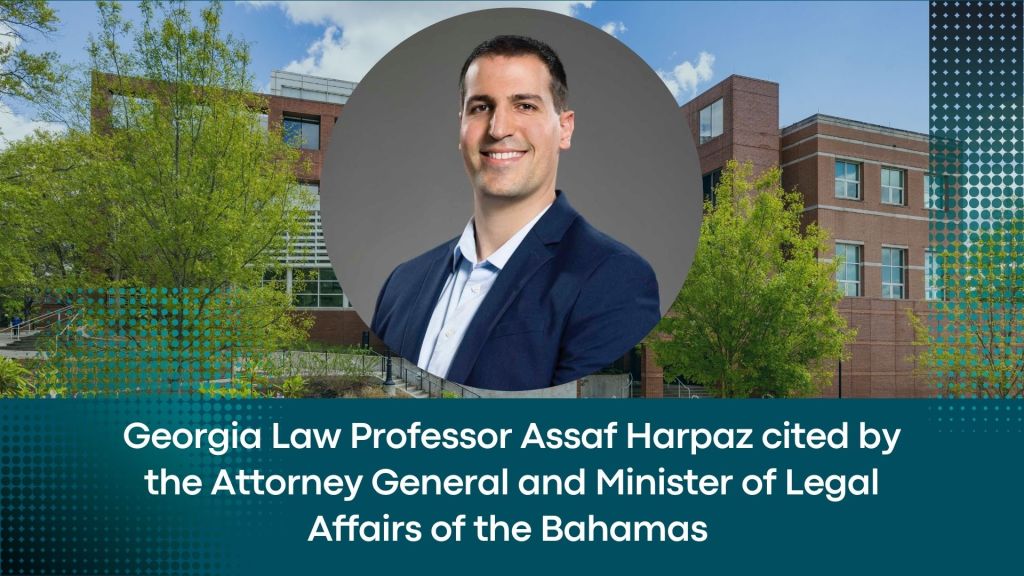
Georgia Law Professor Assaf Harpaz cited by the Attorney General and Minister of Legal Affairs of the Bahamas

University of Georgia School of Law Professor Assaf Harpaz’s article “International Tax Reform: Who Gets a Seat at the Table?” was recently quoted by Senator the Hon. Leo Ryan Pinder, Attorney General and Minister of Legal Affairs of the Bahamas, during the STEP LATAM Conference Remarks on The UN Convention on Global Tax Cooperation.

Below is an abstract of the article:

The international tax framework relies on early-twentieth-century principles and favors the interests of the Global North, which created it. It bases taxing rights on a corporation’s physical presence and mostly allocates profits to the country of residence. Moreover, it has been slow to adapt to modern business practices. In the digital economy, companies shift profits with relative ease and often do not require a physical presence in the location of their consumers. International taxation needs reform, but leading proposals do not reflect meaningful input from the Global South and are unlikely to serve the needs of developing countries.

In 2021, the Organisation for Economic Co-operation and Development (OECD), known informally as the “World Tax Organization,” introduced new rules for the cross-border taxation of multinational enterprises. The new rules intend to address the tax challenges of digitalization and profit-shifting, and they are likely the most significant change to international taxation in several decades. However, the OECD does not represent the interests of developing economies, and the proposed reform has not remedied the historic imbalance which disfavors the Global South.

This Article highlights the shortcomings of the OECD’s multilateral efforts in the context of taxation and digitalization. It analyzes the political lawmaking of the OECD and presents the new rules as a compromise that fails to address inequities in cross-border taxation. The Article argues that the reform undermines tax sovereignty and that the current international tax regime overlooks the involvement of the world’s developing countries. It asserts that attempts to promote inclusivity within the OECD have largely been expressive and that the international tax framework inherently disadvantages developing countries and their interests. The Article proposes steps to promote the equal-footed participation of developing countries in future international tax policy initiatives. First, it recommends expanding voting rights for non-members within the OECD. Second, it supports the creation of a new intergovernmental framework within the United Nations that is better positioned to revisit traditional international tax norms through a genuinely inclusive process.

Assaf Harpaz joined University of Georgia School of Law as an assistant professor in summer 2024 and teaches classes in federal income tax and business taxation. Harpaz’s scholarly focus lies in international taxation, with an emphasis on the intersection of taxation and digitalization. He explores the tax challenges of the digital economy and the ways to adapt 20th-century tax laws to modern business practices.

Georgia Law students attend 2024 ASIL Midyear Meeting in Chicago

Two University of Georgia School of Law students attended the American Society of International Law (ASIL) Midyear Meeting last month in Chicago, Illinois. This year’s meeting was hosted at the University of Chicago Law School.

Attendees included Samuel Kuo (LL.M. ’25) and Eman Mistry (J.D. ’25). Both students received a Louis B. Sohn Professional Development Fellowship to support their attendance of this conference. Awarded by the law school’s Dean Rusk International Law Center, Sohn Fellowships enable students to attend professional development opportunities related to international law.

Both Kuo and Mistry attended numerous panel discussions addressing a range of topics in international law. Kuo reflected on the experience, stating:

“I enjoyed the panel on the topic of disclosure in international arbitration moderated by Kelly Turner at the American Arbitration Association, featuring Dorothy Du from Motorola, Charles Kotuby from Three Crowns, Sarah Reynolds from Reynolds ADR and Javier Rubinstein from Rubinstein ADR LLC. The discussion centered upon the use of generative AI in international arbitration practice.  All areas of the legal profession are preparing for ethical AI use, and it was refreshing to hear a discussion on whether parties should disclose the use of generative AI in anticipating arbitration.”

To read prior posts about prior recipients of Sohn Fellowships, please click here and here.

Georgia Law Professor Thomas Kadri selected as Visiting Fellow of the Law Department of the European University Institute in Florence, Italy

University of Georgia School of Law Professor Thomas E. Kadri was selected as a Visiting Fellow at the Law Department of the European University Institute in Florence, Italy. Kadri’s fellowship will be supported by a Sarah Moss Fellowship and the Rusk Faculty Scholar-in-Residence Program provided by the Dean Rusk International Law Center.

During his time in Florence, Kadri will expand his ongoing research pertaining to the legal and technical regulation of AI-generated “deepfakes” and focus on the European regulatory approaches to this topic. In 2024, Kadri authored his third book, Dilemmas in Digital Abuse, which discusses related topics including harmful technological advancements and the corresponding regulatory responses.

Kadri is an Assistant Professor of Law at Georgia Law Law, and his research focuses on torts and criminal law, with an emphasis on how technology, law, and social norms enable and affect privacy, speech, and abuse. His scholarship appears in journals including the Harvard Law Review Forum, UCLA Law Review, Texas Law Review, Utah Law Review, Maryland Law Review, and Journal of Free Speech Law and he has published shorter pieces in The New York Times and Slate. His course offerings include Torts, Cybercrime, and Regulating Digital Abuse.

Six Master of Laws (LL.M.) students selected as Graduate Editors of the Georgia Journal of International and Comparative Law

Six Master of Laws (LL.M.) students from the University of Georgia School of Law’s class of 2025 were selected to join the Editorial Board of the Georgia Journal of International and Comparative Law as Graduate Editors. The students are: Sara Dorbahani, Michael Faleye, Neethu James, Samuel Kuo, Dzmitry Liasovich, and Ramakrishna Rut Palepu.

As Graduate Editors, each LL.M. student conducts citation checks and writes a Comment or Book Review on the legal topic of their choice. The Graduate Editors further facilitate the Journal’s commitment to “including a diversity of perspectives, experiences, and backgrounds within [its] membership,” according to the Editor in Chief, Jasmine Furin (J.D. ’25).

The Georgia Journal of International and Comparative Law is a preeminent forum for academic discussion on current international subjects. From its inception in 1971 as a student initiative supported by former U.S. Secretary of State and Georgia Law Professor Dean Rusk, the Journal features work by legal scholars and practitioners and student notes written by Journal members.

Georgia Law Professor Desirée LeClercq cited in Financial Times 

University of Georgia School of Law Professor Desirée LeClercq‘s report “Enforcement of the United States-Mexico-Canada Agreement (“USMCA”) Rapid Response Mechanism: Views from Mexican Auto Sector Workers” was cited in the article “How the Democrats Worker-Centred Trade Policy Failed” in the Financial Times.

Below is the article’s abstract:

This study examines whether the RRM empowers workers’ voices in the Mexican auto sector. To this end, between January and March 2024, we interviewed 130 workers across seven supplier facilities (auto plants facilities and logistics facilities) and five assembly plants, for a total of 12 facilities. Three of the facilities were not unionized; nine facilities were unionized. Three of the twelve plants had used the RRM (“RRM facilities”), addressing various violations of labor rights, voting processes to approve or reject collective contracts, voting processes to elect independent unions, and dismissals and intimidation of workers in union activism. All three RRM cases were remediated through plans requiring the facility to hold a new legitimization vote and union election and offer worker-level trainings. Our preliminary results problematize some assumptions that drove RRM implementation. The Biden administration and members of the United States Congress have promoted the RRM as a way to strengthen the Mexican government’s efforts to implement Mexican labor law reform, empower workers in productive export sectors, and give them a voice over their labor conditions. Our results suggest that, four years after the implementation of the USMCA and the reforms of Mexico’s labor legislation, a little more than half of the workers are aware of the labor law reform, and opinions are divided on whether it is strengthening labor rights. Some workers thought the reforms were going well, while many thought the reform process was going poorly or did not know how it was going. The majority of workers we interviewed revealed that they did not understand the new democratic procedures to legitimize their collective bargaining agreements, nor that they could access the RRM platform to express their complaints. Nevertheless, the workers we interviewed at RRM facilities tended to be more knowledgeable of the labor law reforms and its attendant rights and processes than those at facilities that have not undergone RRM investigation and remediation, and they tended to view their bargaining representative and conditions of work more favorably. Our study suggests that when workers are given the opportunity to participate in democratic elections under international supervision, after receiving training on the shop floor about their rights and election procedures, they gain knowledge and ownership over their working conditions.

LeClercq joined the University of Georgia School of Law in 2024 as an assistant professor. She teaches International Trade and Workers Rights, International Labor Law, International Law and U.S. Labor Law, as well as the International Law Colloquium. She also serves as a faculty co-director of the Dean Rusk International Law Center and as the faculty adviser for the Georgia Journal of International and Comparative Law.

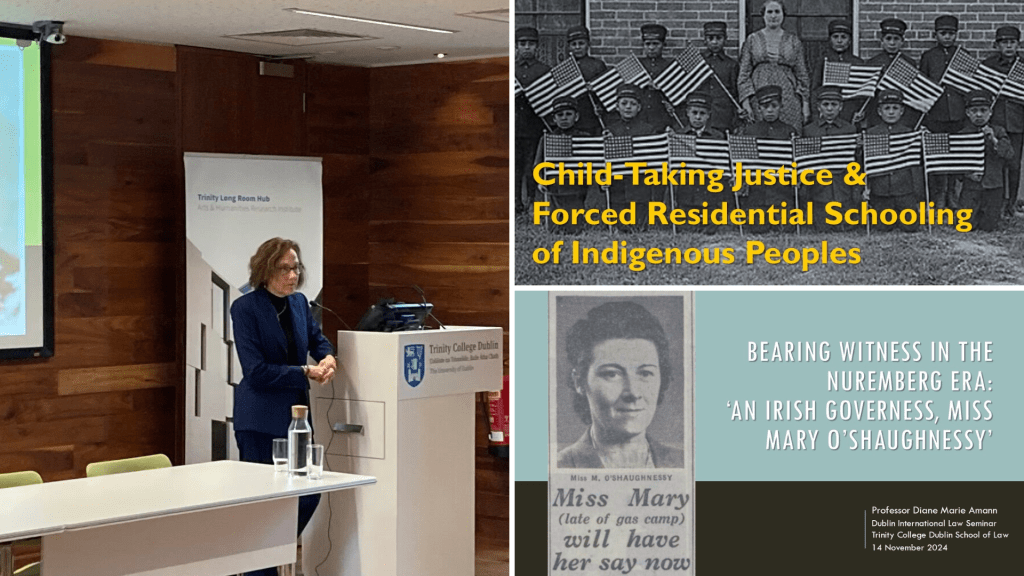
Georgia Law Professor Diane Marie Amann presents on child-taking and Nuremberg-era witnesses at Trinity College Dublin and Queen’s University Belfast law schools

University of Georgia School of Law Professor Diane Marie Amann gave a series of public lectures in mid-November at Irish law schools.

While a Visiting Research Scholar at Trinity College Dublin School of Law, she:

The moderator for both events was Trinity Law Professor Michael A. Becker, who sponsored Professor Amann’s visit.

Professor Amann also presented “Child-Taking Justice and Forced Residential Schooling of Indigenous Peoples” at the Centre for Human Rights, Queen’s University Belfast School of Law.

Amann is Regents’ Professor of International Law, Emily & Ernest Woodruff Chair in International Law, and a Faculty Co-Director of our Dean Rusk International Law Center here at Georgia Law. She has pursued a research-intensive semester this autumn, primarily as a Research Visitor at the Oxford Faculty of Law Bonavero Institute of Human Rights and Visiting Fellow at Exeter College Oxford.

Georgia Law Professor Desirée LeClercq publishes on International Economic Law and Policy Blog

University of Georgia School of Law Professor Desirée LeClercq published an article titled “Whither the Worker-Centered Trade Policy?” for the International Economic Law and Policy Blog. This article presents LeClercq’s views on the Trump administration’s trade agenda.

Below is an excerpt from the article:

“The Biden administration changed U.S. trade policy significantly when it adopted a “worker-centered” trade policy that justified entering into “frameworks” and not trade agreements. That policy didn’t win many accolades from the trade crowd. Many critics felt that it forewent critical opportunities by refusing to discuss market access in new trade contexts. Without getting into that debate, this post discusses whether the Biden administration’s worker-centered trade policy – and notably, use of that policy under the United States-Mexico-Canada Agreement (USMCA) Facility-Specific Rapid-Response Labor Mechanism (RRM) – will outlive the administration.

I think it will, but it will look different. And some, including labor rights advocates like myself, might prefer the Trump administration’s approach.”

LeClercq joined the University of Georgia School of Law in 2024 as an assistant professor. She teaches International Trade and Workers Rights, International Labor Law, International Law, U.S. Labor Law and the International Law Colloquium. She also serves as a faculty co-director of the Dean Rusk International Law Center and as the faculty adviser for the Georgia Journal of International and Comparative Law.

Georgia Law Professor Assaf Harpaz presents at SEC Workshop

University of Georgia School of Law Professor Assaf Harpaz presented his draft paper “Global Tax Wars in the Digital Era” at the University of Alabama School of Law as part of the Junior/Senior SEC Workshop.

Below is an abstract of the paper:

Current debates in international taxation often center on how to fairly allocate taxing rights among different jurisdictions. When an enterprise earns income abroad, the country of residence (where the taxpayer resides) and the country of source (where income is generated) have legitimate, competing claims to tax that income. The question is further complicated in a digital economy where profit shifting practices are abundant and businesses no longer require a physical presence in the location of their online consumers.

The international tax system has traditionally favored residence-based taxation. Now, international taxation is at a crossroads with intergovernmental organizations battling to redefine the principles of cross-border taxation. The regime has been dominated by the Global North through the Organisation for Economic Co-operation and Development (OECD), which has drawn backlash due to its undemocratic procedure and unfavorable outputs for developing countries. The United Nations has held a relatively peripheral role in global tax governance, which is poised to change with an upcoming UN Framework Convention on International Tax Cooperation – an initiative overwhelmingly supported by developing countries.

This article explores the “tax wars” surrounding the leadership for global tax governance, contrasting the taxing powers and interests of the OECD-led Global North with those of the UN-backed Global South. It highlights the distortive outcomes created by outdated international tax principles and argues for a shift toward source-based taxation. To do so, it proposes revisiting the permanent establishment standard in model treaty language, creating an opportunity for broader taxation of business profits in the source country. This transition will address longstanding disparities and is increasingly warranted in a digital economy that does not rely on physical presence.

Assaf Harpaz joined University of Georgia School of Law as an assistant professor in summer 2024 and teaches classes in federal income tax and business taxation. Harpaz’s scholarly focus lies in international taxation, with an emphasis on the intersection of taxation and digitalization. He explores the tax challenges of the digital economy and the ways to adapt 20th-century tax laws to modern business practices.