Georgia Law Professor Christopher Bruner presents on the politics of corporate sustainability reform

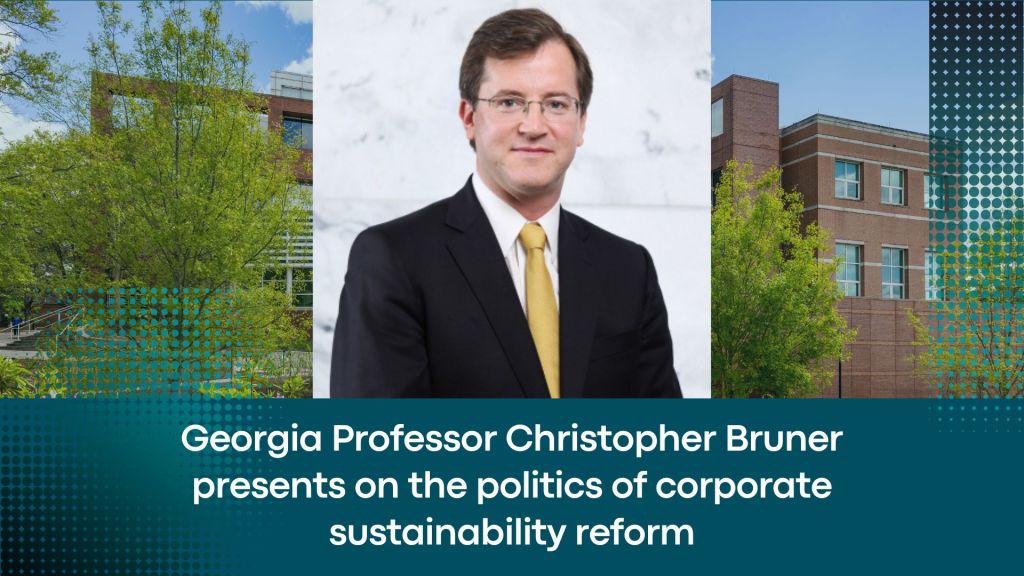
University of Georgia School of Law professor Christopher M. Bruner presented “A Political Economy of Corporate Sustainability Reform in the United States” at an online event hosted by the University of Oslo Faculty of Law in October.  The event was organized by Oslo’s Sustainability Law research group and convened by Professor Beate Sjåfjell.

Below is an abstract of the presentation:

Conservative backlash against sustainability initiatives and environmental, social, and governance (ESG) investment policies has been particularly intense in the United States – to the point that these issues have become mired in the broader ‘culture wars’ that increasingly characterize American public life and permeate policymaking. Today, initiatives styled as corporate sustainability or ESG are often rejected outright by conservative federal and state actors opposed to intrusion of what they regard as ‘woke’ progressive policies into economic law. In response, A Political Economy of Corporate Sustainability Reform in the United States tackles two related challenges in the US context – (1) how to advance first-best corporate governance reforms in the long-term, and (2) how to advance second-best alternatives in the near-term.

Christopher M. Bruner is the Stembler Family Distinguished Professor in Business Law at the University of Georgia School of Law and serves as a faculty co-director of the Dean Rusk International Law Center.

Welcoming the Master of Laws (LL.M.) students to Georgia Law

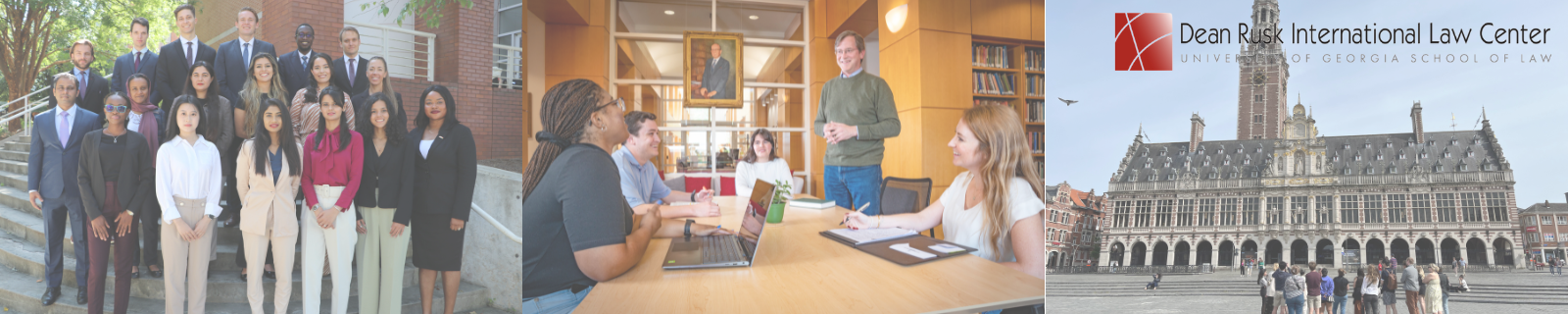
With the Fall 2024 semester in full swing, the Dean Rusk International Law Center is proud to welcome another class of talented lawyers, now studying for our University of Georgia School of Law Master of Laws (LL.M.) degree.

This group of 18 hails from 13 different countries in Africa, Asia, Europe, and the Americas, including Pakistan, Brazil, Iran, Nigeria, India, the Republic of Georgia, Turkey, the United Kingdom, Belarus, Peru, Venezuela, Switzerland, and Germany. Among them are lawyers specializing in a wide range of fields including business law, human rights law, administrative law, international arbitration, data privacy law, tax law, cryptocurrency law, criminal law, intellectual property law, business immigration and labor law, environmental law, and education law. 

They are pictured above, standing on the steps of Dean Rusk Hall. From the left to right – top row: Carolina Ruiz, Paria Keramatkhah, Fatemeh Khouei, João Felipe Villa do Miu, Samuel Kuo, Danish Ali; middle row: Christian Schneider, Sara Dorbahani, Dzmitry Liasovich, Michael Faleye, Fabienne Taller, Bekir Kerabekmez; bottom row: Irakli Kakubava, Assis José Couto do Nascimento, Ramakrishna Ruthwik Palepu, Ana Luiza Couto do Nascimento, Neethu James, Zulma Perez.

This Class of 2025 joins a tradition that began at the University of Georgia School of Law in the early 1970s, when a Belgian lawyer became the first foreign-trained practitioner to earn a Georgia Law LL.M. degree. In the ensuing four decades, the law school and its Dean Rusk International Law Center have produced around 600 LL.M. graduates, with ties to nearly 100 countries and every continent in the world.

Side by side with J.D. candidates, LL.M.s follow a flexible curriculum tailored to their own career goals – goals that may include preparation to sit for a U.S. bar examination, or pursuit of a concentration affording advancement in their home country’s legal profession or academic institutions.

The application for the LL.M. Class of 2026 is now open; for information or to apply for LL.M. studies, see here.

Georgia Law Professor Diane Marie Amann elected Visiting Fellow at Oxford’s Exeter College

Earlier this month University of Georgia School of Law Professor Diane Marie Amann was elected a Visiting Fellow at Exeter College, Oxford University, for this autumn’s Michaelmas Term.

While in the United Kingdom, she is serving simultaneously as a Research Visitor at the Oxford Faculty of Law Bonavero Institute of Human Rights.

Amann is Regents’ Professor, Emily & Ernest Woodruff Chair in International Law, and Faculty Co-Director of the Dean Rusk International Law Center here at the University of Georgia School of Law. Her courses include Public International Law, Constitutional Law, Human Rights, and Transnational Criminal Law.

During this research-intensive semester Amann is pursuing her scholarship related to women professionals who played roles in international criminal trials after World War II and also her work on child rights, especially as they relate to armed conflict and similar violence.

Founded in 1314, Exeter College is the fourth-oldest among Oxford’s three dozen colleges. It is located in the city center next to the university’s Bodleian Library.

Shannon Green of USAID’s Bureau for Democracy, Human Rights, and Governance speaks at Georgia Law

Shannon N. Green, a UGA graduate who serves as the Assistant to the Administrator of the Bureau for Democracy, Human Rights, and Governance (DRG) at the U.S. Agency for International Development (USAID), spoke to students at the University of Georgia School of Law last week. The discussion, entitled “Building a Career in Human Rights Diplomacy,” was moderated by Dr. Amanda Murdie, Head of the Department of International Affairs and Georgia Athletic Association Professor of International Affairs.

In Green’s current role, she leads USAID’s efforts to invigorate democracy, enhance human rights and justice, and bolster governance that advances the public interest and delivers inclusive development. Previously, Green was the Senior Advisor to the Administrator and Executive Director of the Anti-Corruption Task Force where she led USAID’s historic elevation of anti-corruption and aligned the Agency’s policies, programming, and resources to counter corruption at a global scale.

Before returning to public service in 2021, Green was the Senior Director of Programs at the Center for Civilians in Conflict (CIVIC) and Director and Senior Fellow of the Human Rights Initiative at the Center for Strategic and International Studies (CSIS), where her research focused on addressing threats to democratic institutions and norms, enhancing justice and accountability, and improving security forces’ respect for human rights.

From 2004 – 2015, Green held a number of positions in the U.S. Government, including as the Senior Director for Global Engagement on the National Security Council. In that role, she spearheaded efforts to deepen and broaden U.S. engagement with critical populations overseas, including the President’s Stand with Civil Society Agenda and young leader initiatives around the world. Prior to that, Green served in the DRG Center, where she developed policies, strategies, and programs to advance political reform and human rights in the Middle East and North Africa.

This event was part of a visit organized by the UGA Office of Global Engagement under the leadership of the Associate Provost for Global Engagement, Martin Kagel, as part of the FYOS Global Citizenship Cluster series. The event was co-sponsored by the School of Public and International Affairs.

Georgia Law LL.M. student Samuel Kuo admitted as a Fellow to the Chartered Institute of Arbitrators

University of Georgia School of Law Master of Laws (LL.M.) student Samuel Kuo was recently admitted as a Fellow of the Chartered Institute of Arbitrators (FCIArb).

Fellowship is the highest level of membership in the Chartered Institute of Arbitrators (CIArb), and as a Fellow, Kuo is now part of a distinguished group of experienced dispute resolution practitioners and eligible to join the CIArb’s, and other arbitral institutions’, dispute panels of neutrals. CIArb is a global professional organization with over 15,000 members worldwide that represents the interests of alternative dispute resolution practitioners. The headquarters are located in London and the institute was founded in 1915. Its North America Branch has over 400 members and the closest chapter to the University of Georgia geographically is Atlanta.

Kuo, who is from Taiwan and the United Kingdom, received his bachelor of laws degree with upper second class honors from the University of York in the United Kingdom. During his law studies he held a variety of editorial positions and served in leadership positions, including international societies representative, secretary of the University of York International Students’ Association and mock parliament leader. In addition to completing several legal internships, he worked in the marketing department at Gunnercooke LLP in Manchester, England. Kuo serves on the editorial board of the Journal of Legal, Ethical and Regulatory Issues (JLERI) and is a fellow of the Royal Society for the Encouragement of Arts, Manufactures and Commerce. He is a member of the Chartered Institute of Arbitrators (MCIArb) and received a Michael Mustill Scholar of Gray’s Inn and the International Dispute Resolution Centre scholarship to undertake further study in international arbitration. Prior to his LL.M. studies, Mr. Kuo served as a moot arbitrator at the 31st Willem C. Vis International Commercial Arbitration Moot and the 21st Vis East Moot as well as several pre-moots.

The Master of Laws (LL.M.) degree at Georgia Law offers foreign law graduates opportunities to learn about the U.S. legal system, deepen knowledge of an area of specialization, and explore new legal interests. To learn more and to apply, visit our website.

Georgia Law Professor Desirée LeClercq testifies before the U.S. International Trade Commission in Washington, DC

University of Georgia School of Law Professor Desirée LeClercq testified before the United States International Trade Commission hearing on the United States Mexico Agreement (USMCA) Automotive Rules of Origin: Economic Impact and Operation, 2025 Report earlier this month.

During this hearing, LeClercq presented her empirical study examining the effects of the USMCA Rapid Response Mechanism on workers in the Mexican auto sector. Current 3L Gloria Maria Correa assisted LeClercq in researching for this report. The abstract from the pre-hearing brief is as follows:

This pre-hearing brief is a submission to the U.S. International Trade Commission in relation to its investigation on the USMCA Automotive Rules of Origin: Economic Impact and Operation, 2025 Report. This investigation is a useful exercise and an opportunity to provide information about a recent study, entitled “Enforcement of the United States-Mexico-Canada Agreement (“USMCA”) Rapid Response Mechanism: Views from Mexican Auto Sector Workers,” conducted at Cornell University to help inform the Commission’s assessment. This study explores whether efforts under the United States-Mexico-Canada Agreement (USMCA) Facility-Specific Labor Rapid Response Mechanism (RRM) are leveling the playing field between U.S. and Mexican auto facilities by strengthening the labor rights of workers in the Mexican auto sector.

Desirée LeClercq joined the University of Georgia School of Law in 2024 as an assistant professor. She teaches International Trade and Workers Rights, International Labor Law, International Law and U.S. Labor Law. She also serves as a faculty co-director of the Dean Rusk International Law Center and as the faculty adviser for the Georgia Journal of International and Comparative Law.

Georgia Law Professor Diane Marie Amann discusses child-taking at annual forum International Nuremberg Principles Academy in Germany

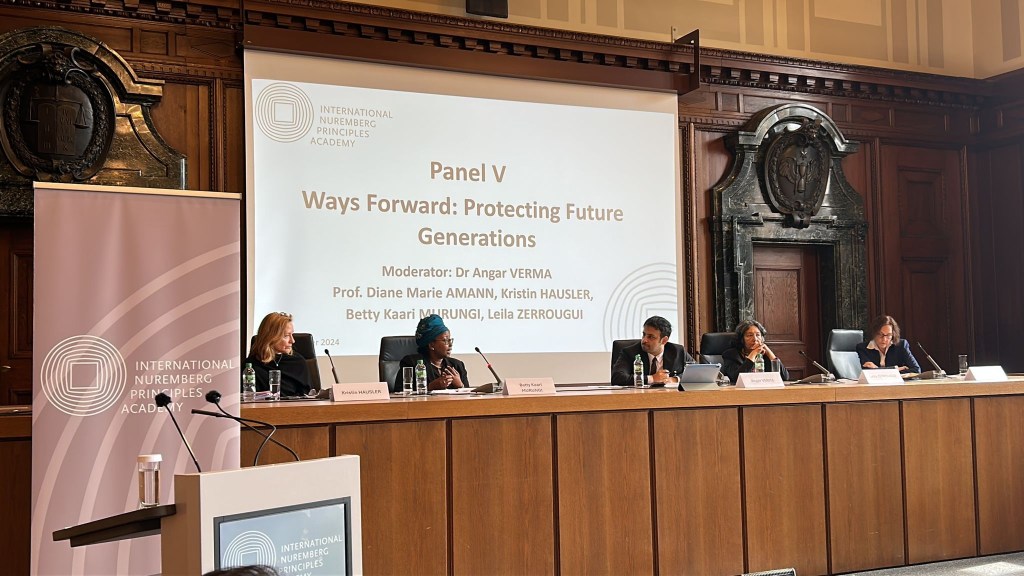
University of Georgia School of Law Professor Diane Marie Amann spoke at last week’s Nuremberg Forum 2024, the annual three-day meeting of the International Nuremberg Principles Academy. It was held in the Nuremberg, Germany, courtroom where hundreds of Nazi defendants were tried in the wake of World War II.

The theme of this year’s Forum was “For Every Child: Protecting Children’s Rights in Armed Conflict.” Amann spoke on the closing panel, “Ways Forward: Protecting Future Generations,” pictured above. She is pictured at right along with, l to r: Kristin Hausler; Betty Kaari Murungi; moderator Angar Verma; and Leila Zerrougui.

Amann gave an overview of her new article “Child-Taking,” 45 Michigan Journal of International Law 305 (2024), with focus on forced residential schooling of Indigenous children. As theorized in the article available here, child-taking occurs when a state or similar powerful entity takes a child and then endeavors to alter, erase, or remake the child’s identity. Though a criminal phenomenon, it may be redressed not only in criminal justice systems, but also through transitional justice mechanisms.

Amann is Regents’ Professor of International Law, Emily & Ernest Woodruff Chair in International Law, and a Faculty Co-Director of our Dean Rusk International Law Center here at Georgia Law. She served from 2012 to 2021 as International Criminal Court Prosecutor Fatou Bensouda’s Special Adviser on Children in & affected by Armed Conflict. This fall, she is spending a research-intensive semester in the United Kingdom, where she is a Research Visitor at the Oxford Faculty of Law Bonavero Institute of Human Rights.

Georgia Law Professor Kannan Rajarathinam (LL.M. ’88) interviewed by Hindustan Times

University of Georgia School of Law alumnus and adjunct professor Kannan Rajarathinam (LL.M. ’88) was interviewed in Hindustan Times about his new book, The DMK Years: Ascent, Descent, Survival (India Viking, 2024). The book will be available for purchase on November 15, 2024 in the United States.

The article titled “Unclear if the DMK is still the party of the modest or is for the modest” was written by Divya Chandrababu and was published on September 20.

Below is the introduction to the interview:

Political commentator and author R. Kannan recently launched his book, ‘The DMK Years: Ascent, Descent, Survival’ which is [an] account of the DMK’s journey, from its foundation in 1949 by CN Annadurai to its present-day prominence under Tamil Nadu Chief Minister MK Stalin. In an interview with Hindustan Times, the author speaks on the DMK’s 75th founding day and the Hindu assertion of the BJP that has forced the DMK to hold a conference for Murugan, the Hindu deity. Chief Minister Stalin’s son Udhayanidhi’s real test is a post-Stalin-phase, he says, adding that DMK’s strength is in its [organizational] base and a divided opposition, but if actor Vijay were to join forces with AIADMK or others, the ruling party might be in trouble for the 2026 assembly polls. 

The University of Georgia School of Law’s Dean Rusk International Law Center is hosting a book talk on Tuesday, November 19th for Rajarathinam. The conversation will be co-facilitated by Professor Laura Phillips-Sawyer of Georgia Law and Dr. Laura Zimmermann of the School of Public and International Affairs. This event is part of International Education Week, a joint initiative of the U.S. Department of State and the U.S. Department of Education, an effort to promote programs that prepare Americans for a global environment and celebrate the benefits of international education.

Kannan Rajarathinam is an adjunct professor at the University of Georgia School of Law teaching a course on International Organizations. Between 1993 and 2022, he served the United Nations in various capacities, including senior political affairs officer, head of office, senior planning and coordination officer, chief civil affairs officer, and legal officer from Afghanistan to Bosnia and Herzegovina. Before joining the UN, he briefly taught at the University of Madras in India as a guest faculty member and junior professor and practiced law. Presently, he serves on the Dean Rusk International Law Center Advisory Council.

Georgia Law Professor Adam Orford presents at World Congress of Environmental History in Finland

University of Georgia School of Law professor Adam D. Orford recently presented his article “The Oil Pollution Act of 1924: A Centennial Reassessment” and spoke on the panel “Law, History, and the Environment” at the World Congress of Environmental History, hosted at the University of Oulu in Finland. The theme for this year’s conference was “Transitions, Transformations and Transdisciplinarity: Histories Beyond History.”

Below is the paper’s abstract:

This Article examines the social, political, and legislative history of the United States Oil Pollution Act of 1924. A century after its enactment, the nation’s first federal antipollution law remains undeservedly obscure. At the height of the conservative Lochner era, during the conservative Coolidge Administration, with conservative majorities in both houses of Congress, and in the face of opposition from the oil and marine shipping industries, the United States Congress enacted a national law prohibiting oil pollution. How did this happen? Who was involved? And what can be learned about today’s conservative legal and political environment?

This work is part of a larger project to synthesize histories of political conservatism and national environmental legislation in the U.S. prior to the 1970s. The author’s prior work has traced this development back to through the postwar years. This work extends the inquiry further, examining U.S. federal antipollution legislation within the context of the social and political environment of the post-progressive 1920s, with attention to the role of private associations and business interests in promoting the legislation, and of technological feasibility in ultimately securing passage while also limiting the law’s scope.

There has not been a major study of this law since the 1980s, providing an excellent opportunity to integrate new historical perspectives – including environmental history and the recognition of political conservatism as an important historical force – as well as newly available archival records.

Orford is an Assistant Professor of Law at the University of Georgia School of Law. His interdisciplinary research investigates legal and policy approaches to environmental protection, human health and wellbeing, and deep decarbonization of the United States economy. He also participates in collaborative research initiatives across UGA, including as the lead of the Georgia element of the National Zoning Atlas and as a participant in ongoing investigations into the legal, political, environmental and social dimensions of new energy manufacturing and emerging carbon removal technologies.

Nomsa Ndongwe, Research Fellow at the James Martin Center for Nonproliferation Studies, speaks at Georgia Law

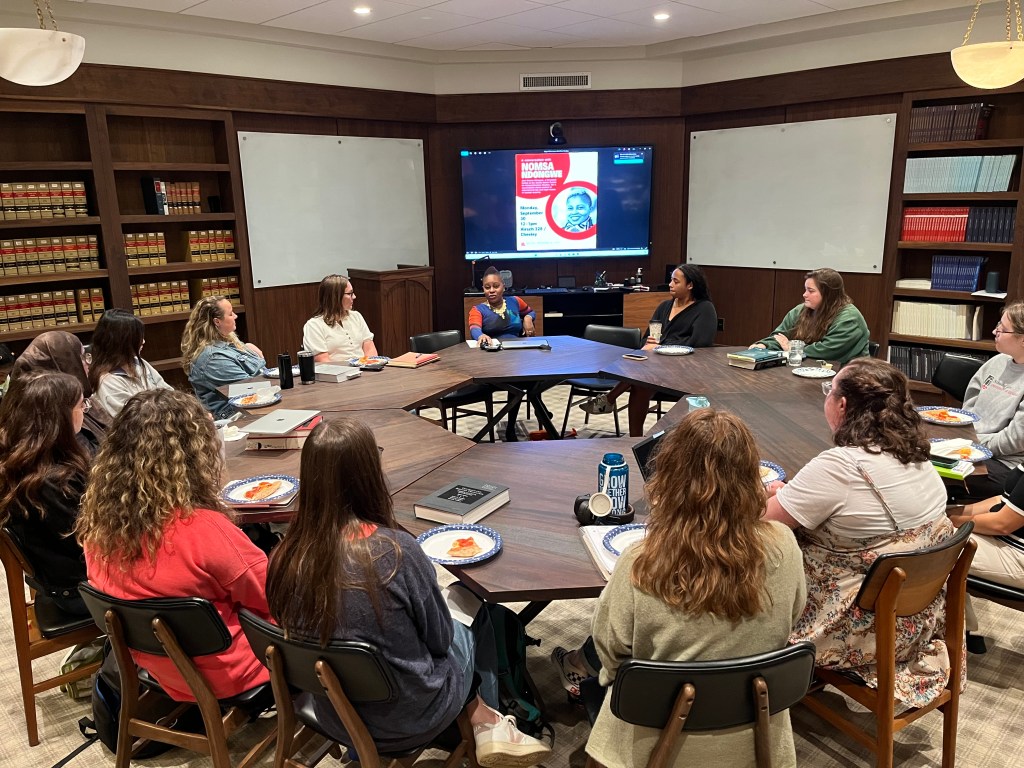
James Martin Center for Nonproliferation Studies (CNS) Research Fellow Nomsa Ndongwe spoke to students about careers in international law and contemporary security challenges this week at the University of Georgia School of Law.

Ndongwe discussed her own career trajectory and current work in nonproliferation at CNS. She identified several skills aspiring international lawyers can work towards in law school, including learning languages and developing subject matter expertise. Ndongwe championed the importance of professional networking, building relationships with peers, and making use of the resources available to students at Georgia Law, like the Career Development Office and the Dean Rusk International Law Center. She also answered student questions about the use of artificial intelligence in international law, current proceedings in international courts, and global nuclear security challenges.

Ndongwe is a Co-founder of the WCAPS West Coast Chapter, and an N-Square Innovators Network Fellow 2020 – 2021. As of January 2022, she co-leads the CNS Young Women in Nonproliferation Initiative, is a School of International Futures Mentor 2023, and served as a Girl Security mentor. She is also a part of the P5 –Young Professionals Network (YPN) 2022-2023 cohort. She has a Master of Arts in Nonproliferation, Terrorism Studies, and Financial Crime Management from the Middlebury Institute of International Studies. She obtained her first degree, an LLB Single (Hons) degree at Brunel University, and her Postgraduate Diploma in Legal Practice (LPC) from the University of Law in Guildford, UK.

Previously, she served as diplomat for the Zimbabwe Permanent Mission to the United Nations Office at Geneva, focusing mainly on the Disarmament portfolio and International Telecommunication Union (ITU). Nomsa is a featured non-proliferation panelist/moderator for the Ploughshares Foundation, Harvard Belfer Center, Trinity College DC, United Nations Office for Disarmament Affairs (UNODA) New York, Naval Postgraduate School, United Nations Institute for Disarmament Research (UNIDIR), N Square Innovators Network and Royal United Services Institute (RUSI).