As Graduate Editors, each LL.M. student conducts citation checks and writes a Comment or Book Review on the legal topic of their choice. The Graduate Editors further facilitate the Journal’s commitment to “including a diversity of perspectives, experiences, and backgrounds within [its] membership,” according to the Editor in Chief, Jasmine Furin (J.D. ’25).
The Georgia Journal of International and Comparative Law is a preeminent forum for academic discussion on current international subjects. From its inception in 1971 as a student initiative supported by former U.S. Secretary of State and Georgia Law Professor Dean Rusk, the Journal features work by legal scholars and practitioners and student notes written by Journal members.
This study examines whether the RRM empowers workers’ voices in the Mexican auto sector. To this end, between January and March 2024, we interviewed 130 workers across seven supplier facilities (auto plants facilities and logistics facilities) and five assembly plants, for a total of 12 facilities. Three of the facilities were not unionized; nine facilities were unionized. Three of the twelve plants had used the RRM (“RRM facilities”), addressing various violations of labor rights, voting processes to approve or reject collective contracts, voting processes to elect independent unions, and dismissals and intimidation of workers in union activism. All three RRM cases were remediated through plans requiring the facility to hold a new legitimization vote and union election and offer worker-level trainings. Our preliminary results problematize some assumptions that drove RRM implementation. The Biden administration and members of the United States Congress have promoted the RRM as a way to strengthen the Mexican government’s efforts to implement Mexican labor law reform, empower workers in productive export sectors, and give them a voice over their labor conditions. Our results suggest that, four years after the implementation of the USMCA and the reforms of Mexico’s labor legislation, a little more than half of the workers are aware of the labor law reform, and opinions are divided on whether it is strengthening labor rights. Some workers thought the reforms were going well, while many thought the reform process was going poorly or did not know how it was going. The majority of workers we interviewed revealed that they did not understand the new democratic procedures to legitimize their collective bargaining agreements, nor that they could access the RRM platform to express their complaints. Nevertheless, the workers we interviewed at RRM facilities tended to be more knowledgeable of the labor law reforms and its attendant rights and processes than those at facilities that have not undergone RRM investigation and remediation, and they tended to view their bargaining representative and conditions of work more favorably. Our study suggests that when workers are given the opportunity to participate in democratic elections under international supervision, after receiving training on the shop floor about their rights and election procedures, they gain knowledge and ownership over their working conditions.
LeClercq joined the University of Georgia School of Law in 2024 as an assistant professor. She teaches International Trade and Workers Rights, International Labor Law, International Law and U.S. Labor Law, as well as the International Law Colloquium. She also serves as a faculty co-director of the Dean Rusk International Law Center and as the faculty adviser for the Georgia Journal of International and Comparative Law.
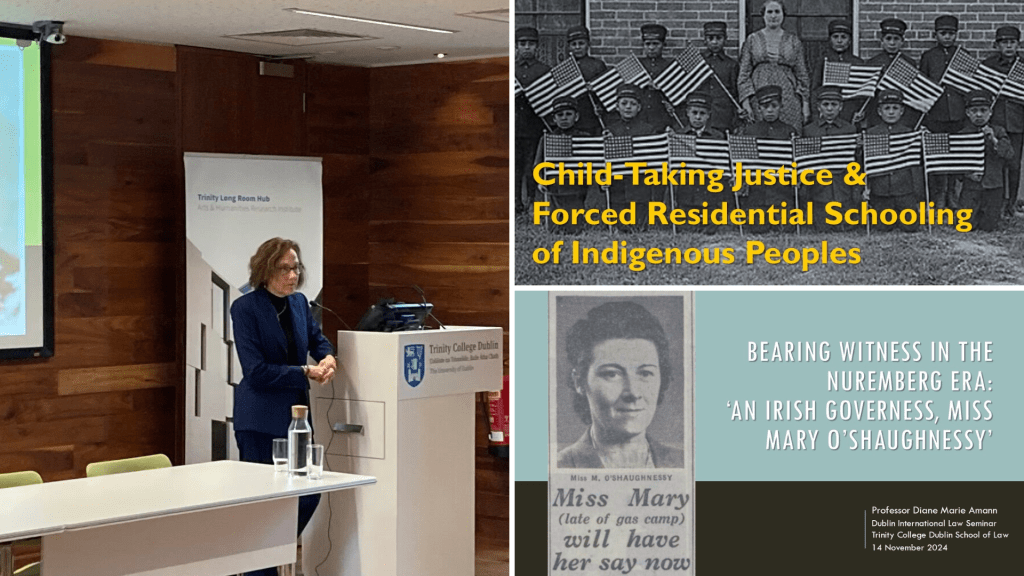
Amann is Regents’ Professor of International Law, Emily & Ernest Woodruff Chair in International Law, and a Faculty Co-Director of our Dean Rusk International Law Center here at Georgia Law. She has pursued a research-intensive semester this autumn, primarily as a Research Visitor at the Oxford Faculty of Law Bonavero Institute of Human Rights and Visiting Fellow at Exeter College Oxford.


 exchange of notes