The University of Georgia School of Law’s spring 2025 International Law Colloquium welcomed Professor Luwam Dirar of Western New England University School of Law as its second speaker last week.
Dirar presented her working paper titled, “Emancipation, Decolonization, and Gender in the Context of African Integration.” Dirar’s research and scholarly focus centers on international human rights law and the intersection of international economics and international relations. Dirar has also served as a consultant to several African governments and international organizations regarding migration and law.
Associate Director of the Dean Rusk International Law Center, Taher Benany, served as Dirar’s faculty discussant. Professor Desirée LeClercq is overseeing the colloquium, which is designed to introduce students to features of international economic law through engagement with scholars in the international legal field.
Below is an abstract of Dirar’s working paper:
The 1960s institutionalization and formalization of Africa’s continental integration was a manifestation of the ontological fragility of the concept of emancipation in the African context. As a concept, continental emancipation excluded concerns of women and formalized the divorce between decolonization and racial domination on the one hand and social emancipatory movements on the other. This divorce was contrary to the expectation of women who sought the end of colonial subjugation as a turning point for women’s emancipation from not only colonial and racial domination but also from social oppression. This article argues that the continental emancipation project betrayed the hopes of women who sought decolonization or the end of white racial domination as central to the end of gendered and gendering social subjugation. This article will have four parts. The first part will be a general introduction and will explore women’s emancipation in the context of regional integration studies. The second part will explore the internal contradictions of the concept of emancipation. The third part will explore the marketization of regional integration in Africa and the debates surrounding gender in trade agreements. The fourth part will be the conclusion and way forward.
To view the full list of International Law Colloquium speakers, visit our website. A summary of the previous week’s talk with Professor Harlan Cohen can be found here.
This program is made possible through the Kirbo Trust Endowed Faculty Enhancement Fund and the Talmadge Law Faculty Fund.
The University of Georgia School of Law welcomed international lawyer Eva Keïta to campus this week to discuss her experience at the International Court of Justice (ICJ) with students in Professor Diane Marie Amann‘s Public International Law course.
Keïta provided students with an overview of the ICJ, where she was an Associate Legal officer and a Judicial Fellow assisting a judge on various public international law matters. She spoke about the makeup of the ICJ, the role of members on each of the Judges’ teams, and how students can make themselves more competitive for open positions. Keïta then took questions from students, detailing her own professional journey as an international dispute settlement lawyer and providing advice for those interested in pursuing international legal careers.
Before her time at the ICJ, Keïta honed her expertise in international arbitration and litigation and handled complex international disputes at two international law firms in Paris. Keïta also has significant experience handling pro bono and international human rights matters. She provided legal representation to an inmate serving a life sentence under California’s Three Strikes Law in post-conviction proceedings, assisted human trafficking victims in compensation proceedings in front of French courts, and volunteered for four months in Togo, providing legal assistance to inmates through a local NGO.
Prior to her legal career, Keïta pursued a bachelor’s and master’s degree in political science, specializing in international relations, from the Sorbonne. In addition, Keïta holds a LL.M. in international economic law, business & policy from Stanford Law School and her first law degree from Sciences Po in Paris.
The University of Georgia School of Law’s spring 2025 International Law Colloquium began last week with Professor Harlan Cohen of Fordham University School of Law. For more than a decade, the International Law Colloquium Series has brought leading scholars to Georgia Law, where they have presented works in progress and invited discussion and comments from students as well as faculty discussants.
This year, Professor Desirée LeClercq is overseeing the colloquium, which is designed to introduce students to features of international economic law through engagement with scholars in the international legal field. The course broadly defines “international economic law,” to include traditional approaches (trade and investment agreements) as well as non-traditional, emerging approaches (examining the effects of international economic law on marginalized communities and considering re-distributional policies).
Cohen presented his working paper titled, “The International Order, International Law, and the Definition of Security.” Cohen, who previously served as the Gabriel M. Wilner/UGA Foundation Professor in International Law at the University of Georgia School of Law and Faculty co-Director of the Dean Rusk International Law Center, specializes in international trade, international law, international legal theory, global governance, and U.S. foreign relations law.
As economic security has seemingly moved to the center of American and European foreign policy, both the United States and the European Union have broadened their interpretation of international law rules governing security, coercion, and intervention. These broadened interpretations have supported a bevy of new sanctions, trade restrictions, investment controls, and industrial policies that have turned the global economy into an increasingly weaponized space. But these interpretations are not exactly new, echoing developing state interpretations of international law that developed states had long ago seemingly rejected. How are these once moribund interpretations of security, force, and coercion being brought back to life?
This essay argues that these interpretative shifts highlight the role of the international order as an interpretative mechanism within international law. Borrowing from the work of Robert Cover, it explains the ways that the international order acts as a jurispathic agent within the system, judging which interpretations live on and which are cast aside. As global power shifts, the international order shifts with it, potentially reopening interpretative fights over international law. Today’s fights over the meaning of security, force, and coercion thus reflect both the realities of a changing order and the battle to shape the one to come.
To view the full list of International Law Colloquium speakers, visit our website.
This program is made possible through the Kirbo Trust Endowed Faculty Enhancement Fund and the Talmadge Law Faculty Fund.
I entered law school with a clear vision: to build a career in international law. The specifics of what that entailed, however, were admittedly hazy. Determined to clarify my path, I adopted a holistic approach to exploring the field. Over three years, I immersed myself in international law courses, participated in summer global programs, and worked as a student attorney in the immigration clinic–all in search of work that would ignite my passion. Time and again, these opportunities reaffirmed my commitment to serving others and deepened my love for all things international. The culmination of this journey was an eye-opening semester in Washington, D.C., where I had the privilege of working at the Office of the Legal Adviser at the Department of State, known affectionately as “L.” It was there, in the beating heart of our foreign affairs, that I found the spark I had been seeking, anchoring my resolve to work in international law and public service.
The Office of the Legal Adviser
Often described as the government’s international law firm, the Office of the Legal Adviser (L) comprises roughly 300 attorneys. This powerhouse is divided into 23 offices, each corresponding to one or more of the State Department’s bureaus. These include regional offices focused on specific areas of the world and functional offices dedicated to specialized subject areas. As a full-time extern, I worked with the regional office for African and Near Eastern Affairs and the functional office for Management.
The core mission of L is to provide counsel. Attorney-advisers assist policymakers in shaping and implementing U.S. foreign policy while promoting the development and adherence to international law and its institutions. As an extern, I spent my days assisting the attorney-advisers through contributions that took the form of research, writing, and briefings. Over the course of four demanding months and close to twenty research assignments, I cultivated these skills at a breathtaking pace. Meanwhile, I delved deeper into international law topics I had only skimmed in class: peace agreements, international humanitarian law, human rights, international organizations, foreign assistance, law of the sea, the International Court of Justice, the Freedom of Information Act, and Executive Orders. Each assignment helped me grow, providing a challenge that expanded my understanding of the intricate and dynamic world of international law.
Beyond satisfying my intellectual curiosity, the work at L was deeply rewarding. Whether defending humanitarian assistance or contributing to ceasefires, the focus was on alleviating human suffering and fostering positive change. I was surrounded by colleagues who were fiercely dedicated to human rights, and despite slow progress at times, their unwavering commitment and passion were inspiring. Each of them offered a unique example of how I could shape both my career and my life, and I am profoundly grateful for having had the opportunity to learn from them.
Soft Power
One moment that stands out from my semester occurred about two months into my externship when I was invited to tag along to an L softball game. The day was crisp and breezy, with the Jefferson Memorial peeking through the trees surrounding the fields. Attorneys from L arrived in small groups, wearing jerseys emblazoned with their team name, “Soft Power.” After a quick warm-up, the Japanese Embassy team arrived, and the game began. I settled onto a picnic blanket with attorneys from the Office of Oceans and International Environmental and Scientific Affairs. As we chatted about work and life in D.C., the game played on, and before long, it was over.
After the game, we gathered at the Japanese Embassy for sushi and pizza, and the Acting Legal Adviser, Rich Visek, took the floor. “I assumed we would lose, like we always do,” he quipped, self-deprecatingly. But this time, victory was ours. He adjusted his remarks, and he expressed gratitude for the embassy’s sportsmanship and willingness to host the tradition. It was a beautiful event, a symbolic celebration of the enduring relationship between our nations.
It was only later that I fully grasped the significance of the team’s name, “Soft Power.” On the surface, it evoked the image of a formidable softball team. But it was also a clever nod to the essence of diplomacy–a country’s ability to influence and build relationships through persuasion and collaboration, rather than coercion. This concept of soft power perfectly encapsulated the work I observed at L. Even amid escalating global conflicts, the undercurrent of our efforts was diplomacy–quiet, persistent, and impactful. Whether through policy discussions or friendly softball games, the power of diplomacy was ever-present, shaping the world in ways both visible and unseen.
My semester at L was more than an externship; it was a defining chapter in my journey. It deepened my passion for international law, sharpened my skills, and introduced me to extraordinary mentors who embody the values I hope to carry forward in my career. Most importantly, it solidified my belief in the power of service–and the enduring impact of soft power–to make a meaningful difference in the world.
Amann is Regents’ Professor of International Law, Emily & Ernest Woodruff Chair in International Law, and a Faculty Co-Director of our Dean Rusk International Law Center here at Georgia Law.
The “What Figures” article is her contribution to the journal’s symposium issue based on a book about the Chagos Islands and the International Court of Justice advisory opinion, written by University College London Law Professor Philippe Sands, who was a barrister in those proceedings.
The issue also includes a foreword by Sands and a co-authored dialogue between Diane F. Orentlicher and Morton H. Halperin, as well as articles by Dan Bodansky, Christopher J. Borgen, Jorge Contesse, Peter G. Danchin, Jeffrey Dunoff, Margaret M. deGuzman, Mark A. Drumbl, Jean Galbraith, Rachel López, Jonathan H. Marks, Elizabeth Nwarueze, Obiora Chinedu Okafor, Ayodeji Kamau Perrin, and Sebastian von Massow.
Here’s the abstract for Amann’s article, which is available here:
“One person’s life forms the core around which Philippe Sands’ The Last Colony explores the events leading up to the advisory opinion on the Legal Consequences of Chagos Archipelago from Mauritius in 1965. That person is Liseby Bertrand Elysé, who was born in 1953 in Chagos, then forcibly removed to Mauritius in 1973. Her efforts to return home eventually brought her to a 2018 hearing at The Hague, where she spoke to the International Court of Justice bench by means of a subtitled video. This essay, which appears in a symposium issue on Sands’ book, investigates the ethics, the effectiveness, and the emancipatory potential of the author’s telling of the story of the Chagossian woman he most often calls ‘Madame Elysé.’”
Presented her work in progress, “Child-Taking Justice and Forced Residential Schooling of Indigenous Peoples,” as part of the Bonavero Perspectives workshop series at the Oxford Faculty of Law Bonavero Institute of Human Rights. Moderating was another Bonavero Research Visitor, Professor Eva Marie Belser of the University of Fribourg in Switzerland.
Amann is Regents’ Professor of International Law, Emily & Ernest Woodruff Chair in International Law, and a Faculty Co-Director of our Dean Rusk International Law Center here at Georgia Law, where she teaches Public International Law, Constitutional Law, and various upper-division courses exploring interrelations between national and international legal frameworks.
Amann is Regents’ Professor of International Law, Emily & Ernest Woodruff Chair in International Law, and a Faculty Co-Director of our Dean Rusk International Law Center here at Georgia Law.
Her article, which draws upon her ongoing research into lawyers and other women professionals played at post-World War II trials, forms part of the journal’s special review series marking the centenary of the Hague Academy of International Law.
Available here, the article focuses on the life of one “Nuremberg woman,” Dr. Aline Chalufour, who attended the Academy in 1937 and again in 1957. Her experiences both shed light on how marginalized groups fared in the Academy’s first 100 years, and also call upon the Academy, and the field it promotes, to do better in the next 100 years.
International tax debates often center on how to fairly allocate taxing rights on the profits of multinational enterprises, carrying significant global economic implications. When a business earns income abroad, the country of residence (where the taxpayer resides) and the country of source (where income is generated) both have legitimate, competing claims to tax that income. The international tax system favors residence-based taxation. The source country has the right to tax business profits only if the enterprise carries on a permanent establishment in its borders, which typically requires physical presence. The permanent establishment standard becomes flawed in a digital economy where profit shifting practices are abundant and businesses no longer require a physical presence in the location of their online consumers.
These enduring norms are poised to change with an upcoming United Nations (UN) Framework Convention on International Tax Cooperation – an initiative overwhelmingly supported by Global South economies. The Global North has historically dominated the international tax regime through the Organisation for Economic Co-operation and Development (OECD), informally known as the “World Tax Organization”. A UN framework convention could introduce new standards to address the tax challenges of digitalization, though it would need to bridge the underlying North-South divide.
This article explores the “tax wars” surrounding the leadership for global tax governance, contrasting the taxing powers and interests of the OECD-led Global North with those of the UN-backed Global South. It argues for a shift toward source-based taxation by revisiting the permanent establishment standard. This transition will address longstanding inequities and is increasingly warranted in a digital economy that does not rely on physical presence.
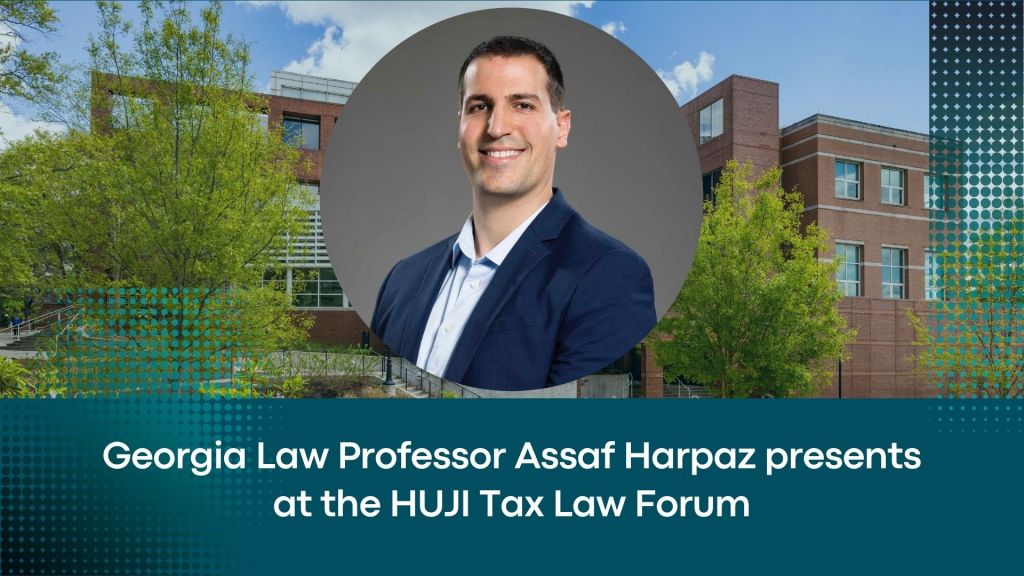
Assaf Harpaz joined University of Georgia School of Law as an assistant professor in summer 2024 and teaches classes in federal income tax and business taxation. Harpaz’s scholarly focus lies in international taxation, with an emphasis on the intersection of taxation and digitalization. He explores the tax challenges of the digital economy and the ways to adapt 20th-century tax laws to modern business practices.
Kobi Korankye: Ph.D. student in Philosophy, Franklin College of Arts and Sciences
Beatrice Robson: Ph.D. student in Agricultural and Applied Economics, College of Agricultural and Environmental Sciences
Uyiosa (“Uyi”) Ugiagbe: Ph.D. student in Mathematics Education, Mary Frances Early College of Education
All information about the Graduate Certificate in International Law, including upcoming application cycles and virtual information sessions, can be found here.
The International Law Colloquium, a time-honored tradition here at the University of Georgia School of Law, returns this spring semester with another great lineup of global legal experts.
In Spring 2025, this for-credit course is designed to introduce students to features of international economic law, broadly defined, through engagement with scholars in the international legal field. The course broadly defines “international economic law” to include traditional approaches (trade and investment agreements) as well as non-traditional, emerging approaches (examining the effects of IEL on marginalized communities and considering re-distributional policies). This course consists of presentations of substantial works-in-progress on a variety of international law topics by prominent scholars from other law schools. In keeping with a tradition established when the series began in 2006, students will write reaction papers on the scholars’ manuscripts, and then discuss the papers with the authors in class. Leading the class will be Desirée LeClercq, Assistant Professor of Law & Faculty Co-Director of the Dean Rusk International Law Center. Other Georgia Law faculty, including Diane Marie Amann and Christopher Bruner, will join in the dialogues.
Further supporting the colloquium are staff at our Center; in particular, the Center’s Global Practice Preparation team, which includes Catrina Martin and student workers Casey Smith (J.D. ’26) and Aubry Tedford (J.D. ’25). The colloquium further benefits from generous support from the Kirbo Trust Endowed Faculty Enhancement Fund and the Talmadge Law Faculty Fund.
Presenting at the Spring 2025 Colloquium (pictured above, clockwise from top left):
January 17: Harlan Cohen, Fordham University School of Law “The International Order, International Law, and the Definition of Security”
January 24: Luwam Dirar, Western New England University School of Law “Emancipation, Decolonization, and Gender in the Context of African Integration”
January 31: Diane Marie Amann, University of Georgia School of Law “Economies of Injustice and the Forced Residential-Schooling of Indigenous Americans”
February 7: Christopher Bruner, University of Georgia School of Law “Sustainable Corporate Governance and Prospects for a US Value Chain Due Diligence Law”
February 14: Katrin Kuhlman, Georgetown University School of Law “Micro International Law”
February 21: Olabisi D. Akinkugbe, Schulich School of Law “Trade and Development in an Era of Geopolitics: A Third World View”
February 28: Ben Heath, Temple University School of Law “Sanctions and Sanctuary: Refuge, Violence, and the Legal Ordering of (Economic) Warfare”
March 14: Weijia Rao, Boston University School of Law “Signaling through National Security Lawmaking”
March 21: Julian Arato, Michigan University School of Law “The Institutions of Exceptions”
April 4: Trang (Mae) Nguyen, Temple University School of Law “Goods’ Citizenship”
April 11: Rachel Brewster, Duke University School of Law “Global settlements in the Foreign Corrupt Practices Act”
April 18: Sarah Dadush, Rutgers Law School “Shared Responsibility in American Contract Law”







 exchange of notes