
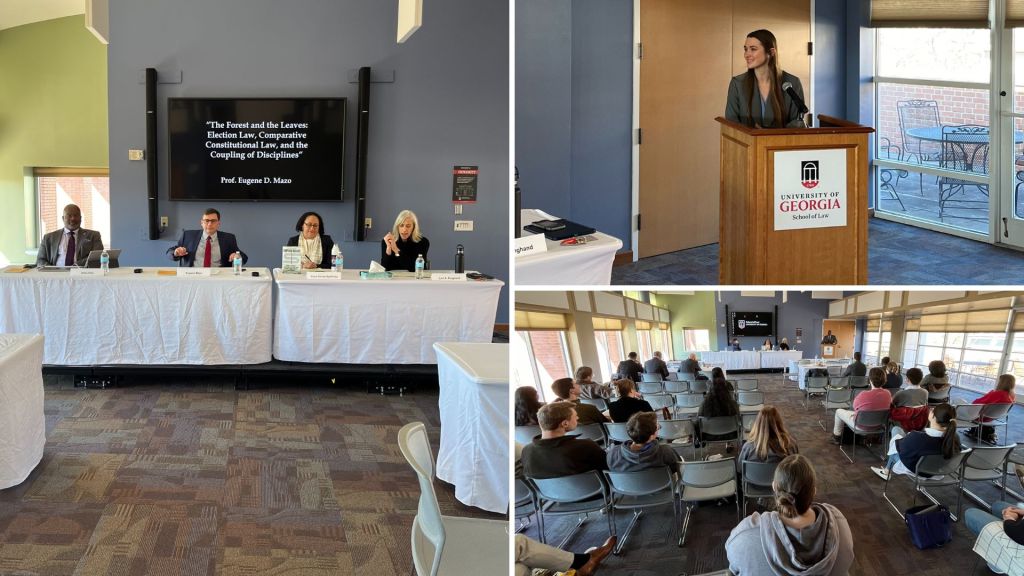
The University of Georgia School of Law’s spring 2025 International Law Colloquium welcomed Schulich School of Law, Dalhousie University Professor Olabisi D. Akinkugbe, who presented his working paper, “Trade and Development in an Era of Geopolitics: A Third World View.” Tim Samples, Associate Professor of Legal Studies in the Terry College of Business at the University of Georgia, served as Akinkugbe’s faculty discussant.
Akinkugbe is the Purdy Crawford Chair in Business Law and Associate Professor at the Schulich School of Law, Dalhousie University. His research covers several topics on issues in and at the intersection of public international law, international economic law, human rights, law and development, international courts, and regional economic integration in Africa. He explores these issues from the national, regional, and international contexts. Akinkugbe’s research draws on critical traditions such as Socio-legal approaches to law, Post-colonialism, and Third World Approaches to International Law (TWAIL) among others.
Below is an abstract of the working paper Akinkugbe presented:
This chapter examines the relationship between trade and development. Centering the heterogeneity of developing states within the World Trade Organization (WTO), the chapter briefly analyses some of the trade law interests that are most important to these different types of developing countries. It then turns to the question: how has international trade law accommodated the needs of different types of developing countries through special and differential treatment? The Chapter contends that the structure of the rules of the global economic order and the WTO in relation to trade were developed and are being implemented in the shadow of a fiercely contested geopolitical and power struggle. Despite the flexibilities in the WTO, developing and small island developing states’ trade interests are significantly marginalized in their implementation. Given the rise of conflicts in geopolitics and trade interests within the power WTO Member States, the Chapter contends that without fundamentally centering and reimagining the inequities in our international trade regime, mere “window dressing” or adoption of new rules of trade would only further marginalize the trade interests of the developing countries and SIDS in a non-inclusive way.
This year, Professor Desirée LeClercq is overseeing the international law colloquium, which is designed to introduce students to features of international economic law through engagement with scholars in the international legal field. To view the full list of International Law Colloquium speakers, visit our website.
This program is made possible through the Kirbo Trust Endowed Faculty Enhancement Fund and the Talmadge Law Faculty Fund.




 exchange of notes