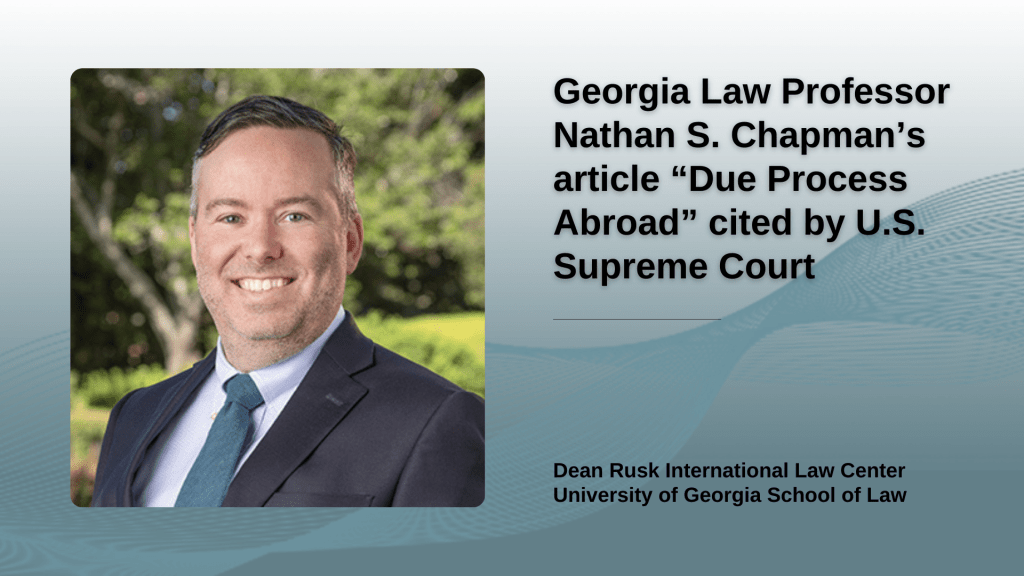
Georgia Law Professor Nathan S. Chapman’s article “Due Process Abroad” cited by U.S. Supreme Court

University of Georgia School of Law Professor Nathan S. Chapman’s articles “Due Process Abroad” (112 Northwestern University Law Review 377 (2017)) and “Due Process as Separation of Powers” (121 Yale Law Journal 1672 (2012) (with M.W. McConnell)) were cited by the U.S. Supreme Court in Fuid v. Palestine Liberation Organization.

Below is the abstract from “Due Process Abroad”:

Defining the scope of the Constitution’s application outside U.S. territory is more important than ever. In February, the Supreme Court heard oral argument about whether the Constitution applies when a U.S. officer shoots a Mexican teenager across the border. At the same time, federal courts across the country scrambled to evaluate the constitutionality of an Executive Order that, among other things, deprived immigrants of their right to reenter the United States. Yet the extraterritorial reach of the Due Process Clause—the broadest constitutional limit on the government’s authority to deprive persons of “life, liberty, or property”—remains obscure.

Up to now, scholars have uniformly concluded that the founding generation did not understand due process to apply abroad, at least not to aliens. This Article challenges that consensus. Based on the historical background, constitutional structure, and the early practice of federal law enforcement on the high seas, this Article argues that the founding generation understood due process to apply to any exercise of federal law enforcement, criminal or civil, against any person anywhere in the world. Outside the context of war, no one believed that a federal officer could deprive a suspect of life, liberty, or property without due process of law— even if the capture occurred abroad or the suspect was a noncitizen.

This history supports generally extending due process to federal criminal and civil law enforcement, regardless of the suspect’s location or citizenship. This principle has immediate implications for cross-border shootings, officially sponsored kidnappings and detentions abroad, the suspension of immigration benefits, and the acquisition of foreign evidence for criminal defendants.

Chapman currently serves as the law school’s associate dean for faculty development and holds the Cleveland Distinguished Chair of Law. He writes and teaches about constitutional law, especially constitutional rights, and law and religion. Most recently, he is the author, with Michael W. McConnell, of Agreeing to Disagree: How the Establishment Clause Promotes Religious Pluralism and Protects Freedom of Conscience (OUP, 2023).

Georgia Law Professor Desirée LeClercq organizes transnational conference in Mexico City to discuss the future of the USCMA

University of Georgia School of Law Professor Desirée LeClercq recently organized and funded (through a grant won at Cornell University) a transnational conference of U.S., Mexican, and Canadian labor unions and leaders at Flacso Mexico in Mexico City. Patricia Campos-Medina (WI-ILR Cornell University), Alex Covarrubias (El Colegio de Sonora), and Cirila Quintero (El Colegio de la Frontera Norte) served as conference co-organizers.

This one-day transnational labor conference solicited the views of labor unions, non-governmental organizations (NGOs), organizers, and workers on the United States-Mexico-Canada Agreement (USMCA)’s Rapid Response Mechanism (RRM) in light of current geopolitical dynamics. Participants identified current challenges in filing petitions under the RRM, aligned strategic approaches to the 2026 re-negotiation of the USMCA, and discussed ways to work together notwithstanding current tensions in politics and trade. The conference was structured to first discuss the RRM on a technical level before broadening to account for political tensions and joint transnational strategies. It concluded with ways participants could remain organized and collaborate in the future.

LeClercq joined the University of Georgia School of Law in 2024 as an assistant professor. She teaches International Trade and Workers Rights, International Labor Law, International Law and U.S. Labor Law. She also serves as a faculty co-director of the Dean Rusk International Law Center and as the faculty adviser for the Georgia Journal of International and Comparative Law.

Georgia Law Foreign and International Law Librarian Anne Burnett presents virtual program for international lawyers through the Jacksonville Urban League Center 

University of Georgia School of Law’s Foreign and International Law Librarian Anne Burnett presented “Legal Research Reimagined: AI, Exams, and the Global Legal Mindset” for the Jacksonville Urban League Center for Advocacy and Social Justice on July 14, 2025. She discussed the rapidly-evolving impact of artificial intelligence on legal research and legal education as well as providing an introduction to the variety of paths and opportunities for international lawyers.

Burnett has been the foreign and international law librarian at the University of Georgia School of Law Alexander Campbell King Law Library since 1996. Burnett serves as the primary provider of reference services for the international, foreign and comparative law collections and is a member of the library’s research team. Burnett also teaches courses in international legal research, advanced legal research and the LL.M. Legal System of the United States course.

Burnett’s previous law library experience includes the Legislative Reference Library in Austin, TX, and the Young Law Library at the University of Arkansas School of Law. Her other professional legal experience includes working as deputy legislative counsel at the Legislative Counsel Bureau for the Nevada Legislature in Carson City, NV. She also worked as a judicial law clerk for the Honorable Deborah A. Agosti, Second Judicial District Court, State of Nevada. Burnett is a member of the state bars of California and Nevada. She is active in the American Association of Law Libraries, the International Federation of

Georgia Law Professor Nathan S. Chapman presents at University of Queensland

University of Georgia School of Law Professor Nathan S. Chapman gave two presentations at the University of Queensland Law School in Brisbane, Australia this summer. He presented “Natural Law and Religious Liberty” at a faculty and student seminar, and “Fair Notice and Qualified Immunity” was presented at a faculty workshop.

Chapman received financial support to travel to the University of Queensland from the Dean Rusk International Law Center as a Rusk Scholar-in-Residence, an initiative promoting international opportunities for Georgia Law faculty that advance the mission of the Center.

Chapman currently serves as the law school’s associate dean for faculty development and holds the A. Gus Cleveland Distinguished Chair of Law. He writes and teaches about constitutional law, especially constitutional rights, and law and religion. Most recently, Chapman is the author, with Michael W. McConnell, of Agreeing to Disagree: How the Establishment Clause Promotes Religious Pluralism and Protects Freedom of Conscience (OUP, 2023).
Georgia Law Professor Desirée LeClercq presents on trade and worker rights at the World Trade Organization  

University of Georgia School of Law Professor Desirée LeClercq recently delivered a presentation on the future of multilateralism, trade, and worker rights to World Trade Organization officials and researchers in Geneva, Switzerland.

LeClercq received financial support to attend this workshop from the Dean Rusk International Law Center as a Rusk Scholar-in-Residence, an initiative promoting international opportunities for Georgia Law faculty that advance the mission of the Center.

LeClercq joined the University of Georgia School of Law in 2024 as an assistant professor. She teaches International Trade and Workers Rights, International Labor Law, International Law and U.S. Labor Law. She also serves as a faculty co-director of the Dean Rusk International Law Center and as the faculty adviser for the Georgia Journal of International and Comparative Law.

Georgia Law Professor Assaf Harpaz reviews article on regulatory mismatches between the United States and Europe

University of Georgia School of Law Professor Assaf Harpaz recently reviewed “Regulatory Mismatches in the United States and the European Union”, a paper by Michael S. Knoll, Ruth Mason, and Wolfgang Schön.

Below is a summary of the article:

This article explores regulatory mismatches, differences in regulations between different states, in the United States and the European Union, focusing on their differing approaches to market integration and regulatory diversity. The US emphasizes state autonomy, allowing regulatory pluralism to foster local experimentation and reflect diverse democratic preferences.

The Supreme Court’s handling of mismatches through balancing tests in decisions like Pike v. Bruce Church (1970), is limited and inconsistent, with a preference for leaving unresolved issues to Congress. In contrast, the EU prioritizes legislative and, to a lesser extent, judicial, harmonization and mutual recognition, with the Court of Justice rigorously reviewing member-state regulations for necessity, proportionality, and compatibility with fundamental market freedoms. Recent trends toward subsidiarity, however, signal a growing respect for national diversity. Both unions weigh state and market interests, but the United States tends to see regulatory diversity as a federalism benefit, whereas the EU views harmonization as essential to its integration goals.

Harpaz joined the University of Georgia School of Law as an assistant professor in summer 2024 and teaches classes in federal income tax and business taxation. Harpaz’s scholarly focus lies in international taxation, with an emphasis on the intersection of taxation and digitalization. He explores the tax challenges of the digital economy and the ways to adapt 20th-century tax laws to modern business practices.