Remembering recent Georgia Law visit by Judge Patricia Wald (1928-2019)

Over the last decade it was my honor on occasion to invite Judge Pat Wald to join in a project, to contribute a writing or to speak at an event. Invariably she accepted with the same wry caveat: “Yes, if I am still here by then.” Happily she always was still “here,” enlivening every project to which she contributed. But now she is not. News media reported that Patricia Anne McGowan Wald died in her Washington home yesterday, having succumbed at age 90 to pancreatic cancer.

Many obituaries will focus on her prodigious and inspiring career in the United States: her journey, from a working-class upbringing in a single-parent family, to practice as a lawyer on child rights and in the Department of Justice, to service, in the District of Columbia Circuit, as the 1st woman Chief Judge of a U.S. Court of Appeals, and quite recently, as an Obama appointee to the Privacy & Civil Liberties Oversight Board.

We international lawyers also will recall Wald’s fierce service as a judge on the International Criminal Tribunal for the former Yugoslavia. There, she took part in noted judgments, among them a genocide conviction in Prosecutor v. Krstić and a “turning point” appellate ruling in Prosecutor v. Kupreškić.

Even after retiring from the ICTY, Judge Wald championed international criminal justice, placing particular emphasis on women. It was my privilege to welcome her interventions on these subjects, and at times to aid publication of her contributions (Pat’s computer savvy was, it must be said, rudimentary).

Just last year, our Georgia Journal of International & Comparative Law was honored to publish Pat’s essay “Strategies to Promote Women’s Participation in Shaping International Law and Policy in an Era of Anti-Globalism,” based on remarks she’d given here at the University of Georgia School of Law Dean Rusk International Law Center. They were a highlight of our 10th birthday conference for IntLawGrrls blog, not least because Pat referred to us assembled scholars and practitioners as “you ‘young people’ in the room.” She traced the beginnings of international criminal justice, then said:

“I do not suggest that the process of integrating women as upfront participants in international courts, let alone the inclusion of the crimes most commonly committed against women as worthy subjects of international criminal law jurisprudence, has been completed. More accurately, these developments had just gotten off to a reasonable start at the moment that global politics seem to have begun to shift toward a so-called anti-globalist populism. My central point, therefore, is that we must strategize in the face of a desired, yet elusive future.”

Her strategies: ally to strengthen international law, international legal education, and global-mindedness in many sectors, including the arts; “protec[t] the venues in which women have had significant impact,” including the International Criminal Court and related forums; and work globally to raise women’s awareness “about educational opportunities, rights to land ownership and profits, how to start a small business, how to farm efficiently, how to participate in voting or run for office, and about legal rights to divorce or separation.”

Issues like these were prominent in a special issue of the International Criminal Law Review, “Women and International Criminal Law,” dedicated to the Honorable Patricia M. Wald, for which I served as a co-editor along with Jaya Ramji-Nogales, Beth Van Schaack, and Kathleen A. Doty. Wald herself wrote on “Women on International Courts: Some Lessons Learned” for vol. 11 no. 3 (2011). And as shown in that issue’s table of contents, additional contributors included many whom Judge Wald’s life and work had touched: Supreme Court Justice Ruth Bader Ginsburg and Harvard Law Dean Martha Minow, along with Kelly Askin, Karima Bennoune, Doris Buss, Naomi Cahn, Margaret deGuzman, Katharine Gelber, Laurie Green, Nienke Grossman, Rachel Harris, Dina Francesca Haynes, Jennifer Leaning, David Luban, Rama Mani, Jenny Martinez, Fionnuala Ní Aoláin, Katie O’Byrne, Lucy Reed, Leila Nadya Sadat, and David Tolbert. The issue stemmed from a 2010 roundtable (pictured below) that then-Executive Director Elizabeth “Betsy” Andersen hosted at the American Society of International Law, an organization Judge Wald long supported.

Pat’s support for IntLawGrrls predated this event. In 2009, she had contributed a trilogy of essays to the blog: 1st, “What do women want from international criminal justice? To help shape the law”; 2d, “What do women want? Tribunals’ due attention to the needs of women & children”; and 3d, “What do women want? International law that matters in their day-to-day lives”.

In keeping with the blog’s practice at that time, Pat dedicated her IntLawGrrls posts to a transnational foremother, “a wonderful German/Jewish woman, Gisela Konopka,” a University of Minnesota social work professor with whom Pat had collaborated in a lawsuit against the Texas Youth Authority. In her lifespan of 93 years, Konopka, Wald wrote, “fought in prewar Germany for children’s rights, was put in a concentration camp, managed to get out and work her way through occupied Europe to America, where she became the champion of children, especially girls, who got in trouble with the law.” Explaining how Konopka had influenced her, Judge Wald penned a sentence that today does service as her own epitaph:

“She inspired me as to what an older woman can do right up to the point of departure to help those behind.”

(Cross-posted from Diane Marie Amann)
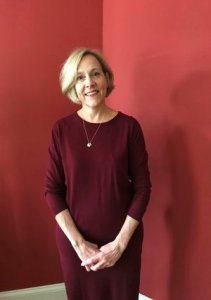
Georgia Law Professor Diane Marie Amann profiled by ATLAS women

img_2013cropProfessor Diane Marie Amann, holder of the Emily & Ernest Woodruff Chair in International Law here at the University of Georgia School of Law and our Center’s Faculty Co-Director, was profiled at ATLAS yesterday, in a post written by the organization’s co-founder, barrister Sareta Ashraph.

ATLAS, which stands for “Acting Together: Law, Advice, Support,” is a community of female-identifying lawyers, activists, and jurists with expertise in public international law. Founded in 2012, the organization aims to create a space where women in the field can reach out to each other for information, career advice, and mentoring. ATLAS builds upon and is complementary to the ethos of IntlLawGrrls, a blog Amann founded in 2007. Her charter coeditors, as she notes, were Beth Van Schaack, Jaya Ramji-Nogales, and our Center’s Director, Kathleen A. Doty. Amann joins 8 other women so far featured by ATLAS.atlas+empowered+women+empower+women

In her profile, Amann reflects on her career path and its high points, including teaching, working with inspirational people such as Mireille Delmas-Marty, clerking for U.S. Supreme Court Justice John Paul Stevens, and serving as Special Adviser on children’s issues to Fatou Bensouda, Prosecutor of the International Criminal Court. Amann also comments on diversity of the profession, noting:

“Many (or perhaps, only some) in the profession have become more aware and more vocal on the need for diversity when it comes to gender, race, ethnicity, and sexual orientation. That has not yet translated into a level of progress that is both right and required. At the same time, there have been far fewer conversations, and less awareness, of the lack of diversity within our profession when it comes to class. There seem to be few international lawyers who come from a working-class background, who are in their family’s first college-going generation.”

Amann goes on to offer advice to young women hoping to work in international law: follow your heart; move towards the positive; never stop learning; build a network of friends and mentors; build skills; and find time to do the things that make you happy.

Read the full profile here.

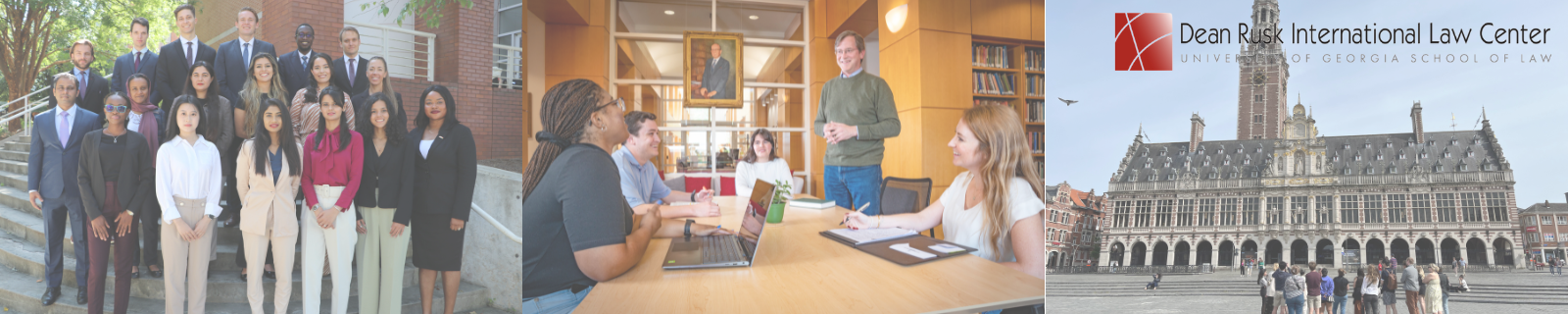
Season’s greetings

Photo Collage_drft2_fnl_crp

Wishing a festive holiday season to all friends of our Dean Rusk International Law Center, University of Georgia School of Law. We look forward to exchanges and collaborations in the coming New Year!

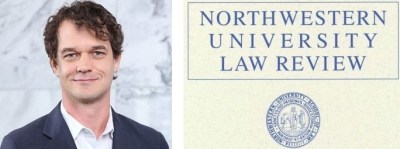
Georgia Law Professor Jason Cade publishes on sanctuaries in Northwestern Law journal, presents work at Fordham Law colloquium

This month, University of Georgia School of Law Professor Jason A. Cade published his latest article on immigration law in the Northwestern University Law Review, and also presented the article at a Fordham University School of Law conference.
The article, entitled “Sanctuaries as Equitable Delegation in an Era of Mass Immigration Enforcement,” appears at 113 Nw. U. L. Rev. 433 (2018).

Cade presented the work at Fordham Law’s 2018 Cooper Walsh Colloquium, a scholarly gathering that explored “Remodeling Sanctuary: Urban Immigration in a New Era.”

Cade teaches Immigration Law and directs the law school’s Community Health Law Partnership Clinic. His scholarship explores intersections between immigration enforcement and criminal law, the role of prosecutorial discretion in the modern immigration system, and judicial review of deportation procedures.

Here’s the abstract of his newly published article:

Opponents of—and sometimes advocates for—sanctuary policies describe them as obstructions to the operation of federal immigration law. This premise is flawed. On the better view, the sanctuary movement comports with, rather than fights against, dominant new themes in federal immigration law. A key theme—emerging both in judicial doctrine and on-the-ground practice—focuses on maintaining legitimacy by fostering adherence to equitable norms in enforcement decision-making processes. Against this backdrop, the sanctuary efforts of cities, churches, and campuses are best seen as measures necessary to inject normative (and sometimes legal) accuracy into real-world immigration enforcement decision-making. Sanctuaries can erect front-line equitable screens, promote procedural fairness, and act as last-resort circuit breakers in the administration of federal deportation law. The dynamics are messy and contested, but these efforts in the long run help ensure the vindication of equity-based legitimacy norms in immigration enforcement.

The full article is available here.

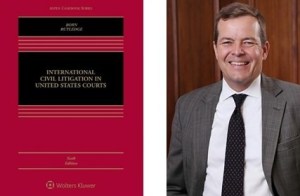
Georgia Law Dean Peter B. “Bo” Rutledge co-authors 6th edition of International Civil Litigation casebook

Now in print: the 6th edition of International Civil Litigation in United States Courts, a casebook co-authored by Peter B. “Bo” Rutledge (right), Dean and holder of the Herman E. Talmadge Chair of Law here at the University of Georgia School of Law, and Gary B. Born, London-based Chair of the International Arbitration Practice Group of the WilmerHale law firm.

As described by its publisher, Wolters Kluwer:

International Civil Litigation in United States Courts is the essential, comprehensive law school text for the current and future international litigator or international corporate lawyer. Covering all the topics discussed in competing texts and more, this casebook seamlessly combines international litigation, conflict of laws, and comparative civil procedure. This Sixth Edition includes excerpts and updated discussion of recent U.S. court decisions and legislation relating to a wide range of private and public international law topics, including foreign sovereign immunity, choice of law, antisuit injunctions, legislative jurisdiction, service of process on non-U.S. citizens, international discovery, foreign judgment enforcement, and international arbitration.

Table of contents and other details available here.

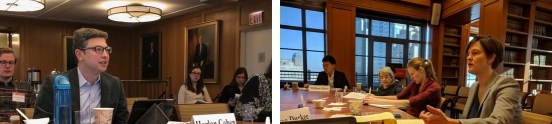
Georgia Law Professors Cohen and Durkee present at 2018 International Business Law Scholars Roundtable

The University of Georgia School of Law was well represented at IBL 2018, this year’s International Business Law Scholars Roundtable.

The event, held last Friday and Saturday at Brooklyn Law School, opened with a panel on “Corporate and Private Law Governance Issues in the International Sphere.” Among the speakers was Georgia Law Professor Melissa J. Durkee (above right), who presented “The New Functional Sovereignty: Private Authority in Global Governance.”

The gathering concluded with a panel on “International Economic Law,” at which Harlan G. Cohen (above left), Wilner/UGA Foundation Professor in International Law and our Center’s Faculty Co-Director, presented “What is International Trade Law For?”

They joined dozens of scholars, from law faculties at Harvard, NYU, Peking University, Sweden’s Orebo University, and elsewhere.

Immigration, guest worker law, IntLawGrrls blog featured in new issue of Center’s SSRN research series

The latest edition of our Dean Rusk International Law Center Research Paper Series is now available at the Legal Scholarship Network of SSRN, the Social Science Research Network.

The series is a joint project of two University of Georgia School of Law units: our Center, plus our law school’s Alexander Campbell King Law Library. Series Editor-in-Chief is Thomas Striepe, the library’s Associate Director for Research Services.

To be found in this edition, Vol. 4 No. 2 of the series:

► Abstracts of two articles by Georgia Law Professor Jason A. Cade, an expert on immigration law:

► The other two abstracts arise out of the March 2017 conference held here at Georgia Law to commemorate the 1st decade of IntLawGrrls, a still-thriving blog that Georgia Law Professor Diane Marie Amann, our Center’s Faculty Co-Director, founded in March 2007:

These and all papers in our Dean Rusk International Law Center Research Series may be found here.

Georgia Law faculty take part in ASIL Midyear Meeting and Research Forum

From left, Melissa J. Durkee, Diane Marie Amann, Kathleen A. Doty, and Harlan G. Cohen

Four members of our University of Georgia School of Law faculty took part last weekend in the American Society of International Law Midyear Meeting and Research Forum at UCLA School of Law in Los Angeles.

Diane ASIL► Professor Diane Marie Amann, the Emily & Ernest Woodruff Chair in International Law and Faculty Co-Director of our Dean Rusk International Law Center, presented “Glimpses of Women at the Tokyo Tribunal,” which will appear as a chapter in a forthcoming volume commemorating this week’s 70th anniversary of the judgment of the International Military Tribunal for the Far East. Amann, who is serves as a Counselor of the American Society of International Law, also took part in the Society’s Executive Council meeting.

Professor Harlan G. Cohen, holder of the Gabriel M. Wilner/UGA Foundation Professorship in International Law and Faculty Co-Director of the Dean Rusk International Law Center, participated in the meeting of the Board of Editors of the American Journal of International Law. He was elected to the Board last year and serves as Editor of AJIL’s International Decisions section.MJDurkee

◄ Professor Melissa J. Durkee presented her work, “The New Functional Sovereignty: Private Authority in Global Governance,” on a panel exploring the roles of corporations in international law.

IMG_7538

► Center Director Kathleen A. Doty offered career advice to current law students and recent graduates as part of ASIL’s International Law Speed Networking. This event was part of a series of offerings at the Midyear Meeting aimed at professional development for students and early-career lawyers.


Drawing links between initiatives to increase protection of children during armed conflict & similar violence


“‘Protecting Children’: A Welcome Addition to Efforts to Redress Wartime Harms,” an essay I published yesterday at Just Security, underscores connections among a number of recent initiatives related to children and armed conflict.

The essay welcomes Protecting Children in Armed Conflict (Hart Publishing 2018), the 600-page report of the 2017 Inquiry on Protecting Children in Armed Conflict spearheaded by Gordon Brown, former British Prime Minister and current UN Special Envoy for Global Education. (I served on the Inquiry’s Advisory Panel.)

Leading a team of researchers was Shaheed Fatima QC, a barrister at London’s Blackstone Chambers, who spoke on this work at the International Law Weekend panel last month. (prior post here) My Just Security essay offers a detailed description and favorable critique of this research, noting the work’s connections with what the UN Security Council terms the “Six Grave Violations against Children in Armed Conflict.”

The essay further draws links between this work and the 2016 International Criminal Court Office of the Prosecutor Policy on Children, which I had the honor of helping to prepare in my ongoing service as ICC Prosecutor Fatou Bensouda’s Special Adviser on Children in & affected by Armed Conflict. (prior post here) The essay points to “the complementary potential of these and other initiatives,” and concludes:

Together, they may advance two essential goals: first, to articulate norms prohibiting wartime harms against children; and second, to secure redress for any such harms that occur.

My Just Security essay is here. It is part of a miniforum which began with a post last week jointly authored by Fatima and Brown, available here. The Just Security series will continue with forthcoming posts by Sarah Knuckey (Columbia Law), Alex Moorehead (Columbia Law), and Alex Whiting (Harvard Law).

(Cross-posted from Diane Marie Amann)

Center’s Laura Kagel to meet with prospective LLMs in Austria, Croatia, and Germany

LLM cover pageLaw students in Austria, Croatia, and Germany will soon have the opportunity to talk with a Dean Rusk International Law Center staffer about pursuing a degree at here at the University of Georgia School of Law.

Later this month yours truly, Laura Tate Kagel, the Center’s Associate Director of International Professional Education, will give a presentation for students at Johannes Gutenberg University in Mainz, Germany, and take part in LL.M. fairs in Vienna, Austria, and Zagreb, Croatia. Sponsor of the fairs is EducationUSA, an arm of the U.S. Department of State.

I’ll be on hand personally to discuss the career benefits and special advantages of earning the Master of Law, or LL.M., degree at Georgia Law. (See prior posts about our current LL.M. students, as well as our hundreds of LL.M. alums, here.)

If you’d like to schedule to meet with me, please email LLM@uga.edu, and you can register for the fairs via the links below.

Monday, November 12, Mainz: 18:00-20:00, Johannes Gutenberg University, Department of Law and Economics. Email LLM@uga.edu for more details.

Wedne1sday, November 14, Vienna: 16:00 – 18:00, University of Vienna, Juridicum Dachgeschoss, 10-16 Schottenbastei, 1010. Register to attend online.

Friday, November 16, Zagreb: 18:00-20:00 at the Sheraton Hotel, Ul. kneza Borne 2, 10000. Register to attend online.

Hope to see you there!