International courts studied in new volume co-edited by Professor Cohen

Harlan Grant Cohen, the Gabriel M. Wilner/UGA Foundation Professor in International Law here at the University of Georgia School of Law, has just posted at SSRN “Introduction: Legitimacy and the Courts”, the opening segment of a forthcoming  Cambridge University Press volume. Institutions treated in subsequent chapters include the International Court of Justice, the World Trade Organization, the International Centre for the Settlement of Investment Disputes, and the European Court of Human Rights.

Cohen co-edited the forthcoming essay collection, entitled Legitimacy and International Courts, with Baltimore Law Professor Nienke Grossman, Deputy Director of her law school’s Center for International and Comparative Law, and two Oslo Law professors who co-direct that university’s PluriCourts project, Andreas Føllesdal and Geir Ulfstein.

The “Introduction” manuscript, which forms part of our Dean Rusk International Law Center Research Paper Series at SSRN, may be downloaded here.

Here’s the abstract:

Legitimacy and International Courts examines the underpinnings of legitimacy, or the justification of the authority, of international courts and tribunals. It brings together an esteemed group of authors, noted for both their expertise in individual courts, tribunals, or other adjudicatory bodies, and their work on legitimacy, effectiveness, and governance more broadly, to consider the legitimacy of international courts from a comparative perspective. Authors explore what strengthens and weakens the legitimacy of various different international courts, while also considering broader theories of international court legitimacy. Some chapters highlight the sociological or normative legitimacy of specific courts or tribunals, while others address cross-cutting issues such as representation, democracy, independence and effectiveness.

This Introduction surveys some of the key contributions of this volume and distills some of the lessons of its varied chapters for the legitimacy of international courts. Parts II and III are largely conceptual in approach, exploring what legitimacy means for each and all of the courts. Part IV takes a more functional approach, exploring how various factors internal or external to particular courts have contributed to those courts’ normative or sociological legitimacy. Part V provides thumbnail summaries of each the chapters that follow.

“Highly recommended”: Professor Chapman on “Due Process Abroad”

Due Process Abroad is the title of the timely manuscript that Nathan S. Chapman (right), an Assistant Professor here at the University of Georgia School of Law, has just posted at SSRN. At the influential Legal Theory Blog, Georgetown Law Professor Lawrence Solum has given his “highly recommended” recognition to this study of the extraterritorial application of the Due Process Clause of the U.S. Constitution.

The manuscript, which forms part of our Dean Rusk International Law Center Research Paper Series at SSRN, may be downloaded here.

Here’s the abstract:

Defining the scope of the Constitution’s application outside U.S. territory is more important than ever. This month the Supreme Court will hear oral argument about whether the Constitution applies when a U.S. officer shoots a Mexican child across the border. Meanwhile the federal courts are scrambling to evaluate the constitutionality of an Executive Order that, among other things, deprives immigrants of their right to reenter the United States. Yet the extraterritorial reach of the Due Process Clause — the broadest constitutional limit on the government’s authority to deprive persons of “life, liberty, and property” — remains obscure.

Up to now, scholars have uniformly concluded that the founding generation did not understand due process to apply abroad, at least not to aliens. This Article challenges that consensus. Based on the English historical background, constitutional structure, and the early practice of federal law enforcement on the high seas, this Article argues that the founding generation understood due process to apply to any exercise of federal law enforcement, criminal or civil, against any person, anywhere in the world. Outside the context of war, no one believed that a federal officer could deprive a suspect of life, liberty, or property without due process of law — even if the capture occurred abroad or the suspect was a non-citizen.

This history has important implications. It strongly supports the extension of due process to federal criminal and civil law enforcement, regardless the suspect’s location or citizenship. This principle has immediate implications for cross-border shootings, officially sponsored kidnappings and detentions abroad, the suspension of immigration benefits, and the acquisition of foreign evidence for criminal defendants.

Georgia Law alumnus, Professor Javier Dondé, returns as Visiting Scholar

We at the Dean Rusk International Law Center are delighted this week to host a distinguished Visiting Scholar: University of Georgia School of Law alumnus, Dr. Javier Dondé Matute.
He earned his LL.M. degree from Georgia Law in 1998, and is now a Professor of International Criminal Law at Instituto Nacionale de Ciencias Penales (National Institute of Criminal Sciences – INACIPE, for short) in Mexico City, Mexico.

He’ll be resident at our Center all week, pursuing his sabbatical research on the post-World War II trials at Nuremberg. Additionally, he’ll present a work in progress, entitled “Criminal Responsibility as a Founding Principle of International Criminal Law,” this Wednesday, March 15, as part of our International Law Colloquium Series led by Georgia Law Professor Harlan G. Cohen.

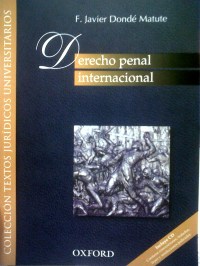
Professor Dondé has written and published widely on issues such as international criminal law, comparative criminal law, human rights, and extradition; his books include Derecho penal internacional (Oxford University Press 2008). He also has served as an adviser to Mexico’s Supreme Court and to various other judicial, prosecutorial, law enforcement, and human rights agencies. He is a member of the editorial boards of two leading Latin American law reviews, the Revista Iberoamericana de Derechos Humanos and the Anuario Mexicano de Derecho Internacional.
In addition to his Georgia Law LL.M., Professor Dondé holds a Ph.D. in international and comparative criminal law from the University of Aberdeen, Scotland, and completed his undergraduate studies at Instituto Tecnológico Autónomo de México (ITAM).

¡Bienvenidos!

Professor Burch presents on class actions at global conference in Israel

burch-profileA leading Georgia Law expert on complex litigation, Professor Elizabeth Chamblee Burch, recently presented on the subject at an international conference at the Tel Aviv University Faculty of Law in Israel.

Entitled “Fifty Years of Class Actions – A Global Perspective,” the 2-day conference brought together scholars not only from the United States and Israel, but also from Australia, Canada, Chile, Germany, Hong Kong, Italy, and the Netherlands.

Professor Burch, who holds the Charles H. Kirbo Chair of Law at the University of Georgia School of Law, spoke on the topic of “Publicly Funded Objectors.” Commenting on her paper was Dr. Eran Taussig, an attorney and lecturer at several universities in Israel.

Here’s the abstract:

On paper, class actions run like clockwork. But practice suggests the need for tune-ups: judges still approve settlements rife with red flags, and professional objectors may be more concerned with shaking down class counsel than with improving class members’ outcomes. The lack of data on the number of opt-outs, objectors, and claims rates fuels debates on both sides, for little is known about how well or poorly class members actually fare. This reveals a ubiquitous problem: information barriers confront judges, objectors, and even reformers.

Rule 23’s answer to information barriers is to empower objectors. At best, objectors are a partial fix. They step in as the adversarial process breaks down in an attempt to resurrect the information-generating function that culture creates. And, as the proposed changes to Rule 23’s handling of objectors reflect, turmoil exists over how to encourage noble objectors that benefit class members while staving off those that namely seek rents from class counsel.
Yet, this concern about screening the bad from the good has distracted us from both the bigger question and the true challenge. The bigger question is how we ensure that judges have the necessary information (and incentive) to monitor the attorneys and ensure that the settlement is fair when the adversarial system breaks down. And the real challenge is how we confront the intense regulatory struggle that arises anytime private actors perform public functions.

Addressing the public-private challenge can generate possibilities for overcoming information deficits. Our class-action scheme is not the only one that relies on private actors to perform public functions: citizens privately fund political campaigns, and private lobbyists provide research and information to lawmakers about public bills and policies. Across disciplines, the best responses to those challenges have often been to level up, not down. As such, this Essay proposes a leveling up approach to address judges’ information deficit such that they can better perform their monitoring role. By relying on public funds to subsidize nonprofit objectors’ information-gathering function, we can disrupt private class counsel’s disproportionate influence.

U.S. immigration law subject of timely article by Professor Jason A. Cade

cade_profileAn especially timely account of U.S. immigration law has just been published by Georgia Law’s expert on the subject, Professor Jason A. Cade.

Entitled “Judging Immigration Equity: Deportation and Proportionality in the Supreme Court,” the article  examines the Supreme Court’s deportation and immigration enforcement jurisprudence over the last 15 years, arguing that the Court’s decisions have been increasingly animated by a proportionality norm.

Here’s the abstract:

Though it has not directly said so, the United States Supreme Court cares about proportionality in the deportation system. Or at least it thinks someone in the system should be considering the justifiability of removal decisions. As this Article demonstrates, the Court’s jurisprudence across a range of substantive and procedural challenges over the last fifteen years increases or preserves structural opportunities for equitable balancing at multiple levels in the deportation process. Notably, the Court has endorsed decision makers’ consideration of the normative justifiability of deportation even where noncitizens have a criminal history or lack a formal path to lawful status. This proportionality-based lens helps unify the Court’s seemingly disparate decisions regulating the immigration enforcement system in recent years. It also has implications for deferred action enforcement programs such as the DACA program implemented by President Obama in 2012. The Court’s general gravitation toward proportionality analysis in this field is sound. Nevertheless, there are drawbacks to the Court’s approach, and the cases are probably best seen as signals to the political branches that the deportation system remains in dire need of wide-ranging reform.

The article, which appears at 50 UC Davis Law Review 1029 (2017), is available here.

Belgian Consul General de Baets featured at Global Atlanta luncheon

willem

Pictured at front, from right: Belgian Consul General William de Baets and Phil Bolton and Trevor Williams, respectively, publisher and managing editor of Global Atlanta.

For decades, we at the University of Georgia School of Law have welcomed collaboration with Belgium and its people and institutions. Even before 1978, when Belgium’s national airline became the 1st foreign carrier to fly nonstop to Atlanta, a Belgian attorney became the 1st foreign-trained lawyer to earn Georgia Law’s Master of Laws (LL.M.) degree. And thanks to the hard work and generosity of Georgia Law professors like Gabriel Wilner and our Center’s namesake, former U.S. Secretary of State Dean Rusk, we’ve partnered with leading Belgian universities to offer summer seminars on issues related to international  law and policy, often with a focus on European Union and transatlantic cooperation. That tradition will continue via this summer’s global governance school at the home of our partner, the Leuven Centre for Global Governance at the University of Leuven, one of Europe’s premier research institutions.

Thus it was a special pleasure to attend last Friday’s “Consular Conversations: Luncheon Interview With Belgium’s Consul General,” held at the Atlanta office of Miller & Martin, where Tom Harrold, Georgia Law alumnus and member of our Dean Rusk International Law Center Council, leads the International/World downloadLaw practice group. The event was part of a series of conversations sponsored by another Center partner, Global Atlanta.
Guest of honor was William de Baets, who’s served since last April as Belgium’s top diplomat in the Southeastern United States. In a wide-ranging conversation with Phil Bolton and Trevor Williams, Global Atlanta’s publisher and managing editor, de Baets explained he’d joined Belgium’s foreign service following 9 years as a Navy officer. Postings before his arrival at Atlanta included deputy head of mission in Côte d’Ivoire, Ethiopia, and Venezuela, and political counselor at Belgium’s embassy in Washington, D.C.

De Baets said that his office provides consular services and also engages in public and economy diplomacy; Friday’s conversation fulfilled the latter role. He spoke to a full house – a testament to the fact that Belgium ranks among the top 10 foreign investors in Georgia, which is home to more than 70 Belgian companies and more than 5,000 Belgian nationals.

Asked about Belgium’s renown as the home of Tintin and the Smurfs, not to mention 20th C. surrealists like René Magritte, de Baets recalled an artistic tradition that reaches back to the 16th C. Flemish master, Peter Paul Rubens. Additionally, Belgium did not gain independence until 1830; before that “the territory kept changing hands and was ruled by other people,” he noted. “We couldn’t speak up too much. We were saying yes and thinking no, or saying yes and doing what we wanted to do. It was a source of our humor – we couldn’t take ourselves too seriously.”

Again answering a question, de Baets spoke of his father’s participation in the resistance during Germany’s occupation of Belgium during World War II.

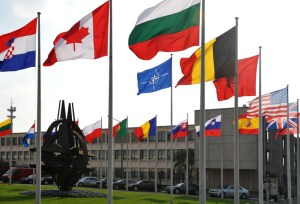
Flags of the 28 NATO member countries

Conversation then turned to Belgium’s role in contemporary matters. Regarding Brussels-based NATO (right), the defense alliance established 68 years ago by the North Atlanta Treaty, de Baets noted apparent disagreement within the new U.S. administration. Indeed, earlier in the week the South Carolina Governor tapped to become U.S. Ambassador to the United Nations, Nikki Haley, had called NATO “important.”

Although the United States can defend itself without NATO, Europe cannot, and so de Baets advocated strengthening the European Union’s security pillar to offset any weakening of NATO. Such alliances are essential for countries like Belgium and its neighbor, Luxembourg. Yet de Baets acknowledged difficulty in achieving the goal, given disagreement among EU member states – including Britain, even before its people voted in favor of Brexit.

Dubbing compromise a “Belgian export,” de Baets indicated that his country could a key role in aiding Europe’s efforts to resolve crises in financial and security sectors, as well as migration. The goal, he said, is to “strengthen our security without giving up our values.”

Georgia Law welcomes LLM-linked partnership with Fulbright in Hungary

sonjajokaybpest2016cropA new partnership between the University of Georgia School of Law and the Hungarian-American Fulbright Commission will provide exceptional scholarship opportunities for qualified Hungarian law graduates who wish to pursue a Master of Laws (LL.M.) degree.

Georgia Law Dean Peter B. “Bo” Rutledge and Dr. Károly Jókay, Executive Director of the Hungarian-American Fulbright Commission, signed the agreement. It follows meetings among representatives of both institutions, including the October 2016 meeting in Budapest between Jókay, depicted above at right, and Georgia Law Professor Sonja R. West (prior posts).

Administered by the law school’s Dean Rusk International Law Center, the Georgia Law LL.M. degree has deep historical ties in Europe, as well as an active network of graduates there. This Fulbright partnership promises to enhance intercultural exchange not only for foreign-trained lawyers who come to Athens to earn their LL.M., but also for the J.D. students with whom they interact, inside and outside the classroom (prior posts).

The Fulbright Program – established in 1946 under legislation introduced by J. William Fulbright, then a freshman U.S. Senator from Arkansas – funds international educational and cultural exchanges for students and scholars. It is administered by the Bureau of Educational and Cultural Affairs of the U.S. State Department in more than 150 countries.

We look forward to welcoming Hungarian students and strengthening our connection to both Central Europe and the Fulbright Program.

1st Amendment Professorship to Sonja West, globally noted media law expert

cropsonja_lawrencefulbrighthu13oct16Very pleased to note the appointment of Georgia Law Professor Sonja R. West, an internationally recognized expert in media law,  the inaugural holder of the Otis Brumby Distinguished Professorship in First Amendment Law. News of the position, which is shared by the law school and the University of Georgia Grady College of Journalism and Mass Communication, came in a university press release issued just before the holiday break.

Of her appointment, Georgia Law Dean Peter B. “Bo” Rutledge said:

“Sonja is a distinguished scholar in media law, and it is fitting that she be named to this professorship, which is devoted specifically to teaching and research about the First Amendment.”

As noted in a previous Exchange of Notes post, last October West represented Georgia Law in Budapest, Hungary, where she:

► Spoke on “Improving Press Coverage of the Courts through Communication” at the European Judicial Conference on Courts and Communication.

► Met with Budapest-based alums and representatives from the Hungarian-American Fulbright Commission, with whom she discussed Georgia Law’s Master of Laws (LL.M.) degree.  West’s at that meeting the photo above; to her immediate left is Dr. Jessica Lawrence, who earned her J.D. from Georgia Law and now is a Lecturer at Budapest’s Central European University. Surrounding them are Fulbright representatives: at far left, Krisztina Kováts, and to the right of West, Dr. Károly Jókay, Körtvélyesi Zsolt, and Molnár Gábor.

► Visited the law faculty at Pázmány Péter Catholic University. In fact, West has accepted an invitation to return to that Budapest university in June, to take part in a Free Speech/Media Law Discussion Forum.

Georgia Law’s International Law Colloquium returns for Spring 2017

intl_law_colloquiumThe International Law Colloquium, a time-honored tradition at the University of Georgia School of Law, returns this spring semester with another great lineup of global legal experts.

Led by our newest holder of an international law professorship, Harlan G. Cohen (prior posts), this 3-credit course consists of presentations of substantial works-in-progress on a variety of international law topics by prominent scholars from other law schools. Since the series began in 2006, students have read and written reaction papers on the scholars’ manuscripts, and then discussed the papers with the authors in class. Other Georgia Law and university faculty often have joined in these dialogues.

We at the Dean Rusk International Law Center are pleased to support this colloquium, thanks to the work of Kathleen A. Doty and Britney Hardweare, respectively, our Center’s Director of and Administrative Assistant for Global Practice Preparation.

Presenting at the Spring 2017 Colloquium are:

photo

◄ January 20: Duncan B. Hollis, Associate Dean for Academic Affairs and James E. Beasley Professor of Law at Philadelphia’s Temple University Beasley School of Law, Constructing Norms for Global Cybersecurity.

kingsbury► January 27: Benedict Kingsbury, Murry & Ida Becker Professor of Law and Director of the Institute for International Law and Justice at New York University School of Law, Contested Megaregulation: Global Economic Ordering After TPP.

todres◄ February 3: Jonathan Todres, Professor of Law, Georgia State University College of Law, Human Rights Education: Traversing Legal and Geographical Boundaries.

jain► February 10: Neha Jain, Associate Professor of Law and McKnight Land-Grant Professor, University of Minnesota Law School, Radical Dissents at International Criminal Courts.

puig◄ February 24: Sergio Puig, Associate Professor of Law and Director of the International Economic Law and Policy Program at the University of Arizona James E. Rogers College of Law, Blinding International Justice.

donde► March 15: Professor Javier Dondé Matute (LLM 1998) of the National Institute of Criminal Sciences, Mexico City, Mexico, a Spring 2017 Georgia Law Visiting Scholar, Criminal Responsibility as a Founding Principle of International Criminal Law.

durkee◄ March 24: Melissa J. Durkee, Assistant Professor of Law, University of Washington School of Law, The Global Norms Market.

achiume► March 31: Professor E. Tendayi Achiume, Assistant Professor of Law, UCLA School of Law, International Law and Xenophobic Anxiety.

Professor Harlan Cohen, Georgia Law’s newest chair in international law

cropcohen_harlan_columns2012Our new year begins with a new chaired professor in international law.

Georgia Law Professor Harlan G. Cohen was named the inaugural holder of the Gabriel M. Wilner/UGA Foundation Professorship in International Law in a university press release issued just before the holiday break.

Cohen has been a vital member of our international law curriculum since joining the Georgia Law faculty in 2007. His courses include international law, global governance, international trade, international business transactions, and U.S. foreign affairs and national security law, and human rights, and he is widely published on those topics.

Recognition of his expertise and prominence in the field is evident: Cohen is Managing Editor of AJIL Unbound, the online platform of the American Journal of International Law, and his service to the American Society of International law includes membership on ASIL’s Executive Council, co-chairing the 106th Annual Meeting and ASIL-Southeast, and membership on the Executive Committee of ASIL’s International Legal Theory Interest Group. Cohen also has co-chaired the Junior International Law Scholars Association and is an elected member of the American Law Institute.

His role in promoting the work of our Dean Rusk International Law Center includes mentoring globally minded students, leading the International Law Colloquium, inviting speakers and organizing conferences, and serving as faculty advisor to the Georgia Journal of International & Comparative Law. These mentorship and advising roles are like those undertaken by the namesake of the new chair: Gabriel M. Wilner (1938-2010), whose long career on Georgia Law’s faculty included service as Associate Dean and holder of the Kirbo Chair of Law. The professorship was created through a gift from Kenneth Klein, a former student of Wilner who is a partner at Mayer Brown in Washington, D.C., and matching funds from the UGA Foundation.

In the words of Georgia Law Dean Peter B. “Bo” Rutledge:

“Harlan has established his reputation as an intellectual leader in international law. His appointment as the inaugural holder of the Wilner/UGA Foundation Professor in International Law will help further the law school’s commitment to providing our students with a strong foundation that will assist them as they join the legal profession in law, business or public service – in the United States as well as abroad. The law school is grateful to our alumnus Ken Klein and the UGA Foundation for their support of this professorship.”