Georgia Law Professor Diane Marie Amann publishes in Temple symposium on Sands’ Chagos book

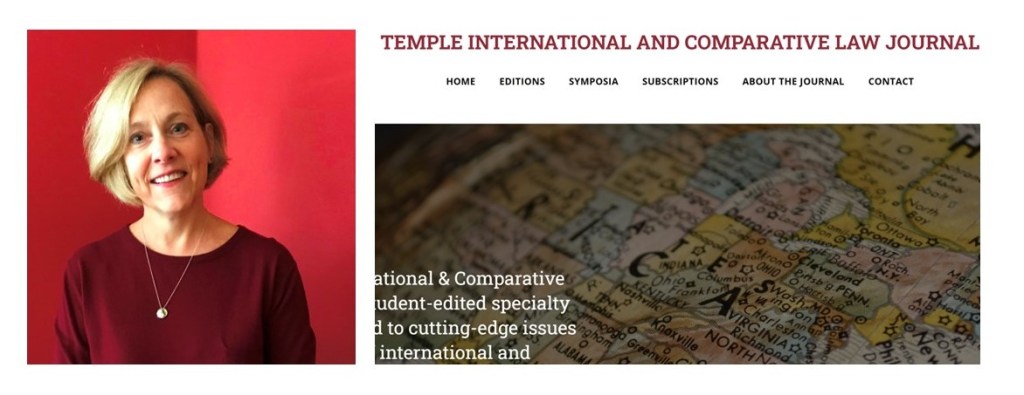
“What Figures Lurk on Madame Elysé’s Path? Reflections on Philippe Sands’ The Last Colony,” an article by University of Georgia School of Law Professor Diane Marie Amann, has just been published at 38 Temple International & Comparative Law Journal 91 (2024).

Amann is Regents’ Professor of International Law, Emily & Ernest Woodruff Chair in International Law, and a Faculty Co-Director of our Dean Rusk International Law Center here at Georgia Law.

The “What Figures”  article is her contribution to the journal’s symposium issue based on a book about the Chagos Islands and the International Court of Justice advisory opinion, written by University College London Law Professor Philippe Sands, who was a barrister in those proceedings.

The issue also includes a foreword by Sands and a co-authored dialogue between Diane F. Orentlicher and Morton H. Halperin, as well as articles by Dan Bodansky, Christopher J. Borgen, Jorge Contesse, Peter G. Danchin, Jeffrey Dunoff, Margaret M. deGuzman, Mark A. Drumbl, Jean Galbraith, Rachel López, Jonathan H. Marks, Elizabeth Nwarueze, Obiora Chinedu Okafor, Ayodeji Kamau Perrin, and Sebastian von Massow.

Here’s the abstract for Amann’s article, which is available here:

“One person’s life forms the core around which Philippe Sands’ The Last Colony explores the events leading up to the advisory opinion on the Legal Consequences of Chagos Archipelago from Mauritius in 1965. That person is Liseby Bertrand Elysé, who was born in 1953 in Chagos, then forcibly removed to Mauritius in 1973. Her efforts to return home eventually brought her to a 2018 hearing at The Hague, where she spoke to the International Court of Justice bench by means of a subtitled video. This essay, which appears in a symposium issue on Sands’ book, investigates the ethics, the effectiveness, and the emancipatory potential of the author’s telling of the story of the Chagossian woman he most often calls ‘Madame Elysé.’”

Georgia Law Professor Diane Marie Amann presents on child-taking and Nuremberg-era witnesses in workshops at University of Oxford

University of Georgia School of Law Professor Diane Marie Amann closed out her Fall 2024 research visit at the University of Oxford, where she was a Research Visitor at the Oxford Faculty of Law Bonavero Institute of Human Rights and Visiting Fellow at Exeter College Oxford, by giving two presentations at Oxford. She:

Lectured on “Women Bearing Witness in the Nuremberg Trials Project” in the Oxford Faculty of Law Public International Law Discussion Group. Tsvetelina van Benthem, Research Officer at the Blavatnik School of Government, moderated. Amann’s talk, which was delivered at All Souls College and live online, concluded the Group’s Michaelmas Term series.

Presented her work in progress, “Child-Taking Justice and Forced Residential Schooling of Indigenous Peoples,” as part of the Bonavero Perspectives workshop series at the Oxford Faculty of Law Bonavero Institute of Human Rights. Moderating was another Bonavero Research Visitor, Professor Eva Marie Belser of the University of Fribourg in Switzerland.

Amann is Regents’ Professor of International Law, Emily & Ernest Woodruff Chair in International Law, and a Faculty Co-Director of our Dean Rusk International Law Center here at Georgia Law, where she teaches Public International Law, Constitutional Law, and various upper-division courses exploring interrelations between national and international legal frameworks.

Georgia Law Professor Diane Marie Amann publishes in European Journal of International Law

A Nuremberg Woman and the Hague Academy,” an essay by University of Georgia School of Law Professor Diane Marie Amann, has just been published at European Journal of International Law 813 (2024).

Amann is Regents’ Professor of International Law, Emily & Ernest Woodruff Chair in International Law, and a Faculty Co-Director of our Dean Rusk International Law Center here at Georgia Law.

Her article, which draws upon her ongoing research into lawyers and other women professionals played at post-World War II trials, forms part of the journal’s special review series marking the centenary of the Hague Academy of International Law.

Available here, the article focuses on the life of one “Nuremberg woman,” Dr. Aline Chalufour, who attended the Academy in 1937 and again in 1957. Her experiences both shed light on how marginalized groups fared in the Academy’s first 100 years, and also call upon the Academy, and the field it promotes, to do better in the next 100 years.

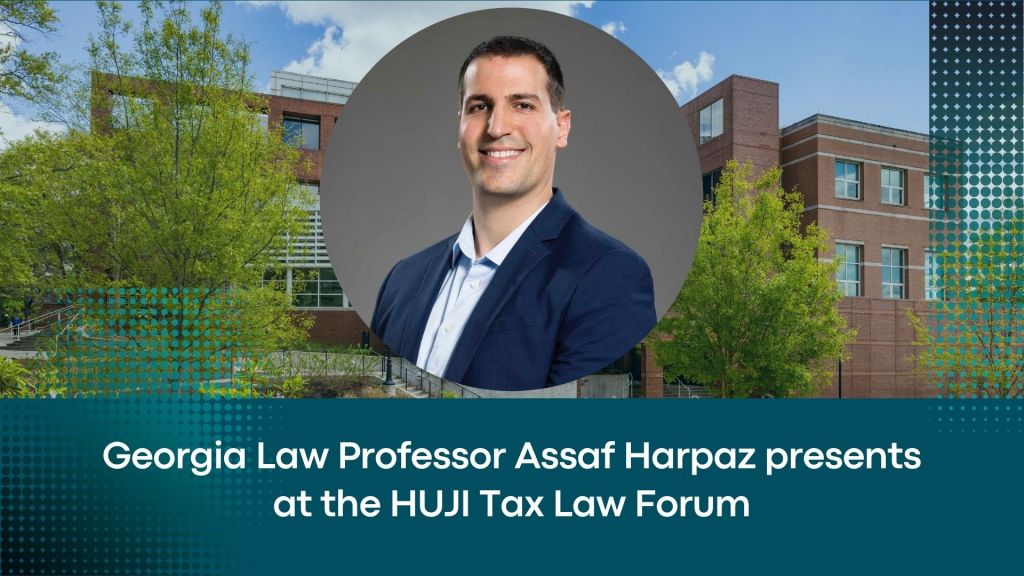
Georgia Law Professor Assaf Harpaz presents at the HUJI Tax Law Forum

University of Georgia School of Law Professor Assaf Harpaz presented his draft paper “Global Tax Wars in the Digital Era” at the Hebrew University of Jerusalem’s Tax Law Forum during December.

Below is an abstract of the paper:

International tax debates often center on how to fairly allocate taxing rights on the profits of multinational enterprises, carrying significant global economic implications. When a business earns income abroad, the country of residence (where the taxpayer resides) and the country of source (where income is generated) both have legitimate, competing claims to tax that income. The international tax system favors residence-based taxation. The source country has the right to tax business profits only if the enterprise carries on a permanent establishment in its borders, which typically requires physical presence. The permanent establishment standard becomes flawed in a digital economy where profit shifting practices are abundant and businesses no longer require a physical presence in the location of their online consumers.

These enduring norms are poised to change with an upcoming United Nations (UN) Framework Convention on International Tax Cooperation – an initiative overwhelmingly supported by Global South economies. The Global North has historically dominated the international tax regime through the Organisation for Economic Co-operation and Development (OECD), informally known as the “World Tax Organization”. A UN framework convention could introduce new standards to address the tax challenges of digitalization, though it would need to bridge the underlying North-South divide.

This article explores the “tax wars” surrounding the leadership for global tax governance, contrasting the taxing powers and interests of the OECD-led Global North with those of the UN-backed Global South. It argues for a shift toward source-based taxation by revisiting the permanent establishment standard. This transition will address longstanding inequities and is increasingly warranted in a digital economy that does not rely on physical presence.

 Assaf Harpaz joined University of Georgia School of Law as an assistant professor in summer 2024 and teaches classes in federal income tax and business taxation. Harpaz’s scholarly focus lies in international taxation, with an emphasis on the intersection of taxation and digitalization. He explores the tax challenges of the digital economy and the ways to adapt 20th-century tax laws to modern business practices.

Coursework to begin for 2025 cohort of students seeking Graduate Certificate in International Law

The start of the spring 2025 semester this week marks the arrival of the fourth cohort of Graduate Certificate in International Law students here at the University of Georgia School of Law.

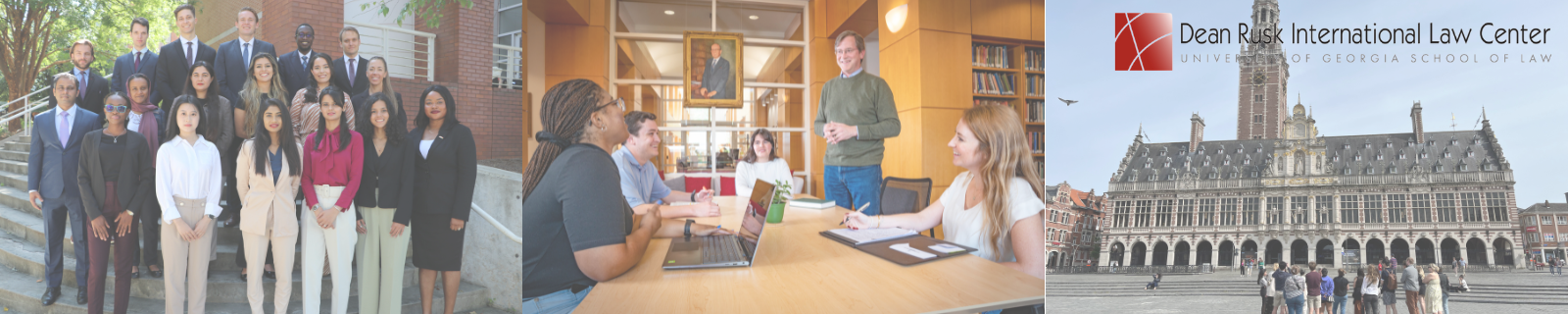
Administered through Georgia Law’s Dean Rusk International Law Center, postgraduate students from other disciplines within the university will earn this academic certificate following their successful completion, in classes alongside J.D., LL.M., and M.S.L. students, of fifteen credit hours chosen from among the law school’s rich comparative, transnational, and international law curriculum.

Joining the law school’s first previous cohorts (introduced here, here, and here), this fourth class of six students includes:

  • Mari Diaz: Master of International Policy student, School of Public and International Affairs
  • Ben Enyetornye: Ph.D. student in Comparative Biomedical Science, College of Veterinary Medicine
  • Md. Asaduzzaman (“Asad”) Jabin: Ph.D. student in Electrical and Computer Engineering, College of Engineering
  • Kobi Korankye: Ph.D. student in Philosophy, Franklin College of Arts and Sciences
  • Beatrice Robson: Ph.D. student in Agricultural and Applied Economics, College of Agricultural and Environmental Sciences
  • Uyiosa (“Uyi”) Ugiagbe: Ph.D. student in Mathematics Education, Mary Frances Early College of Education

All information about the Graduate Certificate in International Law, including upcoming application cycles and virtual information sessions, can be found here.

International Law Colloquium returns to Georgia Law in Spring 2025 semester

The International Law Colloquium, a time-honored tradition here at the University of Georgia School of Law, returns this spring semester with another great lineup of global legal experts.

In Spring 2025, this for-credit course is designed to introduce students to features of international economic law, broadly defined, through engagement with scholars in the international legal field.  The course broadly defines “international economic law” to include traditional approaches (trade and investment agreements) as well as non-traditional, emerging approaches (examining the effects of IEL on marginalized communities and considering re-distributional policies). This course consists of presentations of substantial works-in-progress on a variety of international law topics by prominent scholars from other law schools. In keeping with a tradition established when the series began in 2006, students will write reaction papers on the scholars’ manuscripts, and then discuss the papers with the authors in class. Leading the class will be Desirée LeClercq, Assistant Professor of Law & Faculty Co-Director of the Dean Rusk International Law Center. Other Georgia Law faculty, including Diane Marie Amann and Christopher Bruner, will join in the dialogues.

Further supporting the colloquium are staff at our Center; in particular, the Center’s Global Practice Preparation team, which includes Catrina Martin and student workers Casey Smith (J.D. ’26) and Aubry Tedford (J.D. ’25). The colloquium further benefits from generous support from the Kirbo Trust Endowed Faculty Enhancement Fund and the Talmadge Law Faculty Fund.

Presenting at the Spring 2025 Colloquium (pictured above, clockwise from top left):

January 17: Harlan Cohen, Fordham University School of Law
“The International Order, International Law, and the Definition of Security”     

January 24: Luwam Dirar, Western New England University School of Law
“Emancipation, Decolonization, and Gender in the Context of African Integration”

January 31: Diane Marie Amann, University of Georgia School of Law 
“Economies of Injustice and the Forced Residential-Schooling of Indigenous Americans”

February 7: Christopher Bruner, University of Georgia School of Law
“Sustainable Corporate Governance and Prospects for a US Value Chain Due Diligence Law”

February 14: Katrin Kuhlman, Georgetown University School of Law
“Micro International Law”

February 21: Olabisi D. Akinkugbe, Schulich School of Law
“Trade and Development in an Era of Geopolitics: A Third  World  View”

February 28: Ben Heath, Temple University School of Law
“Sanctions and Sanctuary: Refuge, Violence, and the Legal Ordering of (Economic) Warfare

March 14: Weijia Rao, Boston University School of Law 
“Signaling through National Security Lawmaking”

March 21: Julian Arato, Michigan University School of Law
“The Institutions of Exceptions”

April 4: Trang (Mae) Nguyen, Temple University School of Law
“Goods’ Citizenship”

April 11: Rachel Brewster, Duke University School of Law
“Global settlements in the Foreign Corrupt Practices Act”

April 18: Sarah Dadush, Rutgers Law School
“Shared Responsibility in American Contract Law”

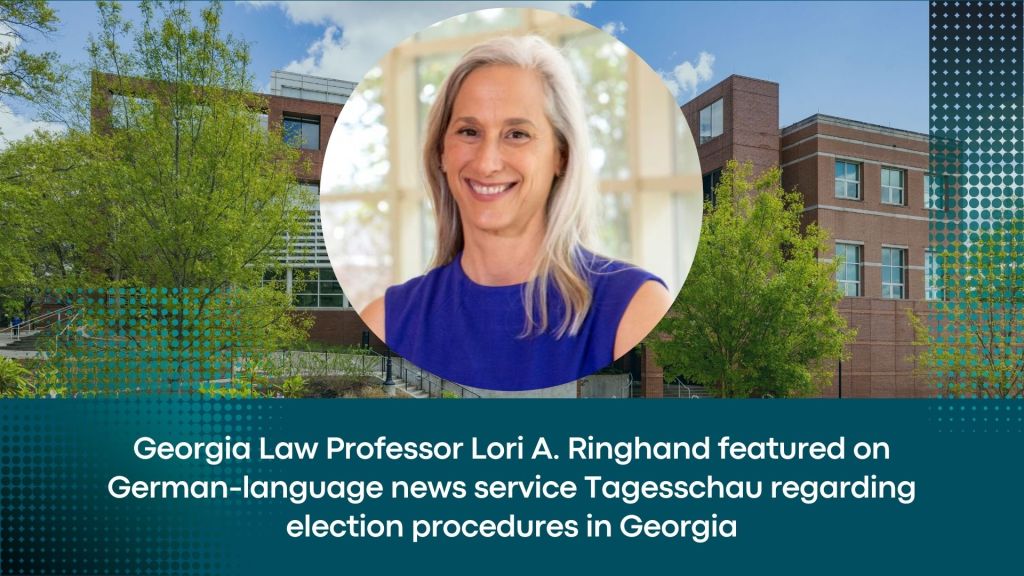
Georgia Law Professor Lori A. Ringhand featured on German-language news service Tagesschau regarding election procedures in Georgia

University of Georgia School of Law Professor Lori A. Ringhand was featured on the German-language news service Tagesschau regarding election procedures in Georgia. The article titled “Wahlhelfer mit ‘Panik-Knöpfen’” was reported by Ralf Borchard and published October 31, 2024.

Ringhand teaches courses on constitutional law and election law. She has been a member of the University of Georgia School of Law faculty since 2008 and was named a Hosch Professor in 2012 and awarded a Josiah Meigs Distinguished Professorship, UGA’s highest teaching honor, in 2021. She is a nationally known Supreme Court scholar and the author of two books about the Supreme Court confirmation process: Supreme Court Confirmation Hearings and Constitutional Change (with Paul M. Collins) published by Cambridge University Press; and Supreme Bias: Gender and Race in U.S. Supreme Court Confirmation Hearings, (with Christina L. Boyd and Paul M. Collins), published by Stanford University Press. She also is the co-author of Constitutional Law: A Context and Practices Casebook, which is part of a series of casebooks dedicated to incorporating active teaching and learning methods into traditional law school casebooks. Ringhand also publishes extensively on election law related issues, and was awarded a Fulbright Distinguished Chair Award at the University of Aberdeen in Scotland to explore the different approaches to campaign finance regulation taken by the United States and the United Kingdom.

Georgia Law Professor Christopher Bruner featured on Law360

University of Georgia School of Law Professor Christopher M. Bruner was featured on Law360 regarding opportunities for international law firms amid shifting geopolitical landscapes. The article titled “What’s Next For The Global Legal Market In 2025?” was written by Cara Bayles and published December 5, 2024.

From the article:

Shrinking markets may even present opportunities for firms that “lean into the geopolitical conflict,” by representing Chinese companies in contentious regulatory matters with the U.S., according to Christopher Bruner, a professor of business law and international law at the University of Georgia School of Law.

“What for one firm might pose risks in terms of how they operate in China, for another might present opportunities if they are helping companies navigate those choppy geopolitical waters,” he said.

Christopher M. Bruner is the Stembler Family Distinguished Professor in Business Law at the University of Georgia School of Law and serves as a faculty co-director of the Dean Rusk International Law Center.

Georgia Law students assist alumnus Johan Van den Cruijce (LL.M. ’94) in publishing “Guide to Listing in Belgium”

Several University of Georgia School of Law students were involved in research and editing for the 13th edition of the 2024 Guide to Listing in Belgium, published earlier this year by a Georgia Law alumnus. This book provides an overview on the governance and regulatory landscape of listed companies in Belgium.

Johan Van den Cruijce (LL.M. ’94), Managing Director of Atlas Services Belgium, a company of the Orange group, co-authored the publication with his colleagues Nicolas Janssens de Bisthoven, Julie Van Opdenbosch, and Hilde Santens. Georgia Law students who have contributed to this version and to past editions include: Daniel “Tripp” Vaughn (J.D. ’25), Emina Sadic Herzberger (J.D., ’22), Starlyn Endres (J.D., ’22), and Alina Salgado (J.D., ’23).

Below is an abstract of the book:

The purpose of this Guide is to outline the specific issues and continuing obligations a listed company may be confronted with in Belgium. The point of reference for this Guide is the position of an issuer that is listed on a Belgian regulated market. A listing on a regulated market is subject to more conditions and triggers more ongoing obligations than a listing on any other trading venue. Insight into the organisation and functioning of a regulated market can thus ease the understanding of the regulatory framework of all other trading venues in Belgium.

This Guide deals with topics ranging from company law, corporate governance, finance and tax to opportunities for employee participation and the obligations and status of directors and executive managers. The Guide also covers the reasons and procedures for a possible de-listing, which is an issue that may become relevant to any listed company. Experience has shown that institutional investors and corporate governance rating agencies are keen to gain a deeper understanding of the rights and obligations of the various players that emerge in de-listing. This newly expanded 2024 edition also highlights the impact of important recent developments and insights in the fields of reporting, compliance, sustainability and valuation.

This Guide is conceived as a quick-reference document. All chapters can be consulted separately and the notes allow the reader to find additional information on the topics and issues discussed.

Profits from book sales will be donated to the Orange Belgium Fund, supporting projects that enhance digital inclusion in Belgium. This Fund is managed by the King Baudouin Foundation.

Georgia Law Professor Desirée LeClercq featured in Inside US Trade article 

University of Georgia School of Law Professor Desirée LeClercq was recently featured in Inside US Trade regarding the U.S.-Mexico-Canada Agreement’s Rapid Response Mechanism (RRM) and how it may be used by the upcoming Trump administration.

The December 5 article entitled “Under Trump, hope — and recommendations — for the stronger use of RRM” was written by Margaret Spiegelman. It references a report LeClercq co-authored with Mexican researchers on the views of workers in the Mexican auto sector on their labor rights under the USMCA’s RRM, as well as her November 10 post for the International Economic Law and Policy Blog entitled “Whither the Worker-Centered Trade Policy?”

From the article:

University of Georgia School of Law Assistant Professor Desirée LeClercq…says a recent study she conducted with El Colegio de Sonora professor Alex Covarrubias-V and Cirila Quintero Ramirez, a research professor at El Colegio de Frontera Norte, Unidad Matamoros, suggests that the mechanism has disproportionately served a relatively narrow group of workers with ties to major U.S. unions and non-governmental organizations, without raising labor standards overall.

LeClercq, who was USTR’s director of labor affairs during President Trump’s first term, said she believes a second Trump administration, less beholden to such groups, might be incentivized to use the tool more broadly to try to improve labor standards that give Mexico an unfair competitive edge.

LeClercq joined the University of Georgia School of Law in 2024 as an assistant professor. She teaches International Trade and Workers Rights, International Labor Law, International Law and U.S. Labor Law, as well as the International Law Colloquium. She also serves as a faculty co-director of the Dean Rusk International Law Center and as the faculty adviser for the Georgia Journal of International and Comparative Law.