Georgia Law professor Christopher Bruner presents working paper at International Law Colloquium

The University of Georgia School of Law’s spring 2025 International Law Colloquium welcomed Professor Christopher Bruner, who presented his working paper, “Sustainable Corporate Governance and Prospects for a US Value Chain Due Diligence Law.” Joshua Barkan, Associate Professor in the Department of Geography at the University of Georgia, served as Bruner’s faculty discussant.

Bruner is the Stembler Family Distinguished Professor in Business Law at the University of Georgia School of Law and serves as a faculty co-director of the Dean Rusk International Law Center. Bruner’s scholarship centers around corporate law, corporate governance, comparative law and sustainability.

Below is an abstract of Bruner’s working paper:

Laws requiring multinational companies to undertake due diligence to detect, prevent, and mitigate human rights and environmental abuses in their value chains have proliferated across Europe, and the European Union has adopted a directive to harmonise such national laws. This chapter assesses the prospects for enactment of such a value chain due diligence law in the United States.

Although such laws are often conceptualised as an extension of corporate law, they can just as readily be conceptualised as an extension of trade law – and the latter approach offers real potential to sidestep anti-ESG and anti-sustainability sentiment among the US political right. Packaged as a trade initiative, the prospects for bipartisanship improve because the political left and right can each embrace the effort by reference to policy preferences resonating with their respective bases. To the progressive left, such laws raise labour and environmental standards globally, while to the conservative right, such laws protect domestic industry from unfair foreign competition.

The chapter first examines corporate politics in the United States, discussing how fundamental corporate governance debates revolve around thorny ideological issues that strongly polarise the political left and right, diminishing the prospects for a value chain due diligence law conceptualised as an extension of corporate law. It then examines trade politics in the United States, discussing how framing by reference to trade improves the prospects for a US value chain due diligence law by sidestepping such ideological issues and giving both the political left and right plausible ways to view such a law as a victory for their respective bases. The chapter concludes with discussion of trade-offs raised by these differing modes of legal strategy and institutionalisation, observing that the corporate law approach offers broader reach with weaker enforcement while the trade law approach offers narrower reach with stronger enforcement.

This year, Professor Desirée LeClercq is overseeing the colloquium, which is designed to introduce students to features of international economic law through engagement with scholars in the international legal field. To view the full list of International Law Colloquium speakers, visit our website.

This program is made possible through the Kirbo Trust Endowed Faculty Enhancement Fund and the Talmadge Law Faculty Fund.

Georgia Law’s Community HeLP Clinic wins asylum case for long-time client

The University of Georgia School of Law’s Community Health Law Partnership Clinic recently secured asylum for a long-time client.

Under the supervision of Director & Hosch Professor Jason A. Cade and Staff Attorney Kristen Shepherd, Elizabeth M. “Beth” Boland (J.D. ’26) and third-year student Lauren R. Harter (J.D. ’25) represented the client at her most recent hearing in Arlington, Virginia, marking the end of nine years of advocacy. Clinic Paralegal Sarah Ehlers served as interpreter.   

Other students who worked on the case, which included litigation before the 11th Circuit Court of Appeals, Board of Immigration Appeals, and the Federal District Court for the Northern District of Georgia, were Carolina Mares (J.D. ’25), Hope Skypek (J.D. ’24), Anna T. Ratterman (J.D. ’24), Ariane C. “Ari” Williams (J.D. ’22), Thomas A. Evans (J.D. ’22) and Frederick King (J.D. ’21). 

“Defending Democracy: A Comparative Perspective,” February 21 Georgia Journal of International and Comparative Law annual conference

This year’s annual conference of the Georgia Journal of International and Comparative Law will address “Defending Democracy: A Comparative Perspective.”

The daylong conference will take place on Friday, February 21 in the Larry Walker Room of Dean Rusk Hall at the University of Georgia School of Law.

Sponsoring along with GJICL, a student-edited journal established more than 50 years ago, is the law school’s Dean Rusk International Law Center. GJICL Editor in Chief, Jasmine Furin (J.D. ’25) and Executive Board members Logan Berg, Nina Dickerson, and Caleb Morris worked with Professor Lori A. Ringhand, J. Alton Hosch Professor of Law & Josiah Meigs Distinguished Teaching Professor; Center staff Sarah Quinn, Director; Catrina Martin, Global Practice Preparation Assistant; Taher S. Benany, Center Associate Director; and with the GJICL’s Faculty Advisor, Professor Desirée LeClercq, who is Assistant Professor of Law & Faculty Co-Director of the Dean Rusk International Law Center.

Below is the concept note of the conference:

Nations across the world are struggling to defend their institutions of democratic government. Voters are dissatisfied with how their institutions are working, social media is changing how nations define and regulate political speech, and courts are struggling to understand their rule in policing constraints on the exercise of political power and protecting individual rights. 

This event brings together comparative law scholars from across the country to discuss a range of issues involving democracy, democratic backsliding, and comparative constitutional protections of democratic norms and institutions. Discussions may include comparative lessons in “militant democracy,” the role of judges in defining or protecting democracy and democratic participation, democratic protections in the American constitutional system and how they differ from other nations, democracy and free speech, and lessons from recent elections around the world. 

The day’s events are as follows:

9:00-9:15am | Welcome Messages

Usha Rodrigues, Dean, University Professor & M.E. Kilpatrick Chair of Corporate Finance and Securities Law

9:15-10:30am | Panel 1: Democracy and Institutional Legitimacy 

  • Richard Albert, Hines H. Baker and Thelma Kelley Baker Chair in Law, University of Texas at Austin School of Law 
  • Zachary Elkins, Professor, University of Texas at Austin 
  • Panel Moderator: Taher S. Benany, Associate Director, Dean Rusk International Law Center, University of Georgia School of Law

10:30-10:45am | Break

10:45-12:00pm | Panel 2: Democratic Governance and Constitutional Design

  • David E. Landau, Mason Ladd Professor and Associate Dean for International Programs, Florida State University College of Law
  • David S. Law, E. James Kelly, Jr., Class of 1965 Research Professor of Law, University of Virginia
  • Miguel Schor, Class of 1977 Distinguished Scholar and Professor of Law, Drake University Law School
  • Panel Moderator: Joseph S. Miller, Ernest P. Rogers Chair of Intellectual Property and Unfair Competition Law, University of Georgia School of Law

12:00-1:00pm | Lunch

1:00-2:15pm | Panel 3: Individual Rights and Democratic Participation

  • Ciara Torres-Spelliscy, Professor of Law, Stetson Law
  • Eugene D. Mazo, Associate Professor of Law, Duquesne University
  • Atiba Ellis, Laura B. Chisholm Distinguished Research Scholar and Professor of Law, Case Western Reserve School of Law 
  • Panel Moderator: Lori A. Ringhand, J. Alton Hosch Professor of Law & Josiah Meigs Distinguished Teaching Professor, University of Georgia School of Law

2:15 | Closing Remarks

Jasmine Furin, Editor in Chief, Georgia Journal of International and Comparative Law

Notre Dame’s Emilia Justyna Powell presents “Compliance with Decisions of the Permanent Court of Arbitration” at Georgia Law

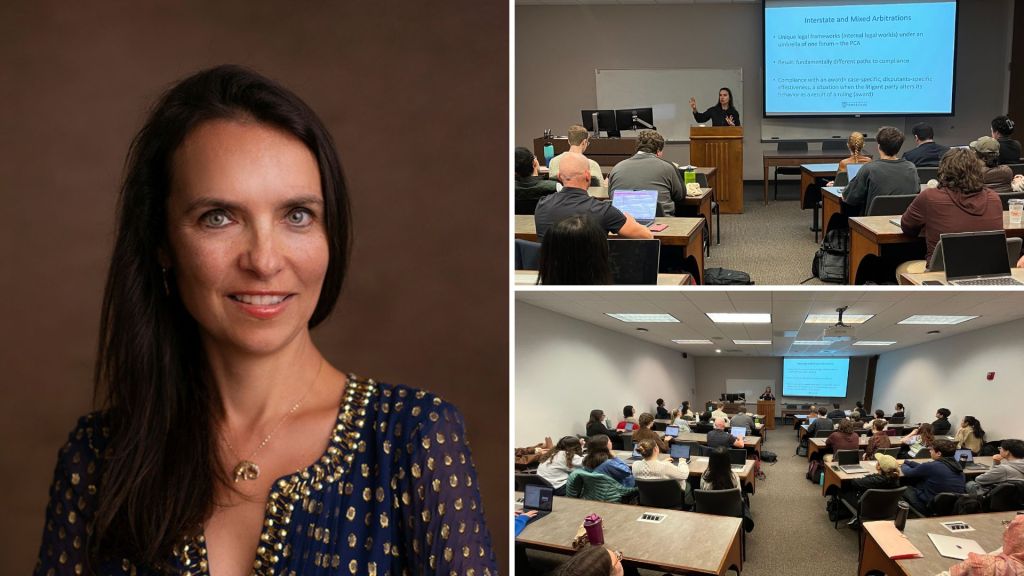
Emilia Justyna Powell, Professor of Political Science and Concurrent Professor of Law at the University of Notre Dame, presented a talk entitled “Compliance with Decisions of the Permanent Court of Arbitration” at the University of Georgia School of Law earlier this week.

Powell presented her findings on the Permanent Court of Arbitration’s award compliance. She presented (qualitatively and quantitively) the underlying reasons for the difference in award compliance in State vs State disputes and Investor vs State Disputes.

Powell has written extensively on international law, international courts, territorial and maritime disputes, international dispute resolution, the Islamic legal tradition, and Islamic constitutionalism. Her prominent publications include a book published in Oxford University Press (2020) entitled Islamic Law and International Law: Peaceful Resolution of Disputes, a Cambridge University Press (2011) book, Domestic Law Goes Global: Legal Traditions and International Courts (with Sara McLaughlin Mitchell). Her new book, The Peaceful Resolution of Territorial and Maritime Disputes (with Krista E. Wiegand) has been published with Oxford University Press in 2023. Currently, professor Powell is working on several research projects devoted to international law, the global order, and constitutional studies: the Permanent Court of Arbitration (with Aníbal Pérez-Liñán), the International Maritime Organization (with Michael J. Atkins, JAG, US Coast Guard), human values in constitutions around the world (with Jarek Nabrzyski and Agnieszka Marczak-Czajka), the evolution of Afghan constitutional order (with Josh Paldino, JAG, US Army), customary law and international law in the world constitutions (with Christina Bambrick and Eric Lease Morgan), and Islamic militant groups’ behavior in the context of humanitarian law (with Jessica Stanton and Tanisha Fazal).

This event was co-sponsored by the Dean Rusk International Law Center and the University of Georgia’s School of Public and International Affairs.

Georgia Law Professor Christopher Bruner featured in Insurance Day

University of Georgia School of Law professor Christopher M. Bruner was featured in Insurance Day, published by London-based Lloyd’s List Intelligence. The article by Ben Margulies, titled “Can the UK Capture Captives?,” discusses the UK government’s effort to create a competitive captive insurance regime.

Bruner shared his thoughts on the factors that make a jurisdiction attractive for establishing captive domiciles, suggesting that smaller jurisdictions can offer fast and flexible policymaking processes. Their small size “makes co-ordination much easier among all the relevant public and private constituencies and it renders their commitment to attractive regulatory structures more credible. They’re highly dependent on these service offerings economically and the market knows it.” London, however, offers competitive advantages in its own right. “London’s main advantage is the extraordinary breadth and depth of corporate and financial services offerings in one place,” Bruner explains. “It’s the ultimate one-stop shop, including in risk management, which provides a strong foundation in the form of pre-existing professional and regulatory know-how.”

Christopher M. Bruner is the Stembler Family Distinguished Professor in Business Law at the University of Georgia School of Law and serves as a faculty co-director of the Dean Rusk International Law Center.

Georgia Law Professor Diane Marie Amann presents working paper at International Law Colloquium

The University of Georgia School of Law’s spring 2025 International Law Colloquium welcomed Professor Diane Marie Amann, who presented her working paper, “Child-Taking Justice and Forced Residential Schooling of Indigenous Americans.”

Amann is Regents’ Professor of International Law, Emily & Ernest Woodruff Chair in International Law, and a Faculty Co-Director of our Dean Rusk International Law Center here at Georgia Law. Amann served as International Criminal Court Prosecutor Fatou Bensouda’s Special Adviser on Children in & affected by Armed Conflict and is a member of the Bring Kids Back UA Task Force.

Her presentation drew upon her recently-published article, “Child-Taking,” 45 Michigan Journal of International Law 305 (2024). Esra Mirze Santesso, Professor in the Department of English at the University of Georgia, as Amann’s faculty discussant. 

This year, Professor Desirée LeClercq is overseeing the colloquium, which is designed to introduce students to features of international economic law through engagement with scholars in the international legal field. To view the full list of International Law Colloquium speakers, visit our website.

This program is made possible through the Kirbo Trust Endowed Faculty Enhancement Fund and the Talmadge Law Faculty Fund

Dean Rusk International Law Center welcomes new Associate Director, Taher S. Benany

Taher S. Benany joined the University of Georgia School of Law’s Dean Rusk International Law Center as associate director in January 2025.

In this role, he oversees global international training programs, including the Global Externships Overseas (GEO) initiative. He also collaborates with Center faculty and staff to plan and implement international law research initiatives, events and conferences, including the annual Georgia Journal of International and Comparative Law conference.

Benany came to Georgia Law from the Shalakany Law Office in Cairo, Egypt, where he was a partner focusing on public international law, global disputes and government affairs for four years. In an earlier stint with the firm from 2014 to 2019, he was a senior associate focusing on public law, international litigation, compliance and government affairs. He also served as a public international law lecturer at the British University in Egypt and served as a public international law expert for the European Union Agency for Criminal Justice Cooperation.

As a legal fellow for the United Nations Human Rights Council for an African state and an international organization, he drafted resolutions and interventions while preparing universal periodic reviews and legal opinions on international human rights instruments.

He earned his Bachelor of Laws from Cairo University in 2017, then continued his legal studies as a Fulbright Scholar at the University of Michigan in Ann Arbor. He also holds a Bachelor of Science in Oral and Dental Medicine and Surgery from Misr International University in 2010, graduating as the valedictorian of his class and serving as a maxillofacial surgeon at the Munira Public Hospital for one year.

Benany speaks Arabic, English and French.   

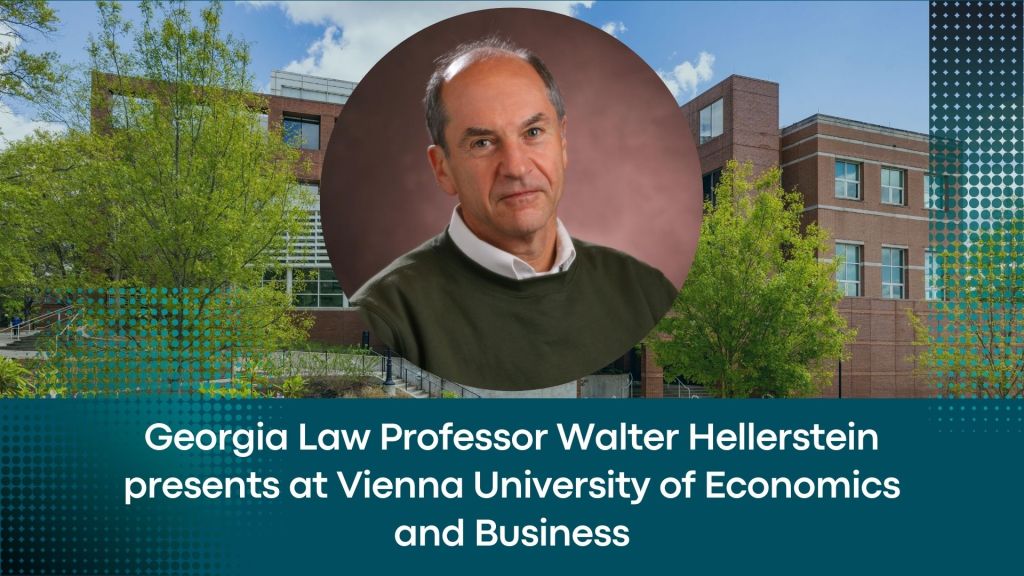
Georgia Law Professor Walter Hellerstein presents at Vienna University of Economics and Business

Distinguished Research Professor & Shackelford Distinguished Professor in Taxation Law Emeritus Walter Hellerstein presented as part of a panel on taxable persons and related issues in VAT law at the Court of Justice of the European Union Conference held at the Vienna University of Economics and Business in Austria during January. 

A description of the conference can be found below:

This conference will focus on the recent case law of the Court of Justice in the area of indirect taxation. The judgment rendered from September 2018 onwards and important previous judgments will be analyzed by panels consisting of leading academics, judges, government representatives and business representatives.

Hellerstein joined the University of Georgia School of Law faculty in 1978 and was named the Francis Shackelford Distinguished Professor in Taxation Law during 1999 and a UGA Distinguished Research Professor in 2011. He taught in the areas of state and local taxation, international taxation and federal income taxation until he retired from teaching at the School of Law in 2015. He is currently a Visiting Professor at the Vienna University of Economics and Business, and he remains actively involved in his scholarship, consulting and, in particular, his work as an academic advisor to the Organisation for Economic Cooperation and Development (OECD).

Luwam Dirar of Western New England University speaks at Georgia Law’s International Law Colloquium

The University of Georgia School of Law’s spring 2025 International Law Colloquium welcomed Professor Luwam Dirar of Western New England University School of Law as its second speaker last week.

Dirar presented her working paper titled, “Emancipation, Decolonization, and Gender in the Context of African Integration.” Dirar’s research and scholarly focus centers on international human rights law and the intersection of international economics and international relations. Dirar has also served as a consultant to several African governments and international organizations regarding migration and law.

Associate Director of the Dean Rusk International Law Center, Taher Benany, served as Dirar’s faculty discussant. Professor Desirée LeClercq is overseeing the colloquium, which is designed to introduce students to features of international economic law through engagement with scholars in the international legal field.

Below is an abstract of Dirar’s working paper:

The 1960s institutionalization and formalization of Africa’s continental integration was a manifestation of the ontological fragility of the concept of emancipation in the African context. As a concept, continental emancipation excluded concerns of women and formalized the divorce between decolonization and racial domination on the one hand and social emancipatory movements on the other. This divorce was contrary to the expectation of women who sought the end of colonial subjugation as a turning point for women’s emancipation from not only colonial and racial domination but also from social oppression. This article argues that the continental emancipation project betrayed the hopes of women who sought decolonization or the end of white racial domination as central to the end of gendered and gendering social subjugation. This article will have four parts. The first part will be a general introduction and will explore women’s emancipation in the context of regional integration studies. The second part will explore the internal contradictions of the concept of emancipation. The third part will explore the marketization of regional integration in Africa and the debates surrounding gender in trade agreements. The fourth part will be the conclusion and way forward.

To view the full list of International Law Colloquium speakers, visit our website. A summary of the previous week’s talk with Professor Harlan Cohen can be found here.

This program is made possible through the Kirbo Trust Endowed Faculty Enhancement Fund and the Talmadge Law Faculty Fund.
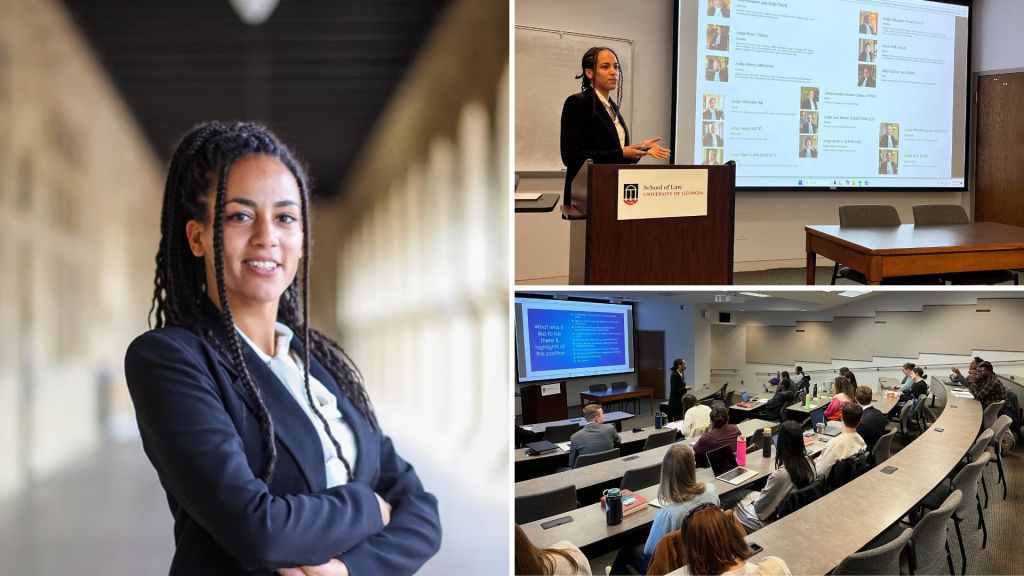
Eva Keïta speaks with Georgia Law students about experience at the International Court of Justice

The University of Georgia School of Law welcomed international lawyer Eva Keïta to campus this week to discuss her experience at the International Court of Justice (ICJ) with students in Professor Diane Marie Amann‘s Public International Law course.

Keïta provided students with an overview of the ICJ, where she was an Associate Legal officer and a Judicial Fellow assisting a judge on various public international law matters. She spoke about the makeup of the ICJ, the role of members on each of the Judges’ teams, and how students can make themselves more competitive for open positions. Keïta then took questions from students, detailing her own professional journey as an international dispute settlement lawyer and providing advice for those interested in pursuing international legal careers.

Before her time at the ICJ, Keïta honed her expertise in international arbitration and litigation and handled complex international disputes at two international law firms in Paris. Keïta also has significant experience handling pro bono and international human rights matters. She provided legal representation to an inmate serving a life sentence under California’s Three Strikes Law in post-conviction proceedings, assisted human trafficking victims in compensation proceedings in front of French courts, and volunteered for four months in Togo, providing legal assistance to inmates through a local NGO.

Prior to her legal career, Keïta pursued a bachelor’s and master’s degree in political science, specializing in international relations, from the Sorbonne. In addition, Keïta holds a LL.M. in international economic law, business & policy from Stanford Law School and her first law degree from Sciences Po in Paris.