In court and in Congress, Georgia Law clinics continue efforts on behalf of immigrant women alleging abuse, retaliation while in ICE detention

University of Georgia School of Law clinics’ faculty and students have continued to press forward– both in court and in Congress – in challenges they have brought on behalf of women clients who are challenging the abuses they endured while in U.S. immigration detention.

As previously posted, Georgia Law’s Community HeLP Clinic and First Amendment Clinic have pursued administrative, judicial, and advocacy paths in support of women who had been in the custody of U.S. Immigration and Customs Enforcement (ICE) at the Irwin Detention Center, a privately run facility in south Georgia. While there, the women were subjected to nonconsensual, gynecological and other medical procedures; those who spoke out were met with retaliatory acts, including attempted or actual removal from the United States.

For more than two years, the Georgia Law clinics have represented some of these women in judicial and administrative proceedings. Associate Dean Jason A. Cade, Director of the Community HeLP Clinic, and Professor Clare R. Norins, Director of the First Amendment Clinic, are among co-counsel in Oldaker v. Giles, a class action complaint pending before Judge W. Louis Sands, U.S. District Court for the Middle District of Georgia. Assisting them have been Staff Attorney Kristen Shepherd, Legal Fellow Lindsey Floyd, and many law students.

The Oldaker litigation took a new turn last Monday, when Judge Sands granted a contested motion and thus added two new named plaintiffs, both of them represented by the Georgia Law clinics.

Congressional action occurred earlier last month, when the Senate’s Permanent Subcommittee on Investigations held a hearing on “Medical Mistreatment of Women in Ice Detention,” on November 15 at the Dirksen Senate Office Building in Washington, D.C.

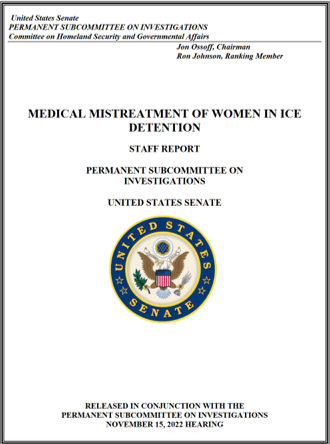
That same day, the subcommittee – led by its Chairman, Sen. Jon Ossoff (D-Georgia), and Ranking Member, Sen. Ron Johnson (R-Wisconsin), simultaneously released a 103-page Staff Report (pictured above) based on its 18-month investigation of the issue. The report recounted many incidents on which the Oldaker suit is based, and further incorporated information provided by six plaintiffs, one of them represented by the Georgia Law clinics. Among other key findings, the report stated that:

  • The women detainees “appear to have been subjected to excessive, invasive, and often unnecessary gynecological procedures” by one of the center’s physicians; and
  • ICE “did not employ a thorough vetting process,” and, before hiring the physician in question, “was not aware of publicly available information regarding medical malpractice suits” and other complaints against him.

Georgia Law Professors Amann, Cohen, Durkee participate in Research Forum and other ASIL Midyear Meeting events

University of Georgia School of Law Dean Rusk International Law Center professors took part in Research Forum panels at the 2022 American Society of International Law Midyear Meeting, held last weekend in Florida, at the University of Miami School of Law.

Our Center’s Director, Professor Melissa J. “MJ” Durkee (top right), who is also Associate Dean for International Programs and Allen Post Professor here at Georgia Law, presented “The Pledging World Order,” her article forthcoming in Yale Journal of International Law, at a Research Forum panel entitled “Global Trends in International Law-Making,” at which Hannah Birkenkoetter, Instituto Tecnológico Autónomo de México, and Nicolas Lamp, Queen’s University Faculty of Law in Canada, presented, with Jeffrey Dunoff, Temple University School of Law in Philadelphia, as discussant.

Meanwhile, Diane Marie Amann (left, in yellow jacket), who is Regents’ Professor of International Law, Emily & Ernest Woodruff Chair in International Law, and a Faculty Co-Director of our Center, served as discussant for a Research Forum panel, entitled “The Behavior of International Courts,” at which Barbara Bazánth, Alina Papanastasiou, and Piero Vásquez Agüero presented works in progress drawn from their dissertation research. All three are Ph.D. candidates, at, respectively, Eötvös Loránd University in Hungary, University of Cambridge in England, and Universidad Nacional Autónoma de México.

The Editorial Board of the Society’s American Journal of International Law also met during the Midyear Meeting. AJIL Board member Durkee attended in person, while a 3d member of the Georgia Law faculty, AJIL Board member Harlan Grant Cohen (bottom right), who is the Gabriel M. Wilner/UGA Foundation Professor in International Law and a Faculty Co-Director of our Center, attended online.

Present at this weekend’s biennial meeting of the ASIL Executive Council were Durkee, who is a Council member, and Amann, who is an ASIL Counsellor.

Georgia Law Professor Bruner serves as commentator at University of Oslo launch of book on business and sustainability

Christopher M. Bruner, the Stembler Family Distinguished Professor in Business Law here at the University of Georgia School of Law, served as a commentator Thursday at a book launch hosted by the Faculty of Law at the University of Oslo, Norway.

The book, Innovating Business for Sustainability: Regulatory Approaches in the Anthropocene (Elgar 2022) is an essay collection edited by Professors Beate Sjåfjell, University of Oslo, Carol Liao, University of British Columbia in Canada, and Aikaterini Argyrou, Nyenrode Business University in the Netherlands. All three co-editors took part in the online launch event. Professor Cecilia Bailliet of the University of Oslo served as commentator along with Georgia Law Professor Bruner.

In a published item regarding the book – which is the second publication under the auspices of Daughters of Themis: International Network of Female Business Scholars – Bruner has written:

“There is growing recognition that the interconnected global crises we face require urgent reforms to the conduct of business, yet the nature and extent of such reforms remain hotly debated. This essential volume compellingly argues that we must embed the concept of sustainability at the very heart of corporate law, and the authors’ expert analyses challenge us to rethink prevailing regulatory approaches in light of the gendered nature of existing structures and the complexity of social-ecological systems.”

Georgia Law Professors Durkee, Amann in key roles at annual International Law Weekend conference in New York

Our University of Georgia School of Law Dean Rusk International Law Center was well-represented at last week’s International Law Weekend, the annual 3-day conference of the American Branch of the International Law Association held at multiple venues in New York City. Theme of this year’s conference, which marked the centennial anniversary of the American Branch, was “The Next 100 Years of International Law.”

Our Center’s Director, Professor Melissa J. “MJ” Durkee, who is also Associate Dean for International Programs and Allen Post Professor here at Georgia Law, served as a Co-Chair of the ILW conference. She also chaired Friday’s keynote address, on “The Biden Administration’s Approach to International Justice,” delivered by Beth Van Schaack, U.S. Ambassador-at-Large for Global Criminal Justice.

On Saturday, Diane Marie Amann, who is Regents’ Professor of International Law, Emily & Ernest Woodruff Chair in International Law, and a Faculty Co-Director of our Center, took part in exploration of “The Legitimacy and Fundamental Principles of International Human Rights Law.” Moderated by Mortimer Sellers (Maryland), the panel also featured as speakers Gloria Y.A. Ayee (Harvard), Hélène Ruiz Fabri (Max Planck Institute Luxembourg), and Aaron Xavier Fellmeth (Arizona State). In her own talk on legitimacy and human rights, Amann discussed her article on international child law and peace negotiations, which grew out of a University of Cambridge Lauterpacht Centre settlement options project. (Article available here; prior posts here and here.)

Georgia Law was honored to serve as a Gold Level cosponsor of this conference.

Dr. Elaine Grant-Bryan, Jamaica’s Honorary Consul General, speaks at Georgia Law on investment opportunities

The Honorary Consul General of Jamaica in Atlanta, Dr. Elaine E. Grant-Bryan, spoke on “Investment Opportunities in Jamaica” Monday here at the University of Georgia School of Law.

Her presentation was the most recent installment of our Dean Rusk International Law Center Consular Series, in which diplomats provide Georgia Law students, staff, and faculty with global perspectives on international trade, cooperation, development, and policy.

Grant-Bryan discussed opportunities for economic collaboration between Georgia and Jamaica. She described the current state of several sectors in the Jamaican economy, including Business Process Outsourcing,, entertainment, and agribusiness, and described how the Ministry of Foreign Affairs and Foreign Trade and the Jamaica Promotions Corporation facilitate these types of foreign investments and trade opportunities. The presentation closed with a question-and-answer session that emphasized the importance of future lawyers developing cross-cultural capacities, especially for students interested in international trade and business.

Born in Kingston, Jamaica, Grant-Bryan was appointed honorary consul on October 1, 2018. She has received several awards for her dedication to public service, including the Judge Glenda Hatchett Award for outstanding service in the field of education in 2005, the Atlanta Mayor Phoenix Award for outstanding achievements in Education and Service to the people of Atlanta in 2006, and, earlier this year, the U.S. Presidential Lifetime Achievement Award in recognition of her thousands of hours of service to the Jamaican diaspora, the Caribbean, and the United States. She is the first Caribbean-born person in Georgia to receive this award.

Georgia Law Professor Amann presents “Absent at the Creation? Nuremberg Women and International Justice” at Max Planck Luxembourg conference

Georgia Law Professor Diane Marie Amann opened a 2-day conference on “Women & International Law” with a presentation entitled “Absent at the Creation? Nuremberg Women & International Criminal Justice.” Also on the initial panel, which Temple Law Professor Jaya Ramji-Nogales moderated, were Professor Helena Alviar García, (Sciences Po-Paris, France), Ph.D. candidate Justina Uriburu (Geneva Graduate Institute, Switzerland), and Professor Ignacio de la Rasilla (Wuhan University, China).

The conference took place last Thursday and Friday at the Max Planck Institute Luxembourg for Procedural Law, whose Director is Professor Hélène Ruiz Fabri. It featured more than 4 dozen scholars and other experts from across the globe, including several from Australia, New Zealand, and the South Pacific. The chapters they presented will appear in a forthcoming Oxford Handbook on Women and International Law, co-edited by Ramji-Nogales and Ruiz Fabri along with Baltimore Law Professor Nienke Grossman and Howard Political Science Professor J. Jarpa Dawuni.

Amann, who is Regents’ Professor of International Law, Emily & Ernest Woodruff Chair in International Law, and Faculty Co-Director of the Dean Rusk International Law Center here at the University of Georgia School of Law, presented on an aspect of her ongoing research into the roles and experiences of lawyers and other women professionals at post-World War II international criminal trials.

“Law of Global Economic Statecraft,” October 24 Georgia Journal of International and Comparative Law conference, to feature book keynote discussion with Nicholas Mulder

This year’s annual conference of the Georgia Journal of International and Comparative Law will consider a highly topical question: “The Law of Global Economic Statecraft.” Featured will be a keynote discussion by Cornell University historian Nicholas Mulder, author of The Economic Weapon: The Rise of Sanctions as a Tool of Modern War (Yale University Press 2022), as well as panels including more than a dozen experts from around the world.

The daylong conference will take place on Monday, October 24, in the Larry Walker Room of Dean Rusk Hall at the University of Georgia School of Law.

Sponsoring along with GJICL, a 50-year-old student-edited journal, is the law school’s Dean Rusk International Law Center. GJICL Executive Conference Editor, 3L Claire Kimbrell, and Senior Conference Editor, Sarah Grace McCord, worked closely with Catrina Martin, the Center’s Global Practice Preparation Assistant, and with GJICL’s Faculty Advisor, Professor Harlan Grant Cohen, who is Gabriel M. Wilner/UGA Foundation Professor in International Law and one of the Center’s Faculty Co-Directors.

The University of Georgia Willson Center for Humanities & Arts is a cosponsor of the keynote event. Additional conference cosponsors include these University of Georgia units: Georgia Law students’ International Law Society; the Center for International Trade & Security, School of Public & International Affairs; the Department of History, Franklin College of Arts & Sciences; and the Department of Economics, Terry College of Business.

Registration for all aspects of the conference (to be livestreamed for online registrants) here.

Here’s the concept note:

“The global economy has been weaponized.  It’s not clear when it happened, or whether it’s even something new, but watching the response to Russia’s invasion of Ukraine has made it impossible to ignore.  With breathtaking speed, a full phalanx of sophisticated economic tools was mobilized against Russia that threatened to sever it from the global economy.  For its, part, Russia demonstrated the continued force of its own economic weapons – its control over substantial supplies of oil and gas.  But the speed with which these tools were amassed was in fact testament to years of experiments and practice.  Economic tools that had been developed to isolate “rogue states,” to fight terrorist networks, and to punish human rights abusers had begun to show how the carrot of the global market could quickly become a lever of influence and a forceful stick.  But these tools gained new prominence as they were refined and redeployed for use in the intensifying economic and geopolitical rivalry between China, the United States, and Europe.  

“Is international law prepared for this reality?  Until recently, tools of economic pressure have been left largely to the margins of the discipline, treated at best as the preferred alternative to more regulated fields of military activities, at worst as exceptional tools that could largely be ignored – even in the face of critiques from the Global South and regarding human rights.  While every international law textbook has chapters on the regulation of military activity and economic cooperation, few have standalone sections on sanctions.  International economic law regimes meanwhile struggle to adapt to the realities of ‘geoeconomics’ and ‘weaponized interdependence,’ in which, structures designed to encourage economic cooperation are repurposed as tools of competition and rivalry.

“A reconsideration is long overdue.  This symposium surveys the current state of economic statecraft – the tools in use, their purposes, and their targets.  It explores how they are or should be regulated.  But most importantly, it seeks to put today’s economic statecraft in historical, political, and legal context asking critical questions about the international order they reflect and the international order they might require.”

The day’s events are as follows:

9-9:10 am Welcome

  • Melissa J. “MJ” Durkee, Associate Dean for International Programs, Director of the Dean Rusk International Law Center, and Allen Post Professor, University of Georgia School of Law

9:10-10:30 am How We Got Here

Speaking on this 1st panel:

  • Zohra Ahmed, Assistant Professor of Law, University of Georgia School of Law
  • Mona Ali, Associate Professor of Economics, State University of New York-New Paltz
  • Henrique Choer Moraes, Minister-Counsellor, Embassy of Brazil in New Zealand
  • Nicholas Mulder, Assistant Professor and Milstein Faculty Fellow, Cornell University Department of History

10:45 am-12:05 pm Where We Are

Lauren Brown, Associate, Squire Patton Boggs, Washington, D.C., will moderate this 2d panel. Speaking will be:

  • Sarah Bauerle Danzman, Director, Tobias Center for Innovation in International Development, and Associate Professor, International Studies, Indiana University-Bloomington
  • Maryam Jamshidi, Associate Professor of Law University of Florida Levin College of Law
  • Tom Ruys, Professor, Faculty of Law and Criminology, Department of European, Public, and International Law, Ghent University, Belgium
  • Jan Zahradil, Member, European Parliament

1:05-2:25 pm Where We’re Headed

Speakers on this 3d panel:

  • Elena Chachko, Lecturer on Law, Harvard Law School
  • J. Benton Heath, Assistant Professor of Law, Temple University Beasley School of Law
  • Henry Farrell, SNF Agora Institute Professor of International Affairs at SAIS, Johns Hopkins University
  • Mona Paulsen, Assistant Professor of Law, London School of Economics Law School, England

2:40-3:55 pm Keynote Book Discussion on “The Economic Weapon: The Rise of Sanctions as a Tool of Modern War”

3:55 pm Thank You

  • Courtney Robinson, Editor-in-Chief, Georgia Journal of International and Comparative Law

One week at Guantánamo Bay, a land filled with stark contrasts

Davis Wright is a recent graduate of the University of Georgia School of Law (JD magna cum laude 2022). During his time in law school, Davis was: Executive Articles Editor for Vol. 50 of the Georgia Journal of International & Comparative Law; co-founder and co-president of the Privacy, Security, and Technology Law Society; and participant in the 2021 Philip C. Jessup International Law Moot Court Competition. Additionally, he completed a semester-long externship in Norfolk, Virginia, in the legal department of HQ SACT, a leading unit of the North Atlantic Treaty Organization; his prior post on that NATO experience is here. This month, Davis will begin practicing law as an Associate at Jones Day in Atlanta. He would like to thank Georgia Law’s Dean Rusk International Law Center for contributing funding to allow him to fly to Washington, D.C., in order to participate as a nongovernmental organization (NGO) observer in Guantánamo Bay, Cuba – an experience that he recounts in this post.

From September 9 to 16, 2022, I was granted the opportunity to be the National Institute of Military Justice NGO Observer at the U.S. Military Commission hearings at Naval Station Guantanamo Bay (NSGB) in Guantánamo Bay, Cuba, in the case against the defendant known as Abd al-Hadi al-Iraqi, although he calls himself Nashwan al-Tamir.

During my time in Guantanamo, I found stark contrasts everywhere: internally, with how I viewed Mr. al-Hadi’s treatment, and externally, with all that I observed on NSGB.

Guantánamo Bay is a beautiful place. Flying into the airstrip of NSGB, you can see the stunning landscape of Cuba, with many mountains jutting out from the island.

After crossing the bay via ferry, surveying the views on water, I arrived at the area of the base that includes Camp Justice, the makeshift complex where the military commissions are held.

After completing check-in, passing through security, and being instructed on what I could and could not do while on base, I was given a tour of the base by my escort.

This was where I noticed the first contrast:

  • Initially, I was shown rocky beaches with clear blue water, breathtaking lookouts with 360-degree views, and lively wildlife that was all around, including iguanas, banana rats, deer, and guinea fowl.
  • But then I also was able to view Camp X-Ray, the hastily thrown together detention facility that housed the first of captives held at Guantánamo Bay in the United States’ war on terror. In this facility, and then in the more permanent Camp Delta afterwards, detainees were (and still are) held without charges, and many allege that they were tortured and abused. X-Ray is now unused and run down, poking out through the overgrown foliage that threatens to swallow it. Nevertheless, it casts a dark shadow and eerie presence over the otherwise idyllic landscape.

The next day, we were shown all that Guantánamo Bay has to offer. There are the aforementioned beaches, a bowling alley, an arcade, an Irish pub, a tiki bar, basketball, racquetball, and pickleball courts, mini-golf, and much more. And I took advantage, by eating, drinking, and enjoying myself on an island that displayed beauty everywhere I looked.

This was the next contrast.

Because while I had just enjoyed what was essentially a day of vacation on a Sunday in Guantánamo Bay, the next morning, behind layers of security, I was observing a U.S. Military Commission hearing for Mr. al-Hadi.

The pre-sentencing hearing that day focused on Mr. al-Hadi’s failing health. Mr. al-Hadi has previously endured 5 spine surgeries, due to a degenerative-spine disease. He needs a sixth. However, an MRI machine is needed to evaluate his spine, and the only one to which he has access at Guantánamo Bay has been broken since November 2021. Although the previous MRI machine had been provided via an awarded contract to a private company, the government failed to contract for maintenance, and, as a result, the machine demagnetized due to a catastrophic loss of helium. Mr. al-Hadi also needs a dexa scan, and the base does not have this capability.

The government has provided an estimate of December 2022 for the operability of a new MRI machine and download of software to the existing CT scan machine to make a dexa scan possible. However, the previous (and now broken) MRI machine took several years to finally make its way to the base and become operational. Due to this, the defense counsel expressed deep skepticism over whether the government’s timeline was realistic. Counsel asked to take the testimony of the Senior Medical Officer – the equivalent of Mr. al-Hadi’s primary care physician – to inquire into his current health situation. Defense counsel also asked to take the testimony of the chair of the Senior Medical Advising Committee, arguing that this individual likely has information regarding the procurement and administration of the MRI machine.

Who, exactly, is this defendant?

Mr. al-Hadi was captured in Turkey in late 2006 and held at a CIA black site for 5 to 6 months. After this time, he was transferred to the detention facility at NSGB. As described in an article by New York Times reporter Carol Rosenberg, this past June Mr. al-Hadi pleaded guilty to the “war crimes of attacking private property – a U.S. military medevac helicopter that insurgents who answered to him failed to shoot down in Afghanistan in 2003 – and of treachery and conspiracy connected to insurgent bombings that killed at least three allied troops, one each from Canada, Britain and Germany.” Many of his fellow detainees are accused of other war crimes; they include Abd al-Rahim al-Nashiri, who allegedly orchestrated the attacks on the USS Cole, and Khalid Shaikh Mohammed, who is alleged to have been one of the masterminds behind the 9/11 attacks.

This is yet another contrast.

It is hard to feel sympathetic for the detainees, including Mr. al-Hadi, because most have legitimately committed heinous crimes against the United States. Yet – unlike others who have also committed heinous crimes but were convicted in U.S. courts – detainees at Guantánamo Bay were held for lengthy periods of time without charges. Many detainees allege that they were tortured either before coming to or during their time on base. These men are also aging and facing increasing health problems, which the government, to date, has inadequately addressed. It is easy to want to ignore these injustices when faced with the war crimes that were committed by those held in Guantanamo Bay. But as Dr. Martin Luther King Jr. said: “Injustice anywhere is a threat to justice everywhere.” And although that quote may be cliché, the United States (and those keeping it accountable) must fight to the urge to allow the crimes of the accused to determine the quality of the legal process they receive.

After the Monday hearing, Tuesday was a classified session, which NGO observers were prohibited from attending, presumably because the judge granted one or both of the defense counsel’s motions for new testimony. And the Wednesday through Friday hearings were either cancelled or classified as well.

This led to the final contrast that I observed. While I got a few more days of relaxing in the sun on the government’s dime, I was flown down to Guantanamo Bay on a charter flight, housed, and provided an escort all for no cost, it remains to be seen whether Mr. al-Hadi ever gets his MRI and dexa scan from that same government.

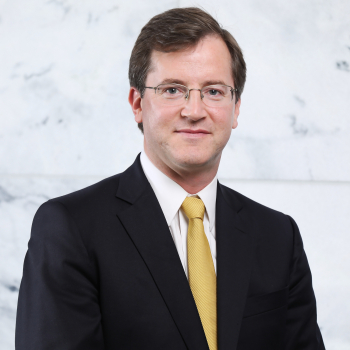
Georgia Law Dean Bo Rutledge, co-author Gary Born publish “International Civil Litigation in the United States” (7th ed.)

The seventh edition of International Civil Ligitation in the United States has just been published by its co-authors, Gary B. Born (bottom left), a London-based lawyer who is chair of the International Arbitration Practice Group at the global law firm WilmerHale, and Peter B. “Bo” Rutledge (top left), who is Dean and Talmadge Chair of Law here at the University of Georgia School of Law.

Here’re the details from Aspen Publishing:

“Examining every topic discussed in competing texts with extensive narrative, unparalleled notes, and detailed citations, this book covers the gamut of international dispute resolution, whether judicial jurisdiction, sovereign immunity, extraterritoriality, conflicts of law, parallel proceedings, discovery disputes, service, judgment enforcement, and international arbitration. This Seventh Edition includes excerpts and updated discussions of recent U.S. court decisions and legislation relating to a wide range of private and public international law topics.” 

Included in this edition are a critique of the Restatement (Fourth) of the Foreign Relations of the United States (American Law Institute 2021), as well as developments in: litigation under the Alien Tort Statute and the Torture Victim Protection Act; sovereign immunity law following several landmark Supreme Court decisions; and extraterritorial application of federal law in the wake of landmark U.S. Supreme Court decisions.

Georgia Law Professor Diane Marie Amann interviewed on international law and developments in Ukraine-Russia war

An international law analysis by Georgia Law Professor Diane Marie Amann on recent developments in the Ukraine-Russia war is quoted in an article published Sunday by Voice of America Russian Service.

The Russian-language article, Юристы по международному праву: аннексия, проведенная Путиным, юридически ничтожна (that is, International Lawyers: The Annexation Carried out by Putin Is Legally Null and Void), was written by Evgenii Komarov. In addition to Amann, who is Regents’ Professor of International Law, Emily & Ernest Woodruff Chair in International Law, and Faculty Co-Director of the Dean Rusk International Law Center here at the University of Georgia School of Law, Komarov interviewed international law professors Lea Brilmayer and Zakhar Tropin, from, respectively, Yale Law School and the Shevchenko National University in Kyiv, Ukraine.

The article related particularly to last week’s assertion by Russian President Vladimir Putin that his country had annexed four regions of Ukraine that Russian troops had occupied in the months following their February 2022 invasion of the country.

Amann analyzed this development in light of international law norms set out in agreements to which Ukraine and Russia both belong, including the 1945 Charter of the United Nations, the 1949 Geneva Conventions, and human rights treaties. She also discussed the potential for accountability and international pressure, through, for instance, economic sanctions and geopolitical isolation, UN treaty bodies on human rights and anti-discrimination, the International Criminal Court, and proposals for a special tribunal.

Komarov wrote:

“The effectiveness of international law ‘depends on political will, and I think that the countries that make these decisions weigh the benefits and costs,’ states Diane Marie Amann. This leads to the fact that justice is moving very slowly.”