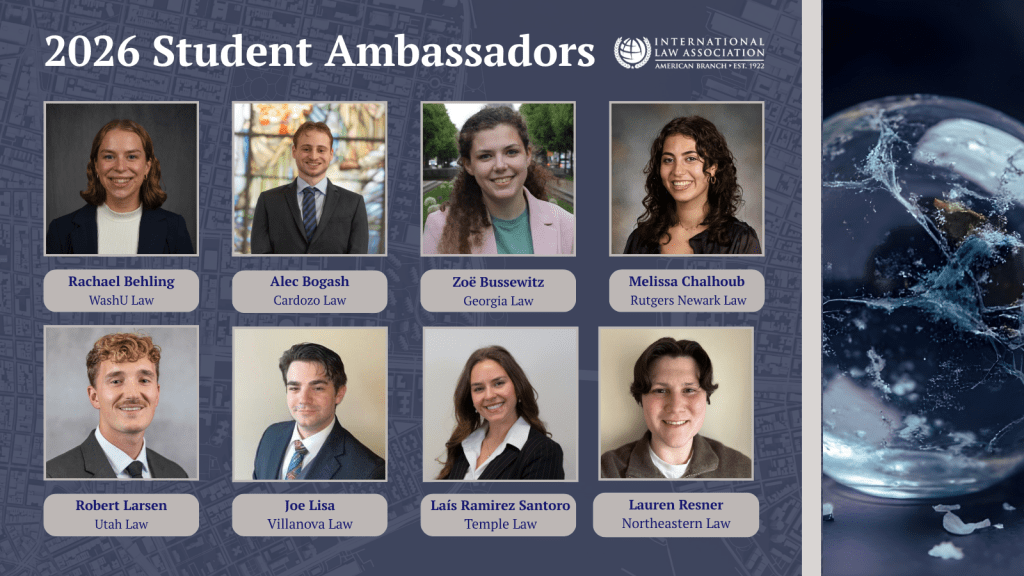
Originally from New York, Bussewitz graduated from Stony Brook University with a bachelor’s degree in Mass Communication and Political Science, where she was the lead reporter for the international beat on SBU’s news broadcast. She has previously interned for the National Security Unit of the U.S. Attorney’s Office (SDNY) and the NYS Attorney General’s Investigations Division. Bussewitz currently works as a Research Assistant for an Office of Naval Intelligence sponsored project concerning international regulation of autonomous underwater vehicles. This summer, Bussewitz will intern with the legal team at Oak Ridge National Lab. Beyond her work, she also has a passion for learning about space law. Bussewitz is thrilled to return to New York for ILW 2026 to build connections with academics and practitioners in the field of international law.
Bussewitz is the fourth Georgia Law student in the last four years to be selected as an ABILA Student Ambassador. She follows Haichen Zhao (J.D. ’27), Madison Graham (J.D. ’25), and Bohdan Krivuts (LL.M. ’24, J.D. ’26), who have all been selected for this role.
This fall, six University of Georgia School of Law students received Louis B. Sohn Professional Development Fellowships to support their attendance of international law conferences. Named after the inaugural holder of the Emily and Ernest Woodruff Chair in International Law at Georgia Law, Sohn Fellowships enable students to attend professional development opportunities related to international law. The Fellowships are administered by the Dean Rusk International Law Center.
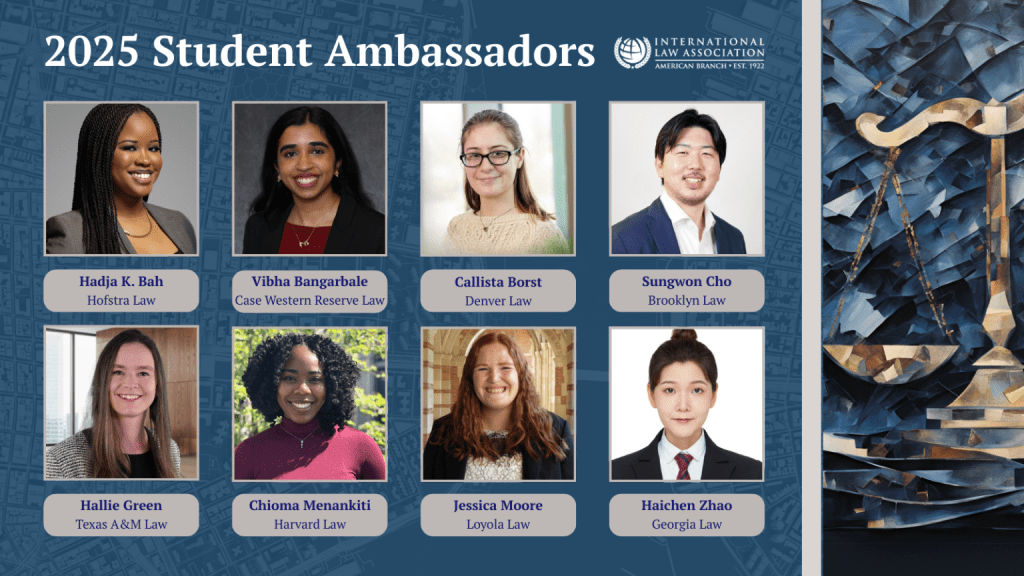
Zhao was selected to be a 2025 Student Ambassador (detailed here). She was one of eight Ambassadors selected nationwide to assist with International Law Weekend.
Ross shared about her favorite panel from the AtlAS annual conference:
I really enjoyed the panel discussion on the impact of tariffs on international arbitration. This panel was addressing tangible issues regarding how businesses, countries, and counsel are adjusting with the current instability surrounding tariffs in the United States. This panel was applying concepts I recently learned about in my International Business Transactions class, including Incoterms and articles of the CISG, and discussing questions of interpretation and application that brought to life what I have been studying in a very real way.
Reflecting on the experience of attending the ABILA ILW, Paudel stated:
This conference has encouraged me to advance my academics and career in international law. Personally, it allowed me to gain hands-on insights on different arenas of international law. Hearing invaluable thoughts of international legal experts, law professors , judges, partners and directors has increased my in-depth knowledge on international law, that I couldn’t have acquired from any written book or article. Professionally, the conference allowed me to build strong networks with the panelists, and participants from other law schools.
Burns noted her biggest takeaway from the ABILA ILW:
My biggest takeaway was an increased confidence in the future of international law. Many, if not all, of the panelists we heard from were exasperated with recent blatant violations of international treaties and a lack of action from international tribunals. Their frustration and insistence on continuing to push for change was inspiring, and they gave me hope that there are still many high-level international professionals who have not thrown in the towel yet.
To read prior posts about Georgia Law students using Sohn Fellowships to attend professional development opportunities, please click here and here.
In response to her selection as a Student Ambassador, Zhao reflected:
Being selected as a Student Ambassador for ABILA is a tremendous honor. With legal education spanning China and the United States, I am passionate about cross-cultural exchange and international collaboration in law. This role provides a unique opportunity to engage more deeply with the global legal community and support the work of ABILA. I look forward to contributing to the development of International Law Weekend, deepening my knowledge of international law, and helping other students discover the diverse academic and professional opportunities available in this field.
Zhao is the third Georgia Law student in the last three years to be selected as an ABILA Student Ambassador. In the past two years, Madison Graham (J.D. ’25) and Bohdan Krivuts (LL.M. 24, J.D. ’26) have served in this role.
Jack Beard, Professor and Director of the Space, Cyber & National Security Law Program at the University of Nebraska College of Law, and member of Committee on the Use of Force for the American Branch of the International Law Association (“ABILA”), served as the panel’s moderator. Panelists included Laura Grego, Senior Scientist and Research Director for the Global Security Program of the Union of Concerned Scientists; Heather Harrison Dinniss, Senior Lecturer for the Department of International and Operational Law at the Swedish Defence University; David A. Koplow, Scott K. Ginsburg Professor of Law for the Georgetown University Law Center; and Dale Stephens, Professor and Director of the Research Unit on Military Law and Ethics at the University of Adelaide, Australia.
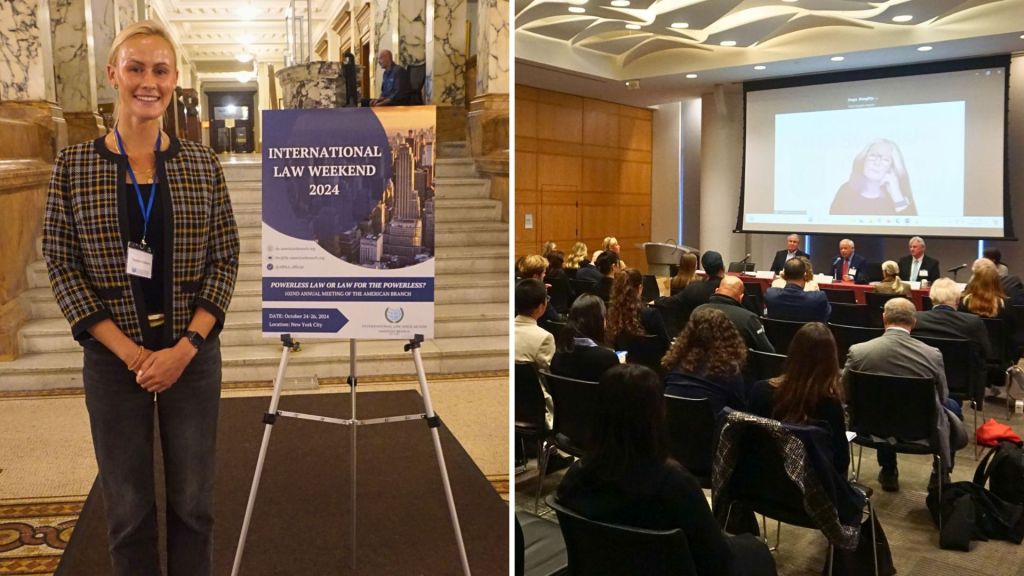
Graham was one of five ambassadors selected nationwide to assist with the work of ABILA in the preparation of the International Law Weekend 2024 conference. She attended ABILA’s ILW along with 7 other Georgia Law students through the support of Louis B. Sohn Professional Development stipends, detailed in a prior post (here). Graham’s full blog post can be accessed here.
Attendees included 3Ls Gloria Maria Correa, Madison Graham, and Tiffany Torchia, and Masters of Laws (LL.M.) students Dzmitry Liasovich, Zulma Perez, Christian Schneider, and Fabienne Taller. Graham was one of 5 students selected to serve as a Student Ambassador for the event. All seven students received a Louis B. Sohn Professional Development Fellowship to support their attendance of this conference. Awarded by the law school’s Dean Rusk International Law Center, Sohn Fellowships enable students to attend professional development opportunities related to international law.
International law faces an existential threat as history unfolds at unprecedented speed worldwide. Indeed, international law and international institutions at times appear incapable of protecting vulnerable persons against war, disease, hunger, exploitation, climate change, and other human and natural catastrophes. Some people–both individually and collectively–are openly eschewing legal values and frameworks in order to pursue results through other means, including dangerous and destabilizing ones. Is international law, in fact, powerless or does it remain a source of power that vulnerable persons can utilize to protect and advance their rights and interests? This year’s ILW is focused on engaged, interactive, and inclusive discussions about how international law can transcend perceptions and misperceptions of its powerlessness and fulfill its aspirations of balancing power through principles of justice, equality, and dignity.
Reflecting on the overall takeaways from the conference, Graham said:
As a student, this conference re-instilled the importance of the research process to me…I was reminded of how important it is to immerse yourself in the big ideas that other people are considering, learning about their work. Even in topics we may already be familiar with, there will always be someone who knows more – or, at the very least, is considering new angles. Put another way, I think conferences like this are integral to ensuring we are continuing to push the mental boundaries we inadvertently place on ourselves when we get into routines and habits of regular school and work lives. Conferences like these help us stay curious, and accordingly, help us re-examine what the law is capable of moving forward.
In describing the ways in which this experience benefitted her professionally, Perez said:
ABILA ILW 2024 was an extraordinary experience on many levels. Personally, I had the opportunity to connect with other professionals and leaders in the legal industry, reinforcing the valuable education I am receiving at Georgia Law by sharing insights with other attendees. Academically and professionally, it sparked my interest about some subjects that I hadn’t previously explored, and I am eager to explore further and apply this knowledge in my career. I now have a clearer understanding of how public and private sectors interact in a various issue, and I can see the professional opportunities that arise from this collaboration.
When asked about her favorite panel from the conference, Correa explained:
My favorite panel discussion was “Arbitrating with International Organizations” because the topic was completely novel to me. The panel discussed some relevant provisions on the International Law Commission’s work on “settlement of disputes to which international organizations are parties,” the practice of arbitral institutions like the Permanent Court of Arbitration, and how arbitration could be a useful tool to overcome barriers like immunity in disputes with international organizations.
To read prior posts about Georgia Law students using Sohn Fellowships to attend professional development opportunities, please click here and here.
Groups like ABILA have been an integral part of my academic growth, and I am thrilled to have the opportunity to contribute as a student ambassador. I hope to use this position to meet other professionals across the field and give back in helping other students better understand the academic and professional opportunities available to them in studying international law
Graham is the second Georgia Law student in the last two years to be selected as an ABILA student ambassador. Last year, LL.M. student Bohdan Krivuts served in this role, detailed in a prior post (here).
Moderated by Thomas Streinz and featuring panelists Adele Barzelay, Nathalie Smuha, and Yirong Sun, the panel addressed Artificial Intelligence, specifically the challenges and importance of regulatory schemes that address the risks associated with AI.
As stated by Krivuts:
“…the uncontrolled usage of AI technologies poses numerous risks to users, governments, and society at large. However, when subjected to appropriate regulations, the use of AI may be beneficial. In today’s world, we can observe how AI technologies have already permeated various aspects of our lives, much like the invention of the internet reshaped the course of human progress decades ago. Therefore, to ensure the effective, and more importantly, safe utilization of AI technologies, international organizations and foreign nations should collaborate in the development of comprehensive AI regulations.”
Krivuts attended ABILA’s ILW along with 7 other Georgia Law students through the support of Louis B. Sohn Professional Development stipends, detailed in a prior post (here). Krivuts’ full blog post can be accessed here.
Top row, from left to right: Aashka Vyas, Bohdan Krivuts, N’guessan Clément Kouame, Savelii Elizarov Bottom row, from left to right: Anna Carolina Mares, Eman Abdella Ali, Shivani Ravi Prakash, Victoria Agbakwuru, and Sarah Quinn
Each fall, the American Branch of the International Law Association hosts its annual International Law Weekend (ILW) conference in New York City. This event features over 30 panels, and many of the world’s leading international lawyers and diplomats participate. Audiences recently have included more than a thousand practitioners, academics, U.N. diplomats, business leaders, federal and state government officials, NGO leaders, journalists, students, and interested citizens.
This year, the University of Georgia School of Law was a sponsor of the event, and eight students attended through the support of Louis B. Sohn Professional Development Scholarships awarded by the Dean Rusk International Law Center. This builds on a tradition of supporting students seeking professional development opportunities (Prior posts here, here, and here). Recipients of the scholarships this year included:
ILW keynote speakers included Ambassador Sheikha Alya Ahmed Saif Al Thani, Permanent Representative of the State of Qatar to the United Nations, and Judge Gatti Santana, President, International Residual Mechanism for Criminal Tribunals. The students enjoyed hearing a range of perspectives on the current international law scheme and how its shortcomings and challenges may be met. For example, one of the panels that Vyas attended was “Investment Law and Energy in times of Armed Conflict.” She appreciated the legal framing of the recent events in Ukraine, and noted that these discussions illuminate the “…considerable gaps…in the current legal regime” and how they could potentially be addressed by “…adopting new measures to maintain cross-border investments during armed conflict.” Kouame, meanwhile, enjoyed the panel entitled “Trade, Labor Rights and Forced Labor.” He said that the panelists provided insight concerning the enforcement of labor and human rights provisions of the USMCA directly related to a research project he is conducting under Professor Christopher M. Bruner.
In addition to the ILW programming, students met with LL.M. alumni working in New York. These included Julie Guo (LL.M., ’09), who hosted students in her firm’s New York City office; along with Parham Zahedi (LL.M., ’18) and Tatyana Popovkina (LL.M., ’23), who met with students before the conference on Saturday. In both meetings, students were able to learn about the experiences of Guo, Zahedi, and Popvkina at UGA Law, how they prepared for the New York bar exam, and their advice for conducting domestic job searches. Students appreciated their insights; Mares, for example, commented that her conversations with alumni reminded her of the strength of the UGA Law community. “Alumni spoke about their gratitude for time spent at UGA and mentioned wanting to do as much as possible to help UGA grads entering the legal field,” she reflected. “Though New York is a competitive market to enter, with hard work and support from fellow UGA grads, it appears to be in reach as a dynamic place to establish a legal career.”
Each of the eight UGA Law students who attended the ABILA ILW agreed that being able to attend this type of professional conference is valuable as they learn about the field of international law and consider their professional futures. Ravi Prakash noted the event’s “transformative impact” on her professional aspirations. “This experience introduced me to a network of highly accomplished individuals in the realm of international law, many of whom are prolific writers, professors, ambassadors and successful attorneys in the field,” she commented. “Interacting with these experts not only expanded my knowledge but also provided valuable insights and connections that will be invaluable in my journey. On a personal level, it instilled in me a deeper passion for international law and a sense of belonging within this community of experts. This event has undoubtedly set me on a path to a more promising and fulfilling future in international law.”
► Scholarly achievements of our Center Director, Melissa J. Durkee, and our many other globally minded faculty, including Diane Marie Amann and Harlan G. Cohen, our Center’s Faculty Co-Directors, as well as Zohra Ahmed, Christopher Bruner, Jason Cade, Nathan Chapman, Walter Hellerstein, Thomas Kadri, Jonathan Peters, Peter B. “Bo” Rutledge, Tim Samples, and Laura Phillips-Sawyer.
► Our International Law Colloquium in Spring 2022, a course featuring works-in-progress conversations with international law scholars based in Latin America and Europe as well as the United States.
► Recent events, including our day-long conference on “The Law of Global Economic Statecraft” cosponsored with the Georgia Journal of International & Comparative Law and other University of Georgia entities, our Consular Series of talks with diplomats, presentations by distinguished lawyers on issues including the Ukraine-Russia war, and participation in panels at meetings of the American Branch of the International Law Association, the American Society of International Law, and other global entities.
► Initiatives aimed at preparing our J.D. and LL.M. students for global legal practice, including our NATO Externship, our Global Externships, and the Global Governance Summer School we host in partnership with the Leuven Centre for Global Governance at Belgium’s University of Leuven (plus additional partnerships with O.P. Jindal University in India and Bar Ilan University in Israel).
Our Center’s Director, Professor Melissa J. “MJ” Durkee, who is also Associate Dean for International Programs and Allen Post Professor here at Georgia Law, served as a Co-Chair of the ILW conference. She also chaired Friday’s keynote address, on “The Biden Administration’s Approach to International Justice,” delivered by Beth Van Schaack, U.S. Ambassador-at-Large for Global Criminal Justice.
On Saturday, Diane Marie Amann, who is Regents’ Professor of International Law, Emily & Ernest Woodruff Chair in International Law, and a Faculty Co-Director of our Center, took part in exploration of “The Legitimacy and Fundamental Principles of International Human Rights Law.” Moderated by Mortimer Sellers (Maryland), the panel also featured as speakers Gloria Y.A. Ayee (Harvard), Hélène Ruiz Fabri (Max Planck Institute Luxembourg), and Aaron Xavier Fellmeth (Arizona State). In her own talk on legitimacy and human rights, Amann discussed her article on international child law and peace negotiations, which grew out of a University of Cambridge Lauterpacht Centre settlement options project. (Article available here; prior posts here and here.)



 exchange of notes