Georgia Law Professor Diane Marie Amann elected Visiting Fellow at Oxford’s Exeter College

Earlier this month University of Georgia School of Law Professor Diane Marie Amann was elected a Visiting Fellow at Exeter College, Oxford University, for this autumn’s Michaelmas Term.

While in the United Kingdom, she is serving simultaneously as a Research Visitor at the Oxford Faculty of Law Bonavero Institute of Human Rights.

Amann is Regents’ Professor, Emily & Ernest Woodruff Chair in International Law, and Faculty Co-Director of the Dean Rusk International Law Center here at the University of Georgia School of Law. Her courses include Public International Law, Constitutional Law, Human Rights, and Transnational Criminal Law.

During this research-intensive semester Amann is pursuing her scholarship related to women professionals who played roles in international criminal trials after World War II and also her work on child rights, especially as they relate to armed conflict and similar violence.

Founded in 1314, Exeter College is the fourth-oldest among Oxford’s three dozen colleges. It is located in the city center next to the university’s Bodleian Library.

Georgia Law Professor Diane Marie Amann discusses child-taking at annual forum International Nuremberg Principles Academy in Germany

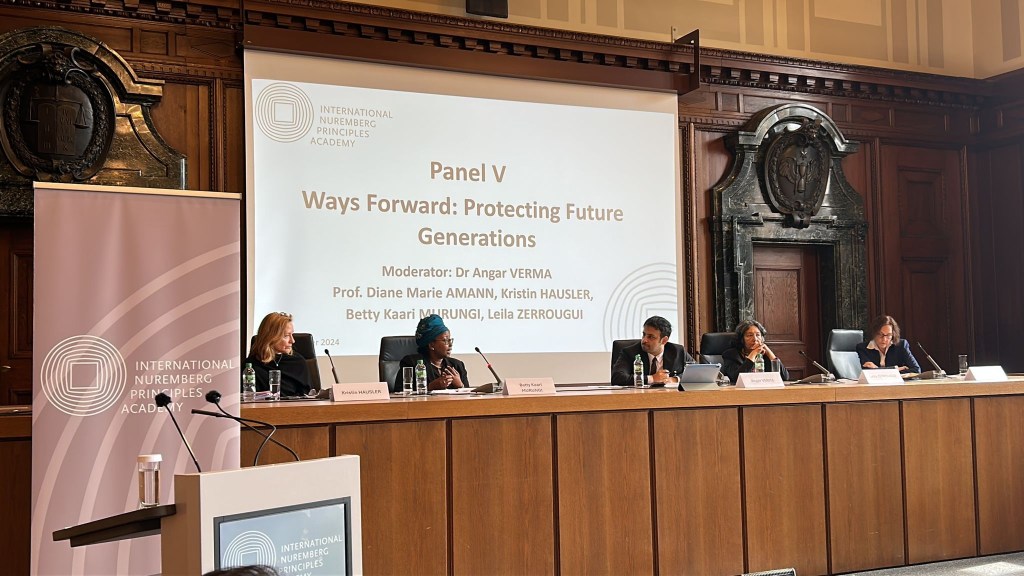
University of Georgia School of Law Professor Diane Marie Amann spoke at last week’s Nuremberg Forum 2024, the annual three-day meeting of the International Nuremberg Principles Academy. It was held in the Nuremberg, Germany, courtroom where hundreds of Nazi defendants were tried in the wake of World War II.

The theme of this year’s Forum was “For Every Child: Protecting Children’s Rights in Armed Conflict.” Amann spoke on the closing panel, “Ways Forward: Protecting Future Generations,” pictured above. She is pictured at right along with, l to r: Kristin Hausler; Betty Kaari Murungi; moderator Angar Verma; and Leila Zerrougui.

Amann gave an overview of her new article “Child-Taking,” 45 Michigan Journal of International Law 305 (2024), with focus on forced residential schooling of Indigenous children. As theorized in the article available here, child-taking occurs when a state or similar powerful entity takes a child and then endeavors to alter, erase, or remake the child’s identity. Though a criminal phenomenon, it may be redressed not only in criminal justice systems, but also through transitional justice mechanisms.

Amann is Regents’ Professor of International Law, Emily & Ernest Woodruff Chair in International Law, and a Faculty Co-Director of our Dean Rusk International Law Center here at Georgia Law. She served from 2012 to 2021 as International Criminal Court Prosecutor Fatou Bensouda’s Special Adviser on Children in & affected by Armed Conflict. This fall, she is spending a research-intensive semester in the United Kingdom, where she is a Research Visitor at the Oxford Faculty of Law Bonavero Institute of Human Rights.

Georgia Law professors, alumna, students take part in annual meeting of American Society of International Law

Many members of the University of Georgia School of Law community – professors, alumna, and students – took part in last week’s 117th Annual Meeting of the American Society of International Law, the theme of which was “The Reach and Limits of International Law to Solve Today’s Challenges.”

The annual meeting took place Wednesday-Saturday at several venues in Washington, D.C.

Representatives of Georgia Law, an ASIL Academic Partner, included three scholars affiliated with the law school’s Dean Rusk International Law Center:

The Center’s Director, Melissa J. “MJ” Durkee, who is also Associate Dean for International Programs and Allen Post Professor, moderated a panel entitled “How Does International Law Change? Theories and Concepts of Legal Change.” (photo top row left) It was sponsored by ASIL’s International Legal Theory Interest Group, for which Durkee serves as Chair. Panelists were: Benedict Kingsbury, New York University; Nico Krisch, Graduate Institute of International and Development Studies in Geneva; and Sivan Shlomo Agon, Bar-Ilan University.

Durkee additionally serves on the ASIL Executive Council and the Board of Editors of the American Journal of International Law, and took part in the meetings of both those groups.

Diane Marie Amann, Regents’ Professor of International Law, Emily & Ernest Woodruff Chair in International Law, and one of our Center’s Faculty Co-Directors (above second from left), took part in a late-breaking panel, “ICC Arrest Warrant Against Putin: Impunity in Check?” (photo above left) Amann, an international child law expert and former Special Adviser to the International Criminal Court Prosecutor on Children in & affected by Armed Conflict, spoke on the significance of the fact that crimes against children form the basis of the international arrest warrant issued March 17 against the President and the Children’s Rights Commissioner of Russia. Additional panel participants were: Javier Eskauriatza, University of Nottingham; Marko Milanovic, University of Reading; Saira Mohamed, University of California-Berkeley; and moderator Katherine Gallagher, Center for Constitutional Rights. Panel video here.

Amann also attended the ASIL Executive Council meeting, completing her term as an ASIL Counsellor.

Harlan G. Cohen, Gabriel M. Wilner/UGA Foundation Professor in International Law and Faculty Co-Director of the Dean Rusk International Law Center, took the ASIL General Assembly stage: in his capacity as Chair of the 2023 Book Awards Committee, he co-presented those honors to numerous authors. (photo top row right, from left to right: ASIL President Greg Shaffer, honoree Damilola Olawuyi, ASIL Executive Director Michael Cooper, and Cohen; video 27:09)

Like Durkee, Cohen is a member of the AJIL Board of Editors and took part in the journal’s meeting. The annual meeting completed his service as Chair of ASIL’s International Legal Theory Interest Group.

A distinguished Georgia Law graduate also was featured:

Tess Davis (JD 2009), who is the Executive Director of the D.C.-based Antiquities Coalition and Dean Rusk International Law Center Council member, served as moderator for a session at the Smithsonian National Museum of Asian Art. (photo above right) Entitled “Protecting Cultural Heritage in Conflict Zones: Multi-Disciplinary Approaches,” the discussion also included: Patty Gerstenblith, DePaul University; Brooke Cuven, Cerberus Capital Management; Richard Kurin, Smithsonian Institution; and Zaydoon Zaid, American Foundation for Cultural Research.

Rounding out the contingent were four Georgia Law students, who received Louis B. Sohn Professional Development grants to serve as volunteers at the meeting: 2L Hao Chen “Bobby” Dong, 3L Collin Douglas, LLM candidate Alexandra Lampe, and 1L Mahi Patel.

Georgia Law Professor Amann presents in Geneva conference on children and International Criminal Court

Georgia Law Professor Diane Marie Amann presented Thursday in a 2-day global conference entitled “A New Path towards Accountability for Crimes and Violations affecting Children in Armed Conflict.” Sponsor of the event, which took place in Geneva, Switzerland, in a hybrid format, was the nongovernmental organization Save the Children.

Amann’s online presentation at last week’s conference concerned the ICC Office of the Prosecutor Policy on Children (2016) (left), which she helped research and draft. She recapped the 4-year process leading to publication of the 2016 Policy, surveyed key points in its content, and suggested areas in which the policy and its implementation could be enhanced.

Amann is Regents’ Professor of International Law, Emily & Ernest Woodruff Chair in International Law, and Faculty Co-Director of the Dean Rusk International Law Center here at the University of Georgia School of Law. By appointment of ICC Prosecutor Fatou Bensouda, Amann served from 2012 to 2021 as the first Special Adviser to the ICC Prosecutor on Children in & affected by Armed Conflict. She continues to publish and present on issues relation to international child law. (prior posts)

Indeed, such an enhancement effort began at Thursday’s event: ICC Prosecutor Karim Khan QC, who took office in mid-2021, announced the launch of a process “to build upon, and renew,” the 2016 Policy. He issued a public call for submission of suggestions, as part of a consultation process set to unfold in the new few months.

Assisting in this Policy-renewal process will be Amann’s successor as Special Adviser in this area: Véronique Aubert, who is also the Lead on Children & Armed Conflict at Save the Children. Aubert spearheaded the organization of last week’s conference in Geneva.

Georgia Law Professor Amann publishes “International Child Law and the Settlement of Ukraine-Russia and Other Conflicts” in International Law Studies

Georgia Law Professor Diane Marie Amann has published, in the century-old, peer-reviewed international law journal of the U.S. Naval War College, an article analyzed international child law in order to imagine ways that peace processes may engage with children and ensure that children’s issues are addressed in future peace agreements.

Entitled “International Child Law and the Settlement of Ukraine-Russia and Other Conflicts,” the article appears at 99 International Law Studies 559-601 (2022) and is available here.

Amann, who is Regents’ Professor of International Law, Emily & Ernest Woodruff Chair in International Law, and Faculty Co-Director of the Dean Rusk International Law Center here at the University of Georgia School of Law, she served from 2012 to 2021 as the Special Adviser to the International Criminal Court Prosecutor on Children in & affected by Armed Conflict.

She undertook research on this topic while a Visiting Academic at University College London this past summer. An earlier version of her research forms part of the Ukraine Peace Settlement Project of the Lauterpacht Centre for International Law at the University of Cambridge in the United Kingdom. (prior post)

Here’s the abstract for Amann’s just-published article:

The Ukraine-Russia conflict has wreaked disproportionate harms upon children. Hundreds reportedly were killed or wounded within the opening months of the conflict, thousands lost loved ones, and millions left their homes, their schools, and their communities. Yet public discussions of how to settle the conflict contain very little at all about children. This article seeks to change that dynamic. It builds on a relatively recent trend, one that situates human rights within the structure of peace negotiations, to push for particularized treatment of children’s experiences, needs, rights, and capacities in eventual negotiations. The article draws upon twenty-first century projects that examine the lives of children in armed conflict by synthesizing international child law. The projects’ syntheses have influenced the work of certain international organizations bodies but not, to date, the work of peace settlements.

To demonstrate their relevance to conflict resolution, the article first outlines two syntheses by the United Nations and by the International Criminal Court Office of the Prosecutor. After mapping child rights and conflict harms, it examines the treatment of children in Colombia’s 2016 peace agreement and a 1999 agreement related to Sierra Leone. The article concludes by proposing child-inclusive options for peace processes and eventual peace agreements.

While Visiting Academic at University College London, Georgia Law Professor Amann presents “No Exit at Nuremberg”

Georgia Law Professor Diane Marie Amann gave a presentation yesterday at University College London Faculty of Laws, where she is a Visiting Academic for all of Summer 2022.

Her talk, entitled “No Exit at Nuremberg: The Postwar Order As Stage for 21st-Century Global Insecurity” (video here) drew upon her research on participants at the post-World War II International Military Tribunal, as well as an existentialist play written toward the end of that long war. The talk investigated the relationship of international criminal justice to security with particular reference to the ongoing Ukraine-Russia conflict.

Amann is Regents’ Professor of International Law, Emily & Ernest Woodruff Chair in International Law, and Faculty Co-Director of the Dean Rusk International Law Center here at the University of Georgia School of Law (she is pictured above at the right of the table). Chairing her talk in London yesterday, and moderating questions from in-person and online attendees was Dr. Martins Paparinskis (above left), a Reader in Public International Law at UCL who recently was elected to an upcoming term on the United Nations’ International Law Commission.

Dean Rusk International Law Center hosts “International Law and the Ukraine-Russia Conflict,” featuring Georgia Law Professors Amann, Cohen, and Durkee

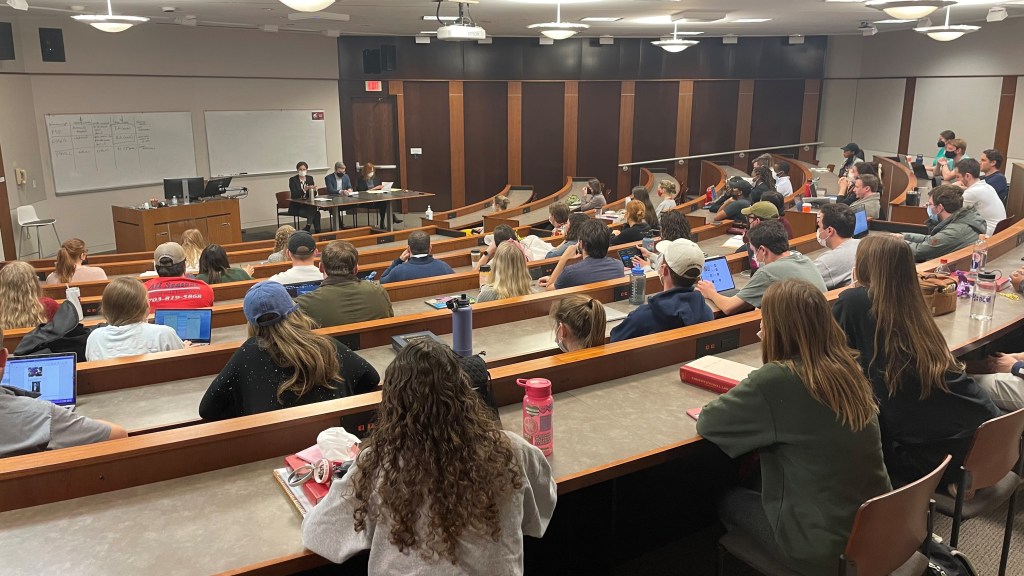
Nearly a hundred members of the University of Georgia School of Law community took part Wednesday in “International Law and the Ukraine-Russia Conflict,” a forum hosted by our Dean Rusk International Law Center and presented by three international law experts on the law school’s faculty.

The armed conflict began on February 24, 2022, when Russian military troops invaded the neighboring state of Ukraine, entering the latter country at points on its northern, eastern, and southern borders. At this writing just a week later, thousands of persons, civilians and combatants alike, reportedly had been killed, and, according to UN High Commissioner for Refugees Filippo Grandi, more than a million Ukrainians had been forcibly displaced.

At Wednesday’s forum, each of the three Georgia Law professors first offered a brief overview of a particular aspect of the armed conflict:

  • Our Center’s Director, Melissa J. “MJ” Durkee, who is also Associate Dean for International Programs and Allen Post Professor, began by outlining the international rules that have outlawed aggressive war – that is, one country’s unjustified invasion of another – since the adoption of the 1945 Charter of the United Nations. She explained why reasons that Russia has put forward do not constitute legally valid justifications for the invasion, and further emphasized the threat that Russia’s actions place on the international rules-based order that came into being after the Allied victory in World War II. In so doing, Durkee cited a UN General Assembly resolution, adopted Wednesday by a huge majority of votes, which condemned Russia’s actions as violative of this order.
  • Next came Harlan Grant Cohen, who is Gabriel M. Wilner/UGA Foundation Professor in International Law and one of our Center’s 2 Faculty Co-Directors. Cohen focused on economic sanctions that have been levied against Russia in the last week, by individual countries including the United States and also by international organizations including the European Union. While noting that these types of economic actions had been developed in response to Iran’s nuclear program, Cohen stressed that the extent and impact of the sanctions already imposed against Russia is unprecedented.
  • Then followed our Center’s other Faculty Co-Director, Diane Marie Amann, who is also Regents’ Professor of International Law and Emily & Ernest Woodruff Chair in International Law. She addressed international humanitarian law, the body of law concerned with the ways that armies and armed groups actually conduct the war. She underscored that this body of law concerns itself with all sides of the conflict, regardless of who started the conflict: fighters on either side may be found liable for violations, and thus charged with war crimes. Amann concluded with a look at forums already engaged to review legal issues arising out of the war, among them the European Court of Human Rights, International Criminal Court, and International Court of Justice.

The forum concluded with a lively and wide-ranging question-and-answer period.

Brutal Peace: Lieber Code, NATO mission, and personal journey, by Georgia Law 3L Miles S. Porter


In this item, Miles S. Porter, a J.D. candidate in the University of Georgia School of Law Class of 2021, reflects on his Spring 2020 full-semester externship at NATO HQ SACT in Norfolk, Virginia. Miles’ background includes: B.A. degree in international relations and German, University of South Carolina 2011; U.S. Army active duty 2013-2018, including tour in Afghanistan; and U.S. Army reservist since 2018.

Peace can be brutal. I am reminded of this axiom as an unwelcome silence invades my office space from the street below. The COVID-19 pandemic has brought life to what some have called a “peaceful” and “virtual” standstill. But with an unprecedented 30-plus million Americans claiming unemployment in the last month, “brutal” seems a more appropriate descriptor.

Like many of my peers, I finished my spring semester externship from home, a mere 800 socially distanced miles from my worksite, the NATO headquarters in Norfolk. Early on, I had looked forward to watching the 30th flag raised at Norfolk in honor of North Macedonia’s recent membership, to enjoying the parade of nations at the NATO Festival, and to hearing former NATO Supreme Allied Commander Transformation General James Mattis speak at the Norfolk Forum. Instead I am at home, reflecting.

While America finds itself embroiled in yet another metaphorical war, against COVID,  perhaps it is appropriate then that my thoughts have ultimately turned to war itself. Specifically, they have turned to a theory of war that decries the paradox of a “humane war.” This paradox is explored in the 2012 book I read as part of my externship tutorial: Lincoln’s Code: The Laws of War in American History, by Yale Law Professor John Fabian Witt. A compelling narrative about one of the first codifications of the laws of war and perhaps one of the earliest uses of lawfare, Lincoln’s Code is more page-turning adventure story than legal treatise.

The book’s conclusions, far from uncontroversial, initially resonated with me. But they also raised important questions about the role of NATO, the rule of law, and the future of warfare. This post will examine those questions, then end with some thoughts on my NATO experience.

Now to “Old Hundred.”

“Old Hundred”

The U.S. War Department issued General Order No. 100, also known as the Lieber Code, in May 1863, at the height of America’s bloodiest war. Commissioned by President Abraham Lincoln’s Secretary of War, Edwin Stanton, and endorsed by the General-in-Chief of all Union Armies, Henry Halleck—an attorney himself—the “Old Hundred” was a necessary contribution to the Union’s war efforts. First, it helped frame the conflict in legal terms, extending law of war protections to prisoners and proving to foreign states that the Union’s actions were in fact legitimate. Second, it enabled Lincoln to achieve his goal of emancipation.

Lincoln had won the 1860 election on a platform that denounced the expansion of slavery into new states. This precipitated the secession of South Carolina even while James Buchanan was still President, and set the nation on the path to civil war.

The story of The Code is told in tandem with the story of its author, and the maxims within are better read as a story of lessons learned. While Francis Lieber was an academic, a professor first at the University of South Carolina and later at what is now Columbia University, he was also a soldier. He was someone who had his family and his life torn apart by war. His sons fought on opposite sides during the conflict he helped to end. Rather than devote himself to pacifism, however, Lieber thought the call to arms was “the most honorable calling of mankind” and that “when carried on by civilized peoples, just wars were the way civilization spread. … Justice, not peace, [was] the highest ideal.”  (Witt 178). Not only did he believe in the importance of just wars, Lieber had kept slaves himself for a time and had seen firsthand the effects of slavery while living in South Carolina. It is in this context that “Old Hundred” should be read.

A notable characteristic of Lieber’s work was that it ran counter to then-conventional doctrine on the laws of war. Lieber openly spoke out against the end of war advocated by the leading contemporary European thinkers (182), preferring the writings of older theorists like Clausewitz. Humanizing wars, in Lieber’s opinion, had the paradoxical effect of prolonging human suffering.  He urged short and sharp wars because “the more earnestly and keenly wars are carried on, the better for humanity, for peace and civilization.” (184) This became the basis for the last sentence in Article 29 of his Code:

“Sharp wars are brief.”

The principle at the essence of the Code is military necessity. As Witt shows, military necessity became an almost absolute power, remarkable for what it forbade and more remarkable for what it allowed. Torture was expressly forbidden but the starvation of villages, emancipation of slaves as enemy property, and martial law were permitted, even expected. And yet the principle persisted, so that in the present day military necessity is one of the five accepted principles of the laws of armed conflict, or LOAC.

“Old Hundred” quickly gained traction abroad. European lawyers and politicians had been searching to codify their own “enlightened” laws of war after over a century of bloody conflicts. To this end, they concluded the very first Geneva Convention in 1864. Yet delegates at that Geneva Conference, influenced by some of the more pacifistic thinkers of the day, had gone in a somewhat different direction than Lieber. Their Convention outlawed some of the barbarities of war, reforming war in the hopes of one day ending it altogether. This approach foretold advancements in the laws of war that would occur in the wake of the World Wars of the 20th century.

Choosing an Approach

The Charter of the United Nations was signed and entered into force in 1945.  A short five years later, the North Atlantic Treaty, NATO’s founding document, likewise was signed and entered into force. Today, in 2020, Kabul, Afghanistan, has been the site of armed conflict and a nearly two-decades-long military presence by America and its NATO allies. The fact provokes questions:

  • Is the “forever war” a byproduct of the humanization of warfare?
  • Is that result what Francis Lieber had fought so vehemently against? Or is it merely indicative of the progress made towards the abolishment of warfare as an institution, which the United Nations and its progeny were designed to facilitate?
  • By sheathing the short war, have we lost a valuable weapon in our proverbial arsenal, holding ourselves to morals that our less scrupulous foes may not?

These were the questions that I faced after reading Lincoln’s Code.

Initially, I embraced the short, sharp wars advocated by Lieber, Tolstoy, and Clausewitz. Frustrated by a perceived lack of progress in recent war efforts and the absence of defining victories (ignoring a certain shipboard declaration of victory), my inclination was towards a strategy of power, shock, and awe. I thought that .

After further consideration, I think maybe this initial reaction was a bit rash: While I agree with many of the principles and ideals set forth by Lieber and his short-war sympathizers, I believe that he made some key mistakes. Like many who romanticize, he failed to account for the realities of the world.

If we do the same, we do so at our own peril.

Short wars reached their pinnacle with the Cold War. That is ironic since the Cold War was long – nearly a half-century prompted by the threat of the ultimate short war, nuclear war.  The international community has since demonstrated a strong aversion to this inhumane form of short war, to the point that in a near-peer conflict it may be more than ill-advised, it may be a nearly impossible strategy to pursue.  The changing instrumentalities of war, towards weapons of mass destruction, have altered the calculus of war.  As America’s near-peer adversaries retain an interest in a balanced geo-political environment, even short wars with non-nuclear equipped opponents seems unlikely.  The new realities of warfare include nuclear weapons, and as long as this remains true, the possibility of short wars will remain distant.

Post-Cold War NATO, or NATO 2.0, represents the other side of this equation. The military alliance, initially established as a After the USSR fell, NATO endured. It participated in some of the largest humanitarian efforts of the 20th and 21st centuries, in places like Kosovo, Haiti, and Afghanistan.

In truth, globalization, the threat of nuclear warfare, and a determined international effort to outlaw war have changed the face of warfare completely. Warfare today is about competition, about living in the gray areas of the law. It resembles humanitarian aid more than it does Gettysburg or Antietam.

Democracy, liberty, and the rule of law are the conquering tools of warfare in the 21st century. They have enabled the alliance to grow to 30 full-fledged members, to conclude official partnerships with 20 Partnership for Peace nations, as well as to develop relationships with numerous other nations from disparate corners of the earth, from Australia to Colombia to Pakistan. The great deterrents in today’s conflicts are not so much weapons as they are the financial costs of waging expeditionary wars and the potential damaging of financial systems. In this environment, communities of peace built on a common foundation are capable of outlasting more powerful foes.

NATO is also capable of holding its own during armed conflicts when they arise. (Another discussion could be had about member nations’ willingness to uphold their article 5 commitment of mutual defense, but that is a separate issue.) NATO retains flexibility in the deployment of its rules of engagement, which allow member nations to pursue their individual national interests while retaining a unity of effort. Effective management of NATO forces requires mastery of this concept by commanders across echelons. Once achieved, it leaves the alliance with plenty of capabilities to accomplish the mission.

Irish poet Robert Lynd once said:

“The belief in the possibility of a short, decisive war appears to be one of the most ancient and dangerous of human delusions.”

The short wars envisioned by Lieber require justice to be the prevailing value in the pursuit of national objectives, and that in turn requires the actors pursuing these objectives to act justly.  The limited set of circumstances where this is achievable make his theory complicated enough to make unwise policy.  The abuses of the Code’s ideas that took place in subsequent conflicts, like the one in the Philippines at the turn of the 20th century, make this clear.  As Witt demonstrated in Lincoln’s Code, the principle of military necessity acted as a cloak that attempted to legitimize abhorrent acts.

Whether organizations like NATO go too far in their pursuit of peace, whether they are influenced too much by groups trying to humanize an inherently inhumane act, strike me as unnecessary questions in today’s environment. Competition will indeed manifest itself as “forever wars.” I find this outcome preferable to the alternative of a persistent nuclear threat. 

Final Thoughts

I have found that even dream jobs can begin to show their faults after a few weeks. While NATO certainly suffers from its shortcomings, this job never lost its appeal. In fact, most of what I initially saw as shortcomings eventually appeared to have been deliberate components of NATO’s grand design. The endless hours needed to exhaust every opinion on a topic until consensus is reached certainly can be challenging. The fact that every nation gets a voice at all, however, is truly amazing.

One of my mentors at NATO once told me,

“The beauty of NATO is that it is.”

I hope that despite its challenges in the future, it will always continue to be.
Georgia Law Professor Diane Marie Amann on her article, in International Review of the Red Cross, on ICC OTP Policy on Children, accountability for conflict-related crimes against children

In this post Professor Diane Marie Amann, the Emily & Ernest Woodruff Chair in International Law and Faculty Co-Director of our Dean Rusk International Law Center here at the University of Georgia School of Law, discusses her most recent article related to the effects on children of armed conflict and similar extreme violence.

Very pleased to announce the publication of my new article, “The Policy on Children of the ICC Office of the Prosecutor: Toward greater accountability for crimes against and affecting children.”

As indicated in the just-before-publication version that I’ve posted at SSRN, the International Review of the Red Cross placed this article online last month, on February 21. Currently, that published version is available to Cambridge Core subscribers at a First View page; once it appears in print, in a special issue on “Children and War,” it will be freely accessible at the Review‘s website.

Here’s the abstract:

The Policy on Children published by the International Criminal Court Office of the Prosecutor in 2016 represents a significant step toward accountability for harms to children in armed conflict and similar extreme violence. This article describes the process that led to the Policy and outlines the Policy’s contents. It then surveys relevant ICC practice and related developments, concluding that despite some salutary efforts, much remains to be done to recognize, prevent and punish the spectrum of conflicted-related crimes against or affecting children.

This article represents my latest effort to assist in raising awareness and developing strategies respecting children and conflict (prior posts). It’s an effort in which I’ve been deeply involved since my 2012 appointment as the International Criminal Court Prosecutor’s Special Adviser on Children in and affected by Armed Conflict.

Central to this effort was the multiyear process of researching and drafting, along with an Office of the Prosecutor working group and in consultation with others, of the document published in 5 languages and launched in November 2016 as the Policy on Children. Other aspects have included:

Happy to provide further details. And as always, comments welcome.

(Cross-posted from Diane Marie Amann blog)

Belgium portion of the Global Governance Summer School concludes with an array of international law topics

LEUVEN – Today marks the final day of classroom sessions of the Georgia Law – Leuven Global Governance School, and the final day students will be resident in Leuven. Students took part in three sessions, which focused on business and human rights, international security governance, and concluded with an overview of challenges to international law and global governance.

First, Dr. Axel Marx (left), Deputy Director of the Leuven Centre for Global Governance Studies, presented on business and human rights. After examining several case studies in which corporate activities adversely affected human rights, participants learned how supply chain and corporate governance structures can affect a business’ ability to manage human rights. Dr. Marx introduced key global governance instruments, such as the United Nations Guiding Principles on Business and Human Rights, that can be used to hold states and corporations accountable for human rights violations.

IMG_6489Second, Kathleen Doty (right), Director of the Dean Rusk International Law Center at University of Georgia School of Law, led an interactive session on global security governance. Professor Doty introduced students to global security governance, including international humanitarian law and arms control law. She explained the development of this body of law, focusing on arms control agreements, and introduced several major regimes and their common features. The students then participated in an exercise; faced with a global security crisis, students were tasked with addressing it via treaty negotiation, illustrating the difficulty of international cooperation.

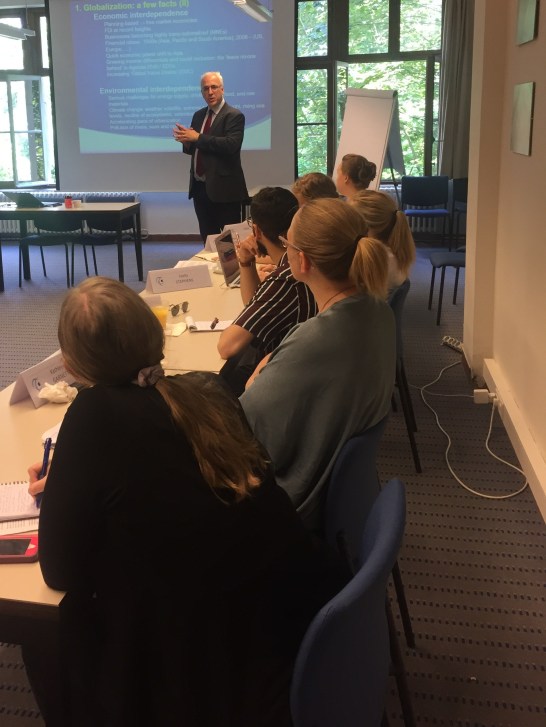
img_6512.jpgThe final session of the day provided an overview of international perspectives on and challenges to global governance, conducted by Professor Dr. Jan Wouters (left), Director of the Leuven Center for Global Governance Studies and the Co-Director of the Global Governance Summer School. Professor Wouters explained the history of globalization and the increase of economic, environmental, and human interdependence. He then explored challenges to the international system, such as anti-globalism, nationalism, and populism.

Student Ayman Tartir receives his diploma from Axel Marx.

Closing out a successful week of studies, students and faculty gathered at the Leuven Institute for Ireland in Europe for a concluding reception. Axel Marx and Kathleen Doty presented participants with attestations of completion.

Tomorrow, students from the University of Georgia School of Law will travel to The Hague, where they will visit international tribunals and organizations.