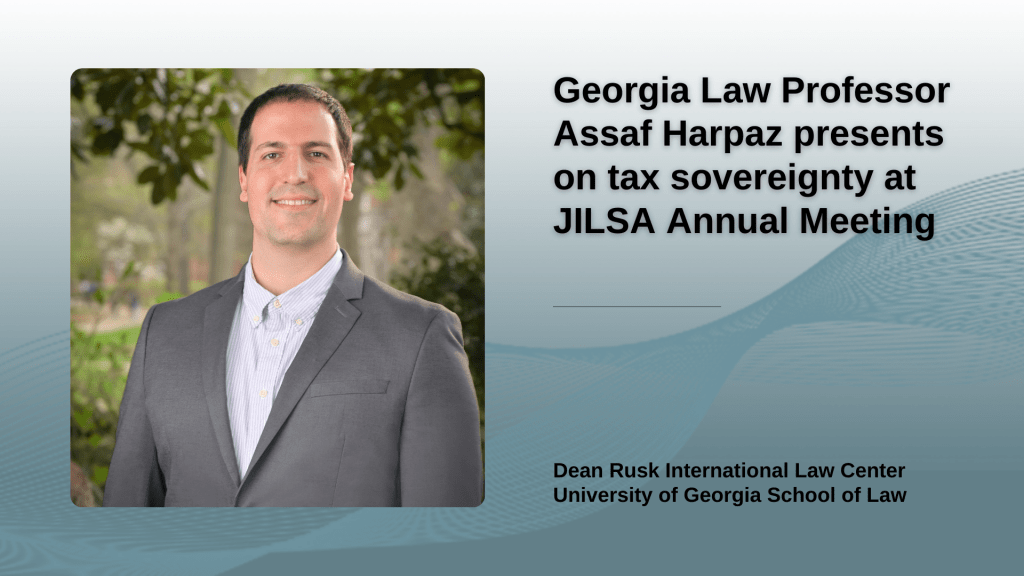
Georgia Law Professor Assaf Harpaz publishes article in American University Law Review

University of Georgia School of Law Professor Assaf Harpaz published “Global Tax Wars in the Digital Era” in the American University Law Review (Vol. 75, 2025). The article explores the global conflict over tax governance, particularly the tensions between OECD-led Global North countries and the UN-backed Global South. It argues for a shift toward source-based taxation that would allow countries to tax online businesses that have a “significant economic presence” without a physical one.

The article’s abstract can be found below:

The digital economy fundamentally disrupts international tax principles that rely on physical presence. When a business earns income abroad, the country of residence (where the taxpayer resides) and the country of source (where income is generated) both have legitimate, competing claims to tax that income. The international tax system tends to favor residence-based taxation. The source country has the right to tax business profits only if the enterprise carries on a permanent establishment within its borders, which typically requires physical presence. The permanent establishment standard becomes flawed in a digital economy where profit shifting practices are abundant and businesses no longer need a physical presence in the location of their online consumer markets.

An upcoming United Nations Framework Convention on International Tax Cooperation recognizes these challenges and is overwhelmingly supported by Global South economies. However, the Global North has historically dominated the international tax regime through the Organization for Economic Co-operation and Development (OECD), informally known as the “World Tax Organization.” A U.N. framework convention creates potential conflict in international tax policymaking and would need to bridge the underlying North-South divide.

This Article explores the “tax wars” surrounding the leadership for global tax governance, contrasting the taxing powers and interests of the OECD-led Global North with those of the U.N.-backed Global South. It argues for a shift toward source-based taxation by revisiting the permanent establishment standard. To achieve this, the Article promotes a significant economic presence doctrine that would expand the permanent establishment criteria to include online businesses. This proposal addresses longstanding inequities and is increasingly warranted in a digital economy that does not depend on physical presence.

Harpaz joined the University of Georgia School of Law as an assistant professor in summer 2024 and teaches classes in federal income tax and business taxation. Harpaz’s scholarly focus lies in international taxation, with an emphasis on the intersection of taxation and digitalization. He explores the tax challenges of the digital economy and the ways to adapt 20th-century tax laws to modern business practices.
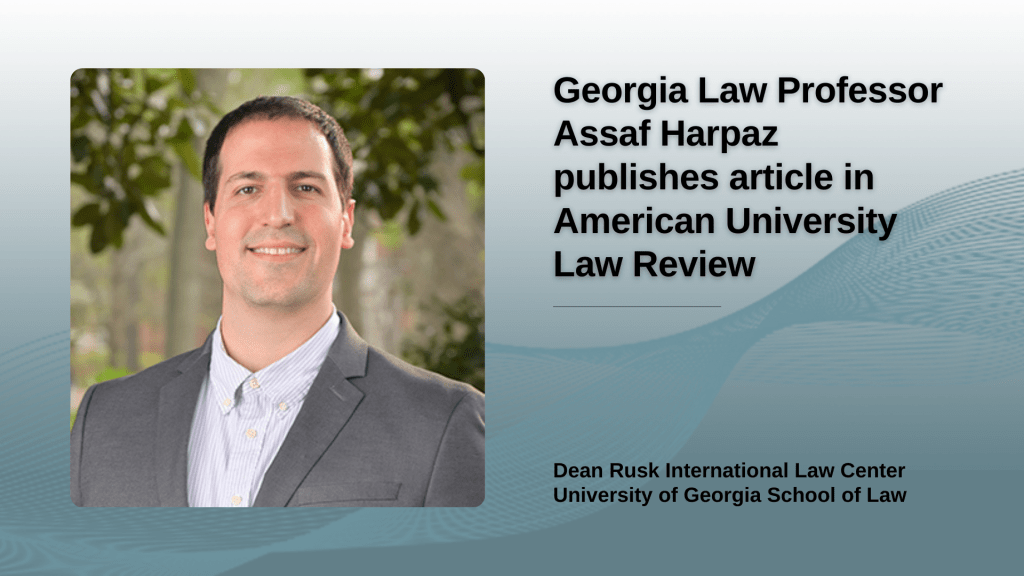
Georgia Law Professor Assaf Harpaz presents at University of Virginia International Business Transactions Guest Lecture Series

University of Georgia School of Law Professor Assaf Harpaz remotely presented his article Global Tax Wars in the Digital Era 75 Am. U. L. Rev. (forthcoming 2025) as part of the University of Virginia International Business Transactions Guest Lecture Series.

The article’s abstract is as follows: 

The digital economy fundamentally disrupts international tax principles that rely on physical presence. When a business earns income abroad, the country of residence (where the taxpayer resides) and the country of source (where income is generated) both have legitimate, competing claims to tax that income. The international tax system tends to favor residence-based taxation. The source country has the right to tax business profits only if the enterprise carries on a permanent establishment within its borders, which typically requires physical presence. The permanent establishment standard becomes flawed in a digital economy where profit shifting practices are abundant and businesses no longer need a physical presence in the location of their online consumer markets. 

An upcoming United Nations (U.N.) Framework Convention on International Tax Cooperation recognizes these challenges and is overwhelmingly supported by Global South economies. However, the Global North has historically dominated the international tax regime through the Organization for Economic Co-operation and Development (OECD), informally known as the “World Tax Organization.” A U.N. framework convention creates potential conflict in international tax policymaking and would need to bridge the underlying North-South divide. 

This Article explores the “tax wars” surrounding the leadership for global tax governance, contrasting the taxing powers and interests of the OECD-led Global North with those of the U.N.-backed Global South. It argues for a shift toward source-based taxation by revisiting the permanent establishment standard. To achieve this, the Article promotes a significant economic presence doctrine that would expand the permanent establishment criteria to include online businesses. This proposal addresses longstanding inequities and is increasingly warranted in a digital economy that does not depend on physical presence. 

Harpaz joined the University of Georgia School of Law as an assistant professor in summer 2024 and teaches classes in federal income tax and business taxation. Harpaz’s scholarly focus lies in international taxation, with an emphasis on the intersection of taxation and digitalization. He explores the tax challenges of the digital economy and the ways to adapt 20th-century tax laws to modern business practices.
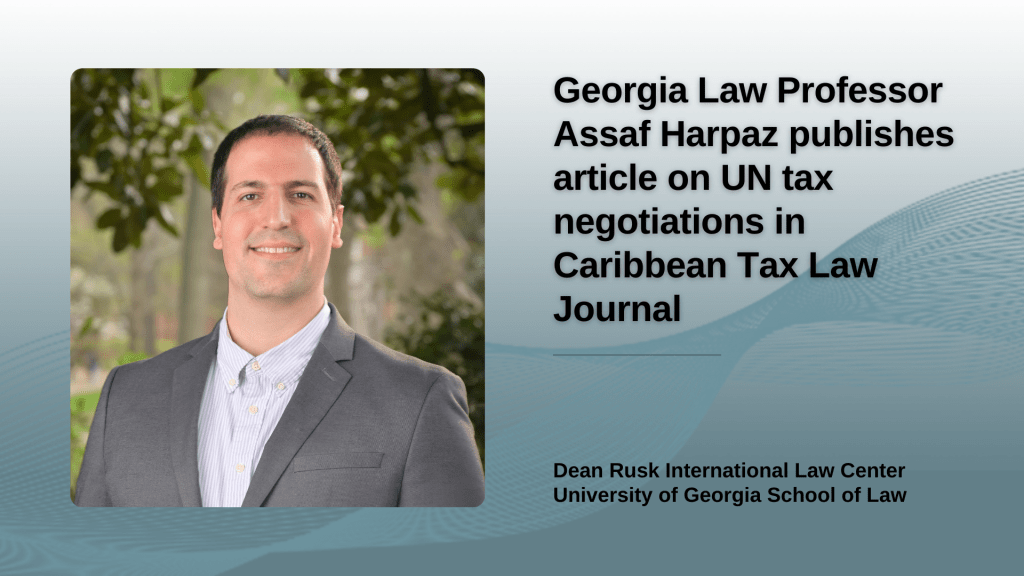
Georgia Law Professor Assaf Harpaz publishes article on UN tax negotiations in Caribbean Tax Law Journal

University of Georgia School of Law Professor Assaf Harpaz published the article “UN Tax Negotiations: North–South Tensions and the Challenge of Institutional Legitimacy” for the Caribbean Tax Law Journal special issue on international tax cooperation at the United Nations.

The article abstract can be found below:

The drafting process for a United Nations Framework Convention on International Tax Cooperation, along with two early protocols, is now underway. A UN framework convention represents a Global South effort to shift international tax policymaking from the OECD to the UN. For developing countries, the UN has long been viewed as a more inclusive space for tax policy negotiations, producing more favorable but historically less influential standards compared to the OECD.

Support for the UN framework convention, including its terms of reference, has been sharply divided across traditional Global North-South lines. The backlash following the OECD’s recent two-pillar reform triggered the UN initiative, as Global South countries quickly turned to the UN to begin a new chapter in cross-border taxation. Nonetheless, the UN framework convention faces an uphill battle as the Global North and South fundamentally diverge on questions of choice of forum, tax principles, and the desired scope of the convention. The U.S.’s recent withdrawal from the UN negotiation process casts further doubt on the institution’s capacity to achieve universality and compete with the OECD for the informal title of “World Tax Organization.

This article examines the ongoing UN tax negotiations, focusing on the Global North-South tensions and the historical context of the UN forum shift. It argues that the North-South divide remains a barrier to garnering institutional legitimacy, potentially undermining the framework convention’s viability.

Harpaz joined the University of Georgia School of Law as an assistant professor in summer 2024 and teaches classes in federal income tax and business taxation. Harpaz’s scholarly focus lies in international taxation, with an emphasis on the intersection of taxation and digitalization. He explores the tax challenges of the digital economy and the ways to adapt 20th-century tax laws to modern business practices.

Georgia Law Professor Assaf Harpaz reviews article on regulatory mismatches between the United States and Europe

University of Georgia School of Law Professor Assaf Harpaz recently reviewed “Regulatory Mismatches in the United States and the European Union”, a paper by Michael S. Knoll, Ruth Mason, and Wolfgang Schön.

Below is a summary of the article:

This article explores regulatory mismatches, differences in regulations between different states, in the United States and the European Union, focusing on their differing approaches to market integration and regulatory diversity. The US emphasizes state autonomy, allowing regulatory pluralism to foster local experimentation and reflect diverse democratic preferences.

The Supreme Court’s handling of mismatches through balancing tests in decisions like Pike v. Bruce Church (1970), is limited and inconsistent, with a preference for leaving unresolved issues to Congress. In contrast, the EU prioritizes legislative and, to a lesser extent, judicial, harmonization and mutual recognition, with the Court of Justice rigorously reviewing member-state regulations for necessity, proportionality, and compatibility with fundamental market freedoms. Recent trends toward subsidiarity, however, signal a growing respect for national diversity. Both unions weigh state and market interests, but the United States tends to see regulatory diversity as a federalism benefit, whereas the EU views harmonization as essential to its integration goals.

Harpaz joined the University of Georgia School of Law as an assistant professor in summer 2024 and teaches classes in federal income tax and business taxation. Harpaz’s scholarly focus lies in international taxation, with an emphasis on the intersection of taxation and digitalization. He explores the tax challenges of the digital economy and the ways to adapt 20th-century tax laws to modern business practices.

Georgia Law Professor Assaf Harpaz presents at the 2025 Law and Society Association Annual Meeting

University of Georgia School of Law Professor Assaf Harpaz  presented his paper, Artificial Intelligence and Taxpayer Entity, at the 2025 Law and Society Association Annual Meeting in May. This presentation was part of the Global Taxation and Policy panel. Harpaz also chaired the conference’s panel on Local Governments and Tax Benefits.

Below is an abstract of the paper:

Artificial intelligence (AI) is changing the world and presents numerous challenges to legal and regulatory frameworks. The evolving, complex yet still ambiguous concept demands rethinking longstanding doctrines at risk of obsoleteness. These tensions are highlighted in federal income taxation, which generally compartmentalizes taxpayers into individuals and business entities. Technological developments such as generative AI upend these conceptions given their capacity to create value and operate autonomously, interacting with the economy in ways that combine human and non-human attributes.

Under current U.S. law, even the most advanced AI models are not directly subject to the income tax regime, as they are neither individuals nor separate business entities. AI is poised to dramatically reshape the tax base by altering both the sources of income (from humans to robots) and the type of income (from labor to capital) that is subject to tax.

This article examines the intersections and frictions between AI models and federal income tax policy. It focuses on questions of taxpayer entity and ownership that arise from the widespread use of AI. The article argues that the unique and non-binary characteristics of AI challenge the principles of personhood, income, and asset character, at the foundation of the income tax system. The extent of disruption will depend on the degree to which AI displaces human labor and achieves sentience.

Harpaz joined the University of Georgia School of Law as an assistant professor in summer 2024 and teaches classes in federal income tax and business taxation. Harpaz’s scholarly focus lies in international taxation, with an emphasis on the intersection of taxation and digitalization. He explores the tax challenges of the digital economy and the ways to adapt 20th-century tax laws to modern business practices.
Georgia Law Professor Assaf Harpaz presents at the American Society of International Law International Economic Law Biennial Conference

University of Georgia School of Law Professor Assaf Harpaz virtually presented his forthcoming paper, Global Tax Wars in the Digital Era, 75 Am. U. L. Rev., at the American Society of International Law International Economic Law Biennial Conference.

Below is an abstract of the paper:

The digital economy fundamentally disrupts traditional international tax principles that rely on physical presence. When a business earns income abroad, the country of residence (where the taxpayer resides) and the country of source (where income is generated) both have legitimate, competing claims to tax that income. The international tax system favors residence-based taxation. The source country has the right to tax business profits only if the enterprise carries on a permanent establishment within its borders, which typically requires a physical presence. The permanent establishment standard becomes flawed in a digital economy where profit shifting practices are abundant and businesses no longer need a physical presence in the location of their online consumer markets.

An upcoming United Nations (UN) Framework Convention on International Tax Cooperation recognizes these challenges and is overwhelmingly supported by Global South economies. However, the Global North has historically dominated the international tax regime through the Organization for Economic Co-operation and Development (OECD), informally known as the “World Tax Organization.” A UN framework convention creates potential conflict in international tax policymaking and would need to bridge the underlying North-South divide.

This article explores the “tax wars” surrounding the leadership for global tax governance, contrasting the taxing powers and interests of the OECD-led Global North with those of the UN-backed Global South. It argues for a shift toward source-based taxation by revisiting the permanent establishment standard. To achieve this, the article promotes the significant economic presence doctrine that would expand the permanent establishment criteria to include online businesses. This proposal addresses longstanding inequities and is increasingly warranted in a digital economy that does not depend on physical presence.

Harpaz joined the University of Georgia School of Law as an assistant professor in summer 2024 and teaches classes in federal income tax and business taxation. Harpaz’s scholarly focus lies in international taxation, with an emphasis on the intersection of taxation and digitalization. He explores the tax challenges of the digital economy and the ways to adapt 20th-century tax laws to modern business practices.

Duke Law Professor Rachel Brewster presents working paper at Georgia Law’s International Law Colloquium

The University of Georgia School of Law’s spring 2025 International Law Colloquium welcomed Duke University School of Law’s Professor Rachel Brewster, who presented her working paper, “The Rise of Global FCPA Settlements.” Assaf Harpaz, Assistant Professor of Law at Georgia Law, served as Brewster’s faculty discussant.

Brewster is the Jeffrey and Bettysue Hughes Distinguished Professor of Law at Duke University School of Law. Her scholarly focus lies in international economic law, international dispute settlement, World Trade Organization (WTO) law, anti-corruption law, and international relations theory. Brewster currently serves as the co-director of Duke’s Center for International and Comparative Law and is co-chair of Duke’s JD-LLM in International and Comparative Law Program.

Below is an abstract of Brewster’s working paper:

For the last two decades, the United States has been the dominant enforcer of anti-bribery norms worldwide.  Using the broad extraterritorial jurisdiction granted by the Foreign Corrupt Practices Act (FCPA), the Department of Justice and the Securities and Exchange Commission have prosecuted domestic and foreign corporations for bribing foreign government officials. This transnational enforcement system has been described as a negative comity regime: foreign governments defer to American prosecutions even if the case involves their nationals. This system has created a robust enforcement environment but often faces foreign resistance to the perceived “American dominance” of the regime.

This Article analyzes the recent rise of a new enforcement model: the global FCPA settlement, where multiple governments enter into parallel deferred prosecution agreements or other non-trial resolutions with corporate entities. This enforcement model is now the principal form for concluding “blockbuster” FCPA cases and has significant implications for the evolution of the transnational anti-bribery law regime. The Article argues that the rise of global settlements results from (1) a greater demand by foreign governments to be involved in foreign bribery resolutions when their national firms are on trial and (2) American prosecutors’ willingness to accommodate this demand when it results in more effective prosecutions (i.e., new cases, more claims, or stronger evidence). This Article contends that the rise of global FCPA settlements marks a significant shift in the international anti-bribery enforcement regime, transitioning from a negative comity to a coordinated comity regime. The global resolution model addresses some of the concerns of the negative comity regime by permitting multiple governments to have a voice in negotiating the level of the penalties, the distribution of the penalties, and any structural reforms that the firm will be required to adopt. It also can potentially increase the effectiveness of the enforcement regime by expanding the geographic scope of the investigations and quality of evidence. The Article concludes by discussing the importance of this Article to the Trump Administration’s recent executive order on FCPA enforcement.

This year, Professor Desirée LeClercq is overseeing the colloquium, which is designed to introduce students to features of international economic law through engagement with scholars in the international legal field. To view the full list of International Law Colloquium speakers, visit our website.

This program is made possible through the Kirbo Trust Endowed Faculty Enhancement Fund and the Talmadge Law Faculty Fund.

Georgia Law Professor Assaf Harpaz presents at Columbia Law’s Davis Polk & Wardwell Tax Policy Colloquium

University of Georgia School of Law Professor Assaf Harpaz presented his draft paper “Global Tax Wars in the Digital Era” at Columbia Law School’s Davis Polk & Wardell Tax Policy Colloquium earlier this month.

Below is an abstract of the paper:

The digital economy fundamentally disrupts traditional international tax principles that rely on physical presence. When a business earns income abroad, the country of residence (where the taxpayer resides) and the country of source (where income is generated) both have legitimate, competing claims to tax that income. The international tax system favors residence-based taxation. The source country has the right to tax business profits only if the enterprise carries on a permanent establishment within its borders, which typically requires a physical presence. The permanent establishment standard becomes flawed in a digital economy where profit shifting practices are abundant and businesses no longer need a physical presence in the location of their online consumer markets.

An upcoming United Nations (UN) Framework Convention on International Tax Cooperation recognizes these challenges and is overwhelmingly supported by Global South economies. However, the Global North has historically dominated the international tax regime through the Organization for Economic Co-operation and Development (OECD), informally known as the “World Tax Organization.” A UN framework convention creates potential conflict in international tax policymaking and would need to bridge the underlying North-South divide.

This article explores the “tax wars” surrounding the leadership for global tax governance, contrasting the taxing powers and interests of the OECD-led Global North with those of the UN-backed Global South. It argues for a shift toward source-based taxation by revisiting the permanent establishment standard. To achieve this, the article introduces a significant economic presence doctrine that would expand the permanent establishment criteria to include online businesses. This proposal addresses longstanding inequities and is increasingly warranted in a digital economy that does not depend on physical presence.

Harpaz joined the University of Georgia School of Law as an assistant professor in summer 2024 and teaches classes in federal income tax and business taxation. Harpaz’s scholarly focus lies in international taxation, with an emphasis on the intersection of taxation and digitalization. He explores the tax challenges of the digital economy and the ways to adapt 20th-century tax laws to modern business practices.

Georgia Law Professor Assaf Harpaz presents at the HUJI Tax Law Forum

University of Georgia School of Law Professor Assaf Harpaz presented his draft paper “Global Tax Wars in the Digital Era” at the Hebrew University of Jerusalem’s Tax Law Forum during December.

Below is an abstract of the paper:

International tax debates often center on how to fairly allocate taxing rights on the profits of multinational enterprises, carrying significant global economic implications. When a business earns income abroad, the country of residence (where the taxpayer resides) and the country of source (where income is generated) both have legitimate, competing claims to tax that income. The international tax system favors residence-based taxation. The source country has the right to tax business profits only if the enterprise carries on a permanent establishment in its borders, which typically requires physical presence. The permanent establishment standard becomes flawed in a digital economy where profit shifting practices are abundant and businesses no longer require a physical presence in the location of their online consumers.

These enduring norms are poised to change with an upcoming United Nations (UN) Framework Convention on International Tax Cooperation – an initiative overwhelmingly supported by Global South economies. The Global North has historically dominated the international tax regime through the Organisation for Economic Co-operation and Development (OECD), informally known as the “World Tax Organization”. A UN framework convention could introduce new standards to address the tax challenges of digitalization, though it would need to bridge the underlying North-South divide.

This article explores the “tax wars” surrounding the leadership for global tax governance, contrasting the taxing powers and interests of the OECD-led Global North with those of the UN-backed Global South. It argues for a shift toward source-based taxation by revisiting the permanent establishment standard. This transition will address longstanding inequities and is increasingly warranted in a digital economy that does not rely on physical presence.

 Assaf Harpaz joined University of Georgia School of Law as an assistant professor in summer 2024 and teaches classes in federal income tax and business taxation. Harpaz’s scholarly focus lies in international taxation, with an emphasis on the intersection of taxation and digitalization. He explores the tax challenges of the digital economy and the ways to adapt 20th-century tax laws to modern business practices.
Georgia Law Professor Assaf Harpaz cited by the Attorney General and Minister of Legal Affairs of the Bahamas

University of Georgia School of Law Professor Assaf Harpaz’s article “International Tax Reform: Who Gets a Seat at the Table?” was recently quoted by Senator the Hon. Leo Ryan Pinder, Attorney General and Minister of Legal Affairs of the Bahamas, during the STEP LATAM Conference Remarks on The UN Convention on Global Tax Cooperation.

Below is an abstract of the article:

The international tax framework relies on early-twentieth-century principles and favors the interests of the Global North, which created it. It bases taxing rights on a corporation’s physical presence and mostly allocates profits to the country of residence. Moreover, it has been slow to adapt to modern business practices. In the digital economy, companies shift profits with relative ease and often do not require a physical presence in the location of their consumers. International taxation needs reform, but leading proposals do not reflect meaningful input from the Global South and are unlikely to serve the needs of developing countries.

In 2021, the Organisation for Economic Co-operation and Development (OECD), known informally as the “World Tax Organization,” introduced new rules for the cross-border taxation of multinational enterprises. The new rules intend to address the tax challenges of digitalization and profit-shifting, and they are likely the most significant change to international taxation in several decades. However, the OECD does not represent the interests of developing economies, and the proposed reform has not remedied the historic imbalance which disfavors the Global South.

This Article highlights the shortcomings of the OECD’s multilateral efforts in the context of taxation and digitalization. It analyzes the political lawmaking of the OECD and presents the new rules as a compromise that fails to address inequities in cross-border taxation. The Article argues that the reform undermines tax sovereignty and that the current international tax regime overlooks the involvement of the world’s developing countries. It asserts that attempts to promote inclusivity within the OECD have largely been expressive and that the international tax framework inherently disadvantages developing countries and their interests. The Article proposes steps to promote the equal-footed participation of developing countries in future international tax policy initiatives. First, it recommends expanding voting rights for non-members within the OECD. Second, it supports the creation of a new intergovernmental framework within the United Nations that is better positioned to revisit traditional international tax norms through a genuinely inclusive process.

Assaf Harpaz joined University of Georgia School of Law as an assistant professor in summer 2024 and teaches classes in federal income tax and business taxation. Harpaz’s scholarly focus lies in international taxation, with an emphasis on the intersection of taxation and digitalization. He explores the tax challenges of the digital economy and the ways to adapt 20th-century tax laws to modern business practices.