Halle Foundation grant recipient Eleanor Cox (J.D. ’26) reflects on semester-long Global Externship Overseas in Germany

Today, we welcome a guest post by Eleanor Cox, a member of the University of Georgia School of Law class of 2026. Cox is the eleventh Georgia Law student to participate in a semester-long international externship and the third recipient of a grant from the Halle Foundation to support her externship in GermanyThe semester-long externships overseas initiative is an extension of the Center’s existing Global Externships Overseas and is offered jointly between the Center and the law school’s Clinical and Experiential Program. Cox’s post describes her experience as a legal extern with Bodenheimer, a German law firm specializing in international arbitration. Cox was based in Bodenheimer’s Berlin office, where she worked under Georgia Law alumnus Dr. Christof Siefarth (LL.M., ’86). Dr. Siefarth, who is also a member of the Dean Rusk International Law Center’s Advisory Council, is a Partner at Bodenheimer.
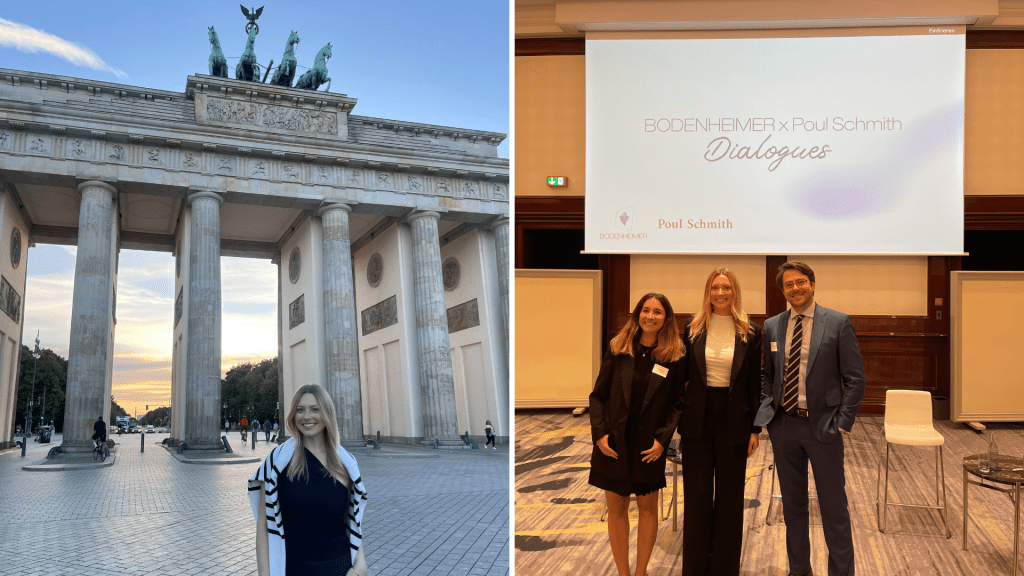
“Do it afraid.” That simple reminder became my mantra during my semester abroad. It is an acknowledgement that discovery rarely feels comfortable at the start. Stepping into a new country, a new legal system, and a new professional culture required me to move forward even when I felt unsteady. But the very discomfort I feared became the gateway to the most meaningful growth I have experienced. During the fall 2025 semester, I externed at BODENHEIMER Law Firm in Berlin—a firm specializing in international dispute resolution with offices also in Cologne.

Living in Berlin

Berlin is a place that refuses to simplify itself. Its history is felt in every neighborhood, yet its present is defined by internationalism and constant reinvention. I met a woman who was nine years old when the wall fell, and she learned that the world had changed only when her family from the East knocked on her family’s front door for the first time. I also met a Syrian student working to adjust to the new language, culture, and that in-between feeling of starting over. Encounters like these reminded me that, as the most populated city in the European Union, Berlin cannot be described as one thing. It is one place that is also all places.

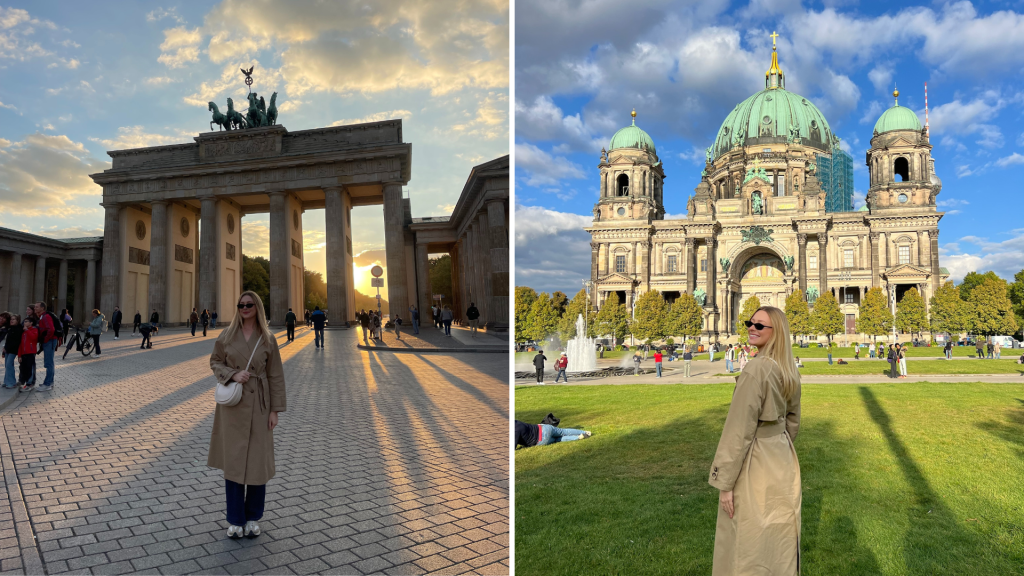
What I will miss most is the sense of community Berliners create without even trying: my morning conversations with a bakery owner on the way to the S-Bahn station, watching the city rush outside the second the sun appears, my favorite neighborhood dog Leo religiously greeting me at a local coffee shop, and never knowing whether a parade would materialize around the corner. It is both unpredictable and deeply human. One of my favorite things about Berlin is living in a city that constantly asks you to discover yourself and expand. It stretches you in small ways, like in the languages you hear, the people you meet, and the art tucked in quiet corners of the city.

Substantive Work and Office Culture

At BODENHEIMER, I worked on cross-border legal matters ranging from construction to inheritance. The international nature of the work required me to expand both my legal thinking and cultural awareness. I worked on matters involving different jurisdictions, which meant relying on machine-translated documents and learning the procedural rules of various arbitral institutions. Unsure of how much work would be available due to my limited German-language skills, I was surprised by how much opportunity being a native English speaker provided. I was able to assist in the drafting of statements of claim, attend case management conferences, and research cross-border enforcement.

With colleagues from four different continents, some of the most valuable learning happened outside of my actual assignments. Long lunches turned into lively conversations about world politics, personal histories, cultural differences, and the small absurdities that make international work so rich. These moments helped me understand the human side of international practice and reminded me how central curiosity is to this area.

Lessons to Carry Forward

The most challenging part of the placement was the constant unfamiliarity. But that challenge became the most rewarding part, too. Every day, I proved to myself, in small ways, that I could adapt and grow through trial and error. I learned to celebrate being unfamiliar rather than feel embarrassed by it. That shift in mindset is something I will carry with me.

Looking back, my semester in Berlin helped me see myself differently, personally and professionally. I became more confident, more flexible, and more willing to step into the unknown. What first felt foreign and intimidating slowly became more familiar. Living and working abroad showed me that the moments that feel uncomfortable are often the ones that push us forward the most. And for me, that made this experience not just educational, but truly transformative.
Elizabeth Ferguson (J.D. ’25) reflects on semester-long Global Externship Overseas in Germany

Today, we welcome a guest post by Elizabeth Ferguson, a member of the University of Georgia School of Law class of 2025. Ferguson participated in a semester-long international externship in spring 2025. The semester-long externships overseas initiative is an extension of the Center’s existing Global Externships Overseas and is offered jointly between the Center and the law school’s Clinical and Experiential Program. Ferguson’s post describes her experience as a legal extern with Bodenheimer, a law firm that handles disputes across jurisdictions, including cases in litigation, arbitration, and mediation and other ADR proceedings. Ferguson was based in Berlin, Germany, where she worked under Georgia Law alumnus Dr. Christof Siefarth (LL.M., ’86).

When I decided to participate in my semester-long Global Externship at Bodenheimer in Berlin, Germany I was looking for a new way to challenge myself academically. I concluded that taking myself far beyond the law school classroom I had spent two and a half years becoming familiar with would be the perfect opportunity. Although I was ready for a challenge, I didn’t anticipate how the lessons I learned in international arbitration would expand beyond its subject matter and into my professional life forever.

Bodenheimer is an international arbitration firm with a truly global scope. As a result, during my four months there, I researched many issues spanning multiple jurisdictions: I immersed myself in Chinese product quality standards, untangled questions of Indian law, and more.

When I received my first assignment, concerning a legal issue relying on law in an Asian country, the reality set in that I did not have the basic building blocks I needed to begin. When I received assignments on an unfamiliar issue while working at American law firms, I had a certain base knowledge to assist me because law school taught me the basics of the American civil and criminal systems and how to research them. However, in this situation, I quickly realized, I had none of those research tools or knowledge ready to go.

Although I conquered each task with the help of my colleagues, law school staff, and by familiarizing myself with the tools and knowledge used in international arbitration, I relived this fearful realization many times. Each time I received an assignment based in a jurisdiction I had not yet faced, I felt as though I was back at square one: navigating a new legal universe, where I didn’t speak the language, didn’t know the rules, and did not know where to begin. In American law firms, I had the comfort of a familiar legal system, a base knowledge to lean on, and research tools I used frequently. However, in Berlin, I often found myself staring at an assignment wondering, “Where do I even start?”

As a result, I began to struggle with something I’d never felt before: imposter syndrome. Imposter syndrome is a phenomenon where professionals experience feelings of inadequacy, despite evidence of their competence and achievements. I knew that I was given this opportunity for a reason, but nevertheless I could not shake this feeling of self-doubt and compare myself to my very impressive colleagues. Most of the attorneys in my office were fluent in at least three languages and were qualified attorneys in several countries! As someone who only spoke English and had not yet even graduated law school, I couldn’t help but compare myself to them and worry that I was simply not up to the task. As a result, my imposter syndrome began to eat away at my confidence.

But here’s the thing about throwing yourself into the deep end: you must learn to swim.

Over time, as I completed challenging assignments and learned from my helpful and knowledgeable colleagues, I developed strategies to identify, build, and promote my value as a young attorney in this unfamiliar environment which helped me combat my imposter syndrome. For example, one attorney frequently asked me to edit English language documents and made the observation that I was the only native English speaker in the office. At this moment, I realized that I was too busy comparing myself to my colleagues, who could all speak three to five languages, to recognize that my native English skills were a unique asset in my office when my colleagues needed someone to edit or translate documents into English. By the end of the semester, I was able to recognize my value in many ways and recognize the meaningful contributions I made through my work product.

Working at Bodenheimer taught me more than just the inner workings of international arbitration: it taught me how to quiet the inner critic, embrace uncertainty, and how to identify and promote my value, rather than focus on perceived shortcomings.

Berlin will always hold a special place in my heart, not just for its beautiful cathedral, the delicious Franzbrötchen, and the amazing colleagues I met, but for the reminder that growth often comes disguised as discomfort.

As I head into my next professional chapter, I’ll carry with me the lesson that the doubts you feel today will become issues you will conquer tomorrow.

***

Applications are open for spring 2026 semester-long Global Externships Overseas (GEOs). All current 2Ls and 3Ls are invited to submit an application by September 15. For more information and the application, please email: ruskintlaw@uga.edu

Georgia Law Professor Adam Orford presents at Climate Symposium in Germany

University of Georgia School of Law Professor Adam D. Orford presented in March at the Symposium on Just Transitions in the United States, UK, and the EU hosted by Indiana University School of Law at the European Gateway in Berlin, Germany. The symposium connected academics and social scientists for a conversation on “climate adaptation and the just transition in the United States, the United Kingdom, and European Union member nations.”

Below is a description of the symposium:

The purpose of this meeting is to connect invited scholars and practitioners writing on the topics of climate change and the just transition, broadly defined, with the goal of discussing recent developments in their respective jurisdictions and best practices for their research, as well as developing potential networks for collaboration. The day is built around brainstorming sessions and group activities to help foster conversation and possible collaborations.

Orford is an Assistant Professor of Law at the University of Georgia School of Law. His interdisciplinary research investigates legal and policy approaches to environmental protection, human health and wellbeing, and deep decarbonization of the United States economy. He also participates in collaborative research initiatives across UGA, including as the lead of the Georgia element of the National Zoning Atlas and as a participant in ongoing investigations into the legal, political, environmental and social dimensions of new energy manufacturing and emerging carbon removal technologies.

UGA Law Professor Kadri presents on “Cyberflashing” and other projects at gatherings in Germany

University of Georgia School of Law Professor Thomas E. Kadri presented his article “Cyberflashing,” co-authored with Harvard Law School SJD candidate Brenda Dvoskin, at a workshop hosted by Goethe University’s Center for Critical Computational Studies in Frankfurt, Germany. He also discussed several current works-in-progress during a visit to the Weizenbaum Institute for the Networked Society in Berlin, Germany. 

At these gatherings, Kadri discussed several of his current projects, including his work investigating how large technology companies have adopted particular strands of feminism to gain, exercise, and justify their power to regulate sexual speech and imagery. He also presented a related project that explores a recent legislative trend to regulate “cyberflashing,” which is the act of sending a nude image to a person without receiving prior consent. Lastly, Kadri discussed a piece proposing a regulatory response to how data brokers are enabling and exacerbating interpersonal abuse like stalking and harassment. 

The Weizenbaum Institute aims to investigate “the ethical, legal, economic and political aspects of digital change” to create an empirical basis for “responsible digitalisation.” Kadri explains how his current research fits within this framework:

“With each new innovation in the digital age, it can be tempting to assume that our capacity to use technology in a certain way means that we should use it in that way. My work, in part, seeks to resist this kind of technological determinism. Digitalization has offered huge benefits for humanity, but that doesn’t mean humanity should abdicate responsibility for judging — including through law — how we should use technology. Though it’s not for me to say, my hunch is that this kind of critical approach to technology (and law) would align with the Weizenbaum Institute’s aims to create a foundation for “responsible digitalisation.”

Kadri is an Assistant Professor of Law at UGA Law, and his research focuses on torts and criminal law, with an emphasis on how technology, law, and social norms enable and affect privacy, speech, and abuse. His scholarship appears in journals including the Harvard Law Review Forum, UCLA Law Review, Texas Law Review, Utah Law Review, Maryland Law Review, and Journal of Free Speech Law and he has published shorter pieces in The New York Times and Slate. His course offerings include Torts, Cybercrime, and Regulating Digital Abuse. 

Prior posts on Kadri’s scholarship can be found here