Georgia Law’s Dean Rusk International Law Center hosts online sessions of working group convened to include recruitment and use of children as standalone offense in proposed U.N. crimes against humanity treaty

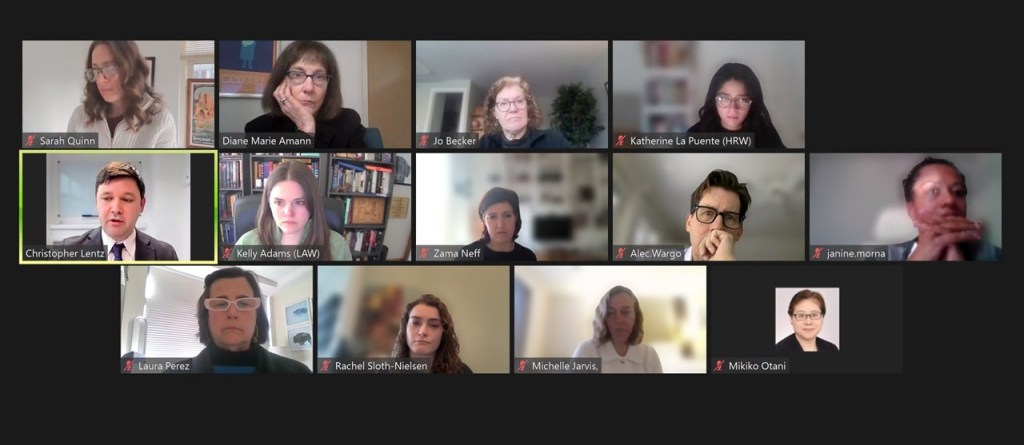
We at the University of Georgia School of Law Dean Rusk International Law Center were honored to host a recent two-part workshop intended to advance consideration of harms against children in a future crimes against humanity treaty.

U.N. member states took a first step toward negotiating this treaty with the January 19-30, 2026, meeting of the Preparatory Committee for the United Nations Diplomatic Conference of Plenipotentiaries on Prevention and Punishment of Crimes against Humanity. Subsequent PrepComm sessions are expected to develop the text of the treaty, based both on the 2019 International Law Commission Draft Articles on Prevention and Punishment of Crimes Against Humanity and on proposals to amend that draft.

Expanding that draft to include children’s concerns – specifically, by enumerating the recruitment and use of children as a standalone crime against humanity – was the aim of the Working Group on a Standalone Crime of Recruitment & Use of Children under the Crimes Against Humanity Treaty which our Center hosted. As explained by a briefing paper circulated before the first workshop:

Estimates indicate that a staggering 473 million children (or 18.9% of the global child population) live in conflict-affected areas and are at heightened risk of being recruited by State and non-State actors alike. The physical and developmental harms resulting from child recruitment and use can be severe and often long-lasting. Children may suffer death, physical injuries, or permanent disabilities because of combat, and many experience serious psychological trauma from being forced to commit or witness acts of violence. Even those not directly involved in combat are also at risk of attack due to their perceived association with armed actors. Recruited girls and boys are also frequently subjected to rape, sexual slavery, forced marriage, and other forms of sexual violence. For most children, recruitment also interrupts or ends their schooling, limiting future opportunities for sustainable livelihoods and civic participation. The harms experienced by recruited children are comparable in nature and gravity to other crimes against humanity enumerated in the Draft Articles.

Diane Marie Amann, who is Regents Professor Emerita, Emily & Ernest Woodruff Chair in International Law, and a former Center Faculty Co-Director at Georgia Law, was a co-convenor of the Working Group, along with Zama Neff, Executive Director of the Children’s Rights Division of Human Rights Watch, Laura Perez, Adjunct Professor at the Columbia University School of International & Public Affairs, and Janine Morna, Researcher on Children at the Amnesty International Crisis Response Programme.

Other experts in the Working Group included: Kelly Adams, Legal Action Worldwide; Cécile Aptel and Miles Hastie; Jo Becker and Katherine La Puente, Human Rights Watch; Alec Wargo and Claire Bertouille, Office of the Special Representative to the Secretary-General for Children in Armed Conflict; Michelle Jarvis, International, Impartial and Independent Mechanism; Christopher Lentz, University of Chicago; Mikiko Otani, Child Rights Connect; and Rachel Sloth-Nielsen, University of Oxford. (Affiliations for identifying purposes only.)

Once published, the proposed text for the crime of recruitment and use will join other proposals related to children and the crimes against humanity treaty. These include two to which various Working Group members also contributed: “Justice for Children in the Future Convention on the Prevention and Punishment of Crimes Against Humanity,” launched at a May 2025 conference at Columbia University; and “Children,” published in January 2026 by the American Branch of the International Law Association Study Group on Crimes Against Humanity.
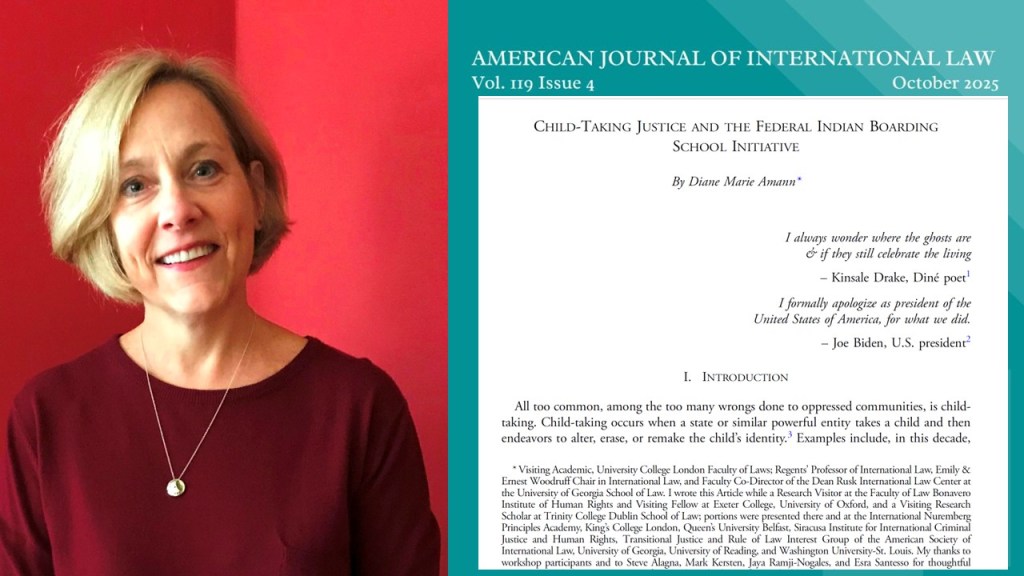
Georgia Law Professor Diane Marie Amann publishes “Child-Taking Justice and the Federal Indian Boarding School Initiative” in the American Journal of International Law

“Child-Taking Justice and the Federal Indian Boarding School Initiative,” an article by University of Georgia School of Law Professor Diane Marie Amann, has just been published in the American Journal of International Law.

Amann is Regents’ Professor of International Law, Emily & Ernest Woodruff Chair in International Law, and a Faculty Co-Director of our Dean Rusk International Law Center here at Georgia Law. During her current research-intensive semester, she is a Visiting Academic at University College London Faculty of Laws.

This new publication continues scholarly research that Amann first explored in her article “Child-Taking,” 45 Michigan Journal of International Law 305 (2024), and that she has presented at many universities and other learned societies in the United States, Ireland, and the United Kingdom.

Here’s an abstract for the new work:

The focus of this article is the 2022–2024 Federal Indian Boarding School Initiative undertaken the U.S. Executive Branch. The article chronicles this three-year process, which included sessions with survivors and their descendants, and which resulted in a two-volume report, in an apology by President Joe Biden, and in designation of a national memorial at one of the most notorious school sites. This article examines the initiative as an example of “child-taking justice”; that is, as a process of what is called “transitional justice”, done in an effort to redress the takings of children from their community, followed by efforts to alter, erase, or remake the children’s identities. The initiative shed glaring light on the past history and present effects of a centuries-old practice by which the United States took Indigenous children from their families and forced them to attend residential schools where they were compelled to submit to Westernized and Christianized notions of “civilization.”

Unfolding within the internal constitutional framework of the United States, the U.S. initiative benefited from meaningful engagement with affected communities. This article nonetheless argues for a framing that also addresses external frameworks; to be specific, one that engages fully with applicable international law and lessons learned elsewhere. The argument runs counter to the United States’ longstanding practice of holding international human rights law at arm’s length, while pressing other countries to conform to that law’s strictures. Efforts of a U.S. human-rights-at-home movement have not reversed that trend. Thus the U.S. initiative made only a hesitant overture to international issues and to three countries, Canada, Australia, and New Zealand, with which it claimed kinship. The 2025 inauguration of a President hostile to rights-based justice pointed to limitations of this approach.

Georgia Law Professor Diane Marie Amann presents on child-taking and Nuremberg-era witnesses in workshops at University of Oxford

University of Georgia School of Law Professor Diane Marie Amann closed out her Fall 2024 research visit at the University of Oxford, where she was a Research Visitor at the Oxford Faculty of Law Bonavero Institute of Human Rights and Visiting Fellow at Exeter College Oxford, by giving two presentations at Oxford. She:

Lectured on “Women Bearing Witness in the Nuremberg Trials Project” in the Oxford Faculty of Law Public International Law Discussion Group. Tsvetelina van Benthem, Research Officer at the Blavatnik School of Government, moderated. Amann’s talk, which was delivered at All Souls College and live online, concluded the Group’s Michaelmas Term series.

Presented her work in progress, “Child-Taking Justice and Forced Residential Schooling of Indigenous Peoples,” as part of the Bonavero Perspectives workshop series at the Oxford Faculty of Law Bonavero Institute of Human Rights. Moderating was another Bonavero Research Visitor, Professor Eva Marie Belser of the University of Fribourg in Switzerland.

Amann is Regents’ Professor of International Law, Emily & Ernest Woodruff Chair in International Law, and a Faculty Co-Director of our Dean Rusk International Law Center here at Georgia Law, where she teaches Public International Law, Constitutional Law, and various upper-division courses exploring interrelations between national and international legal frameworks.

Georgia Law Professor Diane Marie Amann’s remarks on ICC arrest warrants against Russian officials published in ASIL Annual Meeting proceedings

Remarks which University of Georgia School of Law Professor Diane Marie Amann delivered at a plenary panel of the American Society of International Law Annual Meeting have just been published.

Entitled “Children and the ICC Arrest Warrant Against the President and the Children’s Rights Commissioner of Russia,” Amann’s remarks form part of the chapter entitled “Late-Breaking Panel: ICC Arrest Warrants: Impunity in Check?” in 117 American Society of International Law Proceedings 328 (American Society of International Law, 2024).

Amann discussed the significance of the warrants, which had charged Russia’s President and another Presidential official of the war crimes of child deportation, and which were issued just days before the 2023 Annual Meeting. The remarks spurred her to further research on the topic, resulting in her article “Child-Taking,” also published this month, at 45 Michigan Journal of International Law 305 (2024) (prior post).

Also on the panel were: Professor Saira Mohamed, University of California-Berkeley School of Law; Professor Javier S. Eskauriatza, University of Nottingham Scholl of Law; and Professor Marko Milanović, University of Reading School of Law. Katherine Gallagher, Senior Staff Attorney at the Center for Constitutional Rights and an Adjunct Professor of Clinical Law at New York University School of Law, moderated. The panelists’ remarks in full are here.

Amann is Regents’ Professor of International Law, Emily & Ernest Woodruff Chair in International Law, and a Faculty Co-Director of our Dean Rusk International Law Center here at Georgia Law. She served from 2012 to 2021 as International Criminal Court Prosecutor Fatou Bensouda’s Special Adviser on Children in & affected by Armed Conflict. This Fall 2024 semester she is at the University of Oxford in the United Kingdom, serving as a Research Visitor at the Faculty of Law Bonavero Institute of Human Rights and as a Visiting Fellow at Exeter College.