This paper provides an in-depth insight into Environmental, Social, and Governance (ESG) reporting in Nigeria, Africa’s largest economy. The Adoption Readiness Working Group’s proposed implementation of the Sustainability Reporting in Nigeria would mandate ESG reporting. This paper also contrasts Nigeria’s reporting standards and regulations with those of other African nations, including Ghana, South Africa, and Egypt. It aims to provide a better understanding of ESG reporting in Africa, which would help investors and partners intending to invest in Africa.
Corporate personhood and corporate rights are co-constitutive in nature, meaning that they are mutually constructed – there is no singular, one-way causal path between a conception of corporate personhood and a conception of corporate rights. Consequently, modes of reasoning that purport to deduce the substance and extent of corporate rights from the mere fact of corporate personhood are logically circular. Although the relationship between corporate personhood and corporate rights is real and significant, this relationship cannot, in and of itself, comprehensively specify the content of corporate rights; their substance can only be specified by reference to external normative criteria. The upshot is that corporate law inevitably remains a socially and politically contingent field. Those advancing particular conceptions of corporate personhood and corporate rights should acknowledge the contingency of corporate law and present their preferred visions by reference to external normative criteria that they are prepared to acknowledge, describe, and defend.
Bruner is the Stembler Family Distinguished Professor in Business Law at the University of Georgia School of Law and serves as a faculty co-director of the Dean Rusk International Law Center. His scholarship focuses on corporate law, corporate governance, comparative law and sustainability.
Hopenhaym and Bruner discussed the connection between environmental sustainability and human rights, exploring key dynamics, including how communities can suffer when their rights to food, clean water, and fair working conditions are compromised and how corporations are voluntarily improving their practices, but the complexity of their structures—spanning subsidiaries and global supply chains—makes full due diligence difficult. They also talked about where the U.S. stands on corporate compliance and the challenges in providing remedies for affected communities. They concluded the event by discussing the future of corporate accountability, particularly in the context of the ongoing UN Treaty on Business and Human Rights (BHR) process.
Hopenhaym is Co-Executive Director at Project on Organizing, Development, Education and Research (PODER), an organization in Latin America dedicated to corporate accountability. For twenty years, Ms. Hopenhaym has worked on economic, social and gender justice. Since 2006 Ms. Hopenhaym has been working on issues related to human rights and financial institutions and in the last ten years, she has focused specifically on business and human rights, working to advance corporate accountability and strengthen respect for human rights vis-a-vis private and public investments or development projects, and private sector operations. She has been involved in processes related to the implementation of the UN Guiding Principles, as well as in other processes regarding relevant instruments, such as the Binding Treaty negotiations and due diligence laws. She has conducted research on cases related to corporate impact on human rights and the environment and worked with and accompanied local communities affected by public/private projects in their pursuit of justice and remedy. She has conducted advocacy in the LAC region and globally to advance corporate accountability and human rights as well as leading training and capacity building on business and human rights related issues. From January 2019 to December 2021, Ms. Hopenhaym was Chair of the Board of ESCRNet, the international network for economic, social and cultural rights; she has been a board member of EarthRights International since early 2021 and an adviser to the Business and Human Rights Award Foundation since early 2020.
Georgia Law’s Environmental Law Association “seek[s] to further the development and advancement of environmental law through activities designed to increase environmental awareness among members of the community at large and the student bodies of the University of Georgia and the Georgia School of Law.” This year’s ELA President, Kellianne Elliott (J.D. ’26), and Carolina Ruiz (LL.M. ’26) organized this event.
University of Georgia School of Law professor Christopher M. Bruner delivered his presentation “A Political Economy of Corporate Sustainability Reform in the United States” at the Sustainability in Corporate Law Conference at Bucerius Law School in Hamburg, Germany.
Bruner is the Stembler Family Distinguished Professor in Business Law at the University of Georgia School of Law and serves as a faculty co-director of the Dean Rusk International Law Center. He holds a courtesy appointment at the UGA Terry College of Business. Bruner teaches a range of corporate and transactional subjects, and he has received the School of Law’s C. Ronald Ellington Award for Excellence in Teaching.
The University of Georgia School of Law’s spring 2025 International Law Colloquium welcomed Professor Christopher Bruner, who presented his working paper, “Sustainable Corporate Governance and Prospects for a US Value Chain Due Diligence Law.” Joshua Barkan, Associate Professor in the Department of Geography at the University of Georgia, served as Bruner’s faculty discussant.
Bruner is the Stembler Family Distinguished Professor in Business Law at the University of Georgia School of Law and serves as a faculty co-director of the Dean Rusk International Law Center. Bruner’s scholarship centers around corporate law, corporate governance, comparative law and sustainability.
Below is an abstract of Bruner’s working paper:
Laws requiring multinational companies to undertake due diligence to detect, prevent, and mitigate human rights and environmental abuses in their value chains have proliferated across Europe, and the European Union has adopted a directive to harmonise such national laws. This chapter assesses the prospects for enactment of such a value chain due diligence law in the United States.
Although such laws are often conceptualised as an extension of corporate law, they can just as readily be conceptualised as an extension of trade law – and the latter approach offers real potential to sidestep anti-ESG and anti-sustainability sentiment among the US political right. Packaged as a trade initiative, the prospects for bipartisanship improve because the political left and right can each embrace the effort by reference to policy preferences resonating with their respective bases. To the progressive left, such laws raise labour and environmental standards globally, while to the conservative right, such laws protect domestic industry from unfair foreign competition.
The chapter first examines corporate politics in the United States, discussing how fundamental corporate governance debates revolve around thorny ideological issues that strongly polarise the political left and right, diminishing the prospects for a value chain due diligence law conceptualised as an extension of corporate law. It then examines trade politics in the United States, discussing how framing by reference to trade improves the prospects for a US value chain due diligence law by sidestepping such ideological issues and giving both the political left and right plausible ways to view such a law as a victory for their respective bases. The chapter concludes with discussion of trade-offs raised by these differing modes of legal strategy and institutionalisation, observing that the corporate law approach offers broader reach with weaker enforcement while the trade law approach offers narrower reach with stronger enforcement.
This year, Professor Desirée LeClercq is overseeing the colloquium, which is designed to introduce students to features of international economic law through engagement with scholars in the international legal field. To view the full list of International Law Colloquium speakers, visit our website.
This program is made possible through the Kirbo Trust Endowed Faculty Enhancement Fund and the Talmadge Law Faculty Fund.
University of Georgia School of Law professor Christopher M. Bruner was featured in Insurance Day, published by London-based Lloyd’s List Intelligence. The article by Ben Margulies, titled “Can the UK Capture Captives?,” discusses the UK government’s effort to create a competitive captive insurance regime.
Bruner shared his thoughts on the factors that make a jurisdiction attractive for establishing captive domiciles, suggesting that smaller jurisdictions can offer fast and flexible policymaking processes. Their small size “makes co-ordination much easier among all the relevant public and private constituencies and it renders their commitment to attractive regulatory structures more credible. They’re highly dependent on these service offerings economically and the market knows it.” London, however, offers competitive advantages in its own right. “London’s main advantage is the extraordinary breadth and depth of corporate and financial services offerings in one place,” Bruner explains. “It’s the ultimate one-stop shop, including in risk management, which provides a strong foundation in the form of pre-existing professional and regulatory know-how.”
Christopher M. Bruner is the Stembler Family Distinguished Professor in Business Law at the University of Georgia School of Law and serves as a faculty co-director of the Dean Rusk International Law Center.
University of Georgia School of Law Professor Christopher M. Bruner was featured on Law360 regarding opportunities for international law firms amid shifting geopolitical landscapes. The article titled “What’s Next For The Global Legal Market In 2025?” was written by Cara Bayles and published December 5, 2024.
From the article:
Shrinking markets may even present opportunities for firms that “lean into the geopolitical conflict,” by representing Chinese companies in contentious regulatory matters with the U.S., according to Christopher Bruner, a professor of business law and international law at the University of Georgia School of Law.
“What for one firm might pose risks in terms of how they operate in China, for another might present opportunities if they are helping companies navigate those choppy geopolitical waters,” he said.
Christopher M. Bruner is the Stembler Family Distinguished Professor in Business Law at the University of Georgia School of Law and serves as a faculty co-director of the Dean Rusk International Law Center.
University of Georgia School of Law professor Christopher M. Bruner presented “A Political Economy of Corporate Sustainability Reform in the United States” at an online event hosted by the University of Oslo Faculty of Law in October. The event was organized by Oslo’s Sustainability Law research group and convened by Professor Beate Sjåfjell.
Below is an abstract of the presentation:
Conservative backlash against sustainability initiatives and environmental, social, and governance (ESG) investment policies has been particularly intense in the United States – to the point that these issues have become mired in the broader ‘culture wars’ that increasingly characterize American public life and permeate policymaking. Today, initiatives styled as corporate sustainability or ESG are often rejected outright by conservative federal and state actors opposed to intrusion of what they regard as ‘woke’ progressive policies into economic law. In response, A Political Economy of Corporate Sustainability Reform in the United States tackles two related challenges in the US context – (1) how to advance first-best corporate governance reforms in the long-term, and (2) how to advance second-best alternatives in the near-term.
Christopher M. Bruner is the Stembler Family Distinguished Professor in Business Law at the University of Georgia School of Law and serves as a faculty co-director of the Dean Rusk International Law Center.
University of Georgia School of Law professor Christopher M. Bruner published an article titled “National Identity and Economic Development in Market-Dominant Small Jurisdictions” in UC Berkeley’s peer-reviewed Journal of Law and Political Economy.
A working paper version of the article was previously presented at the symposium on “Law, Identity, and Economic Development in the Post-Colonial Era: The Case of the Northern Atlantic and Larger Caribbean Regions,” hosted by the Princeton School of Public and International Affairs. For more information, please see our previous post.
Below is an abstract of the article:
Small jurisdictions that are globally competitive in providing cross-border financial services—market-dominant small jurisdictions (MDSJs)—occupy fascinating and unique positions in global markets, reflecting the complexity of their linkages with major economies. This article explores how the distinctive features of MDSJs highlight important dimensions of the relationship between national identity and economic development. I review literatures that aim to explain how jurisdictions behave in the economic context, focusing on concepts of nationalism, national identity, and nation branding, and how such phenomena might impact one another. I then assess their application to the relationship between national identity and economic development in MDSJs, where realities of size and geography prompt substantial outward orientation and incentivize innovations in law and finance to service economic activity largely occurring elsewhere. The article culminates with a vivid case study—the role of national identity in developing, marketing, and maintaining Bermuda’s outsized role in global insurance markets.
Christopher M. Bruner is the Stembler Family Distinguished Professor in Business Law at the University of Georgia School of Law and serves as a faculty co-director of the Dean Rusk International Law Center.
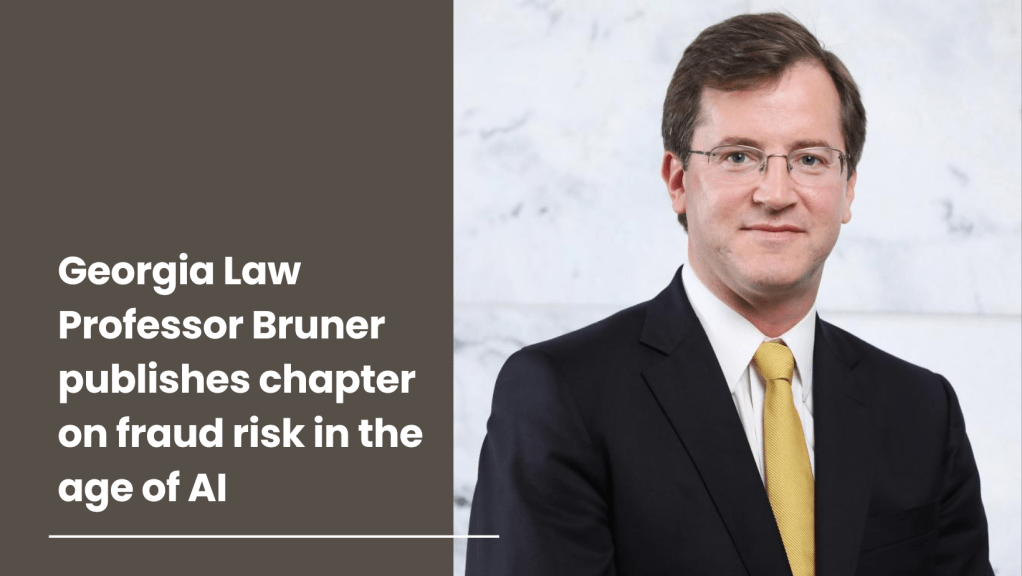
University of Georgia School of Law professor Christopher M. Bruner published a chapter titled “Managing Fraud Risk in the Age of AI” in a book titled Fraud and Risk in Commercial Law (Hart 2024), edited by professor Paul S. Davies of University College London and professor Hans Tjio of the National University of Singapore (NUS).
This book focuses on contemporary problems related to fraud and risk in commercial law.
It has been said by some that we are in a ‘golden age of fraud’. In part this has been caused by globalisation, technological changes and the financialisation of business. This has resulted in the creation of automated linkages with integrated supply chains and the creation of systemic risks, which have been exacerbated by new forms of intangible assets like tokens and their ease of movement. While regulation has ebbed and flowed given the desire of governments to generate economic growth, as well as the distrust of their coercive powers, the courts have sought to strike a balance between considerations such as commercial certainty and fairness.
The book provides an analysis of key contemporary issues on the theme of fraud and risk in commercial law, including: technology and fraud, secondary liability and ‘failure to prevent’ economic crime, abuse of business entities, insolvency and creditor protection, injunctions and other orders, cross-border issues, the relationship between regulation and private law, and solutions for policy makers.
Christopher M. Bruner is the Stembler Family Distinguished Professor in Business Law at the University of Georgia School of Law and serves as a faculty co-director of the Dean Rusk International Law Center.







 exchange of notes