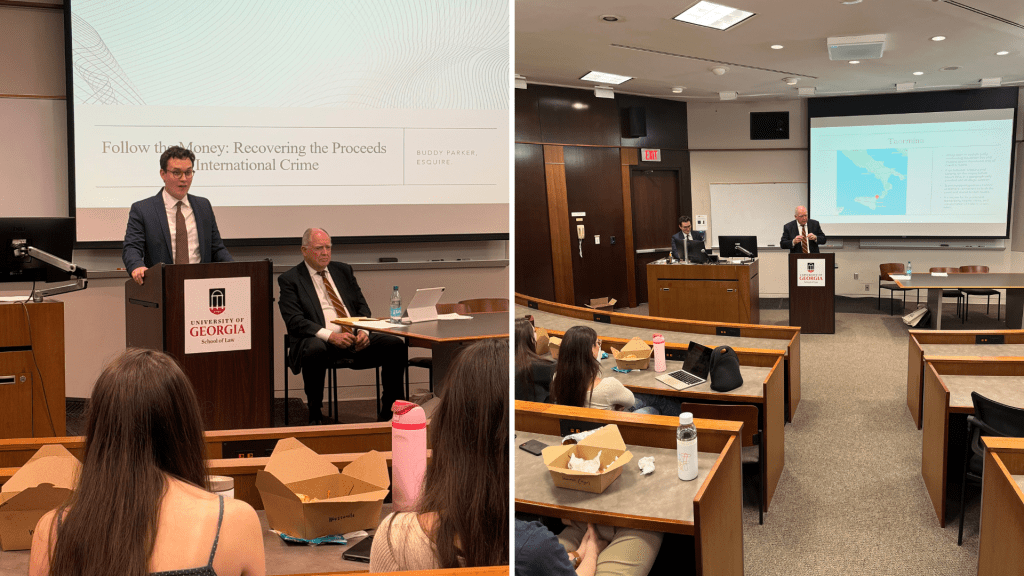
Buddy Parker presents “Follow the Money: Recovering the Proceeds of International Crime” at Georgia Law

The University of Georgia School of Law’s International Law Society recently hosted former prosecutor and criminal defense attorney Wilmer “Buddy” Parker in an event entitled “Follow the Money: Recovering the Proceeds of International Crime.”

After being introduced by Georgia Law student Andrei Niveaux (LL.M. ’26), Parker reflected on the shifting landscape of global asset recovery throughout his fifty plus years of experience in the field. He talked about his professional background and career trajectory litigating high profile criminal cases for both the United States Department of Justice and as a private defense attorney. Parker’s talk spanned the history of asset recovery and discussed contemporary issues in fraud, money-laundering, and forfeiture matters.

Parker entered Government service in 1978 in Washington, D.C., as a Trial Attorney with the Criminal Section of the Tax Division of the Department of Justice. He participated in investigations and prosecutions of tax and related frauds across the country. In 1983, Parker transferred to the U.S. Attorneys office for the Northern District of Georgia. During his tenure as an Assistant United States Attorney in Atlanta, Parker participated in hundreds of investigations and prosecutions of complex financial activities involving money laundering/fraud and racketeering, and international narcotics trafficking. Parker became a supervising Assistant U.S. Attorney managing cases as well as maintaining his own trial calendar. From his investigations in the Atlanta U.S. Attorneys office, he became one of the pioneers of U.S. money laundering prosecutions with their attendant forfeitures. Through the international aspects of these investigations, he became a recognized expert on money laundering and U.S. forfeiture law, making numerous presentations throughout Europe, North America and the Caribbean.

Since 1997, Parker has primarily represented individuals and corporations in far-reaching criminal investigations and prosecutions throughout the United States and internationally. He has also represented individuals in complex civil litigation. He has represented both public and private corporations, lawyers, accountants, corporate officers, bankers and other professionals in various mail and wire fraud, securities fraud, bank fraud, healthcare fraud, tax fraud, money laundering, immigration, public corruption, commercial bribery, RICO and forfeiture investigations and prosecutions. He has also participated in investigations before the Serious Fraud Office (United Kingdom) and acted as a consultant to European lawyers in international matters.
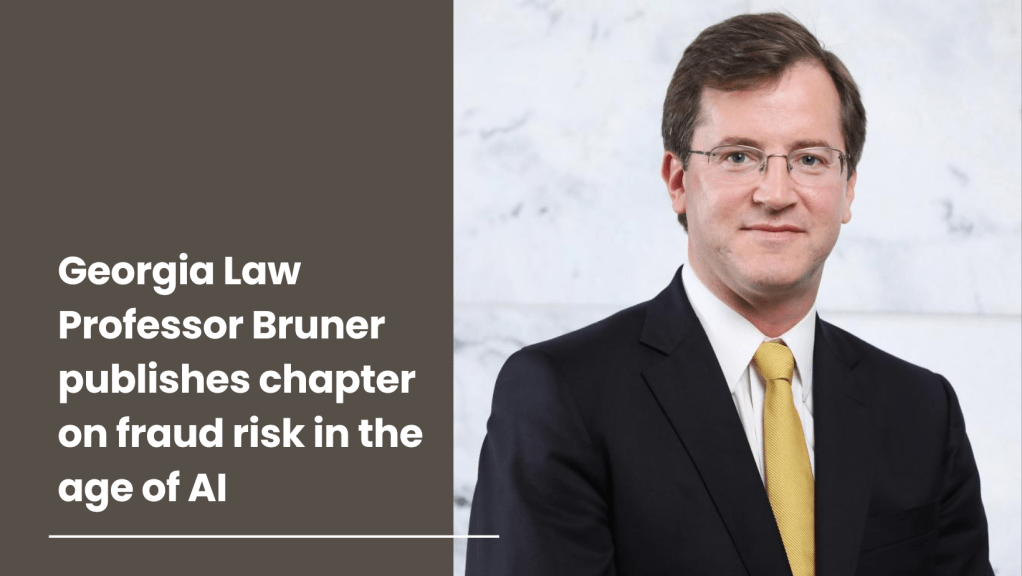
Georgia Law Professor Bruner publishes chapter on fraud risk in the age of AI

University of Georgia School of Law professor Christopher M. Bruner published a chapter titled “Managing Fraud Risk in the Age of AI” in a book titled Fraud and Risk in Commercial Law (Hart 2024), edited by professor Paul S. Davies of University College London and professor Hans Tjio of the National University of Singapore (NUS).

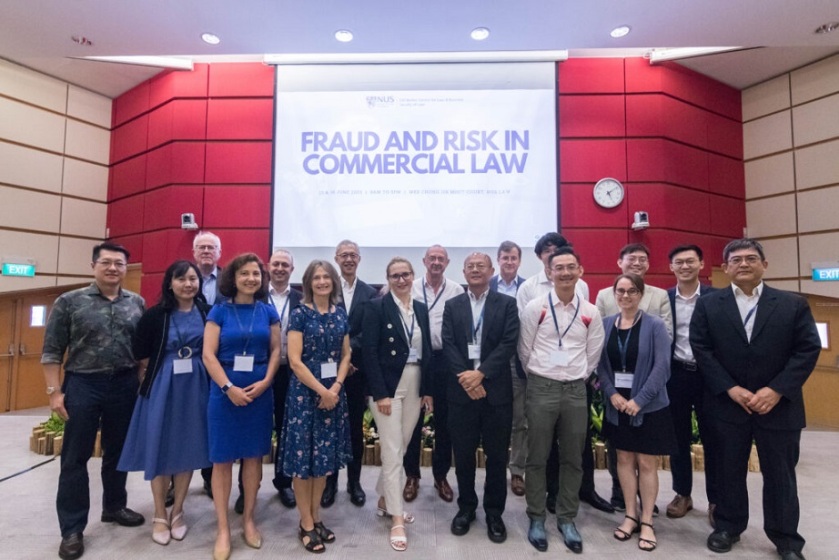
The volume includes papers presented at a conference at NUS, described in a previous post.

Below is a description of the book:

This book focuses on contemporary problems related to fraud and risk in commercial law.

It has been said by some that we are in a ‘golden age of fraud’. In part this has been caused by globalisation, technological changes and the financialisation of business. This has resulted in the creation of automated linkages with integrated supply chains and the creation of systemic risks, which have been exacerbated by new forms of intangible assets like tokens and their ease of movement. While regulation has ebbed and flowed given the desire of governments to generate economic growth, as well as the distrust of their coercive powers, the courts have sought to strike a balance between considerations such as commercial certainty and fairness.

The book provides an analysis of key contemporary issues on the theme of fraud and risk in commercial law, including: technology and fraud, secondary liability and ‘failure to prevent’ economic crime, abuse of business entities, insolvency and creditor protection, injunctions and other orders, cross-border issues, the relationship between regulation and private law, and solutions for policy makers.

Christopher M. Bruner is the Stembler Family Distinguished Professor in Business Law at the University of Georgia School of Law and serves as a faculty co-director of the Dean Rusk International Law Center.

UGA Law Professor Bruner presents “Managing Fraud Risk in the Age of AI” at the National University of Singapore (NUS)

Professor Christopher Bruner, the Stembler Family Distinguished Professor in Business Law and a newly appointed Faculty Co-Director of the Dean Rusk International Law Center, presented “Managing Fraud Risk in the Age of AI” at the National University of Singapore (NUS) in June.

Bruner’s talk was part of a conference titled Fraud and Risk in Commercial Law, organized by Professors Paul Davies (University College London) and Hans Tjio (NUS) and hosted by the EW Barker Centre for Law & Business at the NUS Faculty of Law.

Below is Bruner’s presentation abstract:

Artificial Intelligence (AI) applications are widely expected to revolutionize every dimension of business. This paper explores current and potential impacts of AI on corporate management of fraud risk in both operational and compliance contexts. Much attention has been paid to the operational efficiencies that AI applications could enable in numerous industry settings, and such systems have already become central to a range of services in certain industries – notably finance. Heavy reliance on algorithmic processes can be expected to give rise, however, to a range of risks, including fraud risks. New forms of internal fraud risk, emanating from intra-corporate actors, as well as external fraud risk, emanating from extra-corporate actors, are already placing greater demands on the compliance function and requiring greater corporate investment in responsive AI capacity to keep pace with the evolving risk management environment. At the same time, these developments have already begun to prompt reevaluation of conventional legal theories of fraud that took shape, in commercial and financial contexts alike, by reference to human actors, as opposed to algorithmic processes.

The paper begins with an overview of growing operational reliance upon increasingly sophisticated AI applications across various industry settings, reflecting the increasingly data-intensive nature of modern business. It then explores forms of internal and external fraud risk that may arise from efforts to exploit weaknesses in operational AI, which efforts may themselves involve sophisticated deployment of malicious extra-corporate AI applications – ‘offensive AI’, as the cyber security industry describes it. This can in turn be expected to require responsive corporate efforts in the form of ‘defensive AI’, and the paper describes burgeoning efforts along these lines, as well as the increasing pressure to devote substantial resources and managerial attention to these dynamics that may arise from both corporate law and commercial realities. Finally, the paper analyzes shortcomings of conventional legal theories of fraud in this context. Here the paper assesses the difficulty of applying concepts such as deception, scienter, reliance, and loss causation to algorithmic processes lacking conventional capacity for intentionality and defying conventional explanation as to how inputs and outputs logically relate – a reflection of the AI ‘black box’ problem. The paper concludes with proposals to reform corporate oversight duties to incentivize managerial attention to these issues, and to reform conventional legal theories of fraud to disincentivize malicious AI applications.