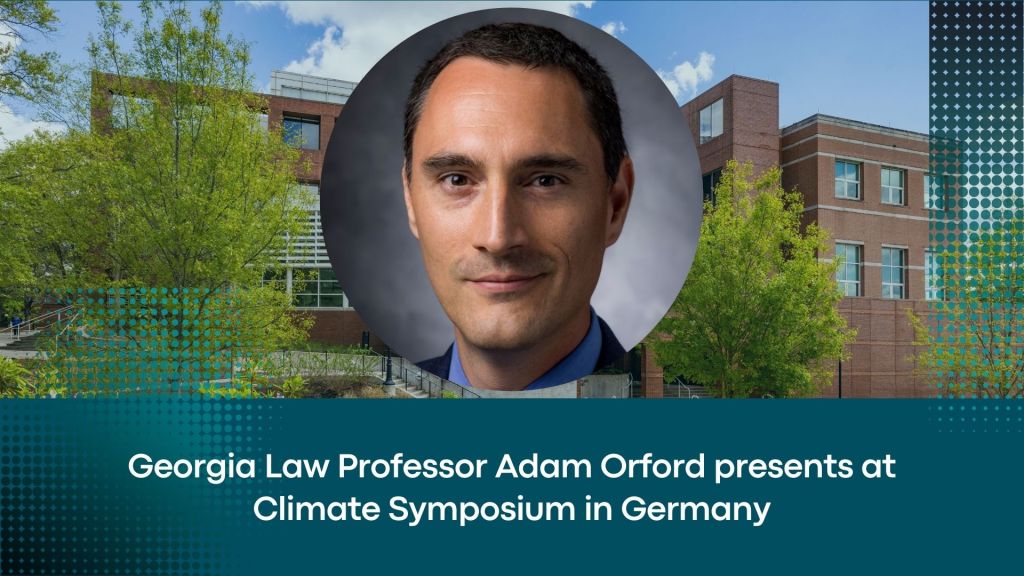
Georgia Law Professor Adam Orford presents at Climate Symposium in Germany

University of Georgia School of Law Professor Adam D. Orford presented in March at the Symposium on Just Transitions in the United States, UK, and the EU hosted by Indiana University School of Law at the European Gateway in Berlin, Germany. The symposium connected academics and social scientists for a conversation on “climate adaptation and the just transition in the United States, the United Kingdom, and European Union member nations.”

Below is a description of the symposium:

The purpose of this meeting is to connect invited scholars and practitioners writing on the topics of climate change and the just transition, broadly defined, with the goal of discussing recent developments in their respective jurisdictions and best practices for their research, as well as developing potential networks for collaboration. The day is built around brainstorming sessions and group activities to help foster conversation and possible collaborations.

Orford is an Assistant Professor of Law at the University of Georgia School of Law. His interdisciplinary research investigates legal and policy approaches to environmental protection, human health and wellbeing, and deep decarbonization of the United States economy. He also participates in collaborative research initiatives across UGA, including as the lead of the Georgia element of the National Zoning Atlas and as a participant in ongoing investigations into the legal, political, environmental and social dimensions of new energy manufacturing and emerging carbon removal technologies.

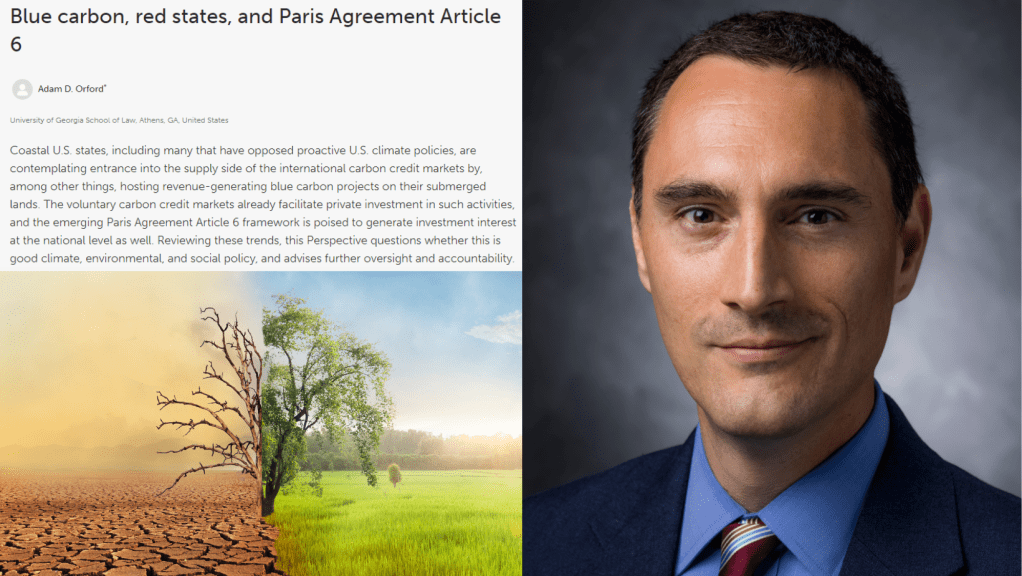
Georgia Law Professor Orford publishes article on blue carbon and the Paris Agreement

Adam D. Orford, Assistant Professor of Law, recently published “Blue Carbon, red states, and Paris Agreement Article 6” in Frontiers in Climate. This is one of four articles under the research topic “Climate Law and Policy 2023: A Proactive Retrospective on Intergovernmental Strategies.”

From the article’s abstract:

Coastal U.S. states, including many that have opposed proactive U.S. climate policies, are contemplating entrance into the supply side of the international carbon credit markets by, among other things, hosting revenue-generating blue carbon projects on their submerged lands. The voluntary carbon credit markets already facilitate private investment in such activities, and the emerging Paris Agreement Article 6 framework is poised to generate investment interest at the national level as well. Reviewing these trends, this Perspective questions whether this is good climate, environmental, and social policy, and advises further oversight and accountability.

Orford joined the University of Georgia School of Law in the fall of 2021. His interdisciplinary research investigates legal and policy approaches to environmental protection, human health and wellbeing, and deep decarbonization of the United States economy. He also participates in collaborative research initiatives across UGA, including as the lead of the Georgia element of the National Zoning Atlas and as a participant in ongoing investigations into the legal, political, environmental and social dimensions of new energy manufacturing and emerging carbon removal technologies.

To download the article, please click here.