The international tax framework relies on early-twentieth-century principles and favors the interests of the Global North, which created it. It bases taxing rights on a corporation’s physical presence and mostly allocates profits to the country of residence. Moreover, it has been slow to adapt to modern business practices. In the digital economy, companies shift profits with relative ease and often do not require a physical presence in the location of their consumers. International taxation needs reform, but leading proposals do not reflect meaningful input from the Global South and are unlikely to serve the needs of developing countries.
In 2021, the Organisation for Economic Co-operation and Development (OECD), known informally as the “World Tax Organization,” introduced new rules for the cross-border taxation of multinational enterprises. The new rules intend to address the tax challenges of digitalization and profit-shifting, and they are likely the most significant change to international taxation in several decades. However, the OECD does not represent the interests of developing economies, and the proposed reform has not remedied the historic imbalance which disfavors the Global South.
This Article highlights the shortcomings of the OECD’s multilateral efforts in the context of taxation and digitalization. It analyzes the political lawmaking of the OECD and presents the new rules as a compromise that fails to address inequities in cross-border taxation. The Article argues that the reform undermines tax sovereignty and that the current international tax regime overlooks the involvement of the world’s developing countries. It asserts that attempts to promote inclusivity within the OECD have largely been expressive and that the international tax framework inherently disadvantages developing countries and their interests. The Article proposes steps to promote the equal-footed participation of developing countries in future international tax policy initiatives. First, it recommends expanding voting rights for non-members within the OECD. Second, it supports the creation of a new intergovernmental framework within the United Nations that is better positioned to revisit traditional international tax norms through a genuinely inclusive process.
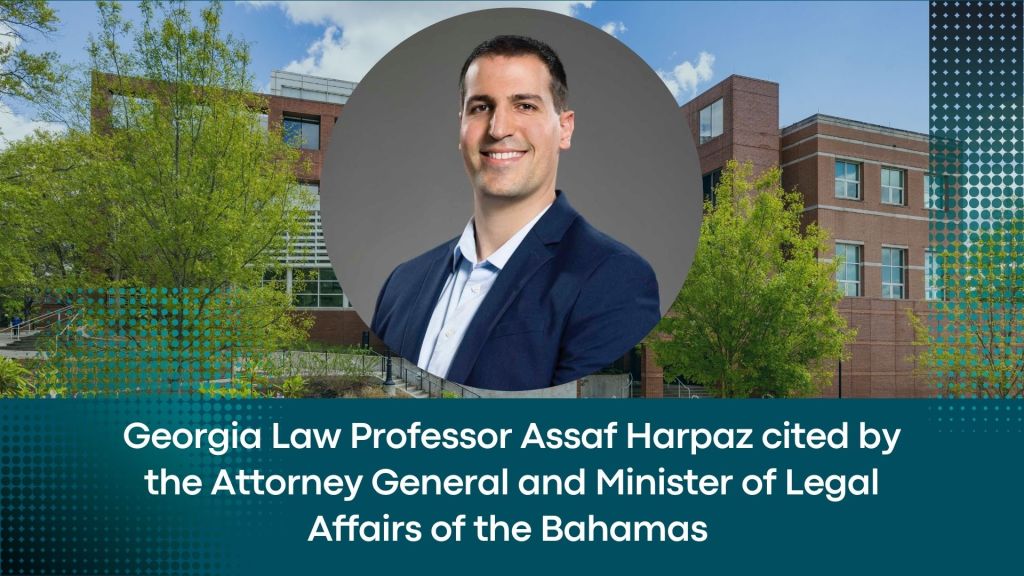
Assaf Harpaz joined University of Georgia School of Law as an assistant professor in summer 2024 and teaches classes in federal income tax and business taxation. Harpaz’s scholarly focus lies in international taxation, with an emphasis on the intersection of taxation and digitalization. He explores the tax challenges of the digital economy and the ways to adapt 20th-century tax laws to modern business practices.
Attendees included Samuel Kuo (LL.M. ’25) and Eman Mistry (J.D. ’25). Both students received a Louis B. Sohn Professional Development Fellowship to support their attendance of this conference. Awarded by the law school’s Dean Rusk International Law Center, Sohn Fellowships enable students to attend professional development opportunities related to international law.
Both Kuo and Mistry attended numerous panel discussions addressing a range of topics in international law. Kuo reflected on the experience, stating:
“I enjoyed the panel on the topic of disclosure in international arbitration moderated by Kelly Turner at the American Arbitration Association, featuring Dorothy Du from Motorola, Charles Kotuby from Three Crowns, Sarah Reynolds from Reynolds ADR and Javier Rubinstein from Rubinstein ADR LLC. The discussion centered upon the use of generative AI in international arbitration practice. All areas of the legal profession are preparing for ethical AI use, and it was refreshing to hear a discussion on whether parties should disclose the use of generative AI in anticipating arbitration.”
To read prior posts about prior recipients of Sohn Fellowships, please click here and here.
During his time in Florence, Kadri will expand his ongoing research pertaining to the legal and technical regulation of AI-generated “deepfakes” and focus on the European regulatory approaches to this topic. In 2024, Kadri authored his third book, Dilemmas in Digital Abuse, which discusses related topics including harmful technological advancements and the corresponding regulatory responses.
Kadri is an Assistant Professor of Law at Georgia Law Law, and his research focuses on torts and criminal law, with an emphasis on how technology, law, and social norms enable and affect privacy, speech, and abuse. His scholarship appears in journals including the Harvard Law Review Forum, UCLA Law Review, Texas Law Review, Utah Law Review, Maryland Law Review, and Journal of Free Speech Law and he has published shorter pieces in The New York Times and Slate. His course offerings include Torts, Cybercrime, and Regulating Digital Abuse.
As Graduate Editors, each LL.M. student conducts citation checks and writes a Comment or Book Review on the legal topic of their choice. The Graduate Editors further facilitate the Journal’s commitment to “including a diversity of perspectives, experiences, and backgrounds within [its] membership,” according to the Editor in Chief, Jasmine Furin (J.D. ’25).
The Georgia Journal of International and Comparative Law is a preeminent forum for academic discussion on current international subjects. From its inception in 1971 as a student initiative supported by former U.S. Secretary of State and Georgia Law Professor Dean Rusk, the Journal features work by legal scholars and practitioners and student notes written by Journal members.
Amann is Regents’ Professor of International Law, Emily & Ernest Woodruff Chair in International Law, and a Faculty Co-Director of our Dean Rusk International Law Center here at Georgia Law. She has pursued a research-intensive semester this autumn, primarily as a Research Visitor at the Oxford Faculty of Law Bonavero Institute of Human Rights and Visiting Fellow at Exeter College Oxford.
“The Biden administration changed U.S. trade policy significantly when it adopted a “worker-centered” trade policy that justified entering into “frameworks” and not trade agreements. That policy didn’t win many accolades from the trade crowd. Many critics felt that it forewent critical opportunities by refusing to discuss market access in new trade contexts. Without getting into that debate, this post discusses whether the Biden administration’s worker-centered trade policy – and notably, use of that policy under the United States-Mexico-Canada Agreement (USMCA) Facility-Specific Rapid-Response Labor Mechanism (RRM) – will outlive the administration.
I think it will, but it will look different. And some, including labor rights advocates like myself, might prefer the Trump administration’s approach.”
LeClercq joined the University of Georgia School of Law in 2024 as an assistant professor. She teaches International Trade and Workers Rights, International Labor Law, International Law, U.S. Labor Law and the International Law Colloquium. She also serves as a faculty co-director of the Dean Rusk International Law Center and as the faculty adviser for the Georgia Journal of International and Comparative Law.
University of Georgia School of Law Professor Assaf Harpaz presented his draft paper “Global Tax Wars in the Digital Era” at the University of Alabama School of Law as part of the Junior/Senior SEC Workshop.
Below is an abstract of the paper:
Current debates in international taxation often center on how to fairly allocate taxing rights among different jurisdictions. When an enterprise earns income abroad, the country of residence (where the taxpayer resides) and the country of source (where income is generated) have legitimate, competing claims to tax that income. The question is further complicated in a digital economy where profit shifting practices are abundant and businesses no longer require a physical presence in the location of their online consumers.
The international tax system has traditionally favored residence-based taxation. Now, international taxation is at a crossroads with intergovernmental organizations battling to redefine the principles of cross-border taxation. The regime has been dominated by the Global North through the Organisation for Economic Co-operation and Development (OECD), which has drawn backlash due to its undemocratic procedure and unfavorable outputs for developing countries. The United Nations has held a relatively peripheral role in global tax governance, which is poised to change with an upcoming UN Framework Convention on International Tax Cooperation – an initiative overwhelmingly supported by developing countries.
This article explores the “tax wars” surrounding the leadership for global tax governance, contrasting the taxing powers and interests of the OECD-led Global North with those of the UN-backed Global South. It highlights the distortive outcomes created by outdated international tax principles and argues for a shift toward source-based taxation. To do so, it proposes revisiting the permanent establishment standard in model treaty language, creating an opportunity for broader taxation of business profits in the source country. This transition will address longstanding disparities and is increasingly warranted in a digital economy that does not rely on physical presence.
Assaf Harpaz joined University of Georgia School of Law as an assistant professor in summer 2024 and teaches classes in federal income tax and business taxation. Harpaz’s scholarly focus lies in international taxation, with an emphasis on the intersection of taxation and digitalization. He explores the tax challenges of the digital economy and the ways to adapt 20th-century tax laws to modern business practices.
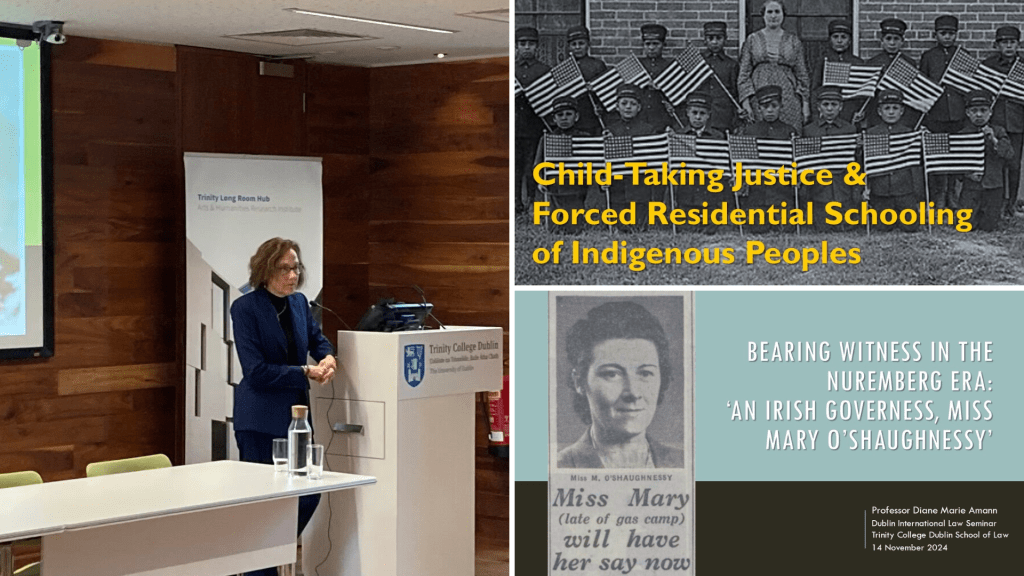
University of Georgia School of Law Professor Diane Marie Amann recently gave a public lecture entitled “Child-Taking: Unlawful Transfer plus Identity Alteration, in Ukraine and Beyond,” at the University of Reading School of Law in Reading, United Kingdom, as part of that law school’s Global Law at Reading (GLAR) lecture series.
Her presentation drew upon her just-published article, “Child-Taking,” 45 Michigan Journal of International Law 305 (2024).
Amann is Regents’ Professor of International Law, Emily & Ernest Woodruff Chair in International Law, and a Faculty Co-Director of our Dean Rusk International Law Center here at Georgia Law. This fall, she is spending a research-intensive semester in the United Kingdom, where she is a Research Visitor at the Oxford Faculty of Law Bonavero Institute of Human Rights and Visiting Fellow at Exeter College Oxford.
Today, we welcome a guest post by John “Jack” Buckelew, a member of the University of Georgia School of Law class of 2025. Jack is the fifth Georgia Law student to participate in a semester-long international externship and the first recipient of a grant from the Halle Foundation to support his externship in Germany. The semester-long externships overseas initiative is an extension of the Center’s existing Global Externships Overseas and is offered jointly between the Center and the law school’s Clinical and Experiential Program. Jack’s post describes his experience as a legal extern with Weickmann, an intellectual property firm in Munich, Germany, where he works under Georgia Law alumnus Dr. Udo W. Herberth (LL.M., ’96). Dr. Herberth heads the firm’s Trademark and Design group.
Working in Munich for the past two months has been a deeply transformative experience, shifting my professional outlook in surprising ways. I began this experience feeling a little burned out. The first two years of law school are notoriously challenging, and somewhere along that arduous road I lost sight of the many reasons that I decided to go to law school. At the end of my 2L summer, I had many doubts in my mind about whether life in a law firm after graduation would reinvigorate my previously held excitement towards being an attorney. But these past two months abroad have shown me the unique freedoms and possibilities that come with a career in law, and my view towards the future is now much more optimistic.
BITMA
Three weeks into my stay in Munich, my office hosted one of its biggest events of the year– the annual Bavarian International Trademark Association Conference (BITMA). The annual conference is a relatively new idea created by my supervisor at Weickmann, Dr. Udo Herberth. He developed the idea at the height of the COVID pandemic as an opportunity for colleagues to connect in-person. Now, attorneys travel from around the world– this year from 20 different countries– to participate in this conference.
Because the IP practice is so international, these attorneys have a vested interest in (1) establishing business relationships with attorneys around the world and (2) learning about the substantive differences of the IP practice in different countries. BITMA was only a two-day event, but those two 48 hours were packed with activities. BITMA kicked off with a day full of instructional presentations where attorneys spoke about novel issues of trademark law in their home countries. Then, participants enjoyed a long meal at a traditional Bavarian restaurant in downtown Munich. The next day, we resumed presentations and then headed back into town to join the rest of the city in celebrating the first weekend of Oktoberfest.
I personally had the chance to talk to over 20 different attorneys about their career paths, their current practice, and what they enjoyed most about their lives as attorneys. The experience was not only extremely informative but also very fun, and I was able to expand my professional network. I honestly feel like the connections I made in that environment will go a lot farther than any meeting in a formal setting ever could. An attorney from France gave me her personal phone number and told me to text her for restaurant recommendations if I’m ever in Paris; another attorney from Cologne told me I could stay on his couch if I ever wanted to visit him; and an attorney from Beijing broke into tears as he shared the importance of finding a good mentor at the start of a career. All of this happened as we danced and sang in our traditional Bavarian clothing. Attending BITMA was an experience to remember.
Substantive Work and Life in Munich
BITMA may have been the highlight of my externship so far, but my day-to-day work has also been extremely engaging. One feature of the job that I have particularly enjoyed is the vast range of substantive issues I am able to work on at Weickmann. On my first day, I worked on a design patent for a grill tray; later, a position trademark for bike sprocket; then, the naming rights for a brand of hiking shoes; and now, I am working on the design for coffee mug sleeve that prevents users from burning their hands. Each of these clients comes from an entirely different industry, all bringing their own creative innovations to the market and seeking protection from our firm. My work is limited to trademarks and designs, but I often have lunch with other attorneys in the firm who work on patents, and the range of products there is arguably even greater. They also work to protect innovation, but at a more technical level. It can be really educational to talk with these patent attorneys just because they are such experts in their given fields. Whether that be physics, chemistry, mechanical engineering, or something else, it is fascinating to hear them break complex technical processes into simple explanations that a non-expert like me can understand.
I have also been enjoying life in Munich outside of work. For example, I am able ride my bike to the office every day, despite living on the opposite side of town from my firm. Aside from my daily commute, I can often walk to get where I need to go, whether that be a friend’s apartment, a nearby plaza, or a neighborhood grocery store. Being able to move around the city this way has been extremely enjoyable and improves my daily satisfaction in a way that is hard to overstate.
One of the most important revelations I’ve had concerning life in Munich is that this city is a real option for me to live in someday. I think I was always aware of the possibility of working internationally as an attorney, but I never considered it as a concrete option in the way I do now. In the past two months I have worked with attorneys in our office who are from all over the world, including Romania, South Korea, Italy, Brazil, China, France, and Ukraine. Seeing people from around the world work together in this office has moved the prospect of working abroad to the front of my mind.
This experience has been rich and rewarding each step of the way. When I arrived in Munich two months ago, I was feeling burned out with law school. Now, I feel like I have the world ahead of me. The world feels bigger; the potential life and career paths ahead feel more numerous. Above all, my time here in Munich has reinvigorated the excitement of finding a career path and a place to live in life. I wholeheartedly recommend the experience to any prospective student looking for a chance to see what life as an attorney looks like in another part of the world.




 exchange of notes