Bruner is the Stembler Family Distinguished Professor in Business Law at the University of Georgia School of Law and serves as a faculty co-director of the Dean Rusk International Law Center.
Christopher M. Bruner is the Stembler Family Distinguished Professor in Business Law at the University of Georgia School of Law and serves as a faculty co-director of the Dean Rusk International Law Center.
University of Georgia School of Law Professor Christopher M. Bruner presented on a panel titled “Sustainability and Emerging Markets” at the “Corporate Governance in the Global South” roundtable hosted by George Washington University Law School in Washington, D.C. The panel was moderated by Rosa Celorio, Associate Dean for International and Comparative Legal Studies and Burnett Family Distinguished Professorial Lecturer in International and Comparative Law and Policy at George Washington University Law School.
Christopher M. Bruner is the Stembler Family Distinguished Professor in Business Law at the University of Georgia School of Law and serves as a faculty co-director of the Dean Rusk International Law Center.
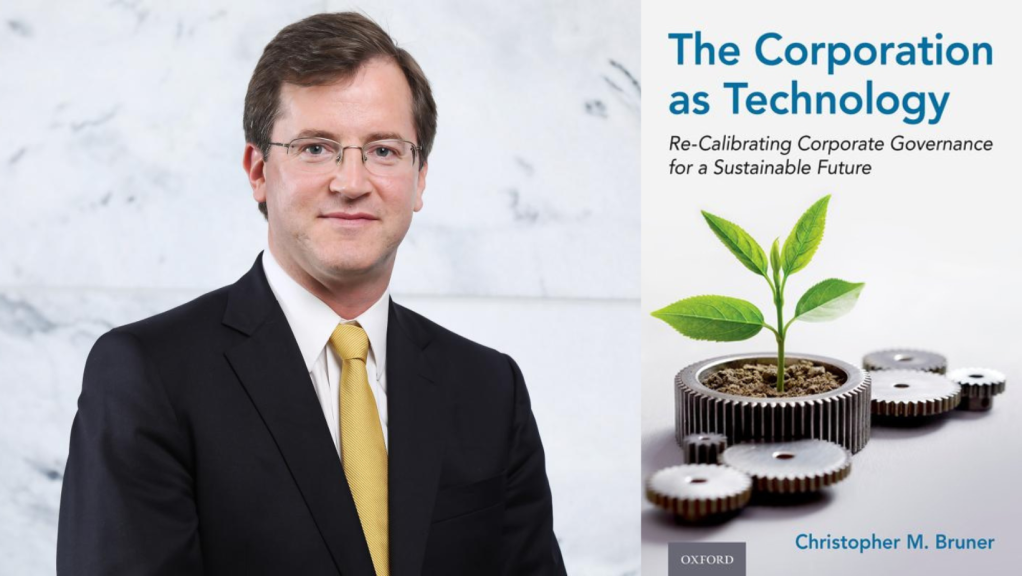
University of Georgia School of Law Christopher M. Bruner was featured by the “Dare to Know!” podcast in March. The episode, titled “Re-Conceptualizing the Corporation: A New Approach,” focused on Bruner’s 2022 Oxford University Press book, The Corporation as Technology: Re-Calibrating Corporate Governance for a Sustainable Future. The interview was conducted by Fabian Corver, a PhD student in philosophy at the University of Groningen in the Netherlands.
Bruner is the Stembler Family Distinguished Professor in Business Law at the University of Georgia School of Law and serves as a faculty co-director of the Dean Rusk International Law Center. His scholarship focuses on corporate law, corporate governance, comparative law and sustainability.
The University of Georgia School of Law’s spring 2025 International Law Colloquium welcomed Professor Christopher Bruner, who presented his working paper, “Sustainable Corporate Governance and Prospects for a US Value Chain Due Diligence Law.” Joshua Barkan, Associate Professor in the Department of Geography at the University of Georgia, served as Bruner’s faculty discussant.
Bruner is the Stembler Family Distinguished Professor in Business Law at the University of Georgia School of Law and serves as a faculty co-director of the Dean Rusk International Law Center. Bruner’s scholarship centers around corporate law, corporate governance, comparative law and sustainability.
Below is an abstract of Bruner’s working paper:
Laws requiring multinational companies to undertake due diligence to detect, prevent, and mitigate human rights and environmental abuses in their value chains have proliferated across Europe, and the European Union has adopted a directive to harmonise such national laws. This chapter assesses the prospects for enactment of such a value chain due diligence law in the United States.
Although such laws are often conceptualised as an extension of corporate law, they can just as readily be conceptualised as an extension of trade law – and the latter approach offers real potential to sidestep anti-ESG and anti-sustainability sentiment among the US political right. Packaged as a trade initiative, the prospects for bipartisanship improve because the political left and right can each embrace the effort by reference to policy preferences resonating with their respective bases. To the progressive left, such laws raise labour and environmental standards globally, while to the conservative right, such laws protect domestic industry from unfair foreign competition.
The chapter first examines corporate politics in the United States, discussing how fundamental corporate governance debates revolve around thorny ideological issues that strongly polarise the political left and right, diminishing the prospects for a value chain due diligence law conceptualised as an extension of corporate law. It then examines trade politics in the United States, discussing how framing by reference to trade improves the prospects for a US value chain due diligence law by sidestepping such ideological issues and giving both the political left and right plausible ways to view such a law as a victory for their respective bases. The chapter concludes with discussion of trade-offs raised by these differing modes of legal strategy and institutionalisation, observing that the corporate law approach offers broader reach with weaker enforcement while the trade law approach offers narrower reach with stronger enforcement.
This year, Professor Desirée LeClercq is overseeing the colloquium, which is designed to introduce students to features of international economic law through engagement with scholars in the international legal field. To view the full list of International Law Colloquium speakers, visit our website.
This program is made possible through the Kirbo Trust Endowed Faculty Enhancement Fund and the Talmadge Law Faculty Fund.
Recent decades have witnessed environmental, social, and economic upheaval, with major corporations contributing to a host of interconnected crises. The Corporation as Technology examines the dynamics of the corporate form and corporate law that incentivize harmful excesses and presents an alternative vision to render corporate activities more sustainable.
The corporate form is commonly described as a set of fixed characteristics that strongly prioritize shareholders’ interests. This book subverts this widely held belief, suggesting that such rigid depictions reinforce harmful corporate pathologies, including excessive risk-taking and lack of regard for environmental and social impacts. Instead, corporations are presented as a dynamic legal technology that policymakers can re-calibrate over time in response to changing landscapes.
This book explores the theoretical and practical ramifications of this alternative vision, focusing on how the corporate form can help secure an environmentally, socially, and economically sustainable future.
Christopher M. Bruner, Stembler Family Distinguished Professor in Business Law and Faculty Co-Director of the Dean Rusk International Law Center, recently presented working papers in Canada and Sweden.
He presented “Corporate Governance and Sustainability Incentives” at a conference titled “Addressing the Sustainability Impacts of Corporations” in October. The conference was hosted by the Nathanson Centre on Transnational Human Rights, Crime and Security at the Osgoode Hall Law School (York University) in Toronto.
Bruner also presented “Corporate Personhood, Corporate Rights, and the Contingency of Corporate Law” at “Decoding the Rights of Companies in the Technocene,” a conference hosted in December by the Lund University Faculty of Law in Lund, Sweden.
Bruner’s scholarship focuses on corporate law, corporate governance, comparative law and sustainability. He is a research member of the European Corporate Governance Institute (ECGI) and has presented his work in numerous countries around the world.




 exchange of notes