Bruner is the Stembler Family Distinguished Professor in Business Law at the University of Georgia School of Law and serves as a faculty co-director of the Dean Rusk International Law Center.
University of Georgia School of Law Professor Christopher Bruner presented “Value Chain Due Diligence and Populist Politics” at the University of Turin in Italy earlier this month. The seminar was co-hosted by the Department of Law and the Department of Economics and Statistics, with Roberto Caranta, Professor, Department of Law, and David Monciardini, Assistant Professor, Department of Economics and Statistics, serving as discussants. The audience included faculty and Ph.D. students.
Bruner is the Stembler Family Distinguished Professor in Business Law at the University of Georgia School of Law and serves as a faculty co-director of the Dean Rusk International Law Center.
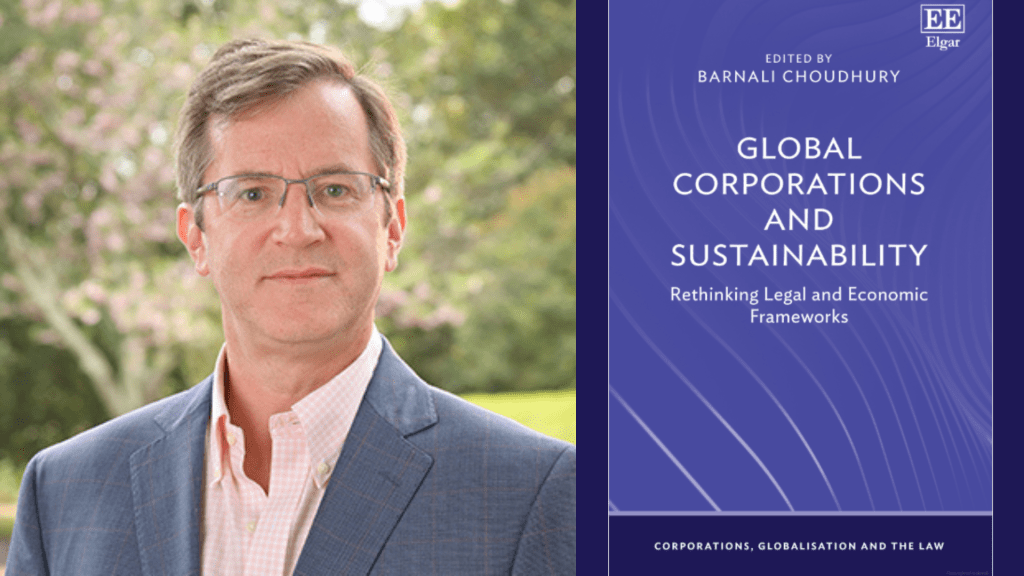
Bruner’s chapter builds on ideas he presented in 2023 at a conference hosted by the University of Macerata in Italy.
Bruner is the Stembler Family Distinguished Professor in Business Law at the University of Georgia School of Law and serves as a faculty co-director of the Dean Rusk International Law Center.
Christopher M. Bruner is the Stembler Family Distinguished Professor in Business Law at the University of Georgia School of Law and serves as a faculty co-director of the Dean Rusk International Law Center.
Bruner is the Stembler Family Distinguished Professor in Business Law at the University of Georgia School of Law and serves as a faculty co-director of the Dean Rusk International Law Center.
The University of Georgia School of Law’s spring 2025 International Law Colloquium welcomed Sarah Dadush, Professor of Law at Rutgers Law School, who presented her working paper, “Shared Responsibility in Contract Law.” Professor Christopher Bruner, Stembler Family Distinguished Professor in Business Law and Faculty Co-Director of the Dean Rusk International Law Center at Georgia Law, served as her faculty discussant. Dadush’s presentation marks the conclusion of the 2025 International Law Colloquium.
Dadush’s scholarly focus lies in business and human rights, consumer law, and social enterprise law. She also serves as the Director of the Responsible Contracting Project (RCP), a project designed to advocate for human rights and environmental due diligence in contract drafting. The RCP is located within the Rutgers Law School’s Center for Corporate Law and Governance.
Below is an abstract of Dadush’s working paper:
At first, the notion that there is such a thing as shared responsibility in American contract law may sound fanciful, if not absurd. A key reason why parties contract in the first place is to allocate risks and responsibilities between them and to clarify who must do what to move the collaboration forward. As such, contractual obligations are understood to be binary, belonging either to one party or the other, not both. In practice, this means that, if there is a breach, only the obligated party will be held responsible, not both. And, if remedies are awarded, they will flow only from the breaching to the non-breaching party, not between them. Thus, the notion that the parties might be contractually responsible not just for their own obligations, but also for those of their counterparty, seems incoherent.
And yet, as this Article shows, it is not uncommon for courts to go beyond the express terms of the contract to make the parties share responsibility for the performance of one another’s obligations. Thus shared responsibility: Each party is held responsible for the other’s contractual (non)performance, even in the absence of an express commitment to share responsibility for performance.
This Article “goes fishing” for shared responsibility in three key areas of contract law: The contents of the contract, breach, and remedies. It demonstrates that shared responsibility is brought to bear to resolve contract disputes more often and with greater legal effect than the simple, binary understanding of contract might predict. When it enters the judicial analysis, shared responsibility can drastically change the answers to the questions: Who had the obligation to perform? Who breached? And, finally, whose harm should be remedied and how?
Having shown that shared responsibility is already a prominent, if overlooked, feature of American contract law, this Article argues that, in certain situations, courts should employ shared responsibility as a default rule. Specifically, courts should employ a shared responsibility default (SRD) when the contract was breached, or otherwise failed, and (1) both parties contributed to the failure, and (2) the failure could, or has already, generated high social costs (e.g., public endangerment, human rights violations in supply chains, consumer deception). In such situations, the SRD would activate the tort law principles of comparative negligence and proximate cause in contract, holding both parties accountable for their respective contributions to the contract’s failure and related social costs. In doing so, the SRD would equip courts to resolve contract disputes in a manner that attends to both contract policy and public policy objectives.
This year, Professor Desirée LeClercq led the colloquium, which was designed to introduce students to features of international economic law through engagement with scholars in the international legal field. To view the full list of International Law Colloquium speakers, visit our website.
This program w made possible through the Kirbo Trust Endowed Faculty Enhancement Fund and the Talmadge Law Faculty Fund.
University of Georgia School of Law Professor Christopher M. Bruner presented on a panel titled “Sustainability and Emerging Markets” at the “Corporate Governance in the Global South” roundtable hosted by George Washington University Law School in Washington, D.C. The panel was moderated by Rosa Celorio, Associate Dean for International and Comparative Legal Studies and Burnett Family Distinguished Professorial Lecturer in International and Comparative Law and Policy at George Washington University Law School.
Christopher M. Bruner is the Stembler Family Distinguished Professor in Business Law at the University of Georgia School of Law and serves as a faculty co-director of the Dean Rusk International Law Center.
There are a variety of acts known as “dark patterns,” such as forcing consumers to register as members when browsing or purchasing products, or obscuring important information for consumers. These acts of dark patterns not only disadvantage consumers and other users, but there are also concerns that they may harm fair and free competition between businesses that use dark patterns and those that do not use such means. It is necessary to consider how to address the issue of dark patterns from the perspective of Antimonopoly Act and competition policy.
This symposium will include speeches and a panel discussion regarding current situation of dark patterns, their regulatory trends and future issues in Japan and abroad, and the way competition policy should approach dark patterns.
Day is an Associate Professor of Legal Studies at the Terry College of Business and holds a courtesy appointment in the School of Law. He is also an Affiliated Fellow at Yale Law School’s Information Society Project as well as the University of North Carolina’s Center for Information, Technology, and Public Life. His research has primarily focused on the intersection of competition, technology, innovation, and privacy as well as the disparate impact of anticompetitive conduct.
University of Georgia School of Law Christopher M. Bruner was featured by the “Dare to Know!” podcast in March. The episode, titled “Re-Conceptualizing the Corporation: A New Approach,” focused on Bruner’s 2022 Oxford University Press book, The Corporation as Technology: Re-Calibrating Corporate Governance for a Sustainable Future. The interview was conducted by Fabian Corver, a PhD student in philosophy at the University of Groningen in the Netherlands.
Bruner is the Stembler Family Distinguished Professor in Business Law at the University of Georgia School of Law and serves as a faculty co-director of the Dean Rusk International Law Center. His scholarship focuses on corporate law, corporate governance, comparative law and sustainability.
Corporate personhood and corporate rights are co-constitutive in nature, meaning that they are mutually constructed – there is no singular, one-way causal path between a conception of corporate personhood and a conception of corporate rights. Consequently, modes of reasoning that purport to deduce the substance and extent of corporate rights from the mere fact of corporate personhood are logically circular. Although the relationship between corporate personhood and corporate rights is real and significant, this relationship cannot, in and of itself, comprehensively specify the content of corporate rights; their substance can only be specified by reference to external normative criteria. The upshot is that corporate law inevitably remains a socially and politically contingent field. Those advancing particular conceptions of corporate personhood and corporate rights should acknowledge the contingency of corporate law and present their preferred visions by reference to external normative criteria that they are prepared to acknowledge, describe, and defend.
Bruner is the Stembler Family Distinguished Professor in Business Law at the University of Georgia School of Law and serves as a faculty co-director of the Dean Rusk International Law Center. His scholarship focuses on corporate law, corporate governance, comparative law and sustainability.







 exchange of notes