Georgia Law Professor Desirée LeClercq publishes on the ILO’s right to strike in EJIL: Talk!

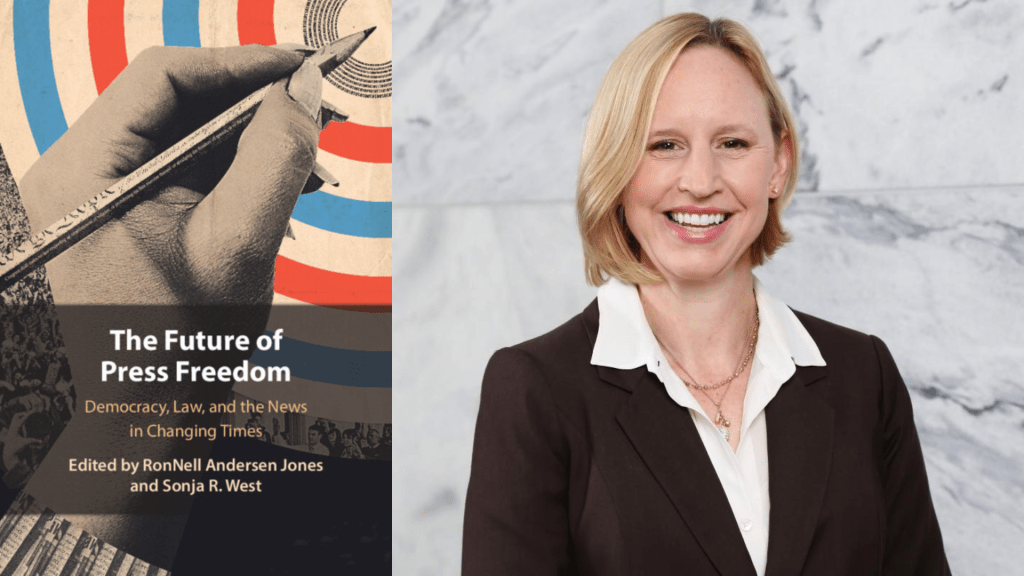
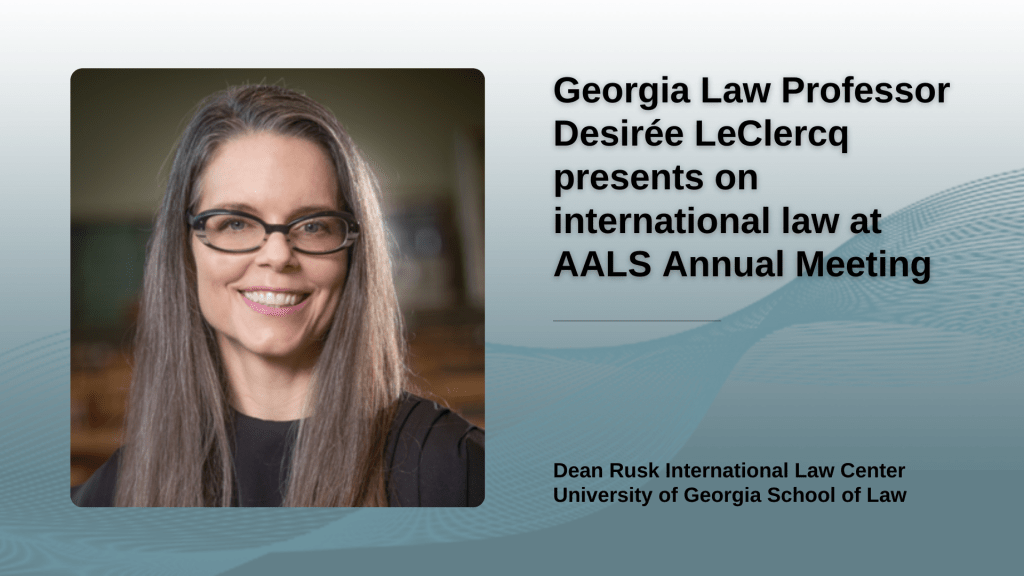
University of Georgia School of Law Professor Desirée LeClercq published “The ILO’s Right to Strike: Distinguishing Non-Binding Principles from Binding Conventions at the ICJ” in EJIL: Talk!, the blog of the European Journal of International Law.

In the post, LeClercq analyzes the International Court of Justice’s proceedings connected to the International Labour Organization’s request for an advisory opinion on whether the right to strike is protected under Convention No. 87. She focuses on how non-binding ILO principles interact with binding conventions, and what that distinction could mean for interpreting Convention No. 87 in international law and in related policy contexts.

LeClercq joined the University of Georgia School of Law in 2024 as an assistant professor. She teaches Contracts, International Trade and Workers Rights, International Labor Law, U.S. Labor Law, and Public International Law. She also serves as a faculty co-director of the Dean Rusk International Law Center and as the faculty adviser for the Georgia Journal of International and Comparative Law and the Labor and Employment Student Association. 

Georgia Law Professor Christopher Bruner featured on Law360 regarding global legal market trends

University of Georgia School of Law Professor Christopher Bruner was featured on Law360 regarding the evolving global footprint of large US law firms. The article titled “How BigLaw Is Redrawing Its Global Map For 2026” was written by Ryan Boysen and published 12/10/25. 

Bruner is the Stembler Family Distinguished Professor in Business Law at the University of Georgia School of Law and serves as a faculty co-director of the Dean Rusk International Law Center.

Georgia Law student Isaac Clement (J.D. ’27) selected to participate in The Hague Academy of International Law’s Private International Law summer course

University of Georgia School of Law student Isaac Clement (J.D. ’27) was selected to participate in The Hague Academy of International Law‘s Private International Law summer course. This initiative will take place at the Peace Palace in The Hague, Netherlands.

Over the course of three weeks in the summer, Clement and others from around the world will engage in advanced study of international private law, international arbitration, and cross-border commercial transactions. These courses and lectures are taught by academics, practitioners, and diplomats from leading institutions around the world.

From The Academy’s website:

The Academy is a centre for teaching and research in public and private international law, with the aim of furthering the scientific study of the legal aspects of international relations. The United Nations General Assembly regularly expresses its appreciation “to the Hague Academy of International Law for the valuable contribution it continues to make to the Programme of Assistance, which has enabled candidates under the International Law Fellowship Programme to attend and participate in the Fellowship Programme in conjunction with courses at the Academy” and notes “the contributions of the Hague Academy to the teaching, study, dissemination and wider appreciation of international law, and calls upon Member States and interested organizations to give favourable consideration to the appeal of the Academy for a continuation of support and a possible increase in their financial contributions, to enable the Academy to carry out its activities, particularly those relating to the Summer and Winter Courses, regional courses and programmes of the Centre for Studies and Research in International Law and International relations.”

Georgia Law Professor Assaf Harpaz presents on tax sovereignty at JILSA Annual Meeting

University of Georgia School of Law Professor Assaf Harpaz recently presented his draft article, “Tax Sovereignty,” at the Junior International Law Scholars Association (JILSA) Annual Meeting. The event was held at the William S. Richardson School of Law at the University of Hawai‘i at Mānoa on January 7.

Below is an abstract of the article:

Tax sovereignty is gaining significant attention in international tax policy. The concept traditionally refers to a government’s authority to design and enforce its own tax laws, without infringement. Policymakers are increasingly invoking the principle to broaden their country’s assertions of taxing rights (e.g., on offshore profits) and to withdraw from international agreements that they deem unfavorable. While tax sovereignty has been widely debated in legal scholarship, its parameters are not clearly established. These tensions have emerged in recent negotiations on issues like the global minimum tax and the legitimacy of tax havens, highlighting the need to better conceptualize the principle. This Article explores the origins of the tax sovereignty principle and its proliferation in the current international tax discourse. It develops a doctrinal account of tax sovereignty that illuminates the obligations and limitations embedded within the concept. The Article argues that tax sovereignty operates as a legally bounded doctrine rather than an unrestricted claim of fiscal autonomy, especially if a sovereign’s policies create negative externalities to others.

In addition to presenting his own work, Harpaz served as a commentator for the presentation “Is Rule of Law Decline Rewarded in Trade? Lessons from the European Union” by Janka Deli of Stanford Law School and was a panelist for a discussion titled “Preparing for a Career in Academia.”

Harpaz joined the University of Georgia School of Law as an assistant professor in summer 2024 and teaches classes in federal income tax and business taxation. Harpaz’s scholarly focus lies in international taxation, with an emphasis on the intersection of taxation and digitalization. He explores the tax challenges of the digital economy and the ways to adapt 20th-century tax laws to modern business practices.

Georgia Law Professor Desirée LeClercq leads experiential learning opportunity for students in Atlanta

In November, University of Georgia School of Law Professor Desirée LeClercq traveled to Atlanta with a group of students as the culmination of their semester-long exploration of international trade.

15 students, including J.D., LL.M., and Graduate Certificate in International Law students, spent the semester examining potential trade and investment opportunities between the State of Georgia and the United Kingdom from an interdisciplinary perspective. They researched and wrote a paper examining key export and import sectors in Georgia and the United Kingdom, and then prepared a hypothetical Memorandum of Understanding (MoU) between the two. The students spent the day in Atlanta presenting to, and fielding technical questions from, three different audiences: representatives from the state of Georgia, transactional and international lawyers from Eversheds Sutherland, and foreign diplomats from the U.K. consulate.

Georgia Department of Economic Development

The group’s first stop of the day was hosted by the Georgia Department of Economic Development (GDEcD), the state’s sales and marketing arm, and had in attendance other state representatives.

At the GDEcD, Madina Bekisheva (GCIL student), Sutton Eady (J.D. ’27), Md. Asaduzzaman Jabin (GCIL student), and Jalyn Ross (J.D. ’27) worked together to present their portion of the hypothetical legal instrument. In their presentation, the group argued for greater collaboration and synergies between the state and the United Kingdom to attract, facilitate, and potentially grow trade. Their arguments centered on export and import data from similarly situated states and novel predictive models they had built demonstrating how enhanced collaborations with the United Kingdom could increase trade and job opportunities in Georgia. The students used the model to identify specific sectors in industry, renewable energy, commerce, and agriculture, among others, where Georgia’s economy and workers could benefit.

Eversheds Sutherland

The group’s second stop of the day was the Atlanta office of Eversheds Sutherland, a global law firm specializing in corporate, energy, litigation, tax, and real estate. This firm has a meaningful relationship with the UK, as it is where the Eversheds law firm originated prior to their 1988 merger with Sutherland. The firm’s global headquarters is located in London, and its historic ties to the country are evident in their presence throughout the British legal market. Students Leighlee Mahony (J.D. ’26) and N’Guessan “Clement” Kouame (LL.M. ’24, J.D. ’26) presented. Both students argued that enhanced trade and investment collaboration between Georgia and the United Kingdom could offer reciprocity in sectors, including legal services.

The students were hosted by Jenny Lambert, Partner, and attended by several practicing attorneys in transactional and international work. The students benefitted both from the lunch that Eversheds Sutherland generously provided, as well as in-depth and vigorous questioning by the firm’s attorneys.

British Consulate General Atlanta

The group’s third and final stop of the day was the British Consulate General Atlanta. Students Maya Roper (J.D. ’27), Victor Azure (LL.M. ’26), Wambui Kamau (LL.M. ’26), and Madina Bekisheva (GCIL student) presented the group’s data and modeling to U.K. diplomats and officials. The group again walked the audience through specific trade and industry sectors, with a special focus on battery production for electric vehicles, the Georgia aerospace industry’s advantage, and veterinary medicine.

Student Reflections

“Coming from a non-law background in Computer Science, I learned that successful trade and partnerships do not thrive on innovation alone. They must be shaped by policy and political realities, economic conditions, population needs, national interests, and stakeholder relationships. The Atlanta trip made this clear by showing how quickly trade negotiations can shift based on context, not on the brilliance of the technology or business itself.” – Md. Asaduzzaman Jabin (GCIL student)

“This course was a great blend of theory and practice, requiring intensive and insightful legal research to understand and gather the materials, as well as concise, precise, and clear drafting of the MoU. The most significant site visit for me was the visit to the Georgia Department of Economic Development. It was a great experience to compare our findings with the department’s work and its vision for improvement. It was also interesting to know that people at the GDDE were doubtful about the use of models for the prediction of growth or value from MoUs. It shows how sometimes new technology may face skepticism for its implementation and convince people to advance or improve their old methods.” – N’Guessan “Clement” Kouame (LL.M. ’24, J.D. ’26)

Georgia Law Professor Nathan S. Chapman presents at international symposium in Italy

University of Georgia School of Law Professor Nathan S. Chapman presented “Christianity, Natural Rights, and Early American Constitutionalism” as part of an interdisciplinary, international symposium titled Natural Rights Across Denominational Divides at the University of Notre Dame‘s campus in Rome, Italy during November. 

This symposium invited Catholic, Protestant, and Orthodox scholars to present and discuss papers debating and discussing the role of natural rights in their theological and legal traditions. The papers will be published in the American Journal of Jurisprudence (Oxford University Press).

Chapman currently serves as the law school’s associate dean for faculty development and holds the Cleveland Distinguished Chair of Law. He writes and teaches about constitutional law, especially constitutional rights, and law and religion. Most recently, he is the author, with Michael W. McConnell, of Agreeing to Disagree: How the Establishment Clause Promotes Religious Pluralism and Protects Freedom of Conscience (OUP, 2023).

Six Georgia Law students to pursue global externships in spring 2026

In the upcoming spring semester, six University of Georgia School of Law students will gain international hands-on learning experience through the Global Externships Overseas (GEO) initiative, administered by the Dean Rusk International Law Center in partnership with the DC Semester in Practice: Micah Booker (J.D. ’27), Aaron Dasher (J.D. ’26), Avery Herman (J.D. ’27), Edmund Kim (J.D. ’27), Sarah Najjar (J.D. ’27), and William Stowers (J.D. ’27). Through their GEOs, students will work abroad in practice areas including international arbitration, M&A, energy and infrastructure, international trade, and cultural heritage law.

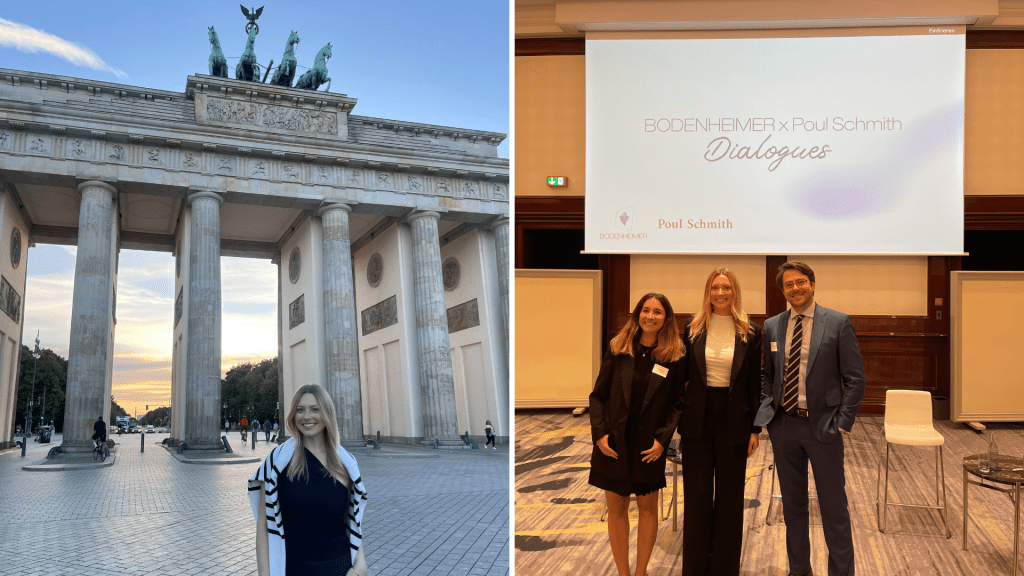
Five students will work in private law settings: Booker with extern with LNT & Partners in Hanoi, Vietnam; Herman will extern with Araoz y Rueda in Madrid, Spain, under the supervision of Ainhoa Veiga (LL.M. ’97); Kim and Najjar will extern with KPMG Legal in Ho Chi Minh City, Vietnam, under the supervision of Binh Tran (J.D. ’11); and Stowers will extern with Bodenheimer in Berlin, Germany, under the supervision of Dr. Christof Siefarth (LL.M. ’86).

Dasher has a public interest placement and will extern remotely with the Antiquities Coalition under the supervision of Tess Davis (J.D. ’09).

Stowers has been selected as the recipient of a grant from the Halle Foundation to support his externship in Germany. Based in Atlanta, The Halle Foundation seeks to promote understanding, knowledge and friendship between the people of Germany and the United States. Stowers is the fourth Georgia Law student to receive this grant to support a semester-long GEO in Germany, following Jack Buckelew (J.D. ’25), Pace Cassell (J.D. ’26), and Eleanor Cox (J.D. ’26).

Najjar has been selected as a recipient of the Office of Global Engagement Asia-Georgia Internship Connection Scholarship. This scholarship funds student pursuing credit-bearing internships in southeast Asia for a duration of at least four weeks. Preference is given to students traveling to Cambodia, Indonesia, Japan, South Korea, Laos, Malaysia, Mongolia, the Philippines, Singapore, Taiwan, Thailand, and Vietnam. Posts about past recipients of this scholarship at Georgia Law can be found here and here.

Since spring 2021, fourteen Georgia Law students have participated in semester-long GEOs, an extension of the Center’s existing GEO initiative that is offered jointly between the Center and the law school’s Clinical and Experiential Program. Professor Jessica L. Heywood, Clinical Associate Professor and Washington, D.C., Semester in Practice Director, teaches and directs students externing abroad in partnership with Taher Benany, Associate Director of the Dean Rusk International Law Center, who oversees the GEO initiative. Like Georgia Law’s summer GEOs, semester-long GEOs are legal placements around the world that offer all law students the opportunity to gain practical knowledge and experience in an international setting. They are typically supervised in their work by Georgia Law alumni. Students return to Athens with new colleagues and mentors, legal practice skills that set them apart from their peers, and a deeper appreciation of the global legal profession.

***

The Center is currently accepting applications for fall 2026 semester-long GEOs; all 1L and 2L students are eligible to apply. Applications are due February 15. For more information and to access the application, please email Taher Benany: taher.benany@uga.edu

Georgia Law Professor Diane Marie Amann presents on Nuremberg trial at London’s Middlesex University

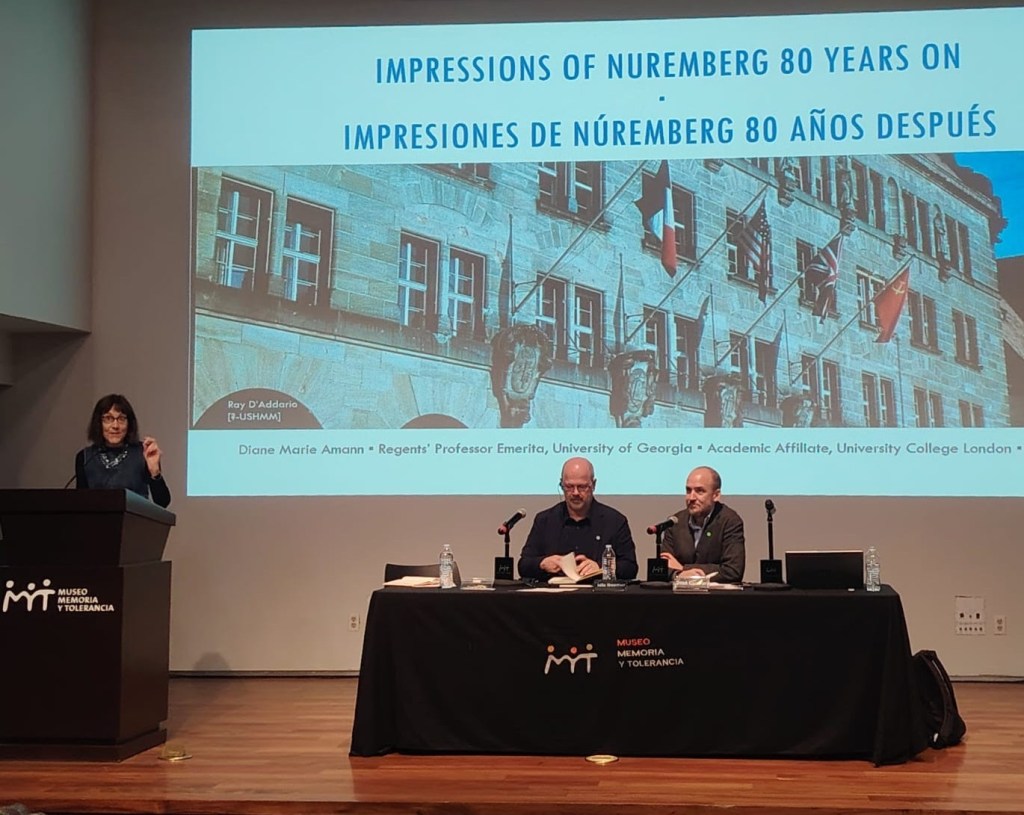
University of Georgia School of Law Professor Diane Marie Amann recently presented “Nuremberg and Its Legacies” as part of a doctoral students’ seminar at Middlesex University School of Law in London.

Amann provided an overview of the year-long post-World War II war crimes trial held in Nuremberg, Germany, before an International Military Tribunal established by Britain, France, the Soviet Union, and the United States. After discussing how the 1945-1946 trial unfolded, she considered the continued impact of the trial with regard to issues like the death penalty, the abolition of government leaders’ immunity from prosecution, and the international law duty to refuse to obey illegal orders.

Leading the two-day seminar were Middlesex Law professors William A. Schabas and Giulia Pecorella.

Amann is Regents’ Professor of International Law, Emily & Ernest Woodruff Chair in International Law, and a Faculty Co-Director of our Dean Rusk International Law Center here at Georgia Law. During her current research-intensive semester, she is an Affiliate Academic at University College London Faculty of Laws. She has published several essays on the Nuremberg era and is writing a book on lawyers and other women professionals at that first trial.

Six Georgia Law students receive Louis B. Sohn Professional Development Fellowships in fall 2025

This fall, six University of Georgia School of Law students received Louis B. Sohn Professional Development Fellowships to support their attendance of international law conferences. Named after the inaugural holder of the Emily and Ernest Woodruff Chair in International Law at Georgia Law, Sohn Fellowships enable students to attend professional development opportunities related to international law. The Fellowships are administered by the Dean Rusk International Law Center.

Elizabeth Burns (J.D. ’26), Wambui Kamau (LL.M. ’26), Anu Paudel (LL.M. ’26), Kara Reed (J.D. ’26), and Haichen Zhao (J.D. ’27) attended the American Branch of the International Law Association’s International Law Weekend in New York City, New York. Jalyn Ross (J.D. ’27) attended the 14th annual conference of the Atlanta International Arbitration Society (AtlAS) in Atlanta, Georgia.

Zhao was selected to be a 2025 Student Ambassador (detailed here). She was one of eight Ambassadors selected nationwide to assist with International Law Weekend.

Ross shared about her favorite panel from the AtlAS annual conference:

I really enjoyed the panel discussion on the impact of tariffs on international arbitration. This panel was addressing tangible issues regarding how businesses, countries, and counsel are adjusting with the current instability surrounding tariffs in the United States. This panel was applying concepts I recently learned about in my International Business Transactions class, including Incoterms and articles of the CISG, and discussing questions of interpretation and application that brought to life what I have been studying in a very real way.

Reflecting on the experience of attending the ABILA ILW, Paudel stated:

This conference has encouraged me to advance my academics and career in international law. Personally, it allowed me to gain hands-on insights on different arenas of international law. Hearing invaluable thoughts of international legal experts, law professors , judges, partners and directors has increased my in-depth knowledge on international law, that I couldn’t have acquired from any written book or article. Professionally, the conference allowed me to build strong networks with the panelists, and participants from other law schools.

Burns noted her biggest takeaway from the ABILA ILW:

My biggest takeaway was an increased confidence in the future of international law. Many, if not all, of the panelists we heard from were exasperated with recent blatant violations of international treaties and a lack of action from international tribunals. Their frustration and insistence on continuing to push for change was inspiring, and they gave me hope that there are still many high-level international professionals who have not thrown in the towel yet.

To read prior posts about Georgia Law students using Sohn Fellowships to attend professional development opportunities, please click here and here.

Georgia Law Professor Diane Marie Amann presents on child-taking at Hague event sponsored by Ukraine and Global Rights Compliance

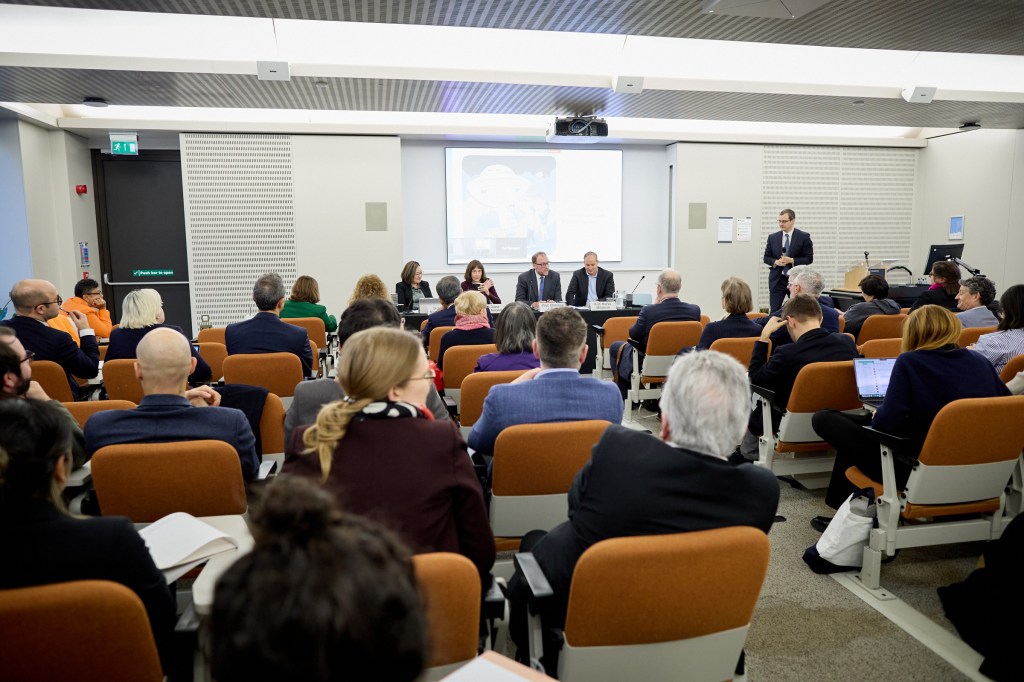
University of Georgia School of Law Professor Diane Marie Amann discussed her research on child-taking at a side event occurring during the 24th annual Assembly of States Parties of the International Criminal Court, held in early December at The Hague in The Netherlands.

Entitled “Vanished Voices: The Plight of Missing Children from Ukraine, Syria and Sudan,” the event was co-sponsored by the government of Ukraine and by Global Rights Compliance, a nongovernmental organization.

In addition to Professor Amann, additional panelists included: Hala Turjman, Independent Institution on Missing Persons in the Syrian Arab Republic: Alla Perfetska, Voices of Children; and Ikhlass Ahmed Altaher Eisa, Strategic Initiatives for Women in the Horn of Africa. Ukraine’s Ambassador to The Netherlands, Andriy Kostin, provided opening and closing remarks, and Wayne Jordash KC, president of the Global Rights Compliance Foundation, moderated the panel.

Amann is Regents’ Professor of International Law, Emily & Ernest Woodruff Chair in International Law, and a Faculty Co-Director of our Dean Rusk International Law Center here at Georgia Law. During her current research-intensive semester, she is an Affiliate Academic at University College London Faculty of Laws.

From 2012 to 2021 Amann served as International Criminal Court Prosecutor Fatou Bensouda’s Special Adviser on Children in & affected by Armed Conflict. Her many publications on international child law include two that analyze the long-standing criminal phenomenon by which a state (or other powerful entity) takes a child and then endeavors to alter, erase or remake the child’s identity. These two articles are  “Child-Taking Justice and the Federal Indian Boarding School Initiative,” 119 American Journal of International Law 629 (2025), and “Child-Taking,” 45 Michigan Journal of International Law 305 (2024).