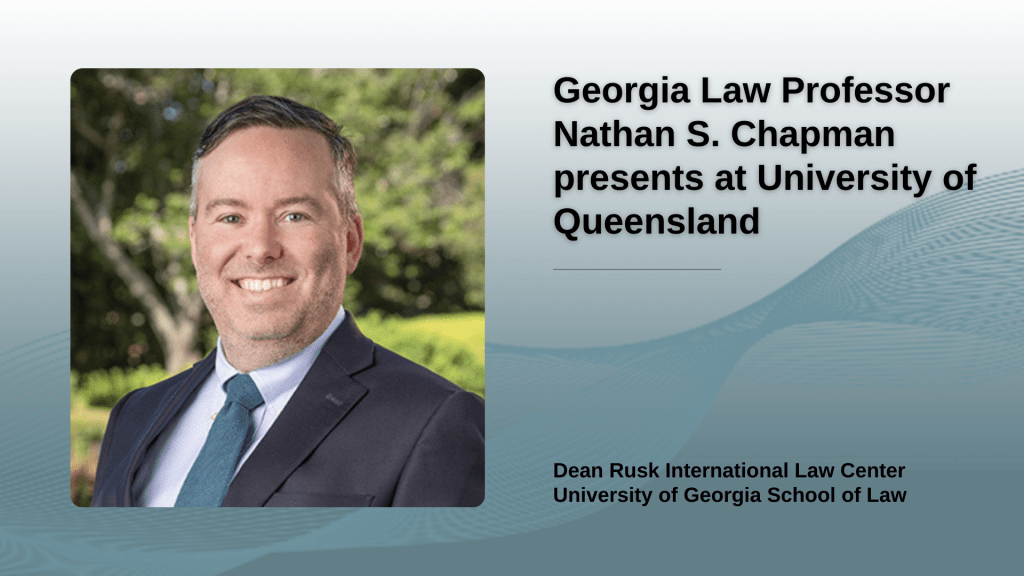
University of Georgia School of Law Professor Nathan S. Chapman gave two presentations at the University of Queensland Law School in Brisbane, Australia this summer. He presented “Natural Law and Religious Liberty” at a faculty and student seminar, and “Fair Notice and Qualified Immunity” was presented at a faculty workshop.
Chapman received financial support to travel to the University of Queensland from the Dean Rusk International Law Center as a Rusk Scholar-in-Residence, an initiative promoting international opportunities for Georgia Law faculty that advance the mission of the Center.
Chapman currently serves as the law school’s associate dean for faculty development and holds the A. Gus Cleveland Distinguished Chair of Law. He writes and teaches about constitutional law, especially constitutional rights, and law and religion. Most recently, Chapman is the author, with Michael W. McConnell, of Agreeing to Disagree: How the Establishment Clause Promotes Religious Pluralism and Protects Freedom of Conscience (OUP, 2023).
The University of Georgia School of Law’s spring 2025 International Law Colloquium welcomed Professor Christopher Bruner, who presented his working paper, “Sustainable Corporate Governance and Prospects for a US Value Chain Due Diligence Law.” Joshua Barkan, Associate Professor in the Department of Geography at the University of Georgia, served as Bruner’s faculty discussant.
Bruner is the Stembler Family Distinguished Professor in Business Law at the University of Georgia School of Law and serves as a faculty co-director of the Dean Rusk International Law Center. Bruner’s scholarship centers around corporate law, corporate governance, comparative law and sustainability.
Below is an abstract of Bruner’s working paper:
Laws requiring multinational companies to undertake due diligence to detect, prevent, and mitigate human rights and environmental abuses in their value chains have proliferated across Europe, and the European Union has adopted a directive to harmonise such national laws. This chapter assesses the prospects for enactment of such a value chain due diligence law in the United States.
Although such laws are often conceptualised as an extension of corporate law, they can just as readily be conceptualised as an extension of trade law – and the latter approach offers real potential to sidestep anti-ESG and anti-sustainability sentiment among the US political right. Packaged as a trade initiative, the prospects for bipartisanship improve because the political left and right can each embrace the effort by reference to policy preferences resonating with their respective bases. To the progressive left, such laws raise labour and environmental standards globally, while to the conservative right, such laws protect domestic industry from unfair foreign competition.
The chapter first examines corporate politics in the United States, discussing how fundamental corporate governance debates revolve around thorny ideological issues that strongly polarise the political left and right, diminishing the prospects for a value chain due diligence law conceptualised as an extension of corporate law. It then examines trade politics in the United States, discussing how framing by reference to trade improves the prospects for a US value chain due diligence law by sidestepping such ideological issues and giving both the political left and right plausible ways to view such a law as a victory for their respective bases. The chapter concludes with discussion of trade-offs raised by these differing modes of legal strategy and institutionalisation, observing that the corporate law approach offers broader reach with weaker enforcement while the trade law approach offers narrower reach with stronger enforcement.
This year, Professor Desirée LeClercq is overseeing the colloquium, which is designed to introduce students to features of international economic law through engagement with scholars in the international legal field. To view the full list of International Law Colloquium speakers, visit our website.
This program is made possible through the Kirbo Trust Endowed Faculty Enhancement Fund and the Talmadge Law Faculty Fund.
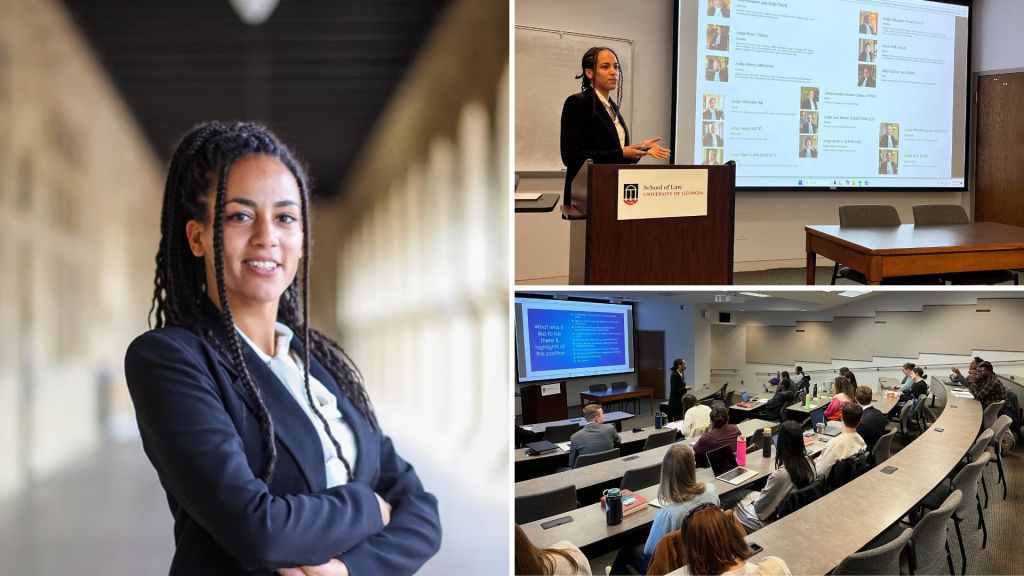
The University of Georgia School of Law welcomed international lawyer Eva Keïta to campus this week to discuss her experience at the International Court of Justice (ICJ) with students in Professor Diane Marie Amann‘s Public International Law course.
Keïta provided students with an overview of the ICJ, where she was an Associate Legal officer and a Judicial Fellow assisting a judge on various public international law matters. She spoke about the makeup of the ICJ, the role of members on each of the Judges’ teams, and how students can make themselves more competitive for open positions. Keïta then took questions from students, detailing her own professional journey as an international dispute settlement lawyer and providing advice for those interested in pursuing international legal careers.
Before her time at the ICJ, Keïta honed her expertise in international arbitration and litigation and handled complex international disputes at two international law firms in Paris. Keïta also has significant experience handling pro bono and international human rights matters. She provided legal representation to an inmate serving a life sentence under California’s Three Strikes Law in post-conviction proceedings, assisted human trafficking victims in compensation proceedings in front of French courts, and volunteered for four months in Togo, providing legal assistance to inmates through a local NGO.
Prior to her legal career, Keïta pursued a bachelor’s and master’s degree in political science, specializing in international relations, from the Sorbonne. In addition, Keïta holds a LL.M. in international economic law, business & policy from Stanford Law School and her first law degree from Sciences Po in Paris.
During this hearing, LeClercq presented her empirical study examining the effects of the USMCA Rapid Response Mechanism on workers in the Mexican auto sector. Current 3L Gloria Maria Correa assisted LeClercq in researching for this report. The abstract from the pre-hearing brief is as follows:
This pre-hearing brief is a submission to the U.S. International Trade Commission in relation to its investigation on the USMCA Automotive Rules of Origin: Economic Impact and Operation, 2025 Report. This investigation is a useful exercise and an opportunity to provide information about a recent study, entitled “Enforcement of the United States-Mexico-Canada Agreement (“USMCA”) Rapid Response Mechanism: Views from Mexican Auto Sector Workers,” conducted at Cornell University to help inform the Commission’s assessment. This study explores whether efforts under the United States-Mexico-Canada Agreement (USMCA) Facility-Specific Labor Rapid Response Mechanism (RRM) are leveling the playing field between U.S. and Mexican auto facilities by strengthening the labor rights of workers in the Mexican auto sector.
Desirée LeClercq joined the University of Georgia School of Law in 2024 as an assistant professor. She teaches International Trade and Workers Rights, International Labor Law, International Law and U.S. Labor Law. She also serves as a faculty co-director of the Dean Rusk International Law Center and as the faculty adviser for the Georgia Journal of International and Comparative Law.



 exchange of notes