Georgia Law Professor Desirée LeClercq publishes article in World Trade Review

University of Georgia School of Law Professor Desirée LeClercq published her article “Tonia Novitz, Trade, Labour, and Sustainable Development: Leaving No One in the World of Work Behind Edward Elgar Publishing, 2024 – Kevin J. Middlebrook, The International Defense of Workers: Labor Rights, US Trade Agreements, and State Sovereignty Columbia University Press, 2024” in the World Trade Review.

LeClercq’s article reviews two books that examine trade and labor rights, the development of the United States-Mexico-Canada Agreement (USMCA) and the Rapid Response Mechanism.

Below is an excerpt from the article:

Over the past decade, trade lawyers and legal researchers have had to take a crash course in international labor law and the so-called ‘sustainable development’ framework. Trade bans across the Atlantic punish governments and corporations for engaging in forced labor. The European Union (EU) recently revised its trade agenda to ensure that commitments to trade agreements with sustainable development provisions are enforceable through sanctions. The United States adopted a ‘worker-centered’ trade policy foregrounding international labor law, the International Labor Organization (ILO), and conceptions of workplace democracy, choice, and voice. The trade and labor linkage, long the source of dispute, is apparently with us to stay, with its attendant implications for trade, political relationships, and international economic law. Namely, who establishes the rules? Governments? International organizations? Civil society? And who decides whether and how those rules are violated?

LeClercq joined the University of Georgia School of Law in 2024 as an assistant professor. She teaches International Trade and Workers Rights, International Labor Law, International Law and U.S. Labor Law. She also serves as a faculty co-director of the Dean Rusk International Law Center and as the faculty adviser for the Georgia Journal of International and Comparative Law.

Georgia Law students attend Atlanta International Arbitration Society annual conference

Last month, a group of eight University of Georgia School of Law students attended the 13th Annual Conference of the Atlanta International Arbitration Society (AtlAS).

Attendees included 3L Jacob Wood and Master of Laws (LL.M.) students Sara Dorbahani, Michael Faleye, Paria Keramatkhah, Neethu James, Fatemeh Khouei, Samuel Kuo, and Zulma Perez. Five of these students (Wood, Dorbahani, Faleye, Keramatkhah, and Khouei) received Louis B. Sohn Professional Development Fellowships to support their attendance of this conference. Awarded by the law school’s Dean Rusk International Law Center, Sohn Fellowships enable students to attend professional development opportunities related to international law.

Conference attendees attended a number of talks and events designed for practitioners and students involved in international arbitration, including the ICC Young Arbitration & ADR Forum, the AtlAS Young Practitioners Group, networking lunches, and panel discussions. Georgia Law Dean Peter B. “Bo” Rutledge led a fireside chat with alumnus and current President of AtlAS, Christof Siefarth (LL.M. ’86).

Reflecting on the variety of panels and speakers in attendance, Keramatkhah said:

My favorite [discussion] was the panel on the “Top 10 Developments in Arbitration” and Dean Rutledge’s speech. This panel covered key trends in international arbitration, such as the rise of the Borneo Arbitration Center, and UNCITRAL procedural amendments. It also highlighted the growing importance of the new IBA Rules of Disclosure and updates to the 1996 English Arbitration Act. Differences between US and European arbitration were discussed, particularly in witness handling, cross-examination, and the judge’s role. I found this panel very interesting as it was very helpful in understanding the current and future challenges of arbitration. As it regards Dean Rutledge’s speech, since I was involved in [the] research of his speech, I appreciated that it provided deep insights into dispute resolution.

In describing the ways in which this experience benefitted him professionally, Wood said:

Attending the AtlAS conference reaffirmed my desire to practice in the field of international arbitration and aided in my pursuit of this goal. I was able to meet and converse with a variety of practitioners and arbitrators from across the globe.

When asked about her favorite moment from the conference, Dorbahani explained:

One of the standout sessions delved into the art of writing for a multicultural audience. As international arbitration becomes more diverse, mastering the nuances of cross-cultural legal advocacy is vital. It emphasizes how language can either clarify or complicate arbitration across borders. Coming from a Civil Law background, I found this especially relevant, as it highlighted the delicate balance needed to communicate effectively in a global legal landscape.

To read prior posts about Georgia Law students using Sohn Fellowships to attend professional development opportunities, please click here and here.

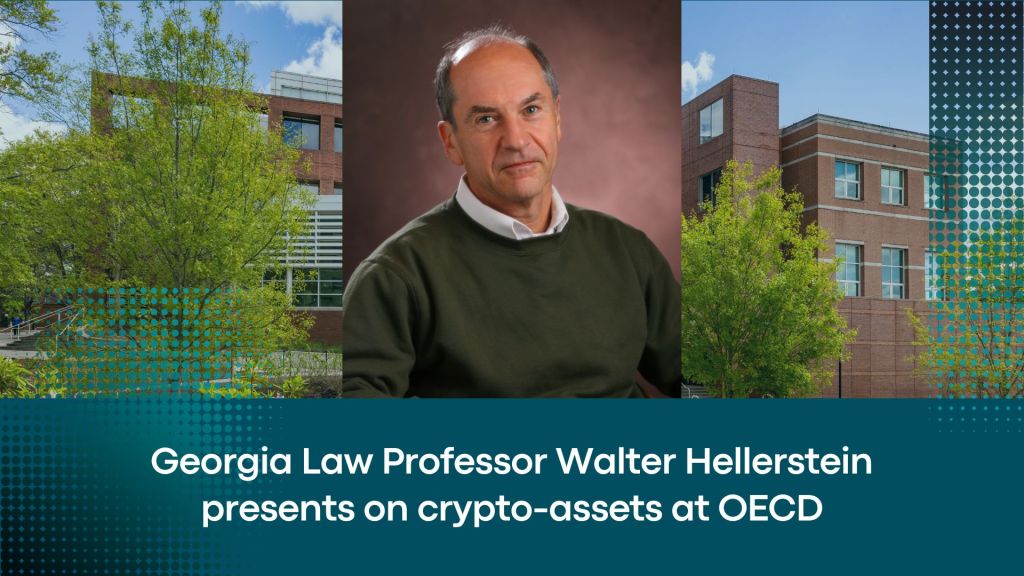
Georgia Law Professor Walter Hellerstein presents on crypto-assets at OECD

Distinguished Research Professor & Shackelford Distinguished Professor in Taxation Law Emeritus Walter Hellerstein co-presented as part of the VAT/GST Treatment of Activities Involving Crypto-Assets at the Organization for Economic Cooperation and Development Technical Advisory Group to Working Party No. 9 on Consumption Taxes meeting in Paris, France, in October.

The Working Party No. 9 on Consumption Taxes is a forum for the discussion of consumption tax policy and administration, working with both Members and non-Members of the OECD to develop appropriate and effective taxation outcomes. To read more about Professor Hellerstein’s previous presentation at the OECD, click here.

Hellerstein, a recipient of the National Tax Association’s Daniel M. Holland Medal for outstanding lifetime contributions to the study and practice of public finance, is widely regarded as the nation’s leading academician on state and local taxation. He has authored numerous books, textbooks, and law review articles, and has practiced extensively in the field. Hellerstein is currently a Visiting Professor at the Vienna University of Economics and Business, and he remains actively involved in his scholarship, consulting, and, in particular, his work as an academic advisor to the OECD.

Georgia Law Professor Diane Marie Amann’s remarks on ICC arrest warrants against Russian officials published in ASIL Annual Meeting proceedings

Remarks which University of Georgia School of Law Professor Diane Marie Amann delivered at a plenary panel of the American Society of International Law Annual Meeting have just been published.

Entitled “Children and the ICC Arrest Warrant Against the President and the Children’s Rights Commissioner of Russia,” Amann’s remarks form part of the chapter entitled “Late-Breaking Panel: ICC Arrest Warrants: Impunity in Check?” in 117 American Society of International Law Proceedings 328 (American Society of International Law, 2024).

Amann discussed the significance of the warrants, which had charged Russia’s President and another Presidential official of the war crimes of child deportation, and which were issued just days before the 2023 Annual Meeting. The remarks spurred her to further research on the topic, resulting in her article “Child-Taking,” also published this month, at 45 Michigan Journal of International Law 305 (2024) (prior post).

Also on the panel were: Professor Saira Mohamed, University of California-Berkeley School of Law; Professor Javier S. Eskauriatza, University of Nottingham Scholl of Law; and Professor Marko Milanović, University of Reading School of Law. Katherine Gallagher, Senior Staff Attorney at the Center for Constitutional Rights and an Adjunct Professor of Clinical Law at New York University School of Law, moderated. The panelists’ remarks in full are here.

Amann is Regents’ Professor of International Law, Emily & Ernest Woodruff Chair in International Law, and a Faculty Co-Director of our Dean Rusk International Law Center here at Georgia Law. She served from 2012 to 2021 as International Criminal Court Prosecutor Fatou Bensouda’s Special Adviser on Children in & affected by Armed Conflict. This Fall 2024 semester she is at the University of Oxford in the United Kingdom, serving as a Research Visitor at the Faculty of Law Bonavero Institute of Human Rights and as a Visiting Fellow at Exeter College.

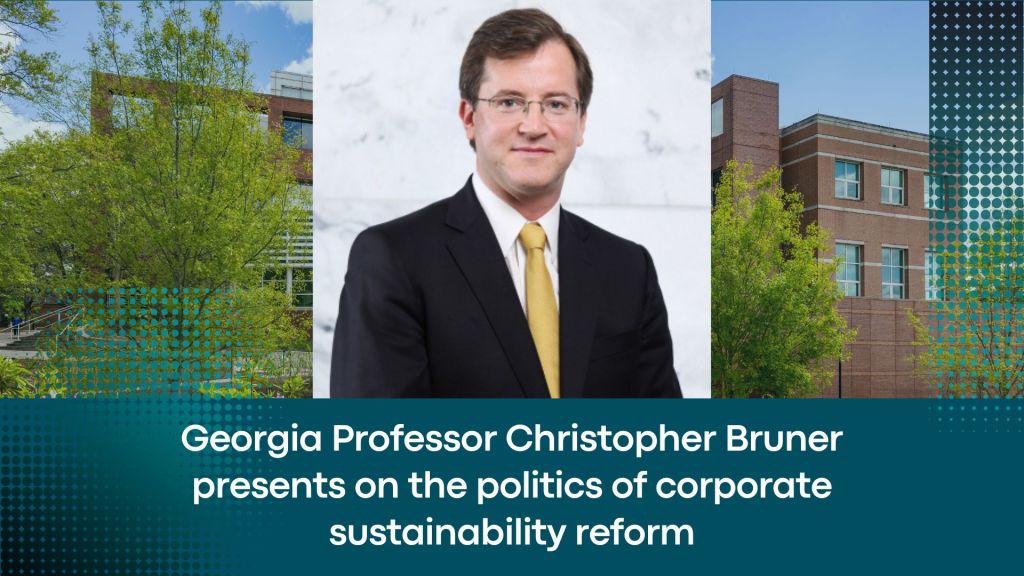
Georgia Law Professor Christopher Bruner presents on the politics of corporate sustainability reform

University of Georgia School of Law professor Christopher M. Bruner presented “A Political Economy of Corporate Sustainability Reform in the United States” at an online event hosted by the University of Oslo Faculty of Law in October.  The event was organized by Oslo’s Sustainability Law research group and convened by Professor Beate Sjåfjell.

Below is an abstract of the presentation:

Conservative backlash against sustainability initiatives and environmental, social, and governance (ESG) investment policies has been particularly intense in the United States – to the point that these issues have become mired in the broader ‘culture wars’ that increasingly characterize American public life and permeate policymaking. Today, initiatives styled as corporate sustainability or ESG are often rejected outright by conservative federal and state actors opposed to intrusion of what they regard as ‘woke’ progressive policies into economic law. In response, A Political Economy of Corporate Sustainability Reform in the United States tackles two related challenges in the US context – (1) how to advance first-best corporate governance reforms in the long-term, and (2) how to advance second-best alternatives in the near-term.

Christopher M. Bruner is the Stembler Family Distinguished Professor in Business Law at the University of Georgia School of Law and serves as a faculty co-director of the Dean Rusk International Law Center.

Welcoming the Master of Laws (LL.M.) students to Georgia Law

With the Fall 2024 semester in full swing, the Dean Rusk International Law Center is proud to welcome another class of talented lawyers, now studying for our University of Georgia School of Law Master of Laws (LL.M.) degree.

This group of 18 hails from 13 different countries in Africa, Asia, Europe, and the Americas, including Pakistan, Brazil, Iran, Nigeria, India, the Republic of Georgia, Turkey, the United Kingdom, Belarus, Peru, Venezuela, Switzerland, and Germany. Among them are lawyers specializing in a wide range of fields including business law, human rights law, administrative law, international arbitration, data privacy law, tax law, cryptocurrency law, criminal law, intellectual property law, business immigration and labor law, environmental law, and education law. 

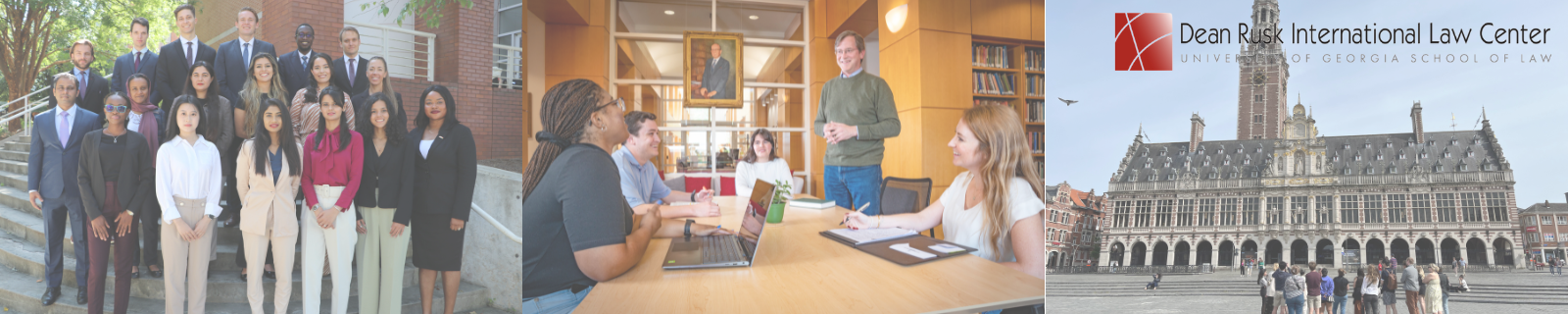
They are pictured above, standing on the steps of Dean Rusk Hall. From the left to right – top row: Carolina Ruiz, Paria Keramatkhah, Fatemeh Khouei, João Felipe Villa do Miu, Samuel Kuo, Danish Ali; middle row: Christian Schneider, Sara Dorbahani, Dzmitry Liasovich, Michael Faleye, Fabienne Taller, Bekir Kerabekmez; bottom row: Irakli Kakubava, Assis José Couto do Nascimento, Ramakrishna Ruthwik Palepu, Ana Luiza Couto do Nascimento, Neethu James, Zulma Perez.

This Class of 2025 joins a tradition that began at the University of Georgia School of Law in the early 1970s, when a Belgian lawyer became the first foreign-trained practitioner to earn a Georgia Law LL.M. degree. In the ensuing four decades, the law school and its Dean Rusk International Law Center have produced around 600 LL.M. graduates, with ties to nearly 100 countries and every continent in the world.

Side by side with J.D. candidates, LL.M.s follow a flexible curriculum tailored to their own career goals – goals that may include preparation to sit for a U.S. bar examination, or pursuit of a concentration affording advancement in their home country’s legal profession or academic institutions.

The application for the LL.M. Class of 2026 is now open; for information or to apply for LL.M. studies, see here.

Georgia Law Professor Diane Marie Amann elected Visiting Fellow at Oxford’s Exeter College

Earlier this month University of Georgia School of Law Professor Diane Marie Amann was elected a Visiting Fellow at Exeter College, Oxford University, for this autumn’s Michaelmas Term.

While in the United Kingdom, she is serving simultaneously as a Research Visitor at the Oxford Faculty of Law Bonavero Institute of Human Rights.

Amann is Regents’ Professor, Emily & Ernest Woodruff Chair in International Law, and Faculty Co-Director of the Dean Rusk International Law Center here at the University of Georgia School of Law. Her courses include Public International Law, Constitutional Law, Human Rights, and Transnational Criminal Law.

During this research-intensive semester Amann is pursuing her scholarship related to women professionals who played roles in international criminal trials after World War II and also her work on child rights, especially as they relate to armed conflict and similar violence.

Founded in 1314, Exeter College is the fourth-oldest among Oxford’s three dozen colleges. It is located in the city center next to the university’s Bodleian Library.

Shannon Green of USAID’s Bureau for Democracy, Human Rights, and Governance speaks at Georgia Law

Shannon N. Green, a UGA graduate who serves as the Assistant to the Administrator of the Bureau for Democracy, Human Rights, and Governance (DRG) at the U.S. Agency for International Development (USAID), spoke to students at the University of Georgia School of Law last week. The discussion, entitled “Building a Career in Human Rights Diplomacy,” was moderated by Dr. Amanda Murdie, Head of the Department of International Affairs and Georgia Athletic Association Professor of International Affairs.

In Green’s current role, she leads USAID’s efforts to invigorate democracy, enhance human rights and justice, and bolster governance that advances the public interest and delivers inclusive development. Previously, Green was the Senior Advisor to the Administrator and Executive Director of the Anti-Corruption Task Force where she led USAID’s historic elevation of anti-corruption and aligned the Agency’s policies, programming, and resources to counter corruption at a global scale.

Before returning to public service in 2021, Green was the Senior Director of Programs at the Center for Civilians in Conflict (CIVIC) and Director and Senior Fellow of the Human Rights Initiative at the Center for Strategic and International Studies (CSIS), where her research focused on addressing threats to democratic institutions and norms, enhancing justice and accountability, and improving security forces’ respect for human rights.

From 2004 – 2015, Green held a number of positions in the U.S. Government, including as the Senior Director for Global Engagement on the National Security Council. In that role, she spearheaded efforts to deepen and broaden U.S. engagement with critical populations overseas, including the President’s Stand with Civil Society Agenda and young leader initiatives around the world. Prior to that, Green served in the DRG Center, where she developed policies, strategies, and programs to advance political reform and human rights in the Middle East and North Africa.

This event was part of a visit organized by the UGA Office of Global Engagement under the leadership of the Associate Provost for Global Engagement, Martin Kagel, as part of the FYOS Global Citizenship Cluster series. The event was co-sponsored by the School of Public and International Affairs.

Georgia Law LL.M. student Samuel Kuo admitted as a Fellow to the Chartered Institute of Arbitrators

University of Georgia School of Law Master of Laws (LL.M.) student Samuel Kuo was recently admitted as a Fellow of the Chartered Institute of Arbitrators (FCIArb).

Fellowship is the highest level of membership in the Chartered Institute of Arbitrators (CIArb), and as a Fellow, Kuo is now part of a distinguished group of experienced dispute resolution practitioners and eligible to join the CIArb’s, and other arbitral institutions’, dispute panels of neutrals. CIArb is a global professional organization with over 15,000 members worldwide that represents the interests of alternative dispute resolution practitioners. The headquarters are located in London and the institute was founded in 1915. Its North America Branch has over 400 members and the closest chapter to the University of Georgia geographically is Atlanta.

Kuo, who is from Taiwan and the United Kingdom, received his bachelor of laws degree with upper second class honors from the University of York in the United Kingdom. During his law studies he held a variety of editorial positions and served in leadership positions, including international societies representative, secretary of the University of York International Students’ Association and mock parliament leader. In addition to completing several legal internships, he worked in the marketing department at Gunnercooke LLP in Manchester, England. Kuo serves on the editorial board of the Journal of Legal, Ethical and Regulatory Issues (JLERI) and is a fellow of the Royal Society for the Encouragement of Arts, Manufactures and Commerce. He is a member of the Chartered Institute of Arbitrators (MCIArb) and received a Michael Mustill Scholar of Gray’s Inn and the International Dispute Resolution Centre scholarship to undertake further study in international arbitration. Prior to his LL.M. studies, Mr. Kuo served as a moot arbitrator at the 31st Willem C. Vis International Commercial Arbitration Moot and the 21st Vis East Moot as well as several pre-moots.

The Master of Laws (LL.M.) degree at Georgia Law offers foreign law graduates opportunities to learn about the U.S. legal system, deepen knowledge of an area of specialization, and explore new legal interests. To learn more and to apply, visit our website.

Georgia Law Professor Diane Marie Amann discusses child-taking at annual forum International Nuremberg Principles Academy in Germany

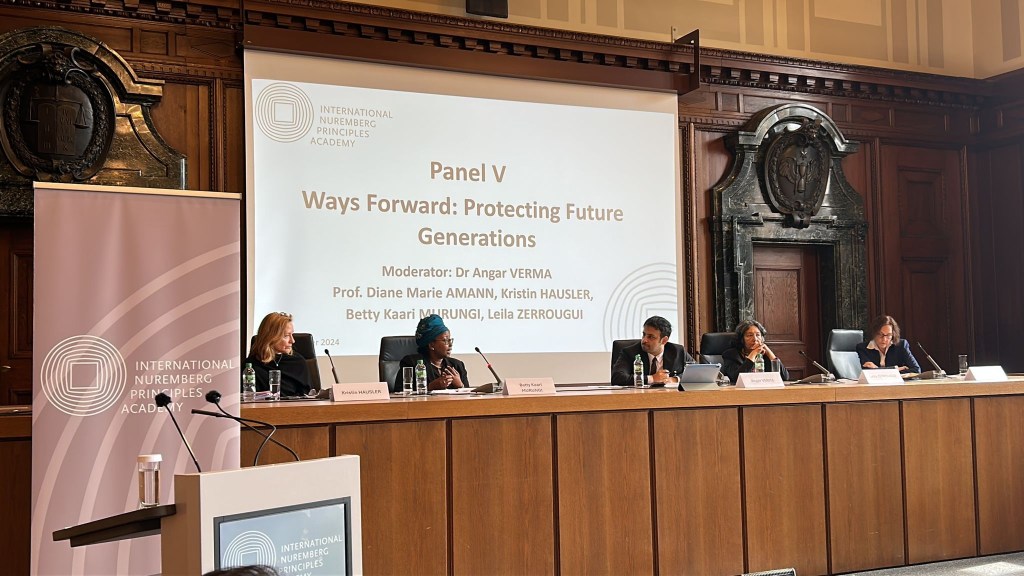
University of Georgia School of Law Professor Diane Marie Amann spoke at last week’s Nuremberg Forum 2024, the annual three-day meeting of the International Nuremberg Principles Academy. It was held in the Nuremberg, Germany, courtroom where hundreds of Nazi defendants were tried in the wake of World War II.

The theme of this year’s Forum was “For Every Child: Protecting Children’s Rights in Armed Conflict.” Amann spoke on the closing panel, “Ways Forward: Protecting Future Generations,” pictured above. She is pictured at right along with, l to r: Kristin Hausler; Betty Kaari Murungi; moderator Angar Verma; and Leila Zerrougui.

Amann gave an overview of her new article “Child-Taking,” 45 Michigan Journal of International Law 305 (2024), with focus on forced residential schooling of Indigenous children. As theorized in the article available here, child-taking occurs when a state or similar powerful entity takes a child and then endeavors to alter, erase, or remake the child’s identity. Though a criminal phenomenon, it may be redressed not only in criminal justice systems, but also through transitional justice mechanisms.

Amann is Regents’ Professor of International Law, Emily & Ernest Woodruff Chair in International Law, and a Faculty Co-Director of our Dean Rusk International Law Center here at Georgia Law. She served from 2012 to 2021 as International Criminal Court Prosecutor Fatou Bensouda’s Special Adviser on Children in & affected by Armed Conflict. This fall, she is spending a research-intensive semester in the United Kingdom, where she is a Research Visitor at the Oxford Faculty of Law Bonavero Institute of Human Rights.