Christopher M. Bruner is the Stembler Family Distinguished Professor in Business Law at the University of Georgia School of Law and serves as a faculty co-director of the Dean Rusk International Law Center.
Earlier this month, the University of Georgia School of Law finished in the top 32 teams out of 805 total teams representing 104 jurisdictions in the 2025 Philip C. Jessup International Law Moot Court Competition. This year’s team included students Dustin Batchelor (J.D. ’26), Grace Johnson (J.D. ’26), Marion Kronauge (J.D. ’26), Morgan Pfohl (J.D. ’26), and Ellis Schmitt (J.D. ’26). Jessup is the world’s largest moot court competition, bringing together students from across the globe to engage with pressing international legal challenges.
Georgia Law’s team advanced to the international rounds after winning the East Coast regional earlier this semester. Johnson and Schmitt also tied for ninth place in the individual oralist rankings.
Global Externships Overseas (GEO), 4-12 week placements for rising second- and third-year law students in private-sector and public-sector law placements around the world.
Global Governance Summer School
This year’s Global Governance Summer School will focus on comparative constitutional law. It is set to begin later this month, when students will travel to two cities in Belgium for a week of site visits and lectures led by Georgia Law’s Matthew I. Hall, Associate Professor of Law, as well as professors from partner university KU Leuven. The first week of this for-credit course also will include professional development briefings at the North Atlantic Treaty Organization (NATO), the European Parliament, the European Commission, the European Economic and Social Committee, private law firms, and NGOs.
Then, programming shifts to The Hague, Netherlands, where Hall will lead briefings at the International Criminal Court, the International Court of Justice, the Permanent Court of Arbitration, and the International Residual Mechanism for Criminal Tribunals. Center director Sarah Quinn and Global Practice Preparation Assistant Catrina Martin will provide logistical assistance throughout the program on the ground and in Athens, respectively.
A total of twenty students will participate in this year’s summer school, including:
Our Center’s Global Externship Overseas initiative, overseen by Center Associate Director Taher Benany, offers Georgia Law students the opportunity to gain practical work experience in a variety of legal settings around the world. This summer, nine students have opted to combine the GEO opportunity with their participation in GGSS: Nicholas Ames, Olivia Buckner, Isaac Clement, Megan Greeley, Stephanie Holterman, Laiba Noor, Jalyn Ross, Lionel Rubio, and Camille Weindorf.
A total of twenty-four Georgia Law students will pursue GEOs in practice areas such as privacy and technology law, environmental law, international arbitration, EU competition, cultural heritage and historic preservation, intellectual property, corporate law, and human rights law.
This year’s GEO class includes eighteen private-sector placements:
This year, six University of Georgia School of Law students attended the 119th Annual Meeting of the American Society of International Law in Washington, D.C. This year’s ASIL Annual Meeting convened with the theme “Traditions and Transitions in International Law.”
Attendees included: Annie Bordeaux (J.D. ’27), Jack Buckelew (J.D. ’25), Eleanor Cox (J.D. ’26), Carolina Mares (J.D. ’25), Jalyn Ross (J.D. ’27), and Emma Whitmore (J.D. ’26). They received a Louis B. Sohn Professional Development Fellowship to support their attendance of this conference. Awarded by the law school’s Dean Rusk International Law Center, Sohn Fellowships enable students to attend professional development opportunities related to international law.
Each student attended numerous panel discussions addressing a range of topics in international law. Some students were able to meet with D.C.-based Georiga Law alumni/ae as well, including Caroline Bailey (J.D. ’24) and Sandon Fernandes (J.D. ’24).
Reflecting on her biggest takeaways from attending the conference, Bordeaux stated:
The speakers…offered a powerful reminder that, even amid global instability and the uneven application of the rule of law, international law still holds the potential to serve as a means of accountability. The insights shared by brilliant professors, leaders, and researchers substantiated the idea that the role of international law remains instrumental in addressing injustice and shaping governance.
Mares reflected on her favorite session from the conference:
During the session on Grotius’ Legacy: The 400th Anniversary of The Law of War and Peace, former Georgia Law Professor Harlan Cohen and fellow panelists offered a compelling and nuanced exploration of Hugo Grotius’ seminal 1625 treatise. The Law of War and Peace laid the groundwork for modern international law, illuminating the interrelationship between human rights and legal norms, the moral dimensions of law, and the idea of law as distinct from both power and religion. Gaining historical context for today’s legal frameworks was a powerful reminder of the foundational values and enduring principles that continue to guide and inspire practitioners in the field.
Buckelew illustrated the connection between attending this conference and his academic and professional goals:
Attending the ASIL Annual Meeting gave me clarity and encouragement at a pivotal moment in my legal education. Personally, it reminded me that I came to law school with the hope of engaging with serious global issues and to be part of a community that values legal principles as tools for progress. Professionally, it helped me envision a path where I can grow into expertise, not just through formal education, but through ongoing engagement with legal communities like ASIL and others.
To read prior posts about Georgia Law students using Sohn Fellowships to attend professional development opportunities, please click here and here.
Bruner is the Stembler Family Distinguished Professor in Business Law at the University of Georgia School of Law and serves as a faculty co-director of the Dean Rusk International Law Center.
The University of Georgia School of Law’s spring 2025 International Law Colloquium welcomed Sarah Dadush, Professor of Law at Rutgers Law School, who presented her working paper, “Shared Responsibility in Contract Law.” Professor Christopher Bruner, Stembler Family Distinguished Professor in Business Law and Faculty Co-Director of the Dean Rusk International Law Center at Georgia Law, served as her faculty discussant. Dadush’s presentation marks the conclusion of the 2025 International Law Colloquium.
Dadush’s scholarly focus lies in business and human rights, consumer law, and social enterprise law. She also serves as the Director of the Responsible Contracting Project (RCP), a project designed to advocate for human rights and environmental due diligence in contract drafting. The RCP is located within the Rutgers Law School’s Center for Corporate Law and Governance.
Below is an abstract of Dadush’s working paper:
At first, the notion that there is such a thing as shared responsibility in American contract law may sound fanciful, if not absurd. A key reason why parties contract in the first place is to allocate risks and responsibilities between them and to clarify who must do what to move the collaboration forward. As such, contractual obligations are understood to be binary, belonging either to one party or the other, not both. In practice, this means that, if there is a breach, only the obligated party will be held responsible, not both. And, if remedies are awarded, they will flow only from the breaching to the non-breaching party, not between them. Thus, the notion that the parties might be contractually responsible not just for their own obligations, but also for those of their counterparty, seems incoherent.
And yet, as this Article shows, it is not uncommon for courts to go beyond the express terms of the contract to make the parties share responsibility for the performance of one another’s obligations. Thus shared responsibility: Each party is held responsible for the other’s contractual (non)performance, even in the absence of an express commitment to share responsibility for performance.
This Article “goes fishing” for shared responsibility in three key areas of contract law: The contents of the contract, breach, and remedies. It demonstrates that shared responsibility is brought to bear to resolve contract disputes more often and with greater legal effect than the simple, binary understanding of contract might predict. When it enters the judicial analysis, shared responsibility can drastically change the answers to the questions: Who had the obligation to perform? Who breached? And, finally, whose harm should be remedied and how?
Having shown that shared responsibility is already a prominent, if overlooked, feature of American contract law, this Article argues that, in certain situations, courts should employ shared responsibility as a default rule. Specifically, courts should employ a shared responsibility default (SRD) when the contract was breached, or otherwise failed, and (1) both parties contributed to the failure, and (2) the failure could, or has already, generated high social costs (e.g., public endangerment, human rights violations in supply chains, consumer deception). In such situations, the SRD would activate the tort law principles of comparative negligence and proximate cause in contract, holding both parties accountable for their respective contributions to the contract’s failure and related social costs. In doing so, the SRD would equip courts to resolve contract disputes in a manner that attends to both contract policy and public policy objectives.
This year, Professor Desirée LeClercq led the colloquium, which was designed to introduce students to features of international economic law through engagement with scholars in the international legal field. To view the full list of International Law Colloquium speakers, visit our website.
This program w made possible through the Kirbo Trust Endowed Faculty Enhancement Fund and the Talmadge Law Faculty Fund.
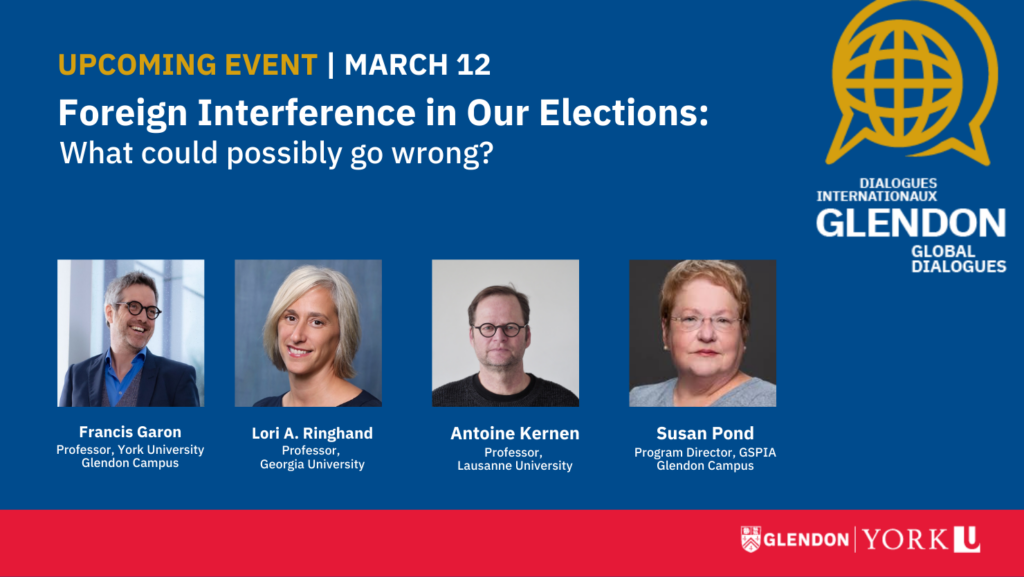
In addition to Ringhand, panelists included Francis Garon, Associate Professor of Political Science, Program Director of The Glendon School of Public and International Affairs; Antoine Kernen, Professor, Lausanne University; and Susan Pond, Director Glendon School of Public and International Affairs, York University.
This year’s Global Dialogue series aims to bring together renowned scholars and practitioners in political science, law, and international affairs to explore:
How foreign actors manipulate public opinion through disinformation and digital influence
The legal and policy frameworks protecting electoral integrity
The role of media, governments, and civil society in countering these threats
Ringhand teaches courses on constitutional law and election law. She has been a member of the University of Georgia School of Law faculty since 2008 and was named a Hosch Professor in 2012 and awarded a Josiah Meigs Distinguished Professorship, UGA’s highest teaching honor, in 2021. She is a nationally known Supreme Court scholar and the author of two books about the Supreme Court confirmation process: Supreme Court Confirmation Hearings and Constitutional Change (with Paul M. Collins) published by Cambridge University Press; and Supreme Bias: Gender and Race in U.S. Supreme Court Confirmation Hearings (with Christina L. Boyd and Paul M. Collins), published by Stanford University Press. She also is the co-author of Constitutional Law: A Context and Practices Casebook, which is part of a series of casebooks dedicated to incorporating active teaching and learning methods into traditional law school casebooks. Ringhand also publishes extensively on election law related issues, and was awarded a Fulbright Distinguished Chair Award at the University of Aberdeen in Scotland to explore the different approaches to campaign finance regulation taken by the United States and the United Kingdom.
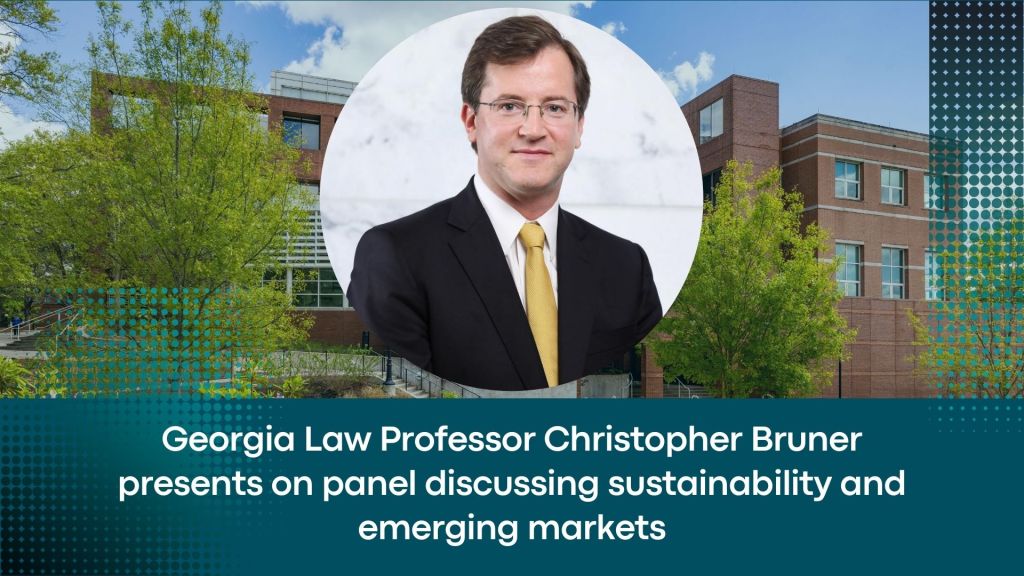
University of Georgia School of Law Professor Christopher M. Bruner presented on a panel titled “Sustainability and Emerging Markets” at the “Corporate Governance in the Global South” roundtable hosted by George Washington University Law School in Washington, D.C. The panel was moderated by Rosa Celorio, Associate Dean for International and Comparative Legal Studies and Burnett Family Distinguished Professorial Lecturer in International and Comparative Law and Policy at George Washington University Law School.
Christopher M. Bruner is the Stembler Family Distinguished Professor in Business Law at the University of Georgia School of Law and serves as a faculty co-director of the Dean Rusk International Law Center.
Last month, the University of Georgia School of Law Master of Laws (LL.M.) class of 2025 traveled to Atlanta for a professional development trip organized by the Dean Rusk International Law Center’s director of international professional education, Dr. Laura Tate Kagel. Students were accompanied by Dr. Kagel, International Professional Education Manager Mandy Dixon, and Center Associate Director Taher Benany.
The group of foreign lawyers was hosted by the law offices of Arnall Golden Gregory, LLP for lunch and a lively discussion with legal practitioners. Abe Schear, a partner in the Real Estate and Leasing practices at AGG, offered the students sound career advice and discussed how his involvement with the International Bar Association helped him grow the firm’s international practice. Theresa Kananen related her career journey and described her current role as partner and co-chair of the Payment Systems & Fintech industry team, offering compelling illustrations of the types of cases that arise in her practice area. Glenn Hendrix, a partner in AGG’s Healthcare Group and the founding president of the Atlanta International Arbitration Society (“AtlAS”), recounted the challenges and advantages of dispute resolution in a global society. Teri Simmons (J.D. ’89), a partner and chair of the firm’s Global Mobility practice and an adjunct professor of law at UGA, and her team members Dorothea Hockel and Naina Bishnoi (LL.M. ’24), explained how they help foreign businesses avoid legal pitfalls when bringing their operations to the United States.
Professional development trips are among many opportunities offered to Georgia Law LL.M. students to foster career connections and gain insight into potential career paths.
To learn more about the LL.M. program, click here.
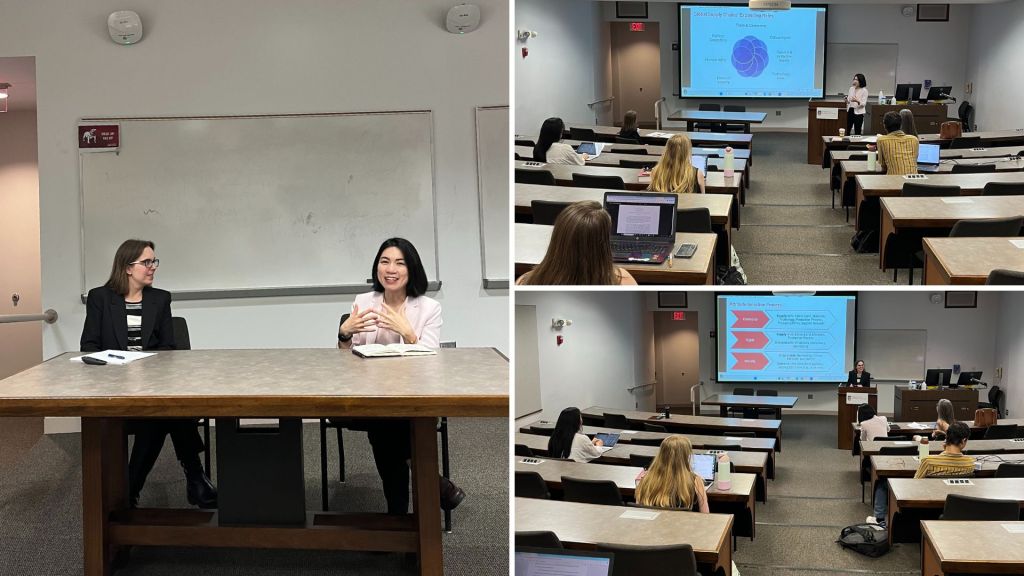
The University of Georgia School of Law’s spring 2025 International Law Colloquium recently hosted Temple Law’s Trang (Mae) Nguyen, who presented her working paper, “Goods’ Nationalities.” Pamela Foohey, Allen Post Professor of Law at Georgia Law, served as Nguyen’s faculty discussant.
Nguyen is an Associate Professor of Law at the Temple University Beasley School of Law and is an Affiliated Scholar at the U.S.-Asia Law Institute at the New York University School of Law. Her research focuses on business law, contracts, transnational law, and international law. Nguyen also previously held research appointments at the University of Hong Kong Faculty of Law, the National University of Singapore Centre for Asian Legal Studies, and the Singapore Management University Yong Pung How School of Law.
Below is an abstract of Nguyen’s working paper:
Products’ nationalities are at the center of today’s fast-changing global order. The Trump administration’s liberal use of tariffs against friends and foes, sanctions against Russian products, the banning of Chinese goods, and efforts to revitalize American manufacturing, to name just a few, all hinge on classifications of where a product is deemed “from.” But in today’s globalized economy, what exactly makes something “American” or “Chinese” or of any other nationality, for that matter?
This Article reexamines how goods acquire their designated nationalities at a time when such designation matters well beyond traditional commerce. It advances two main arguments. First, a product’s nationality is not fixed; rather, it is malleable and can vary depending upon the substantive legal regime under which the good is regulated—once predominantly trade law but now increasingly through a trade-security nexus and a trade-human rights nexus. Second, such malleability occurs through what I call an “attribute selection” process. In effect, each legal regime pivots the nationality analysis on certain “attributes” of a product, swapping and switching them as befit underlying interests and policy goals. The construction of product nationality thus occurs through mapping two separate sets of variables: first, the bundle of attributes of a product, and second, the “prisms” through which laws place significance on these attributes.
This Article makes several contributions. First, descriptively, it charts an updated account on product nationality’s expanded use, particularly in trade law’s nexus with national security and human rights. Second, conceptually, building on this updated descriptive account, it advances a novel framework—the attribute selection process—to unpack the making of product nationality. Third, normatively, it underscores how the need to use product nationality as proxy fits uneasily with the reality of global production, and how efforts to move away from nationality-based rules are likely vulnerable to similar challenges. Ultimately, while the Article makes clear that the concept of nationality is doing heavy lifting across various legal fields, it does not take a strong normative stand, opting instead to explain why taking a strong normative position is premature during fast evolving developments. Finally, the Article offers some practical considerations for policymakers, businesses, and other stakeholders as they consider product-nationality regulations going forward.
This year, Professor Desirée LeClercq is overseeing the colloquium, which is designed to introduce students to features of international economic law through engagement with scholars in the international legal field. To view the full list of International Law Colloquium speakers, visit our website.
This program is made possible through the Kirbo Trust Endowed Faculty Enhancement Fund and the Talmadge Law Faculty Fund.




 exchange of notes