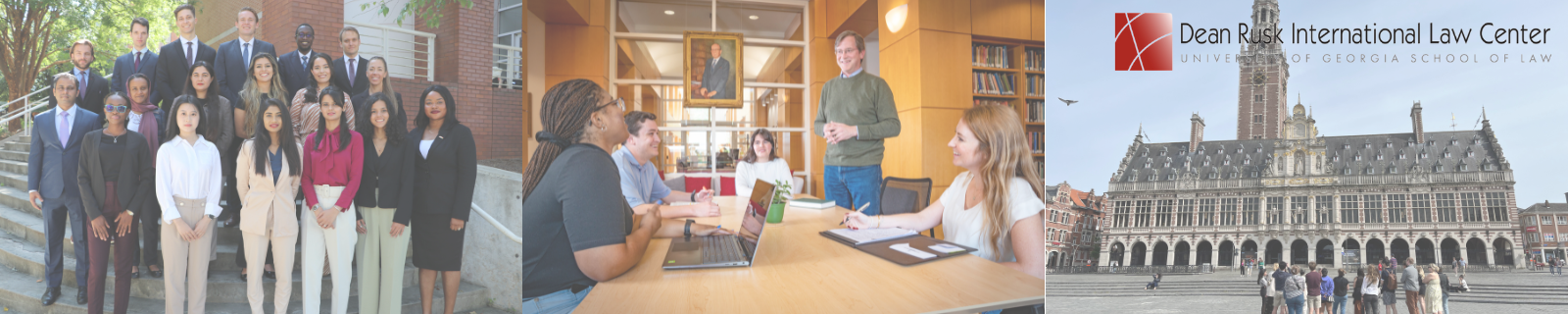
Each year, the University of Georgia School of Law is seeing more and more students seeking out global opportunities. But international study comes with a cost. Your gift helps us raise $12,000 by August 1 to cover travel, housing, and program fees for five law students.
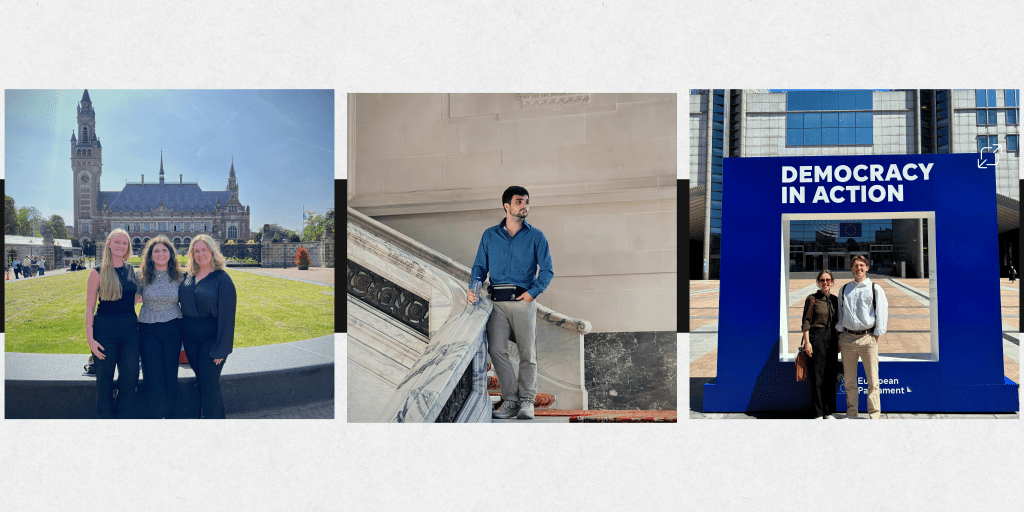
This summer’s photo contest will do just that. Six photos from two of the law school’s standout international programs — Global Governance Summer School and Global Externships Overseas — have been carefully selected, and now it’s your turn to choose the winner!
The photo from each program with the most dollars raised will be featured permanently on a gallery wall in the Dean Rusk International Law Center. Every gift connects students to transformational learning opportunities that shape how future lawyers engage with the world and an increasingly globalized profession.
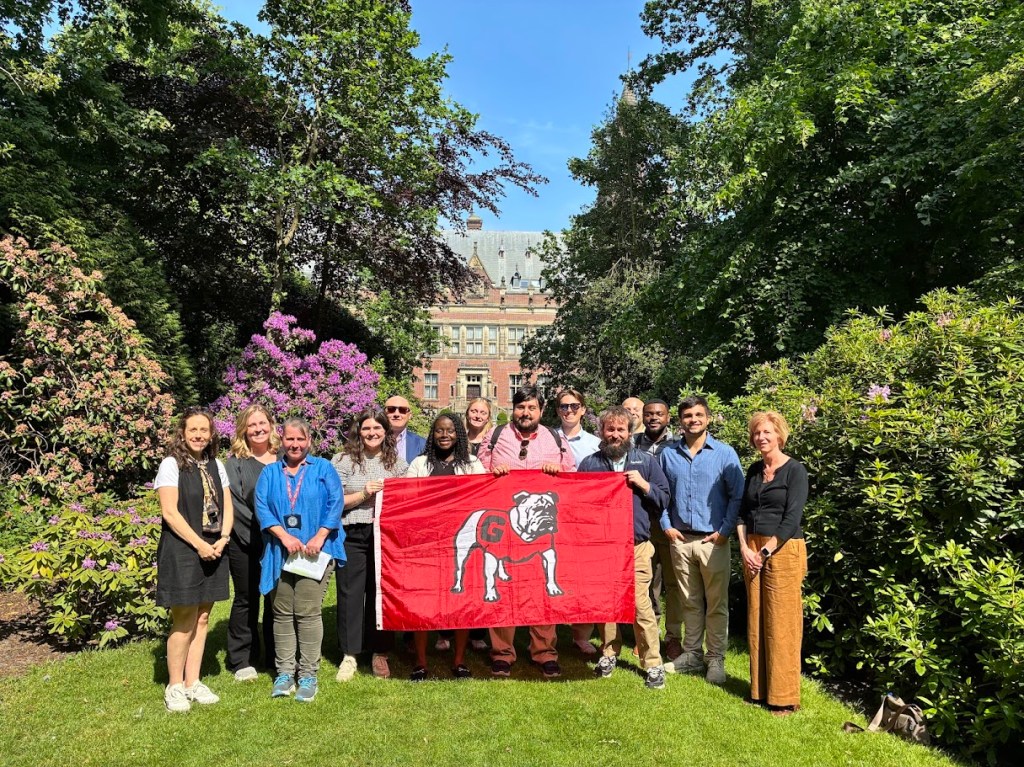
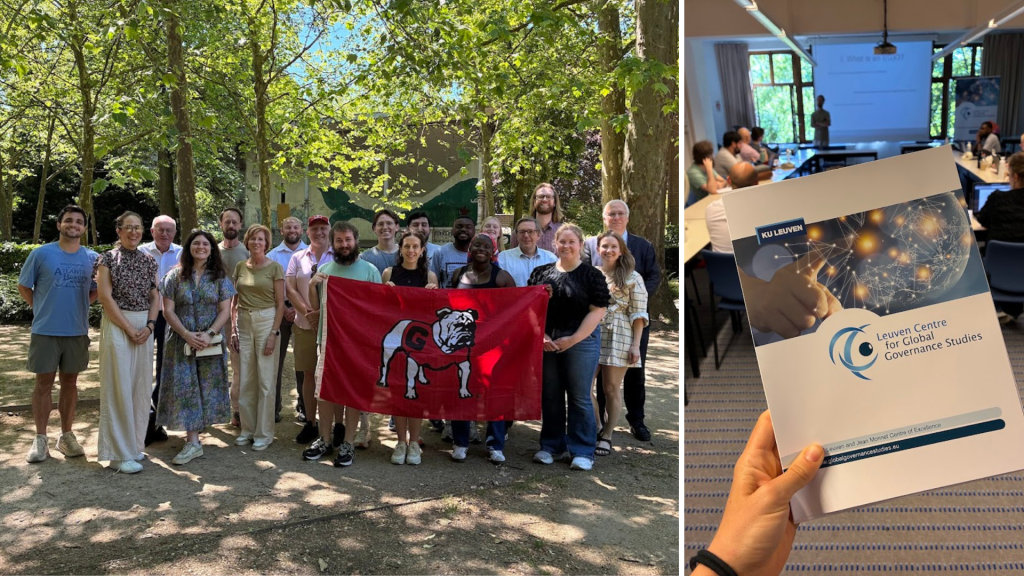
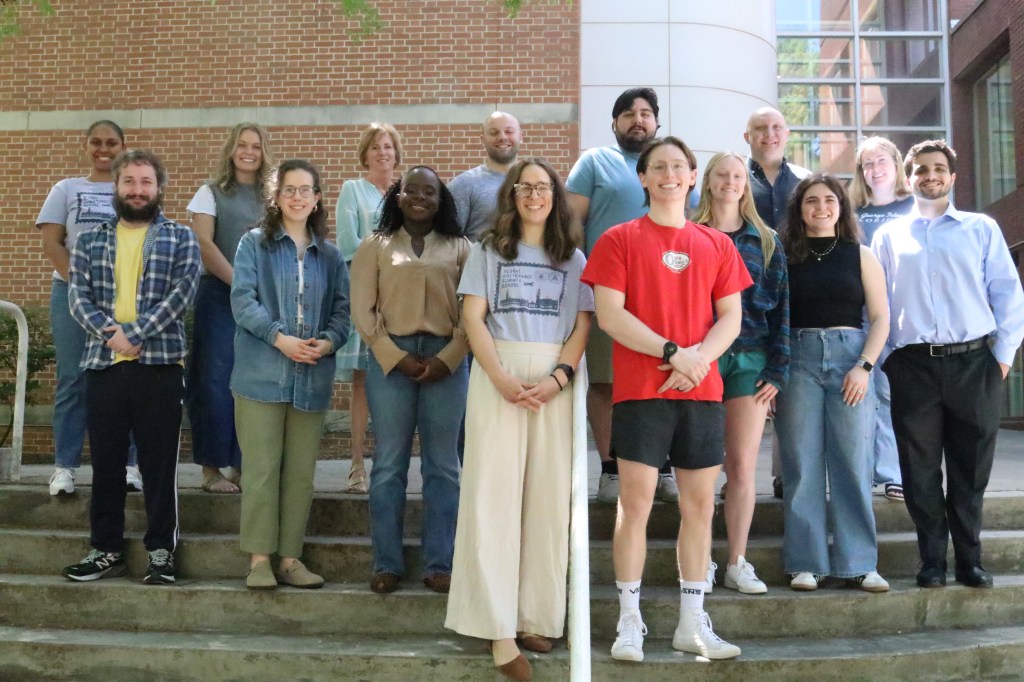
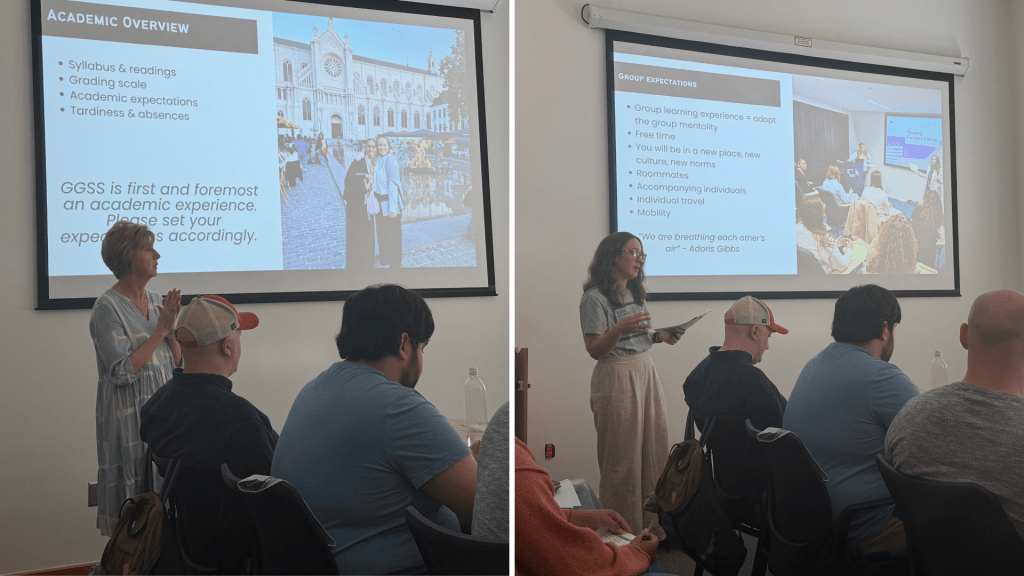
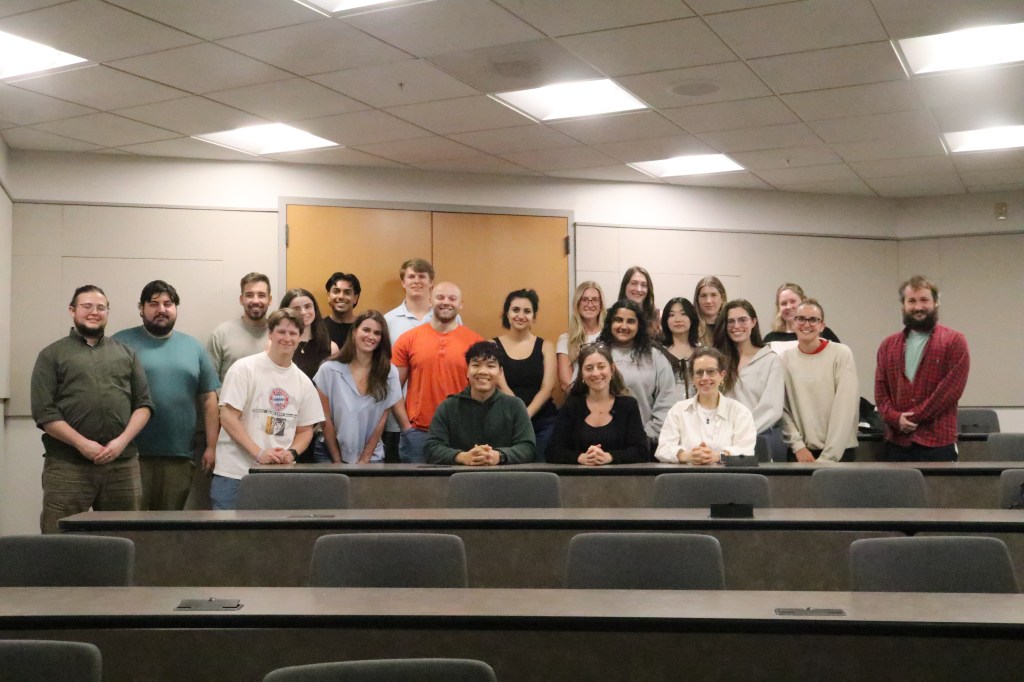
12 students from the University of Georgia School of Law participated in the 2026 Global Governance Summer School, operated in partnership with KU Leuven’s Leuven Centre for Global Governance Studies and administered by the Dean Rusk International Law Center. GGSS continues a decades-long tradition of international study in Brussels for Georgia Law students started by the Charles H. Kirbo Professor of International law Gabriel Wilner. Led this year by Georgia Law Professor Cathy Clutter, the program took place during the final two weeks of May and examined global governance through the lens of comparative environmental law and sustainability in three locations: Brussels, Belgium; Leuven, Belgium; and The Hague, Netherlands.
Brussels, Belgium
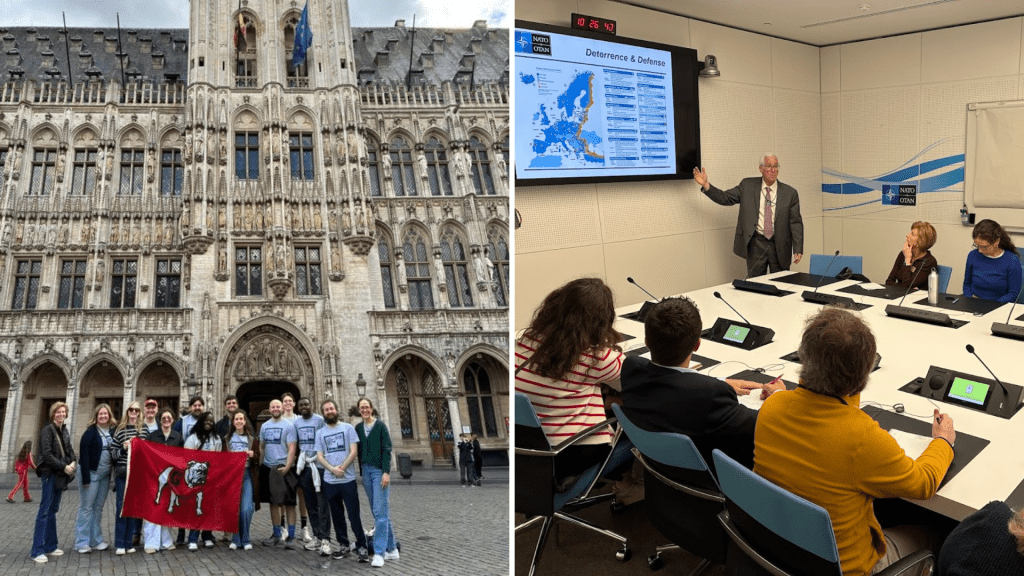
After arriving in Brussels, students started out with a walking tour of the city. Along the way, students were able to see a number of famous landmarks, including Les Galeries Royales Saint-Hubert, the Cathédrale des Saints-Michel-et-Gudule, the Mont des Arts, Bourse Beurs, the Manneken Pis, and the Grand Place. The group learned about how the unique history of Brussels led to the city’s current position as the primary political, administrative, and legislative heart of the European Union.
The academic component of the program in Brussels included a number of site visits and briefings, including:
NATO: students heard from Christopher Lozo, Office Director at Air Force Office of the General Counsel – Europe; Major Anya Nikogosian, Deputy Staff Judge Advocate; and Christopher Van der Waerden, Associate General Counsel
European Economic and Social Committee: Anna Katharina Cameron, Head of Sector on the European Green Deal, and Mr. Lukáš Ďurech, Assistant for the Agriculture, Rural Development, and the Environment Section, gave students an overview of the EESC and its work to advocate on behalf of the interests of European civil society
Council of the European Union: the group received a briefing about the Council and its work from Stefano Loi, who led a discussion about the Council’s role in the EU’s legislative process
Van Bael & Bellis: students heard from Georgia Law alumnus Porter Elliott (J.D. ‘96), Partner, who co-heads VBB’s EU competition team, and David Hull (J.D. ’83), Partner Emeritus, who also specializes in EU competition law
European Commission: Monika Senkel, from the Directorate-General for Regional and Urban Policy, Legal Affairs, and Jurgen Salay, from the Directorate-General for Climate Action, provided a briefing on EU climate policy, its evolution through practical implementation, and how the EU offers economic support to its Member States to achieve its goal of carbon neutrality by 2050
European Parliament: students learned about the history and makeup of the European Parliament and how it functions alongside the Council of the European Union, the European Council, and the Commission from Soren Dalsgaard
BonelliErede: Omar Diaz and Agnese Clementoni Cherubini—both from BonelliErede’s Antitrust and Regulatory Practice Group—gave a presentation about their firm’s work in EU State aid law, environmental protection, and energy policies in EU treaties
Students began with a walking tour of the city, learning about the history of Leuven and visiting iconic landmarks like Leuven’s medieval city walls, the waterways running through the city, the Oude Markt, the historic town hall, and St. Peter’s Church.
Afterwards, students dove into two days of coursework. Professor Cathy Clutter presented lectures about the “triple P bottom line”—people, planet, and profit—examining how they are impacted by sustainability practices and requirements. discussed the topic of environmental justice, using climate migration as a case study. Students considered whether or not environmental inequities should be addressed at the governmental or individual level, and watched several short clips to demonstrate different perspectives and recent news stories related to the topic. Professor Clutter also focused on integrating lessons learned throughout their site visits in Brussels and the program’s readings.
On Sunday, students were joined by Georgia law alumnus Daniel “Tripp” Vaughn (J.D. ’25), who participated in Georgia Law’s summer 2023 Global Governance Summer School. Tripp is currently enrolled in the Master of Laws (LL.M.) degree program at KU Leuven and spoke with students about his decision to pursue an LL.M. and experiences as an LL.M. student in Belgium. Afterwards, he joined students for an afternoon at the Oude Markt while answering student questions about his time at KU Leuven.
Dr. Gustavo Gayger Muller, Senior Researcher at the Leuven Centre for Global Governance Studies, spoke about the European Union, regional organizations, and global governance
Dr. Axel Marx, The Centre’s Deputy Director, addressed the challenge of sustainability, comparing global and EU approaches
Dr. Kari Otteburn, postdoctoral researcher and lecturer at the Leuven Centre for Global Governance Studies, presented on EU trade policy and autonomous measures
Dr. Philip De Man, Senior Researcher at the Leuven Centre for Global Governance Studies, who discussed the law of international organizations and the governance of outer space
Prof. Dr. Jan Wouters, Full Professor of International Law and International Organizations, Jean Monnet Chair ad personam EU and Global Governance, and founding Director of the Institute for International Law and of the Leuven Centre for Global Governance Studies, delivered a lecture about EU-US relations and the America Europe Fund
The Hague, Netherlands
For the final third of the program, students traveled to The Hague, Netherlands, which is known informally as the judicial capital of the world. The Hague is home to many international courts including the International Court of Justice and the International Criminal Court, and more than 150 international organizations.
The academic component of the program in The Hague included a number of site visits and briefings, including:
The International Court of Justice (ICJ): students met with Paul Heckler, Associate Legal Officer, who provided us with a brief history of the ICJ, a description of how it functions, and its recent Advisory Opinion on the Obligations of States in respect of Climate Change. Liyu Feng, Judicial Fellow, gave students a tour of the interior of the Peace Palace
Permanent Court of Arbitration (PCA): Luke Connell, Assistant Legal Counsel, spoke to students both about the history of the PCA and its current work in environmental arbitration
World Arbitration Update: students attended one of the afternoon panel discussions, “What is the Impact of the ICJ and other International Courts Advisory Opinion on Climate Change Obligations in Energy and Mining Disputes?” This panel focused on the practical consequences of the ICJ’s Climate Change Advisory Opinion, specifically including disputes related to mining, natural resources and energy, at the merits stage
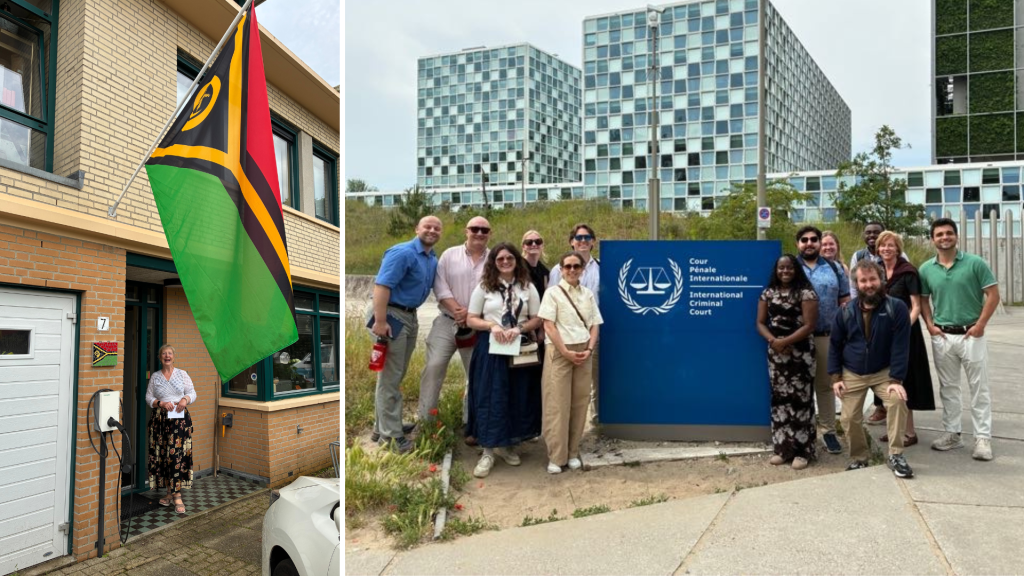
International Criminal Court (ICC): students visited the ICC’s courtroom and learned about the ICC’s structure, history, and current work
Honorary Consulate of the Republic of Vanuatu in The Hague: Elly van Vliet, the Honorary Consul General of the Republic of Vanuatu in The Hague, gave students a briefing about her work with Vanuatu to advocate for ecocide to be adopted as the fifth international crime under the Rome Statute. She concluded her briefing with a simple yet impactful observation on the value of having passion for what you do: “If you care, you can do a lot.”
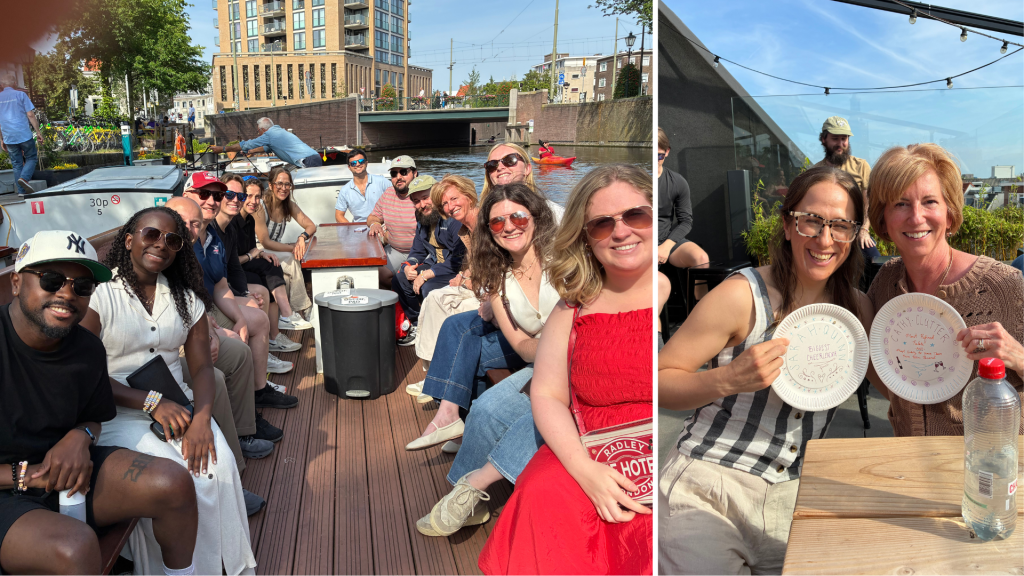
On the program’s final full day in The Hague, the students gathered for a canal tour of the city. The tour guide, a retired teacher, gave a wonderful historical overview of the city. He shared anecdotes about a number of industries that relied on the waterways to transport goods—and also to get rid of waste. Environmental laws, policies, and regulations are very much interwoven into the story of The Hague’s development as a major global city.
The group then ended the evening at a local rooftop restaurant for a final meal and to conclude this year’s program. Students organized paper plate awards, recognizing the unique contributions of their peers to the program over the two week study abroad program.
Students have since left The Hague and have begun their summer jobs, many of them abroad through the Center’s Global Externships Overseas initiative. The Center looks forward to seeing how the experience of spending two weeks in Belgium & The Netherlands plays a role in their upcoming academic decisions, their short- and long-term professional journeys, and their personal perceptions of global governance, environmental law, and sustainability.
Global Externships Overseas (GEO), 4-12 week placements for rising second- and third-year law students in private-sector and public-sector law placements around the world.
Global Governance Summer School
This year’s Global Governance Summer School will focus on comparative environmental law and sustainability. It is set to begin in mid-May, when students will travel to two cities in Belgium for a week of site visits and lectures led by Georgia Law’s Professor Catherine Clutter, as well as professors from partner university KU Leuven‘s Centre for Global Governance Studies. The first week of this for-credit course also will include professional development briefings at the North Atlantic Treaty Organization (NATO), the European Commission, the European Economic and Social Committee, the European Committee of the Regions, the European Council, private law firms, and NGOs.
Then, programming shifts to The Hague, Netherlands, where Clutter will lead briefings at the International Criminal Court, the International Court of Justice, the Permanent Court of Arbitration, and at several embassies and consulates. Center director Sarah Quinn will provide logistical assistance throughout the program.
A total of twelve students will participate in this year’s summer school, including:
Our Center’s Global Externship Overseas initiative, overseen by Center Associate Director Taher Benany, offers Georgia Law students the opportunity to gain practical work experience in a variety of legal settings around the world. This summer, three students have opted to combine the GEO opportunity with their participation in GGSS: David Bekore, Keith Felix, and Margaret Haisty.
A total of nineteen Georgia Law students will pursue GEOs in practice areas such as privacy and technology law, environmental law, international arbitration, EU competition, intellectual property, corporate law, international humanitarian law, and human rights law.
This year’s GEO class includes thirteen private-sector placements:
David Bekore (J.D. ’28): GreeCo SA; Buenos Aires, Argentina
Global Externships Overseas (GEO), 4-12 week placements for rising second- and third-year law students in private-sector and public-sector law placements around the world.
Global Governance Summer School
This year’s Global Governance Summer School will focus on comparative constitutional law. It is set to begin later this month, when students will travel to two cities in Belgium for a week of site visits and lectures led by Georgia Law’s Matthew I. Hall, Associate Professor of Law, as well as professors from partner university KU Leuven. The first week of this for-credit course also will include professional development briefings at the North Atlantic Treaty Organization (NATO), the European Parliament, the European Commission, the European Economic and Social Committee, private law firms, and NGOs.
Then, programming shifts to The Hague, Netherlands, where Hall will lead briefings at the International Criminal Court, the International Court of Justice, the Permanent Court of Arbitration, and the International Residual Mechanism for Criminal Tribunals. Center director Sarah Quinn and Global Practice Preparation Assistant Catrina Martin will provide logistical assistance throughout the program on the ground and in Athens, respectively.
A total of twenty students will participate in this year’s summer school, including:
Our Center’s Global Externship Overseas initiative, overseen by Center Associate Director Taher Benany, offers Georgia Law students the opportunity to gain practical work experience in a variety of legal settings around the world. This summer, nine students have opted to combine the GEO opportunity with their participation in GGSS: Nicholas Ames, Olivia Buckner, Isaac Clement, Megan Greeley, Stephanie Holterman, Laiba Noor, Jalyn Ross, Lionel Rubio, and Camille Weindorf.
A total of twenty-four Georgia Law students will pursue GEOs in practice areas such as privacy and technology law, environmental law, international arbitration, EU competition, cultural heritage and historic preservation, intellectual property, corporate law, and human rights law.
This year’s GEO class includes eighteen private-sector placements:
Global Externships Overseas (GEO), 4-12 week placements for rising second- and third-year law students in private-sector and public-sector law placements around the world.
Global Governance Summer School
This year’s Global Governance Summer School will focus on comparative administrative law. It is set to begin this month, when students will travel to Belgium for a week of lectures led by Georgia Law Associate Dean for Academic Affairs & J. Alton Hosch Professor of Law Kent Barnett, as well as professors from partner university KU Leuven. The first week of this for-credit course also will include professional development briefings at the North Atlantic Treaty Organization, the American Chamber of Commerce to the European Union, private law firms, and NGOs.
Then, programming shifts to The Hague, Netherlands, where Barnett will lead briefings at the International Criminal Court, the International Court of Justice, the Permanent Court of Arbitration, the International Residual Mechanism for Criminal Tribunals, and the U.S. Embassy in The Hague. Center director Sarah Quinn and Global Practice Preparation Assistant Catrina Martin will provide logistical assistance during the program.
Our Center’s Global Externship Overseas initiative places Georgia Law students in externships lasting between four and twelve weeks. It thus offers students the opportunity to gain practical work experience in a variety of legal settings worldwide. This summer, three students have opted to combine the GEO opportunity with participation in GGSS: Emily Munger, Karlie “Kara” Reed, and Benjamin Privitera.
This summer, sixteen Georgia Law students are set to pursue Global Externships Overseas, in practice areas such as privacy and technology law, intellectual property law, cultural heritage and historic preservation, environmental law, international arbitration, corporate law, and human rights law.
This year’s GEO class includes these private-sector placements:
Andrew Miller (rising 3L) – Weickmann & Weickmann; Munich, Germany
In the article, Quinn discusses the Center’s focus on providing Georgia Law students with opportunities to globalize their legal education. She highlights the Center’s student-facing programming, including Global Governance Summer School, Global Externships Overseas, the NATO Externship, and semester-long exchanges with institutional partner O.P. Jindal Global University’s Jindal Global Law School. Explaining how the Center encourages all J.D. students to consider participating in these programs, Quinn states:
“We underscore to our students just how globalized the practice of law is— even [students] aspiring to work domestically can benefit from taking an international law course or gaining work experience abroad.”
Quinn provides information about the Center’s initiatives for foreign-educated law students and professionals, ranging from the 10-month Master of Laws (LL.M.) degree to the Visiting Researcher initiative. She notes that the Center’s events throughout the academic year, including the annual Georgia Journal of International and Comparative Law conference, offer opportunities for participation, particularly from alumni/ae and from interested professionals.
The article can be accessed in its entirety here. Global Atlanta is one of the Center’s institutional partners.
Quinn was named the permanent director of the Dean Rusk International Law Center after leading the unit for seven months on an interim basis. Quinn, who joined the School of Law in 2019, previously served as the associate director for global practice preparation. She was instrumental in developing the school’s partnership with India’s Jindal Global University, establishing the Graduate Certificate in International Law and transitioning the Global Governance Summer School into a credit-bearing program. Prior to joining the law school, Quinn worked with the UGA Office of Global Engagement and the U.S. Peace Corps in addition to serving as a director for the American School Language Institute in Morocco. She earned her B.A., B.F.A. and M.I.P. from UGA and her ED.M. from Harvard University.
University of Georgia School of Law 2L Madison L. Graham was featured in National Juristregarding her experience studying abroad. During her 1L summer in 2023, Graham participated in both the Global Governance Summer School and the Global Externships Overseas initiative, administered by the Dean Rusk International Law Center. She reflects on her experiences in the National Jurist article titled “Studying Abroad Can Be Life Changing” written by Trevor Mason and published in the magazine’s Winter 2024 edition.
Graham discusses the impact of participating in international opportunities as a law student. Graham began her summer with the Global Governance Summer School, a 10-day study abroad presented through a partnership between Georgia Law and KU Leuven’s Centre for Global Governance Studies through which students study in Belgium and the Netherlands:
“As someone already interested in international law, it was really special to see other people who didn’t think that they were interested in it start to challenge their own perspectives, start to realize how ‘international’ law pervades domestic practice, and the scope of international opportunities that exist in the American legal context.
Also, I think it is really important for American law students to recognize and remember that there is an entire world out there handling the same legal challenges we are, and often in a different way.
To have the opportunity to learn from specialists in the field, and step into the courts and government offices of the legal systems we spend semesters learning about, was an incredible opportunity. Getting to do all of that and make new friends along the way was an experience I could not be more thankful for.
The opportunities it provides from an educational and professional perspective are unlike ones I have seen at any other law school, and something every student should consider doing.”
Upon completion of Global Governance Summer School, Graham started a legal externship placement at Van Bael & Bellis through the Global Externships Overseas initiative. Georgia Law alumni David Hull (J.D., ’83) and Porter Elliott (J.D., ’96) facilitate placements and supervise law students at this Brussels-based firm. Van Bael & Bellis specializes in domestic Belgian law matters, mergers and acquisitions, and focuses heavily on EU competition law, EU data privacy, and international trade law. Graham’s summer work focused on the latter three categories, assisting senior associates and partners prepare client memos, regulatory updates, research new EU and US legislation, and proofreading legal documents as a native-English speaker.
“Being challenged to understand a new law-making process helped me not only adapt my research skills to be able to learn what I need to about a ‘foreign’ legal framework, but also better understand effects on US legislative process and domestic policy, generally. Further, I was fortunate to be in a firm with lawyers from 20 different countries, so I was constantly being exposed to different ideas, cultural norms, problem-solving approaches, and even legal backgrounds (given those people that were coming from Civil Law-based countries).
My GEO helped me solidify and reaffirm my aspirations about possibly working abroad if I get the opportunity, and hopefully working in a public sector position. Further, though, it helped me improve my skills researching laws and regulations from other countries and legislative systems, which will benefit me no matter what international-law-focused position I could possibly end up in.
This experience also built my confidence in being able to move to a new place, make new friends, and succeed in a new professional environment. That is a big step for a lot of people post-grad, so having a trial period in an exceptionally new environment is a great trial experience and confidence booster. I also think that anytime you can work around people with that many different personal, cultural, and educational experiences will humble you in the very best way, by forcing you to challenge your preconceived notions about the world. I have always appreciated that challenge, but it’s so easy to forget. This summer was a great reminder and time of reflection for me, and one I think every law student needs.”
***
To learn more about international opportunities at the University of Georgia School of Law, visit our website here.
Applications are now open for the summer 2024 Global Governance Summer School, jointly presented by the University of Georgia School of Law’s Dean Rusk International Law Center and KU Leuven’s Leuven Centre for Global Governance Studies. Each summer, this short-term study abroad takes UGA Law students to Belgium and the Netherlands to explore global governance: the interaction of state, regional, and international legal regimes, plus individuals, corporations, intergovernmental and nongovernmental organizations, networks, and other non-state actors.
In summer 2023, the first summer GGSS ran since 2019, 17 students traveled to Europe for a week of lectures with KU Leuven professors. The first week of this for-credit course also included professional development briefings in Brussels at the European Parliament, where students were able to watch the final vote of the session cast, and a private law firm specializing in EU competition law. The programming then shifted to The Hague, Netherlands, where students received briefings at the International Criminal Court, the International Court of Justice, the International Residual Mechanism for Criminal Tribunals, and Leiden University.
The students in attendance had a variety of professional and academic motivations for participating in GGSS. For some, the professional connections, international experience, and expanded academic network will continue to benefit them as they pursue employment internationally. Erin Nalley, a current 2L who aims to work in international environmental law, stated how important the experiences of GGSS are for someone interested in an international career:
“The cultural, academic, and international experiences on this program were priceless and once in a lifetime. I made new friendships and professional connections on this trip that I most likely would not have made without GGSS.”
For others focusing their professional pursuits domestically, GGSS served as a unique professional development opportunity that will set them apart in their job search. Megan Jones, a current 2L interested in a business law career, reflected on the value of the knowledge she gained through her participation in GGSS:
“GGSS was a great opportunity for someone who sees themselves practicing domestically early in their legal career but still has an interest or desire to incorporate international aspects into their professional future. They say the best way to learn something is to immerse yourself in it, and that is exactly what GGSS is: an immersive experience that introduces you to the wide array of global opportunities the legal field has to offer.“
In addition to the UGA Law students, several graduate students at UGA in the law school’s Graduate Certificate in International Law participated in GGSS. Jasmine Underwood-Starling, a Ph.D. student in the Department of Sociology, noted that the benefits of GGSS are truly interdisciplinary:
“For any student interested in international, foreign, and comparative law, the GGSS is definitely worthwhile. The ability to go from classroom learning to then seeing the knowledge and practices in action the very next day is an invaluable experience. The program was truly inspiring.”
***
Applications for the summer 2024 Global Governance Summer School are now open. Current 1Ls, 2Ls, and graduate students are encouraged to apply. This 12-day, 3-credit summer school will explore global governance through the lens of comparative administrative law led by Kent Barnett, Associate Dean for Academic Affairs & J. Alton Hosch Professor of Law. GGSS will take place from May 20 – June 1, 2024. Students are encouraged to reference this instructional video for step-by-step information regarding how to create and successfully complete an application for GGSS in UGA’s Study Away Portal by the March 1 deadline. For more information, please plan to attend the Center’s International Opportunities Information Session on Tuesday, February 13 at 12pm, or email: ruskintlaw@uga.edu