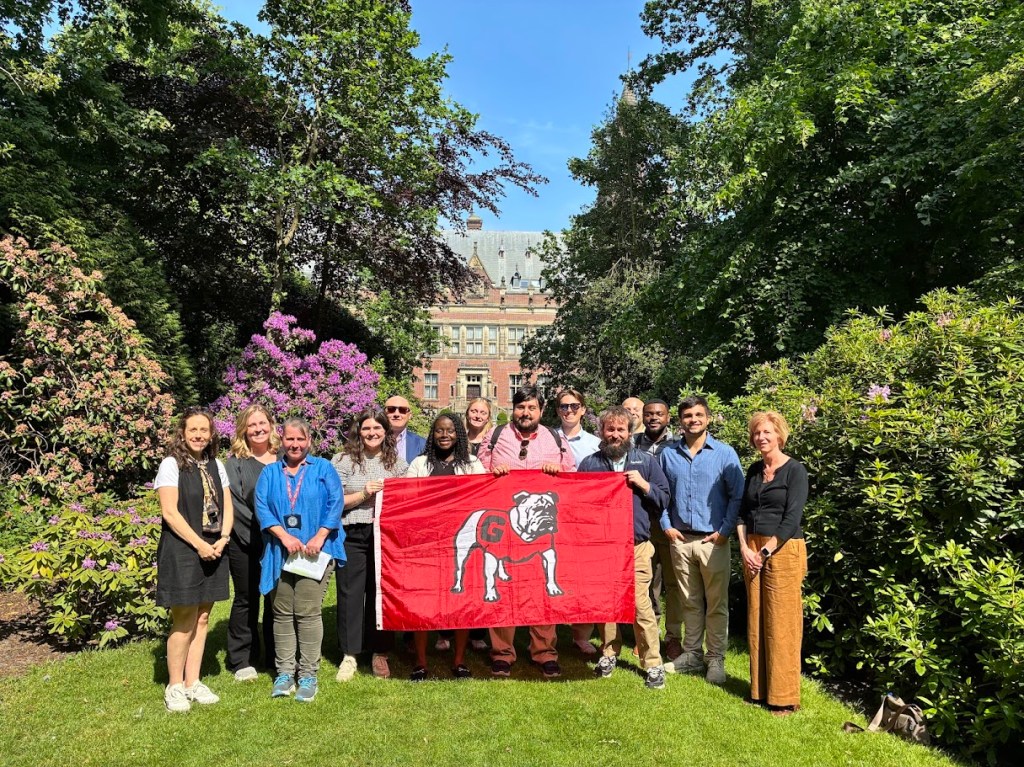
12 students from the University of Georgia School of Law participated in the 2026 Global Governance Summer School, operated in partnership with KU Leuven’s Leuven Centre for Global Governance Studies and administered by the Dean Rusk International Law Center. GGSS continues a decades-long tradition of international study in Brussels for Georgia Law students started by the Charles H. Kirbo Professor of International law Gabriel Wilner. Led this year by Georgia Law Professor Cathy Clutter, the program took place during the final two weeks of May and examined global governance through the lens of comparative environmental law and sustainability in three locations: Brussels, Belgium; Leuven, Belgium; and The Hague, Netherlands.
Brussels, Belgium
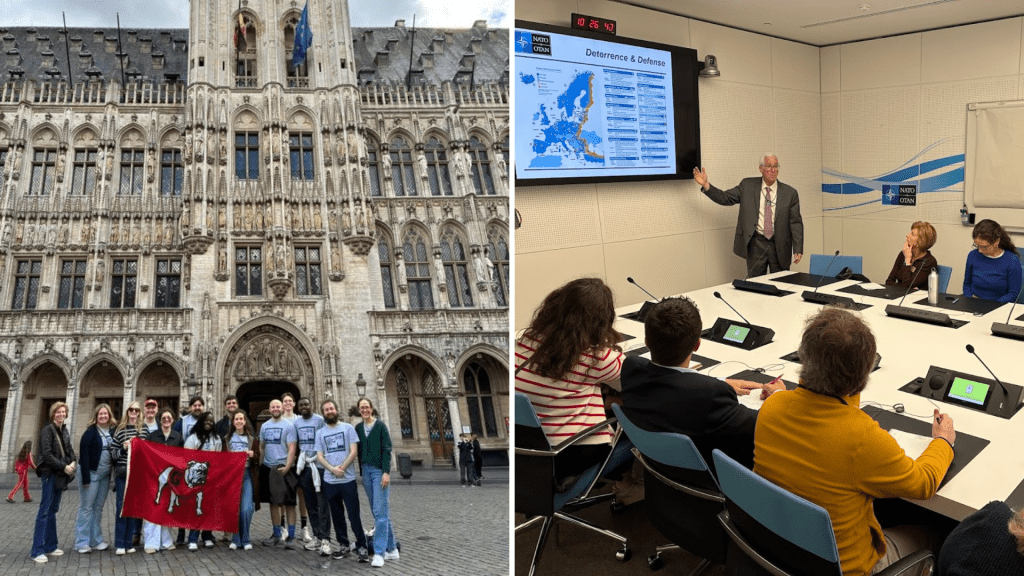
After arriving in Brussels, students started out with a walking tour of the city. Along the way, students were able to see a number of famous landmarks, including Les Galeries Royales Saint-Hubert, the Cathédrale des Saints-Michel-et-Gudule, the Mont des Arts, Bourse Beurs, the Manneken Pis, and the Grand Place. The group learned about how the unique history of Brussels led to the city’s current position as the primary political, administrative, and legislative heart of the European Union.
The academic component of the program in Brussels included a number of site visits and briefings, including:
- NATO: students heard from Christopher Lozo, Office Director at Air Force Office of the General Counsel – Europe; Major Anya Nikogosian, Deputy Staff Judge Advocate; and Christopher Van der Waerden, Associate General Counsel
- Orange: Georgia Law alumnus Johan Van den Cruijce (LL.M. ’94), Managing Director of Atlas Services Belgium, hosted the group. Students received briefings from Sara Bussiere and Manon Gremillot with Orange EU Policy and Marie Adriansen, ESG Manager at Orange
- Equinet, European Network of Equality Bodies: Daris José Lewis Recio, Senior Legal and Policy Officer at Equinet, and Mariam Camilla Rechchad, Policy Officer, AI and Climate, spoke about Equinet’s work on environment, climate change, and equality
- European Economic and Social Committee: Anna Katharina Cameron, Head of Sector on the European Green Deal, and Mr. Lukáš Ďurech, Assistant for the Agriculture, Rural Development, and the Environment Section, gave students an overview of the EESC and its work to advocate on behalf of the interests of European civil society
- European Committee of the Regions: Hullmann Klaus, Administrator at the European Committee of the Regions, provided an overview of this meeting place for regions and cities throughout the EU to share best practices and take part in dialogue with European institutions
- Council of the European Union: the group received a briefing about the Council and its work from Stefano Loi, who led a discussion about the Council’s role in the EU’s legislative process
- Van Bael & Bellis: students heard from Georgia Law alumnus Porter Elliott (J.D. ‘96), Partner, who co-heads VBB’s EU competition team, and David Hull (J.D. ’83), Partner Emeritus, who also specializes in EU competition law
- European Commission: Monika Senkel, from the Directorate-General for Regional and Urban Policy, Legal Affairs, and Jurgen Salay, from the Directorate-General for Climate Action, provided a briefing on EU climate policy, its evolution through practical implementation, and how the EU offers economic support to its Member States to achieve its goal of carbon neutrality by 2050
- European Parliament: students learned about the history and makeup of the European Parliament and how it functions alongside the Council of the European Union, the European Council, and the Commission from Soren Dalsgaard
- BonelliErede: Omar Diaz and Agnese Clementoni Cherubini—both from BonelliErede’s Antitrust and Regulatory Practice Group—gave a presentation about their firm’s work in EU State aid law, environmental protection, and energy policies in EU treaties
Leuven, Belgium
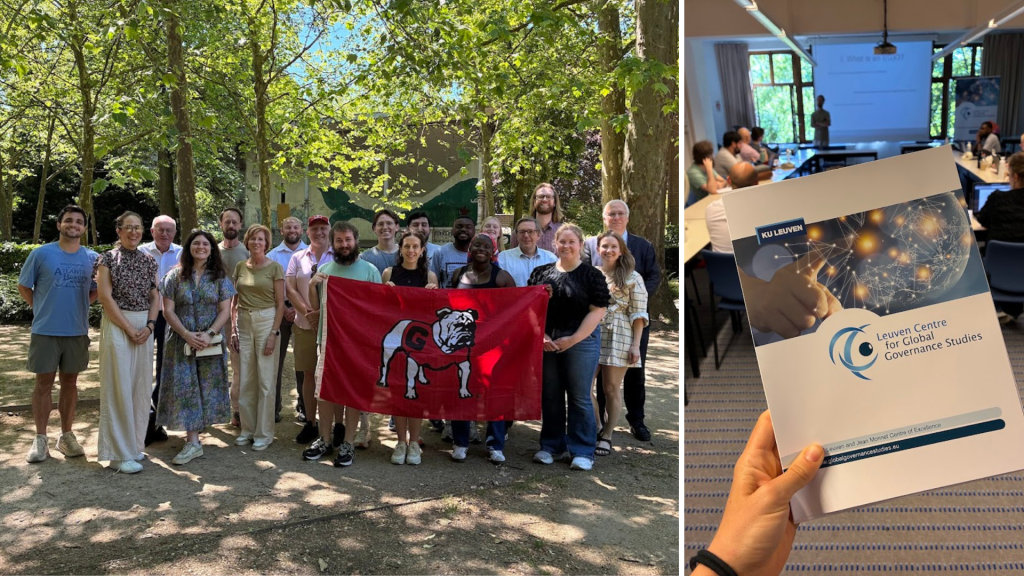
After Brussels, students traveled to Leuven, the home of one of the oldest universities in Europe, KU Leuven and Georgia Law’s institutional partner, the Leuven Centre for Global Governance Studies.
Students began with a walking tour of the city, learning about the history of Leuven and visiting iconic landmarks like Leuven’s medieval city walls, the waterways running through the city, the Oude Markt, the historic town hall, and St. Peter’s Church.
Afterwards, students dove into two days of coursework. Professor Cathy Clutter presented lectures about the “triple P bottom line”—people, planet, and profit—examining how they are impacted by sustainability practices and requirements. discussed the topic of environmental justice, using climate migration as a case study. Students considered whether or not environmental inequities should be addressed at the governmental or individual level, and watched several short clips to demonstrate different perspectives and recent news stories related to the topic. Professor Clutter also focused on integrating lessons learned throughout their site visits in Brussels and the program’s readings.
On Sunday, students were joined by Georgia law alumnus Daniel “Tripp” Vaughn (J.D. ’25), who participated in Georgia Law’s summer 2023 Global Governance Summer School. Tripp is currently enrolled in the Master of Laws (LL.M.) degree program at KU Leuven and spoke with students about his decision to pursue an LL.M. and experiences as an LL.M. student in Belgium. Afterwards, he joined students for an afternoon at the Oude Markt while answering student questions about his time at KU Leuven.
On Monday and Tuesday, students learned from researchers and faculty within the Leuven Centre for Global Governance Studies:
- Dr. Gustavo Gayger Muller, Senior Researcher at the Leuven Centre for Global Governance Studies, spoke about the European Union, regional organizations, and global governance
- Dr. Axel Marx, The Centre’s Deputy Director, addressed the challenge of sustainability, comparing global and EU approaches
- Dr. Kari Otteburn, postdoctoral researcher and lecturer at the Leuven Centre for Global Governance Studies, presented on EU trade policy and autonomous measures
- Dr. Philip De Man, Senior Researcher at the Leuven Centre for Global Governance Studies, who discussed the law of international organizations and the governance of outer space
- Prof. Dr. Jan Wouters, Full Professor of International Law and International Organizations, Jean Monnet Chair ad personam EU and Global Governance, and founding Director of the Institute for International Law and of the Leuven Centre for Global Governance Studies, delivered a lecture about EU-US relations and the America Europe Fund
The Hague, Netherlands
For the final third of the program, students traveled to The Hague, Netherlands, which is known informally as the judicial capital of the world. The Hague is home to many international courts including the International Court of Justice and the International Criminal Court, and more than 150 international organizations.
The academic component of the program in The Hague included a number of site visits and briefings, including:
- The International Court of Justice (ICJ): students met with Paul Heckler, Associate Legal Officer, who provided us with a brief history of the ICJ, a description of how it functions, and its recent Advisory Opinion on the Obligations of States in respect of Climate Change. Liyu Feng, Judicial Fellow, gave students a tour of the interior of the Peace Palace
- Permanent Court of Arbitration (PCA): Luke Connell, Assistant Legal Counsel, spoke to students both about the history of the PCA and its current work in environmental arbitration
- World Arbitration Update: students attended one of the afternoon panel discussions, “What is the Impact of the ICJ and other International Courts Advisory Opinion on Climate Change Obligations in Energy and Mining Disputes?” This panel focused on the practical consequences of the ICJ’s Climate Change Advisory Opinion, specifically including disputes related to mining, natural resources and energy, at the merits stage
- Embassy of Brazil in The Hague: students met with Henrique Choer Moraes, Deputy Head of Mission, and Ana Beatriz Schwanck Fernandes, Assistant – Legal Section. Students were able to learn about the Mercosur trade deal from the Brazilian perspective and how sustainability is a consideration in the trade negotiations.
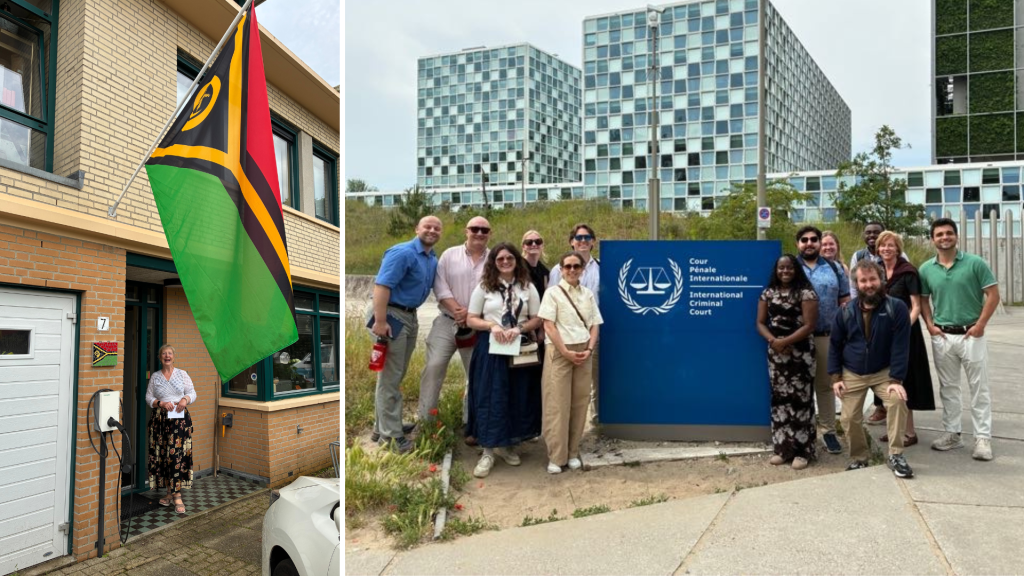
- International Criminal Court (ICC): students visited the ICC’s courtroom and learned about the ICC’s structure, history, and current work
- Honorary Consulate of the Republic of Vanuatu in The Hague: Elly van Vliet, the Honorary Consul General of the Republic of Vanuatu in The Hague, gave students a briefing about her work with Vanuatu to advocate for ecocide to be adopted as the fifth international crime under the Rome Statute. She concluded her briefing with a simple yet impactful observation on the value of having passion for what you do: “If you care, you can do a lot.”
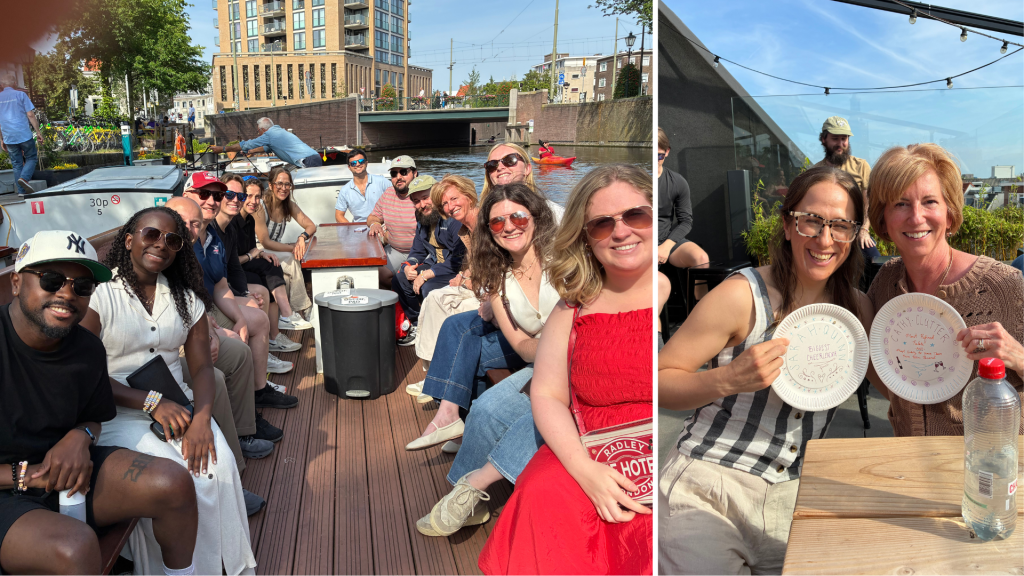
On the program’s final full day in The Hague, the students gathered for a canal tour of the city. The tour guide, a retired teacher, gave a wonderful historical overview of the city. He shared anecdotes about a number of industries that relied on the waterways to transport goods—and also to get rid of waste. Environmental laws, policies, and regulations are very much interwoven into the story of The Hague’s development as a major global city.
The group then ended the evening at a local rooftop restaurant for a final meal and to conclude this year’s program. Students organized paper plate awards, recognizing the unique contributions of their peers to the program over the two week study abroad program.
Students have since left The Hague and have begun their summer jobs, many of them abroad through the Center’s Global Externships Overseas initiative. The Center looks forward to seeing how the experience of spending two weeks in Belgium & The Netherlands plays a role in their upcoming academic decisions, their short- and long-term professional journeys, and their personal perceptions of global governance, environmental law, and sustainability.
 exchange of notes